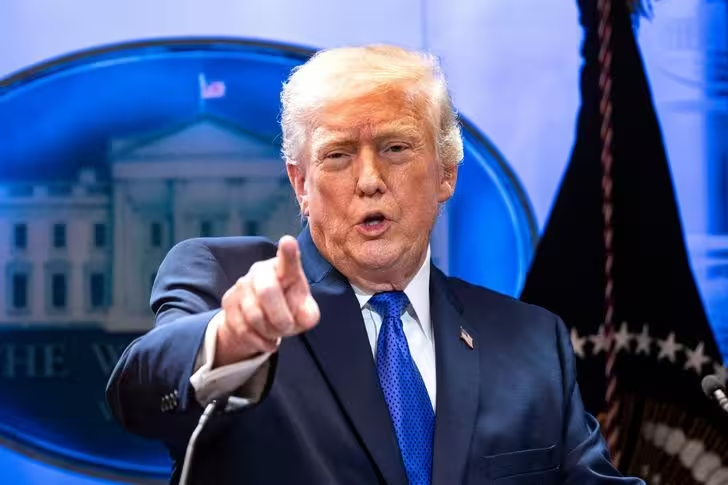
U.S. President Donald Trump has raised the Trump global tariff to 15% from 10%, escalating trade tensions just days after the Supreme Court struck down much of his emergency tariff framework. The decision signals a rapid pivot in strategy rather than a retreat from protectionism.
The Trump global tariff increase follows a court ruling that blocked the administration’s use of the 1977 International Emergency Economic Powers Act to justify sweeping duties. Instead of backing down, the White House is now leaning on alternative trade laws to maintain tariff pressure on major trading partners.
Trump Global Tariff Shift After Supreme Court Setback
The Supreme Court upheld a lower court ruling against Trump’s use of emergency powers to impose broad “reciprocal” tariffs. In response, Trump criticized the decision publicly and announced the tariff increase via social media.
He argued that many countries had taken advantage of the United States for decades. Therefore, he framed the 15% rate as legally justified and necessary for economic fairness. However, legal experts note that the administration must now rely on established trade statutes rather than emergency authority.
Shortly after the ruling, Trump signed a proclamation imposing a temporary 10% global tariff under Section 122 of the 1974 Trade Act. That provision allows limited, short-term tariff action. Now, the move to 15% reflects a more aggressive interpretation of allowable authority.
Legal Pivot to Section 301 Investigations
The administration is also preparing to use Section 301 of the 1974 Trade Act. That mechanism allows the U.S. Trade Representative to investigate and penalize unfair trade practices.
USTR Jamieson Greer confirmed that investigations will target most major trading partners. Areas of concern include industrial overcapacity, forced labor practices, pharmaceutical pricing, and alleged discrimination against U.S. technology firms.
Historical Comparison to the 2018 Trade War
This approach mirrors the 2018–2019 trade conflict with China, when Section 301 became the primary tool for imposing tariffs. At the time, global supply chains faced significant disruption. Markets reacted sharply, and companies restructured sourcing strategies.
However, the current move differs in scope. Instead of focusing primarily on China, the Trump global tariff framework appears broader. It potentially affects allies and emerging economies alike.
Global Market Implications
Financial markets now face renewed uncertainty. A 15% global tariff increases import costs and may fuel inflation pressures in the United States.
Moreover, trading partners may respond with retaliatory measures. South Korea, European Union members, and Southeast Asian economies could reassess trade exposure. Therefore, global exporters must prepare for shifting compliance rules and pricing structures.
Investors also face volatility risk. Trade policy uncertainty historically depresses business confidence and delays capital investment decisions.
African and Emerging Market Impact
African economies could experience indirect consequences from the Trump global tariff shift. Countries exporting textiles, agricultural products, or manufactured goods to the U.S. may see demand disruptions.
Under frameworks such as AGOA, many African nations benefit from preferential access to U.S. markets. If broader tariff strategies intensify, policymakers across Africa may need to renegotiate trade positioning or accelerate diversification toward Asian markets.
Additionally, global trade tensions often strengthen the U.S. dollar. That dynamic raises debt servicing costs for emerging markets holding dollar-denominated liabilities.
Domestic Political Context
Trump framed the tariff increase as part of a broader “America First” strategy. He described the court ruling as flawed and pledged to introduce “new and legally permissible” tariffs in the coming months.
This signals a legal recalibration rather than a policy reversal. While the Supreme Court limited emergency powers, Congress-granted trade tools remain available.
However, critics argue that broad tariffs function as taxes on consumers. Supporters counter that strategic protection strengthens domestic manufacturing.
Why This Matters
Trade policy influences inflation, supply chains, and geopolitical alliances. The Trump global tariff increase therefore carries consequences far beyond Washington.
As the U.S. reasserts tariff pressure, global businesses must reassess sourcing strategies. Meanwhile, emerging markets face heightened uncertainty in export planning and currency stability.
What Happens Next
The administration will likely accelerate Section 301 investigations. Those findings could justify targeted or expanded tariff measures within months.
At the same time, affected countries may pursue legal challenges or negotiate exemptions. Markets will closely watch diplomatic signals, especially from major U.S. allies.
The next phase of U.S. trade policy now hinges on how aggressively the White House applies its revised legal tools.