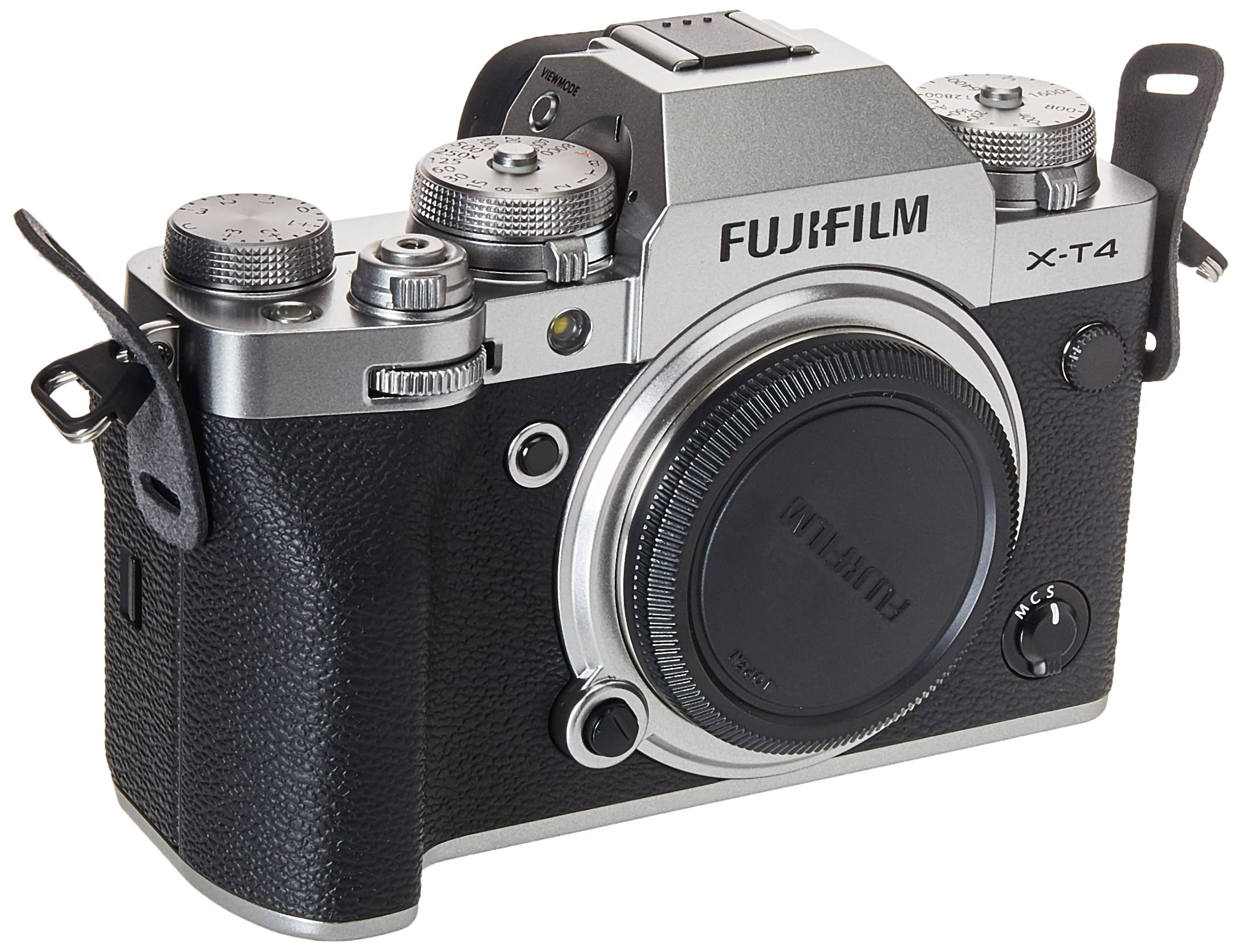
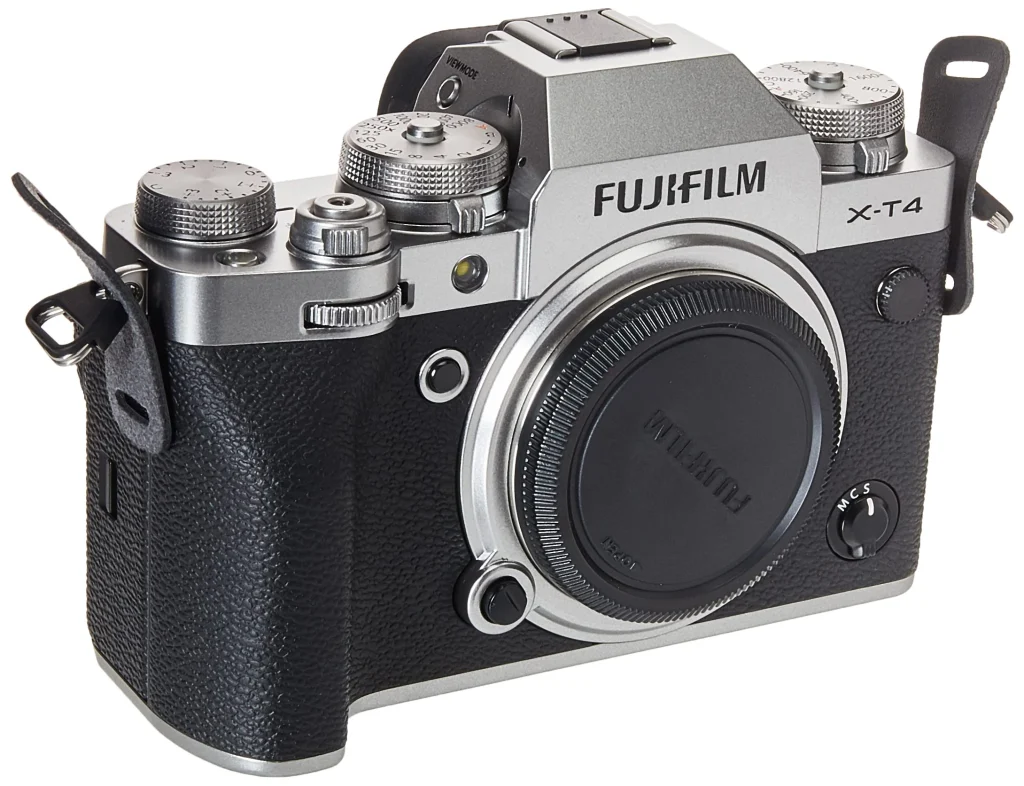
FUJIFILM X-T4 is a hybrid APS-C mirrorless camera built for photographers and video creators who want strong image quality, classic controls, in-body stabilization and serious 4K recording.
Released in April 2020, the X-T4 became one of Fujifilm’s most important X Series cameras because it improved on the X-T3 with in-body image stabilization, a vari-angle screen, better battery life and stronger video usability. It kept the popular 26.1MP X-Trans CMOS 4 sensor while making the body more practical for creators who shoot handheld stills and video.
The camera uses Fujifilm X Mount lenses and a Super 35mm-sized APS-C sensor measuring 23.5 x 15.6 mm. It supports 4K DCI, 4K UHD, Full HD high-speed video, F-Log, H.265 10-bit internal recording and 10-bit HDMI output.
Your supplied data lists the FUJIFILM X-T4 with a 607g weight, 135 x 64 x 93 mm dimensions, base sensitivity of ISO 800 and a maximum tested dynamic range of 11.8 stops at SNR=2.
Key FUJIFILM X-T4 Specifications
| Feature | FUJIFILM X-T4 |
|---|---|
| Camera type | APS-C hybrid mirrorless camera |
| Release period | April 2020 |
| Sensor format | APS-C / Super 35mm |
| Sensor size | 23.5 x 15.6 mm |
| Sensor resolution | 26.1MP |
| Lens mount | Fujifilm X Mount |
| Processor | X-Processor 4 |
| Base sensitivity in supplied data | ISO 800 |
| Maximum video | 4K DCI / 4K UHD up to 59.94p |
| Internal recording | Up to 4:2:0 10-bit in H.265 |
| HDMI output | Up to 4:2:2 10-bit |
| Stabilization | 5-axis in-body image stabilization |
| Supplied weight | 607g |
| Supplied dimensions | 135 x 64 x 93 mm |
| Tested dynamic range | Up to 11.8 stops at SNR=2 |
| Tested rolling shutter | As low as 15.5 ms in 4K 60p |
The X-T4 remains important because it gave Fujifilm users a serious hybrid body before newer models such as the X-H2, X-H2S, X-T5 and X-S20 arrived.
26.1MP APS-C Sensor
The FUJIFILM X-T4 uses a 26.1MP X-Trans CMOS 4 sensor.
This sensor delivers strong still-image quality, attractive colour and enough resolution for professional everyday work. It is useful for portraits, travel, documentary photography, weddings, street photography, family content and online publishing.
Although newer Fujifilm cameras now offer 40.2MP sensors, the X-T4’s 26.1MP sensor remains practical because it balances image quality, file size and video performance.
Why the Sensor Still Works Well
A 26.1MP APS-C sensor is enough for most photographers.
It gives detailed images without creating very large files. It also supports strong 4K video performance, which made the X-T4 a popular hybrid camera for creators who wanted one body for both stills and video.
Fujifilm X Mount
The X-T4 uses Fujifilm’s X Mount.
This gives users access to a wide range of XF and XC lenses, plus many third-party options. The X Mount system includes compact primes, fast portrait lenses, weather-resistant zooms, macro lenses and telephoto lenses.
The camera works especially well with Fujifilm’s weather-resistant XF lenses because the X-T4 body is also built for serious outdoor use.
Best Lens Types for the X-T4
The X-T4 is flexible enough for many shooting styles.
A compact prime works well for street photography. A standard zoom suits travel and events. A fast portrait lens gives strong subject separation. A stabilized telephoto lens helps with sports, wildlife and documentary work.
For video, the in-body stabilization makes even non-stabilized lenses easier to use handheld.
4K DCI and 4K UHD Video
The FUJIFILM X-T4 records 4K DCI at 4096 x 2160 and 4K UHD at 3840 x 2160.
Your supplied data shows 4K DCI recording up to 59.94p in H.265 Long GOP, with 10-bit 4:2:0 internal recording. The camera also supports H.264 recording at 8-bit 4:2:0.
This made the X-T4 one of the strongest APS-C hybrid video cameras of its generation.
Main 4K Recording Options
| Recording Mode | Resolution | Codec | Frame Rate | Datarate | Sampling | Bit Depth |
| 4K DCI | 4096 x 2160 | HEVC ALL-I | Up to 29.97p | 400 Mb/s | 4:2:0 | 10-bit |
| 4K DCI | 4096 x 2160 | HEVC Long GOP | Up to 59.94p | Up to 400 Mb/s | 4:2:0 | 10-bit |
| 4K DCI | 4096 x 2160 | H.264 ALL-I | Up to 29.97p | 400 Mb/s | 4:2:0 | 8-bit |
| 4K DCI | 4096 x 2160 | H.264 Long GOP | Up to 29.97p | Up to 400 Mb/s | 4:2:0 | 8-bit |
For the best internal video quality, H.265 10-bit is the stronger option. For simpler editing and wider compatibility, H.264 can still be useful.
4K/60p Video
One of the biggest strengths of the X-T4 is 4K/60p recording.
This allows smoother motion and gives editors the option to slow footage down on a 24p or 30p timeline. It is useful for travel, sports, events, action scenes, lifestyle videos, product clips and cinematic B-roll.
At the time of release, 4K/60p internal recording was a major feature for an APS-C mirrorless camera.
Why 4K/60p Matters
4K/60p gives creators more flexibility.
A travel filmmaker can capture motion more smoothly. A wedding shooter can slow down emotional moments. A product creator can create clean movement shots. A YouTuber can make B-roll feel more polished.
The X-T4’s 4K/60p mode helped it become popular among hybrid shooters.
F-Log and Dynamic Range
The FUJIFILM X-T4 supports F-Log, Fujifilm’s flat video profile for colour grading.
Your supplied test data shows the X-T4 reaching a maximum dynamic range of 11.8 stops at SNR=2 in full-sensor 4K at 25fps. This result appears in both H.264 and H.265 modes at ISO 800 using F-Log.
Tested Dynamic Range Results
| Sensor Mode | Resolution | Codec | Frame Rate | ISO | Gamma | SNR=2 Result |
| Full Sensor | 3840 x 2160 | H.264 | 25p | 800 | F-Log | 11.8 stops |
| Full Sensor | 3840 x 2160 | H.265 | 25p | 800 | F-Log | 11.8 stops |
| Full Sensor | 3840 x 2160 | H.264 | 25p | 640 | F-Log | 11.1 stops |
| Full Sensor | 3840 x 2160 | H.265 | 25p | 640 | F-Log | 11.2 stops |
These results show that ISO 800 delivers the strongest measured dynamic range in the supplied data.
Rolling Shutter Performance
Rolling shutter affects how video looks when the camera moves quickly or when fast subjects pass across the frame.
Your supplied data shows the X-T4 reaching 20.1 ms in full-sensor 4K at 25fps using H.265 ALL-I. In 4K 60p H.265 Long GOP, the rolling-shutter result improves to 15.5 ms.
Tested Rolling Shutter Results
| Sensor Mode | Resolution | Codec | Frame Rate | Rolling Shutter |
| Full Sensor | 3840 x 2160 | H.265 ALL-I | 25p | 20.1 ms |
| Full Sensor | 3840 x 2160 | H.265 Long GOP | 60p | 15.5 ms |
For normal handheld shooting, interviews, travel footage and controlled camera moves, the X-T4 is manageable. For quick pans, sports and fast action, the 4K 60p mode gives better rolling-shutter performance.
In-Body Image Stabilization
The X-T4 was the first camera in Fujifilm’s X-T line to include in-body image stabilization.
This was a major upgrade because earlier X-T models relied on lens stabilization or external support. The X-T4’s 5-axis IBIS helps reduce camera shake for both stills and video.
For photographers, IBIS allows slower shutter speeds when shooting handheld. For video creators, it helps smooth small movements and makes handheld recording more practical.
Why IBIS Changed the X-T Line
IBIS made the X-T4 more useful for real-world shooting.
Travel creators, wedding shooters, documentary filmmakers and street photographers all benefit from stabilization. It also makes older prime lenses more flexible because stabilization comes from the camera body.
Internal 10-Bit and HDMI Output
The X-T4 records 10-bit 4:2:0 internally in H.265.
It can also output 10-bit 4:2:2 over HDMI to a compatible external recorder. This gives video creators more flexibility when they want better colour information for editing and grading.
Internal 10-bit is useful for compact shooting. HDMI output is better for more serious production workflows where external monitoring and recording are already part of the setup.
Internal vs External Recording
Internal recording keeps the setup small and portable.
External recording improves monitoring, file handling and colour information. For YouTube, travel and everyday video, internal 10-bit is enough. For client work, commercials and controlled shoots, HDMI output can be useful.
Full HD High-Speed Recording
The X-T4 supports Full HD high-speed recording.
Your supplied formats include HD 100p+ modes. Fujifilm’s X-T4 is also known for high-speed Full HD recording up to 240p, which is useful for slow-motion clips.
This helps creators shoot dramatic movement, sports moments, product details, water, fabric, hair movement and creative lifestyle footage.
Recording Formats
The FUJIFILM X-T4 supports several recording formats for stills and video.
| Format | Resolution |
| Full Sensor Photo | 6240 x 4160 |
| 4K DCI 17:9 | 4096 x 2160 |
| 4K UHD 16:9 | 3840 x 2160 |
| 4K DCI 50/60p | 4096 x 2160 |
| 4K UHD 50/60p | 3840 x 2160 |
| 2K 17:9 | 2048 x 1080 |
| Full HD 16:9 | 1920 x 1080 |
| Full HD High Speed | 1920 x 1080 100p+ |
This range made the X-T4 a strong all-round video camera for its generation.
Autofocus and Tracking
The X-T4 uses Fujifilm’s hybrid autofocus system with phase detection.
It supports face and eye detection and improved tracking compared with earlier models. While it does not have the newer AI subject-detection categories found in X-Processor 5 cameras, it remains reliable for portraits, interviews, weddings, travel and everyday content.
For stills and video, autofocus performance is good when paired with modern Fujifilm lenses.
Still Photography Performance
The X-T4 is also a strong photography camera.
It shoots detailed 26.1MP images and supports Fujifilm’s well-known Film Simulation modes. It also offers fast burst shooting, dual card slots, weather resistance and a strong electronic viewfinder.
For photographers who prefer physical controls, the X-T4 keeps classic top dials for shutter speed, ISO and exposure compensation.
Photography Strengths
The X-T4 is good for street, travel, portraits, documentary, events, weddings and landscape photography.
Its IBIS helps handheld work. Its dual card slots improve reliability. Its Film Simulations give users attractive JPEGs straight out of camera.
Film Simulations and Colour
Fujifilm’s Film Simulations are a major part of the X-T4 experience.
The camera includes popular looks such as Classic Chrome, Eterna, Acros, Velvia and Classic Negative. These profiles help photographers and video creators create strong colour in-camera.
For video, Eterna gives a soft cinematic look, while F-Log is better for grading.
Vari-Angle Screen
The X-T4 introduced a fully articulating vari-angle screen to the X-T line.
This is useful for video creators because the screen can face forward for vlogging and self-recording. It also helps with low-angle shots, vertical framing, tripod work and creative angles.
Some still photographers prefer a tilting screen, but hybrid creators benefit from the fully articulating design.
Battery Life
The X-T4 uses Fujifilm’s NP-W235 battery.
This was a major improvement over the smaller battery used in the X-T3. Better battery life makes the camera more reliable for video, travel, events and long shooting days.
For creators recording 4K video, carrying extra batteries is still wise, but the X-T4 is stronger than older Fujifilm bodies in this area.
Build Quality and Weather Resistance
The FUJIFILM X-T4 has a durable, weather-resistant body.
It is designed for serious use in outdoor conditions when paired with suitable weather-resistant lenses. This makes it useful for travel, weddings, documentary work, landscape photography and event coverage.
Weather resistance does not mean waterproofing, but it gives creators more confidence in light rain, dust and changing conditions.
Price and Value
Your supplied data does not include a current price, but the X-T4 remains popular on the used market.
Its value comes from combining 4K/60p, 10-bit internal video, F-Log, IBIS, dual card slots, weather resistance and Fujifilm colour in one body.
Newer cameras offer stronger autofocus, higher resolution, open gate recording, internal ProRes or faster sensor readout. Even so, the X-T4 remains a strong option for creators who want a proven hybrid camera at a lower used price.
Who Should Buy the FUJIFILM X-T4?
The FUJIFILM X-T4 is best for creators who want a capable hybrid camera for both stills and video.
It makes sense for:
Travel photographers
Wedding shooters
YouTubers
Hybrid creators
Street photographers
Documentary filmmakers
Beginner filmmakers
Event photographers
Fujifilm users upgrading from older bodies
Creators who want IBIS and 4K/60p
It may not be ideal for users who need 6.2K open gate, 8K recording, internal ProRes, advanced AI subject detection or the fastest rolling-shutter performance.
FUJIFILM X-T4 Strengths and Weaknesses
The biggest strengths of the X-T4 are 4K/60p, internal 10-bit video, F-Log, IBIS, strong stills performance, dual card slots, weather resistance and classic Fujifilm controls.
Its weaknesses are mainly age-related. It does not offer open gate video, F-Log2, advanced subject detection or newer processor performance. Rolling shutter is also not as strong as stacked-sensor cameras like the X-H2S.
Still, for many creators, the X-T4 remains a balanced and capable camera.
Key Takeaways
- FUJIFILM X-T4 was released in April 2020.
- It uses a 26.1MP APS-C X-Trans CMOS 4 sensor.
- The sensor measures 23.5 x 15.6 mm.
- It uses Fujifilm X Mount lenses.
- The supplied base sensitivity is ISO 800.
- The supplied weight is 607g.
- The supplied dimensions are 135 x 64 x 93 mm.
- It records 4K DCI and 4K UHD up to 59.94p.
- H.265 internal recording supports 4:2:0 10-bit.
- H.264 internal recording supports 4:2:0 8-bit.
- HDMI output supports 10-bit 4:2:2.
- It supports F-Log for colour grading.
- The supplied test data shows up to 11.8 stops at SNR=2.
- Rolling shutter measures 20.1 ms in 4K 25p and 15.5 ms in 4K 60p.
- It includes 5-axis in-body image stabilization.
- It has a fully articulating screen.
- It uses the larger NP-W235 battery.
- It remains a strong used-market hybrid camera.
Frequently Asked Questions
What is the FUJIFILM X-T4?
The FUJIFILM X-T4 is an APS-C mirrorless camera designed for hybrid photography and video, with 4K/60p, IBIS, F-Log and Fujifilm X Mount support.
When was the FUJIFILM X-T4 released?
The camera was released in April 2020, after its official announcement earlier that year.
What sensor does the FUJIFILM X-T4 use?
It uses a 26.1MP APS-C X-Trans CMOS 4 sensor measuring 23.5 x 15.6 mm.
What lens mount does the X-T4 use?
The X-T4 uses Fujifilm’s X Mount.
Does the FUJIFILM X-T4 shoot 4K/60p?
Yes. The X-T4 records 4K DCI and 4K UHD at up to 59.94p.
Does the X-T4 support 10-bit video?
Yes. It records 10-bit 4:2:0 internally in H.265 and can output 10-bit 4:2:2 over HDMI.
Does the FUJIFILM X-T4 support F-Log?
Yes. The X-T4 supports F-Log for colour grading.
What is the tested dynamic range of the X-T4?
Your supplied test data shows up to 11.8 stops at SNR=2 in full-sensor 4K at 25fps using F-Log.
What is the rolling shutter result?
Your supplied test data shows 20.1 ms in 4K 25p and 15.5 ms in 4K 60p.
Does the FUJIFILM X-T4 have IBIS?
Yes. The X-T4 includes 5-axis in-body image stabilization.
Is the X-T4 good for video?
Yes. It remains good for video thanks to 4K/60p, 10-bit H.265, F-Log, IBIS and HDMI 10-bit output.
Is the X-T4 good for photography?
Yes. It is a strong photography camera with a 26.1MP sensor, Film Simulations, weather resistance, dual card slots and classic controls.
Is the FUJIFILM X-T4 still worth buying?
Yes, especially on the used market. It remains a capable hybrid camera, though newer models offer open gate recording, better autofocus and more advanced video tools.
Conclusion
FUJIFILM X-T4 remains one of Fujifilm’s most important hybrid cameras.
It brought in-body stabilization to the X-T line and combined it with 4K/60p, internal 10-bit H.265 recording, F-Log, HDMI 10-bit output, Film Simulations, weather resistance and classic Fujifilm controls.
Newer cameras such as the X-H2S, X-H2, X-T5 and X-S20 now offer more advanced video and autofocus features. However, the X-T4 still delivers a strong balance of still-photo quality, video capability and handling. For creators looking for a proven Fujifilm hybrid camera, it remains a smart and capable choice.
Read Also: FUJIFILM X-S10: Specs, Price, Sensor and Video Features