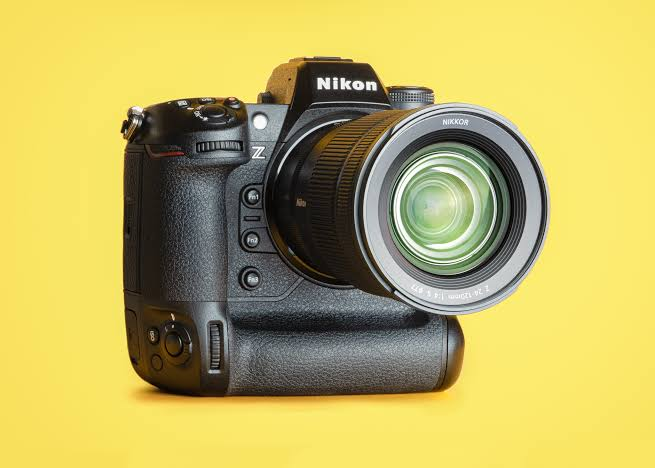
Nikon Z 9 is Nikon’s flagship full-frame mirrorless camera, built for professional photographers, filmmakers and hybrid creators who need speed, reliability and high-resolution image quality in one body.
Released in October 2021, the Z 9 marked a major turning point for Nikon’s mirrorless system. It replaced the need for a traditional DSLR flagship by combining a 45.7MP stacked full-frame sensor, EXPEED 7 processing, advanced subject-detection autofocus, fast still-photo shooting and serious 8K video recording.
The camera uses Nikon’s Z mount and a rugged integrated vertical-grip body. It is heavier than the Nikon Z 8, but that larger design gives professionals better balance with large lenses, stronger battery life and a more traditional flagship feel.
At around $4,996.95 before tax in current retail listings, the Nikon Z 9 remains a premium professional camera aimed at users who need a dependable tool for sports, wildlife, news, weddings, filmmaking and commercial production.
Nikon Z 9 Key Specifications
| Feature | Nikon Z 9 |
|---|---|
| Camera type | Full-frame flagship mirrorless camera |
| Release period | October 2021 |
| Sensor format | Full Frame 35mm |
| Sensor size | 35.9 x 23.9 mm |
| Effective resolution | 45.7MP |
| Sensor design | Stacked CMOS |
| Lens mount | Nikon Z mount |
| Processor | EXPEED 7 |
| Base sensitivity for Log | ISO 800 in many N-Log workflows |
| Maximum RAW video | 8.3K, 8256 x 4644 |
| Main codecs | N-RAW, ProRes RAW HQ, ProRes 422 HQ, H.265, H.264 |
| Weight | About 1,160 g body only |
| Dimensions | About 149 mm x 150 mm x 91 mm |
| Current listed price | Around $4,996.95 before tax |
The Z 9 is designed as a no-compromise professional body. It is not the smallest Nikon mirrorless camera, but it remains one of the strongest options for creators who need stills and video performance in demanding conditions.
Full-Frame 45.7MP Stacked Sensor
The Nikon Z 9 uses a 45.7MP full-frame stacked CMOS sensor.
This sensor gives the camera a strong combination of resolution and speed. Photographers get enough detail for large prints, commercial cropping, wildlife work and professional editorial photography. At the same time, the stacked design allows faster readout than traditional sensors.
The faster readout helps the Z 9 support high-speed still shooting, strong autofocus, reduced rolling shutter and advanced video formats.
Why the Stacked Sensor Matters
A stacked sensor improves how quickly the camera can move image data from the sensor to the processor.
For sports and wildlife photographers, that means better performance when tracking fast subjects. For video shooters, it helps support 8K recording, 4K high-frame-rate capture and cleaner motion handling.
The Z 9 also removes the traditional mechanical shutter, relying on its electronic shutter for stills. That makes sensor readout speed even more important.
Nikon Z 9 Video Recording
The Nikon Z 9 is one of Nikon’s most capable video cameras.
It supports 8.3K RAW recording, 8K UHD, 4K UHD, Full HD and several professional codecs. It can record internally in N-RAW, ProRes RAW HQ, ProRes 422 HQ, H.265 and H.264, depending on the selected mode and firmware support.
| Recording Format | Resolution |
| FX 8.3K | 8256 x 4644 |
| FX 8K UHD | 7680 x 4320 |
| FX 4.1K | 4128 x 2322 |
| FX 4K UHD | 3840 x 2160 |
| FX HD | 1920 x 1080 |
| DX 5.4K | 5392 x 3032 |
| DX 4K UHD | 3840 x 2160 |
| DX HD | 1920 x 1080 |
| 2.3x 4K UHD | 3840 x 2160 |
This makes the camera suitable for documentaries, wildlife films, corporate production, YouTube work, sports coverage, weddings, commercial video and hybrid news gathering.
8.3K N-RAW Recording
The Z 9 supports 8.3K N-RAW recording at 8256 x 4644.
In the supplied recording data, 8.3K N-RAW High Quality reaches up to 59.94p with a bitrate of about 5.8 Gb/s. N-RAW Normal also reaches up to 59.94p but uses lower data rates, making it more practical for longer shoots.
N-RAW gives filmmakers 12-bit recording and more control in post-production. It allows stronger adjustments to exposure, white balance, colour and contrast compared with standard compressed video.
Why 8.3K RAW Matters
8.3K RAW is valuable because it gives editors extra room to work.
A filmmaker can crop, stabilize, reframe or deliver high-quality 4K and 8K projects from a detailed master file. For wildlife, sports and documentary work, that extra resolution can help when the subject is difficult to frame perfectly in the moment.
The trade-off is storage. Z 9 users need fast CFexpress cards, large drives and editing hardware that can handle heavy RAW files.
8K UHD and 4K 120p
The Nikon Z 9 also supports 8K UHD at 7680 x 4320 and 4K UHD up to 120p.
8K UHD is useful for high-resolution production, future-proof archiving and projects that need detailed footage. It also gives creators room to crop into the image while still delivering 4K output.
4K 120p is important for slow motion. It helps filmmakers capture fast action, sports, wildlife movement, dance, product shots and emotional wedding moments with smoother motion.
Best Uses for 4K 120p
4K 120p is especially useful when motion is part of the story.
It works well for birds in flight, athletes, vehicles, water, fabric, ceremonies, stage performances and handheld creative shots. The Z 9’s high-frame-rate options make it a practical tool for creators who need both speed and quality.
Dynamic Range Performance
The supplied lab-style data lists the Nikon Z 9 with a maximum measured dynamic range of 12 stops at SNR=2 in full-frame 8K UHD H.265 at 25fps, ISO 200 and N-Log under firmware version 4.
Other tested modes show different results depending on codec, ISO and firmware version.
| Mode | Resolution | Codec | ISO | Measured Dynamic Range at SNR=2 |
| Full Frame | 7680 x 4320 | H.265 | ISO 800 | 11.6 stops |
| Full Frame | 3840 x 2160 | ProRes HQ | ISO 800 | 11.5 stops |
| Full Frame | 8256 x 4644 | N-RAW | ISO 800 | 10.2 stops |
| Full Frame | 8256 x 4644 | N-RAW | ISO 200 | 9.87 stops |
| Full Frame | 7680 x 4320 | H.265 | ISO 200 | 12.0 stops |
| Full Frame | 3840 x 2160 | ProRes HQ | ISO 200 | 11.8 stops |
These results show that dynamic range can change depending on the recording format and processing. H.265 may show stronger lab numbers because of internal processing, while N-RAW gives filmmakers more post-production flexibility.
For professional work, the best recording mode depends on the project. H.265 is easier for storage and delivery. ProRes is friendly for editing. N-RAW is better when colour grading and image control are the priority.
Rolling Shutter Performance
The Nikon Z 9 performs well for a high-resolution full-frame camera, although rolling shutter still varies by mode.
The supplied data lists 14.5 ms in full-frame 8K UHD H.265 at 25fps, 14.5 ms in 4K ProRes HQ at 25fps and 14.5 ms in 8.3K N-RAW at 25fps. In full-frame 4K H.265 at 120p, the result improves to 4.9 ms.
| Mode | Resolution | Result |
| Full Frame H.265 | 7680 x 4320 | 14.5 ms |
| Full Frame ProRes HQ | 3840 x 2160 | 14.5 ms |
| Full Frame N-RAW | 8256 x 4644 | 14.5 ms |
| Full Frame H.265 120p | 3840 x 2160 | 4.9 ms |
A 14.5 ms result is strong for 8K-class full-frame recording, while 4.9 ms in 4K 120p is excellent for fast movement.
Still Photography Performance
The Nikon Z 9 is a professional stills camera first, even with its powerful video features.
Its 45.7MP sensor gives photographers detailed files for cropping, large prints and commercial work. The camera is suitable for wildlife, sports, fashion, weddings, landscapes, journalism and studio photography.
The integrated vertical grip makes it comfortable for long shoots and portrait-orientation work. It also houses a larger battery, which is useful for professional assignments.
Why Professionals Still Choose the Z 9
The Z 9 is built for reliability.
Its rugged body, fast performance, strong battery life and high-resolution files make it dependable for paid work. It is especially useful for photographers who use large telephoto lenses or spend long hours shooting in the field.
Autofocus and Subject Detection
The Nikon Z 9 uses Nikon’s advanced autofocus system with subject detection and 3D tracking.
It can detect several subject types, including people, animals, birds and vehicles. This makes it useful for sports, wildlife, motorsport, weddings and news photography.
For video users, strong autofocus helps when shooting handheld, using gimbals or working alone. It also reduces the risk of missing important moments during documentary and event work.
Body Design and Handling
The Nikon Z 9 has a professional integrated-grip body.
It weighs about 1,160 g and measures roughly 149 mm x 150 mm x 91 mm. That makes it larger and heavier than the Nikon Z 8, but also better balanced with professional lenses.
The built-in vertical grip helps when shooting portraits, sports and wildlife. It also gives the camera a more durable flagship feel.
Built for Demanding Shoots
The Z 9 is designed for difficult working conditions.
It is best suited to photographers and filmmakers who need a tough camera that can work for long hours. Its size may be too much for casual users, but professionals often value the grip, battery life and control layout.
Nikon Z Mount and Lens Options
The Nikon Z 9 uses the Nikon Z mount.
This gives users access to Nikon’s expanding Z lens system, including professional S-line zooms, fast primes, macro lenses and long telephoto lenses. It also supports adapted F mount lenses through Nikon’s FTZ adapter.
For wildlife and sports shooters, the Z mount system now includes important telephoto options. For video creators, the mount supports both native autofocus lenses and adapted cinema lenses.
Nikon Z 9 Price and Value
The Nikon Z 9 body is currently listed around $4,996.95 before sales tax or VAT.
That price places it firmly in the professional flagship category. It is more expensive than the Nikon Z 8 and Nikon Z6III, but it offers the integrated-grip design, larger battery and top-tier durability that many professionals prefer.
A complete setup will cost more than the body. Buyers should also budget for CFexpress cards, lenses, batteries, storage drives, card readers, microphones, cages, monitors and editing hardware.
For professionals who need a flagship body, the Z 9 still offers strong value because it combines high-end stills and advanced video in one system.
Nikon Z 9 vs Nikon Z 8
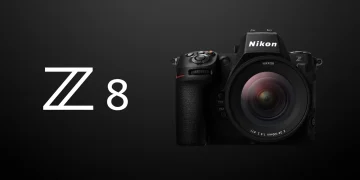
The Nikon Z 9 and Nikon Z 8 share many core features, including a 45.7MP stacked full-frame sensor, EXPEED 7 processing, 8.3K RAW video, 8K UHD and 4K 120p.
The main difference is body design.
The Z 9 has an integrated vertical grip, larger battery and flagship handling. The Z 8 is smaller, lighter and more affordable while keeping much of the same imaging power.
Choose the Z 9 if you want maximum battery life, stronger balance with big lenses and a true flagship body. Choose the Z 8 if you want similar image performance in a smaller camera.
Nikon Z 9 vs Nikon Z6III
The Nikon Z6III is newer, smaller and cheaper, but the Z 9 remains the stronger flagship.
The Z6III has a 24.5MP partially stacked sensor and strong 6K video features. The Z 9 offers higher resolution, 8.3K RAW, 8K UHD and a more professional integrated-grip design.
Choose the Z6III for lighter hybrid work, weddings, travel and budget-conscious video production. Choose the Z 9 for high-end sports, wildlife, news, commercial work and flagship reliability.
Who Should Buy the Nikon Z 9?
The Nikon Z 9 is best for professionals who need speed, durability, resolution and advanced video in one body.
It is a strong choice for:
Sports photographers
Wildlife photographers
News photographers
Wedding professionals
Commercial creators
Documentary filmmakers
Hybrid photo-video teams
Nikon DSLR users moving to mirrorless
Creators who need 8K and 8.3K RAW recording
It is not the best choice for users who want the smallest body. It is designed for professionals who value control, endurance and reliability.
Key Takeaways
- Nikon Z 9 was released in October 2021.
- It uses a 45.7MP full-frame stacked CMOS sensor.
- The sensor size is 35.9 x 23.9 mm.
- The camera uses Nikon’s Z mount.
- It is powered by the EXPEED 7 processor.
- It supports 8.3K N-RAW up to 59.94p.
- It supports 8K UHD and 4K UHD up to 120p.
- Main codecs include N-RAW, ProRes RAW HQ, ProRes 422 HQ, H.265 and H.264.
- Supplied lab data shows up to 12 stops at SNR=2 in 8K H.265.
- Full-frame rolling shutter is listed at 14.5 ms.
- 4K 120p rolling shutter improves to 4.9 ms.
- The body weighs about 1,160 g.
- Current retail listings place the body around $4,996.95 before tax.
Frequently Asked Questions
What is the Nikon Z 9?
The Nikon Z 9 is Nikon’s flagship full-frame mirrorless camera for professional photography and advanced video production.
When was the Nikon Z 9 released?
The Nikon Z 9 was released in October 2021.
What sensor does the Nikon Z 9 use?
The Nikon Z 9 uses a 45.7MP full-frame stacked CMOS sensor measuring 35.9 x 23.9 mm.
What lens mount does the Nikon Z 9 use?
The Nikon Z 9 uses the Nikon Z mount.
Does the Nikon Z 9 shoot 8K video?
Yes. The Nikon Z 9 supports 8K UHD video and 8.3K RAW recording.
Does the Nikon Z 9 support N-RAW?
Yes. The Nikon Z 9 supports internal 12-bit N-RAW recording up to 8.3K.
Does the Nikon Z 9 support ProRes?
Yes. The camera supports ProRes recording, including ProRes 422 HQ and ProRes RAW HQ in supported modes.
What is the Nikon Z 9 dynamic range?
The supplied lab data shows a maximum measured result of 12 stops at SNR=2 in full-frame 8K H.265 at ISO 200 using N-Log.
What is the rolling shutter of the Nikon Z 9?
The supplied data lists 14.5 ms in full-frame 8K and 8.3K modes, and 4.9 ms in 4K 120p H.265.
How much does the Nikon Z 9 cost?
The Nikon Z 9 body is currently listed around $4,996.95 before sales tax or VAT in some retail listings.
Conclusion
The Nikon Z 9 remains one of Nikon’s most important professional mirrorless cameras.
It combines a 45.7MP stacked full-frame sensor, EXPEED 7 processing, advanced autofocus, 8.3K N-RAW, 8K UHD, 4K 120p, strong build quality and an integrated-grip body designed for demanding professional use.
The Z 8 offers similar imaging power in a smaller body, while the Z6III gives hybrid creators a more affordable route into advanced Nikon video. But for professionals who want Nikon’s true flagship experience, the Z 9 still stands as a powerful all-round camera for stills, video, sport, wildlife and commercial production.
Read Also: Nikon Z 8: Specs, Price, Dynamic Range and 8K Video Features