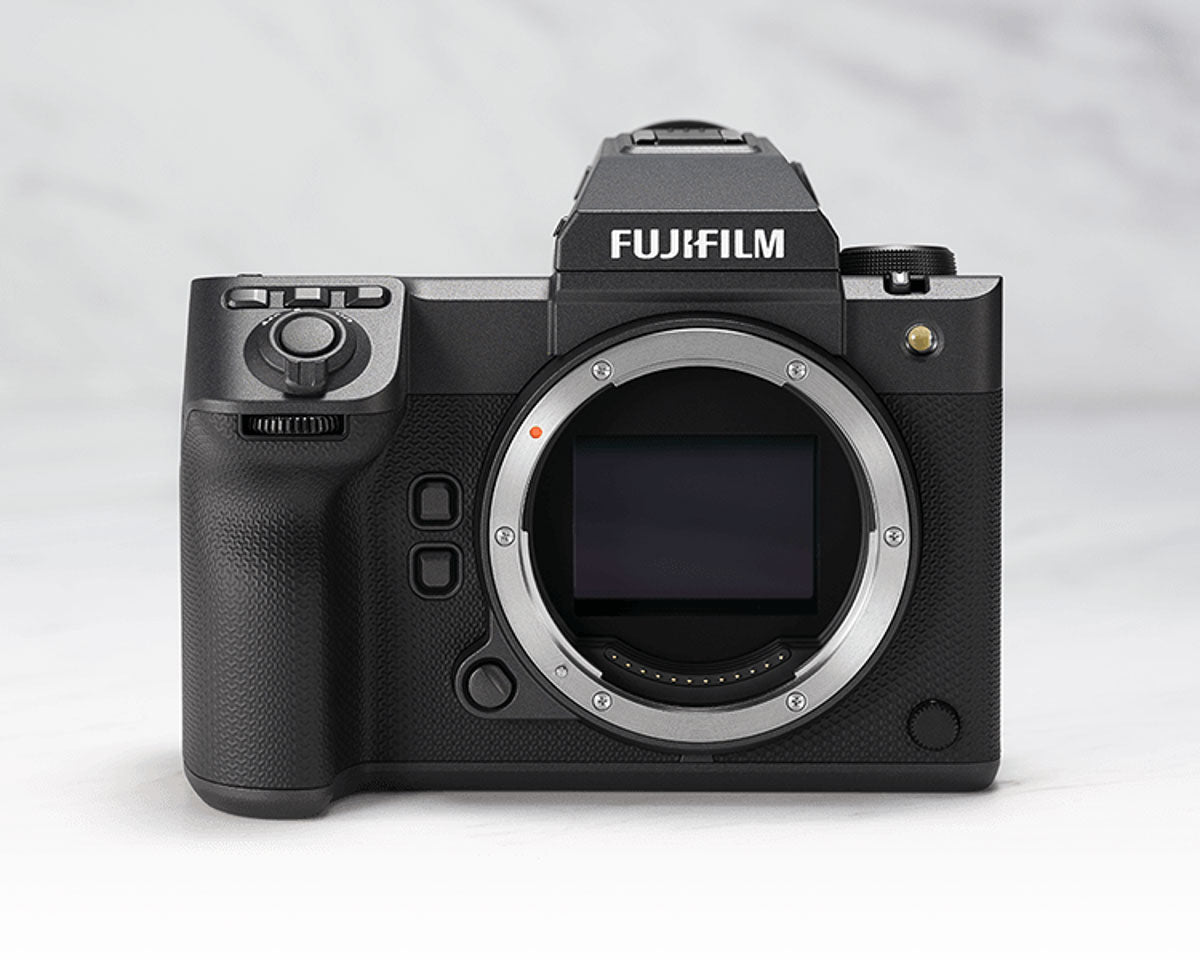
FUJIFILM GFX100 is a professional large-format mirrorless camera built for photographers and filmmakers who need extreme resolution, premium image quality and a large sensor look.
Released in June 2019, the GFX100 was a landmark camera for Fujifilm’s GFX system. It brought 102MP resolution, in-body image stabilization, phase-detection autofocus and 4K video into a large-format mirrorless body with an integrated vertical grip.
The camera uses a 43.8 x 32.9 mm sensor, which is much larger than a standard full-frame sensor. This gives the FUJIFILM GFX100 its biggest advantage: huge detail, wide tonal flexibility and a distinctive large-format image character.
Although later models such as the GFX100S, GFX100 II and GFX100S II improved portability and video features, the original FUJIFILM GFX100 remains important because it proved that high-resolution large-format cameras could become serious hybrid tools.
Your supplied camera data lists the GFX100 with a 1200g weight, 156 x 164 x 103 mm body dimensions, base sensitivity of ISO 800 and a maximum tested dynamic range of 11.3 stops at SNR=2.
Key FUJIFILM GFX100 Specifications
| Feature | FUJIFILM GFX100 |
|---|---|
| Camera type | Large-format mirrorless camera |
| Release period | June 2019 |
| Sensor format | Large format GFX |
| Sensor size | 43.8 x 32.9 mm |
| Sensor resolution | 102MP |
| Lens mount | Fujifilm G Mount |
| Processor | X-Processor 4 |
| Base sensitivity in supplied data | ISO 800 |
| Maximum internal video | 4K UHD / DCI 4K up to 29.97p |
| Internal recording | HEVC 4:2:0 10-bit / H.264 4:2:0 8-bit |
| External RAW | ProRes RAW and Blackmagic RAW workflows |
| Stabilization | 5-axis IBIS, rated up to 5.5 stops |
| Supplied weight | 1200g |
| Supplied dimensions | 156 x 164 x 103 mm |
| Tested dynamic range | 11.3 stops at SNR=2 |
| Tested rolling shutter | 28 ms in 4K UHD 25p |
The GFX100 was designed as a professional imaging tool first, but its video feature set made it more versatile than earlier medium-format-style cameras.
102MP Large-Format Sensor
The main reason to choose the FUJIFILM GFX100 is its 102MP large-format sensor.
The sensor measures 43.8 x 32.9 mm, giving it a much larger imaging area than full-frame and APS-C cameras. That larger area helps create smoother tonal transitions, rich detail and a premium large-format look.
For still photography, 102MP gives creators massive files that can be cropped, retouched and printed at large sizes. This is useful for commercial photography, fashion, landscapes, architecture, product work, studio portraits and fine-art prints.
Why 102MP Matters
A 102MP image gives professionals more freedom.
A commercial photographer can deliver one image in several crops for print, web, banners and social media. A landscape photographer can produce large prints with fine detail. A studio photographer can preserve texture, fabric, skin detail and product surfaces with impressive clarity.
The GFX100 was not built for casual snapshots. It was built for creators who need image files that can survive demanding professional workflows.
Large Format Image Character
The FUJIFILM GFX100 sensor is often described as medium-format-style or large format.
Its sensor is about 70% larger than a 35mm full-frame sensor. This gives images a different feel, especially when paired with Fujifilm GF lenses. The larger sensor can produce a more spacious field of view, smoother tonal rendering and strong subject separation.
For portraits, fashion and commercial work, that look can help images stand apart from smaller-sensor systems.
Fujifilm G Mount
The GFX100 uses Fujifilm’s G Mount.
G Mount lenses are designed to cover the large GFX sensor and resolve enough detail for 102MP still images. This matters because a high-resolution sensor demands high-quality lenses.
Fujifilm’s GF lens system includes primes, zooms and specialty lenses for portraits, landscapes, macro, architecture, travel and studio production.
Lens Quality Matters
A 102MP sensor will show lens weaknesses clearly.
Soft corners, weak contrast, chromatic aberration and poor focusing can become more obvious. To get the best from the GFX100, users should pair it with high-quality GF lenses or carefully tested adapted lenses.
4K Video Recording
The FUJIFILM GFX100 records 4K UHD at 3840 x 2160 and DCI 4K at 4096 x 2160.
Your supplied recording data shows 4K UHD up to 29.97p in HEVC, H.264 and external RAW workflows. Internal HEVC recording supports 4:2:0 10-bit, while H.264 recording supports 4:2:0 8-bit.
This made the GFX100 unusual for its time. It was not only a 102MP stills camera; it also offered serious 4K tools for filmmakers who wanted the large-format look.
Main 4K UHD Recording Options
| Recording Mode | Resolution | Codec | Frame Rate | Datarate | Sampling | Bit Depth |
| 4K UHD | 3840 x 2160 | HEVC ALL-I | Up to 29.97p | 400 Mb/s | 4:2:0 | 10-bit |
| 4K UHD | 3840 x 2160 | HEVC Long GOP | Up to 29.97p | Up to 400 Mb/s | 4:2:0 | 10-bit |
| 4K UHD | 3840 x 2160 | H.264 ALL-I | Up to 29.97p | 400 Mb/s | 4:2:0 | 8-bit |
| 4K UHD | 3840 x 2160 | H.264 Long GOP | Up to 29.97p | Up to 400 Mb/s | 4:2:0 | 8-bit |
For the best internal quality, HEVC 10-bit is the strongest option. H.264 remains useful for simpler editing and compatibility.
ProRes RAW and Blackmagic RAW Output
The FUJIFILM GFX100 can support external RAW workflows through HDMI with compatible recorders and firmware.
Your supplied recording data lists 4K UHD ProRes RAW and Blackmagic RAW at up to 29.97p, 25p, 24p and 23.98p, with 12-bit output.
External RAW gives filmmakers more flexibility for exposure adjustment, colour grading and professional post-production. It also helps extend the value of the GFX100 beyond internal 4K recording.
Why External RAW Matters
Internal recording is convenient, but RAW output gives more control.
A filmmaker can adjust white balance, exposure and colour with more freedom during editing. This is useful for commercials, fashion films, music videos, interviews and high-end branded content.
The GFX100’s RAW output helped make it more relevant to filmmakers who wanted the large-format look from a hybrid camera.
F-Log and Dynamic Range
The FUJIFILM GFX100 supports F-Log for video recording.
F-Log is a flat profile designed to preserve more tonal information for grading. It is useful when shooting high-contrast scenes or when the final image needs a custom colour grade.
Your supplied test data shows the GFX100 reaching 11.3 stops at SNR=2 in full-sensor 4K UHD at 25fps using H.265, ISO 800 and F-Log.
Tested Dynamic Range Result
| Sensor Mode | Resolution | Codec | Frame Rate | ISO | Gamma | SNR=2 Result |
| Full Sensor | 3840 x 2160 | H.265 | 25p | 800 | F-Log | 11.3 stops |
The measured result is respectable, but newer GFX models offer improved video dynamic range and more advanced recording options.
Rolling Shutter Performance
Rolling shutter affects how footage looks when the camera pans quickly or when fast-moving subjects pass across the frame.
Your supplied test data shows the FUJIFILM GFX100 reaching 28 ms in full-sensor 4K UHD at 25fps using H.265.
Tested Rolling Shutter Result
| Sensor Mode | Resolution | Codec | Frame Rate | Rolling Shutter |
| Full Sensor | 3840 x 2160 | H.265 | 25p | 28 ms |
This result means the GFX100 is best used with controlled camera movement. It is suitable for interviews, portraits, landscapes, studio films, commercial product work and slow camera moves. It is less ideal for fast sports, quick handheld pans or action-heavy video.
In-Body Image Stabilization
The GFX100 includes 5-axis in-body image stabilization rated up to 5.5 stops.
This was a major achievement for a large-format camera. High-resolution sensors show camera shake more easily, so stabilization is very important at 102MP.
IBIS helps photographers shoot handheld at slower shutter speeds. It also improves video usability by reducing small camera movements.
Why IBIS Was Important
Before cameras like the GFX100, large-format and medium-format systems were often associated with tripods, studios and controlled shooting.
The GFX100 helped change that. Its stabilization made 102MP large-format photography more practical for handheld portraits, travel, fashion, documentary work and location shoots.
Autofocus and Phase Detection
The FUJIFILM GFX100 includes phase-detection autofocus.
This was another major step for the GFX system. Phase detection made the camera more responsive than earlier contrast-only medium-format-style systems. It improved focusing for portraits, events, fashion work and moving subjects.
The GFX100 is not a sports camera, but its autofocus made large-format shooting more practical for real-world professional work.
Pixel Shift Multi-Shot
The GFX100 supports Pixel Shift Multi-Shot.
This feature uses sensor-shift technology to capture multiple frames and combine them into an ultra-high-resolution image. In supported workflows, the camera can create extremely detailed files for static subjects.
Pixel Shift is useful for artwork reproduction, product photography, archival work, architecture and still-life images.
When to Use Pixel Shift
Pixel Shift requires a tripod and a still subject.
It is not suitable for handheld shooting, street scenes or moving subjects. But in studio conditions, it can produce files with extraordinary detail.
Body Design and Handling
The original FUJIFILM GFX100 has an integrated vertical grip.
This makes it larger and heavier than later models such as the GFX100S. Your supplied data lists the camera at 1200g, with dimensions of 156 x 164 x 103 mm.
The large body gives users better balance with bigger GF lenses and includes professional controls, dual grip handling and a strong electronic viewfinder experience.
Why the Body Is Large
The GFX100 was designed as a flagship.
It was built for professional reliability, stabilization, battery capacity and large-format handling. The size is not ideal for casual travel, but it makes sense for studio, commercial and tripod-based work.
Viewfinder, Screen and Displays
The GFX100 includes a high-resolution electronic viewfinder, tilting rear screen and status displays.
These tools help photographers manage exposure, composition and settings during professional shoots. The integrated body also gives the camera a studio-focused workflow that suits tethered shooting, portrait sessions and commercial environments.
Memory Cards and Storage
The GFX100 uses SD memory cards with UHS-II support.
Your supplied data lists high-bitrate 4K recording up to 400 Mb/s, so fast and reliable cards are important for video. For still photography, 102MP RAW files also require good storage planning.
Photographers using the GFX100 should expect larger files, more backup needs and stronger computers for editing.
Weather Resistance
The FUJIFILM GFX100 is built for professional use and includes weather-resistant construction.
This helps protect the camera from dust, moisture and cold conditions when paired with compatible GF lenses. It is not waterproof, but it is suitable for demanding outdoor and location work.
Landscape, fashion, travel and documentary photographers benefit from this durability.
Still Photography Performance
The GFX100 remains strongest as a still-photo camera.
Its 102MP sensor makes it excellent for commercial, studio, landscape, portrait, architecture, product and fine-art work. It produces files with impressive detail and enough flexibility for heavy retouching and large-format output.
Although newer cameras are faster and smaller, the original GFX100 still delivers professional image quality.
Film Simulations and Colour
The GFX100 includes Fujifilm Film Simulation modes.
These profiles give photographers attractive colour directly from the camera and help speed up JPEG workflows. For video, F-Log is better for grading, while Film Simulations can be useful for faster turnaround projects.
Fujifilm’s colour science remains one of the biggest attractions of the GFX system.
Price and Value
Your supplied data does not include a current price for the FUJIFILM GFX100, but the camera originally launched as a high-end flagship model.
Today, its value depends on the market. Used buyers may find it attractive because it offers 102MP large-format image quality, IBIS, 4K video and professional build quality at a lower price than newer GFX models.
However, users should compare it carefully with the GFX100S and GFX100 II. The newer cameras are smaller, faster and more advanced for video.
Who Should Buy the FUJIFILM GFX100?
The FUJIFILM GFX100 is best for professional photographers who need high-resolution large-format image quality.
It makes sense for:
Commercial photographers
Studio portrait photographers
Fashion photographers
Landscape photographers
Architecture photographers
Product photographers
Fine-art print makers
Artwork reproduction specialists
Creators who want 102MP files
Filmmakers who want large-format 4K RAW output
It may not be ideal for sports shooters, casual vloggers, travel creators who need a small body or filmmakers who require fast rolling-shutter performance.
FUJIFILM GFX100 Strengths and Weaknesses
The biggest strengths of the GFX100 are its 102MP sensor, large-format look, IBIS, professional body design, 4K video, F-Log and external RAW support.
It remains powerful for still photography and controlled video work.
The main weaknesses are size, weight, rolling shutter and older video features. It does not offer 8K, 4K/60p, internal ProRes or the faster readout found in newer cameras. It is also much larger than the GFX100S.
Key Takeaways
- FUJIFILM GFX100 was released in June 2019.
- It uses a 102MP large-format sensor.
- The sensor measures 43.8 x 32.9 mm.
- It uses Fujifilm G Mount lenses.
- The supplied base sensitivity is ISO 800.
- The supplied weight is 1200g.
- The supplied dimensions are 156 x 164 x 103 mm.
- It records 4K UHD and DCI 4K video up to 29.97p.
- Internal HEVC recording supports 4:2:0 10-bit.
- Internal H.264 recording supports 4:2:0 8-bit.
- Video bitrates reach up to 400 Mb/s.
- It supports F-Log for colour grading.
- External ProRes RAW and Blackmagic RAW workflows are supported with compatible recorders.
- The supplied test data shows 11.3 stops at SNR=2.
- The supplied rolling-shutter result is 28 ms.
- It includes 5-axis IBIS rated up to 5.5 stops.
- It supports Pixel Shift Multi-Shot.
- It remains strongest for high-resolution professional still photography.
Frequently Asked Questions
What is the FUJIFILM GFX100?
The FUJIFILM GFX100 is a professional 102MP large-format mirrorless camera designed for high-resolution photography and controlled hybrid video work.
When was the FUJIFILM GFX100 released?
The camera was released in June 2019.
What sensor does the FUJIFILM GFX100 use?
It uses a 102MP large-format sensor measuring 43.8 x 32.9 mm.
What lens mount does the GFX100 use?
The GFX100 uses Fujifilm’s G Mount.
Does the FUJIFILM GFX100 shoot 4K video?
Yes. It records 4K UHD and DCI 4K video up to 29.97p.
Does the GFX100 support 10-bit video?
Yes. It supports internal HEVC 4:2:0 10-bit recording and external workflows with more flexibility.
Does the FUJIFILM GFX100 support RAW video?
Yes. With compatible firmware and external recorders, the GFX100 supports 12-bit RAW video output workflows including ProRes RAW and Blackmagic RAW.
Does the GFX100 support F-Log?
Yes. The camera supports F-Log for colour grading.
What is the tested dynamic range of the GFX100?
Your supplied test data shows 11.3 stops at SNR=2 in full-sensor 4K UHD at 25fps using H.265, ISO 800 and F-Log.
What is the rolling shutter result?
Your supplied data shows a rolling-shutter result of 28 ms in full-sensor 4K UHD at 25fps using H.265.
Does the FUJIFILM GFX100 have IBIS?
Yes. It includes 5-axis in-body image stabilization rated up to 5.5 stops.
Is the GFX100 good for video?
It is useful for controlled 4K video, F-Log and external RAW workflows, but newer GFX models offer stronger video tools, faster readout and better recording options.
Is the FUJIFILM GFX100 good for photography?
Yes. It is excellent for professional photography thanks to its 102MP large-format sensor, IBIS, G Mount lenses and high-resolution image quality.
Who should buy the FUJIFILM GFX100?
It is best for commercial, studio, fashion, portrait, landscape, architecture and fine-art photographers who need very high resolution and large-format image quality.
Conclusion
FUJIFILM GFX100 remains one of the most important cameras in Fujifilm’s GFX history.
It introduced 102MP large-format image quality, in-body stabilization, phase-detection autofocus and professional 4K video features into a flagship mirrorless body. Its large sensor, G Mount lens system and high-resolution files still make it a serious tool for commercial and fine-art photography.
The camera is large, heavy and not as video-advanced as newer models, but it remains powerful for creators who need exceptional still-image detail and controlled 4K large-format video. For professional photographers entering the GFX system, the FUJIFILM GFX100 can still be a compelling option when found at the right price.
Read Also: FUJIFILM X-T4: Specs, Price, Dynamic Range and Video Features