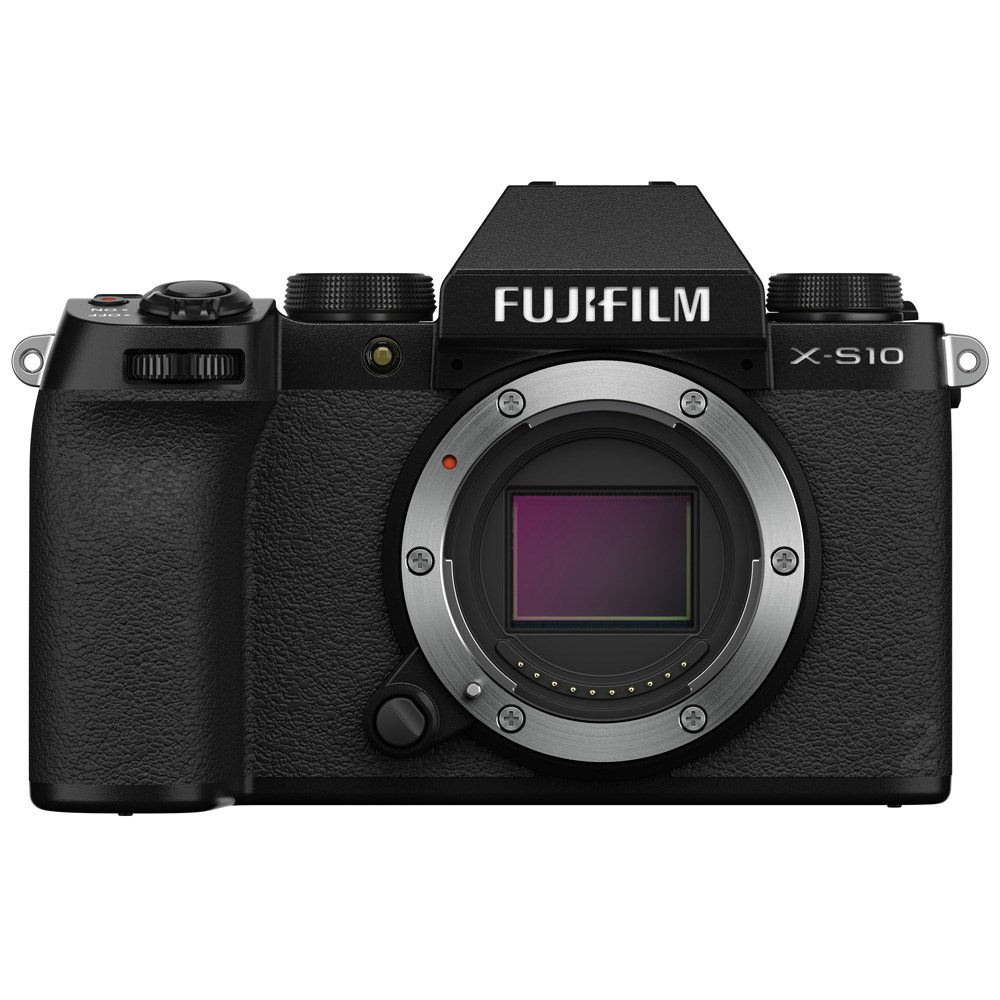
FUJIFILM X-S10 is a compact APS-C mirrorless camera built for creators who want strong image quality, 4K video and in-body stabilization without moving into a large professional body.
Released in October 2020, the X-S10 became an important camera in Fujifilm’s X Series because it brought many higher-end features into a smaller and more approachable design. It uses a 26.1MP X-Trans CMOS 4 sensor, X-Processor 4 and Fujifilm X Mount.
The camera is aimed at travel photographers, vloggers, hybrid shooters, beginner filmmakers, family photographers and creators who want Fujifilm colour science in a lightweight body. Unlike the classic X-T series, the X-S10 uses a more modern mode-dial layout with a deep grip, making it easier for users coming from DSLR or other mirrorless systems.
Your supplied camera data lists the FUJIFILM X-S10 with a Super 35mm-sized APS-C sensor measuring 23.5 x 15.6 mm, base sensitivity of ISO 800, 465g weight and compact dimensions of 126 x 85 x 65 mm.
Key FUJIFILM X-S10 Specifications
| Feature | FUJIFILM X-S10 |
|---|---|
| Camera type | APS-C hybrid mirrorless camera |
| Release period | October 2020 |
| Sensor format | APS-C / Super 35mm |
| Sensor size | 23.5 x 15.6 mm |
| Sensor resolution | 26.1MP |
| Lens mount | Fujifilm X Mount |
| Processor | X-Processor 4 |
| Base sensitivity in supplied data | ISO 800 |
| Maximum internal video | 4K DCI up to 29.97p |
| Internal recording | H.264 4:2:0 8-bit |
| HDMI output | 10-bit 4:2:2 |
| Stabilization | 5-axis in-body image stabilization |
| Weight | 465g |
| Dimensions | 126 x 85 x 65 mm |
| Dynamic range test data | Not tested in supplied database |
| Rolling shutter test data | Not tested in supplied database |
The X-S10 is best understood as a compact all-rounder. It is not as video-heavy as newer Fujifilm bodies such as the X-S20, X-H2 or X-H2S, but it remains a strong hybrid camera for its class.
26.1MP APS-C Sensor
The FUJIFILM X-S10 uses a 26.1MP X-Trans CMOS 4 sensor.
This sensor was one of Fujifilm’s most respected APS-C sensors during its generation. It delivers detailed still images, strong colours and good low-light performance for a compact mirrorless body.
For photography, 26.1MP is enough for portraits, travel, landscapes, street photography, family images, social media content, websites and moderate prints. It also gives creators enough room for cropping without creating overly large files.
Why the Sensor Still Matters
The X-S10 may not have the newer 40.2MP sensor found in later Fujifilm bodies, but its 26.1MP sensor remains practical.
It offers a good balance of resolution, file size and video performance. For many creators, that balance is more useful than simply having more megapixels.
Fujifilm X Mount
The X-S10 uses Fujifilm’s X Mount.
This gives users access to a large lens ecosystem, including Fujifilm XF lenses, compact XC lenses and third-party lenses from brands such as Sigma, Tamron, Viltrox and others.
The camera works especially well with compact primes and lightweight zooms. Its deep grip also makes it comfortable with larger lenses compared with flatter rangefinder-style bodies.
Lens Choice for the X-S10
For travel and everyday use, small primes such as 23mm, 27mm and 35mm lenses keep the camera compact.
For vlogging or video, a wide-angle lens with optical stabilization can be useful. For portraits, Fujifilm’s fast primes give the X-S10 a more professional look.
4K DCI and 4K UHD Video
The FUJIFILM X-S10 records 4K DCI at 4096 x 2160 and 4K UHD at 3840 x 2160.
Your supplied data shows 4K DCI recording up to 29.97p using H.264 at 100 Mb/s or 200 Mb/s. The camera records internally in 4:2:0 8-bit.
This makes the X-S10 suitable for YouTube videos, interviews, travel films, family content, social media clips, educational videos and light commercial work.
Main 4K DCI Recording Options
| Recording Mode | Resolution | Aspect Ratio | Codec | Frame Rate | Datarate | Sampling | Bit Depth |
| 4K DCI | 4096 x 2160 | 17:9 | H.264 | 29.97p | 200 Mb/s | 4:2:0 | 8-bit |
| 4K DCI | 4096 x 2160 | 17:9 | H.264 | 25p | 200 Mb/s | 4:2:0 | 8-bit |
| 4K DCI | 4096 x 2160 | 17:9 | H.264 | 24p | 200 Mb/s | 4:2:0 | 8-bit |
| 4K DCI | 4096 x 2160 | 17:9 | H.264 | 23.98p | 200 Mb/s | 4:2:0 | 8-bit |
| 4K DCI | 4096 x 2160 | 17:9 | H.264 | Up to 29.97p | 100 Mb/s | 4:2:0 | 8-bit |
The 200 Mb/s setting is the stronger option when image quality matters, while 100 Mb/s helps reduce file sizes.
4K UHD, 2K and Full HD Formats
The X-S10 also supports 4K UHD, 2K and Full HD recording formats.
Your supplied recording-format list includes:
| Format | Resolution |
| Full Sensor Photo | 6240 x 4160 |
| 4K DCI | 4096 x 2160 |
| 4K UHD | 3840 x 2160 |
| 2K 17:9 | 2048 x 1080 |
| Full HD | 1920 x 1080 |
| Full HD High Speed | 1920 x 1080 100p+ |
Full HD high-speed recording is useful for slow-motion clips, product shots, sports details, travel B-roll and creative social media edits.
Internal 8-Bit Recording and HDMI Output
The FUJIFILM X-S10 records internally in 8-bit 4:2:0.
That is enough for many everyday creators, but it gives less grading flexibility than the 10-bit internal recording found in newer cameras such as the X-S20, X-T50, X-H2 and X-H2S.
However, the X-S10 can output 10-bit 4:2:2 over HDMI to an external recorder. This makes it more flexible for users who want stronger video quality from a compact Fujifilm body.
Why 10-Bit HDMI Output Matters
Internal 8-bit recording is simple and storage-friendly.
External 10-bit output gives more colour information for grading. This is useful for filmmakers, YouTubers and commercial creators who want to use F-Log and apply heavier colour correction in post-production.
For casual work, internal 8-bit is fine. For more serious projects, external recording gives the X-S10 more professional value.
F-Log and Video Colour
The X-S10 supports F-Log for video users who want more control in post-production.
F-Log captures a flatter image, helping preserve highlight and shadow information compared with standard video profiles. It is useful when shooting in high-contrast lighting or when the creator wants a cinematic grade.
Fujifilm’s Film Simulation modes are also useful for creators who prefer a finished look straight out of camera. This gives users two different workflows: F-Log for grading or Film Simulations for faster delivery.
Dynamic Range Status
Your supplied camera database lists dynamic range as not tested for the FUJIFILM X-S10.
That means there is no measured CineD-style dynamic range figure included in the data. For accuracy, a published review should not invent a number.
Dynamic Range Summary
| Category | Status |
| Supplied database dynamic range | Not tested |
| Base sensitivity in supplied data | ISO 800 |
| Log profile | F-Log |
| Internal recording | 8-bit 4:2:0 |
| HDMI output | 10-bit 4:2:2 |
The practical advice is simple: expose carefully, protect highlights and use F-Log when planning to grade footage.
Rolling Shutter Status
Your supplied database also lists rolling shutter as not tested.
Rolling shutter can affect video when the camera pans quickly or when fast-moving subjects cross the frame. Since no measured figure is supplied, users should test the X-S10 for fast action or rapid handheld movement.
Rolling Shutter Summary
| Category | Status |
| Supplied database rolling shutter | Not tested |
| Highest listed video mode | 4K DCI up to 29.97p |
| Practical advice | Use smooth camera movement for best results |
For interviews, travel videos, lifestyle content and casual handheld shooting, the X-S10 remains useful. For fast sports and action video, newer stacked-sensor cameras offer better performance.
In-Body Image Stabilization
One of the biggest advantages of the FUJIFILM X-S10 is in-body image stabilization.
The camera includes a 5-axis IBIS system in a compact body. This helps photographers shoot handheld at slower shutter speeds and helps video creators capture smoother footage.
For travel creators and vloggers, IBIS is a major benefit. It makes the camera more useful with non-stabilized prime lenses and helps reduce the need for a tripod or gimbal in everyday shooting.
Why IBIS Makes the X-S10 Practical
The X-S10 is small enough to carry daily, but its stabilization makes it more capable than many compact cameras.
A creator can shoot handheld stills in lower light, record walking shots with more stability and use small prime lenses without relying only on lens-based stabilization.
Autofocus and Subject Tracking
The X-S10 uses Fujifilm’s hybrid autofocus system with phase detection.
It supports face and eye detection, making it useful for portraits, vlogging, interviews, family photos and everyday content. While it does not have the newer subject-detection system found in Fujifilm’s X-Processor 5 cameras, it remains capable for general use.
For creators shooting people, the autofocus system is strong enough for most casual and semi-professional situations.
Fully Articulating Screen
The FUJIFILM X-S10 includes a fully articulating vari-angle touchscreen.
This is important for video creators because the screen can face forward for vlogging and self-recording. It also helps with low-angle shots, vertical framing and tripod-based filming.
Compared with a three-way tilting screen, a fully articulating screen is more useful for creators who film themselves.
Compact Body and Handling
The X-S10 has a compact body with a deep grip.
This design separates it from Fujifilm’s more retro-styled cameras. It feels more like a modern mirrorless camera, with a mode dial and comfortable handling for users coming from Canon, Nikon or Sony systems.
Your supplied data lists the weight at 465g and dimensions at 126 x 85 x 65 mm. That makes the camera easy to carry while still feeling secure in the hand.
Who Will Like the X-S10 Body?
The X-S10 is ideal for users who want Fujifilm image quality but do not need classic top dials.
Its grip, mode dial and simple layout make it friendly for beginners, hybrid shooters and creators moving from other camera brands.
Still Photography Performance
The X-S10 is also a strong stills camera.
Its 26.1MP sensor delivers detailed images with Fujifilm’s well-known colour science. It supports RAW and JPEG shooting, Film Simulation modes and fast enough burst performance for everyday photography.
The camera is suitable for travel, street, portraits, family, products, food, lifestyle, events and social media photography.
Film Simulations
Fujifilm’s Film Simulations are one of the main reasons many creators choose the X-S10.
These colour profiles help users create attractive JPEGs and video looks straight out of camera. Popular styles include Classic Chrome, Eterna, Acros, Velvia and Provia.
For creators who do not want heavy editing, Film Simulations make the X-S10 very appealing.
Memory Card and Media
The FUJIFILM X-S10 uses SD memory cards.
Since the camera records 4K video up to 200 Mb/s in the supplied data, users should choose reliable high-speed SD cards that can handle sustained video recording.
For photography, standard fast SD cards are enough. For video, card speed and reliability matter more.
Battery and Connectivity
The X-S10 uses Fujifilm’s smaller NP-W126S battery.
Battery life is acceptable for casual shooting, but creators recording a lot of video should carry spare batteries or use USB-C power where supported.
The camera also includes useful ports for creators, including microphone input, HDMI output and USB connectivity. External monitoring or recording can improve video workflows.
Price and Value
Your supplied data does not list a specific current price for the FUJIFILM X-S10, but the camera remains attractive on the used and discounted market.
Its value comes from the combination of 26.1MP image quality, IBIS, 4K DCI video, F-Log, HDMI 10-bit output and compact handling.
Newer cameras such as the X-S20 offer better video specs, stronger autofocus and improved battery life. However, the X-S10 can still be a smart choice for users who want Fujifilm colour and stabilization at a lower cost.
Who Should Buy the FUJIFILM X-S10?
The FUJIFILM X-S10 is best for creators who want a compact hybrid camera for photography and video.
It makes sense for:
Travel photographers
Beginner creators
Vloggers
YouTubers
Family photographers
Street photographers
Hybrid photo and video users
Students learning filmmaking
Creators who want Fujifilm colour science
Buyers looking for a used Fujifilm bargain
It may not be ideal for users who need 10-bit internal video, 4K/60p, weather sealing, dual card slots or advanced subject-detection autofocus.
FUJIFILM X-S10 Strengths and Weaknesses
The biggest strengths of the X-S10 are its compact body, 26.1MP sensor, IBIS, 4K video, fully articulating screen and Fujifilm colour.
It is easy to carry, easy to use and flexible enough for many types of content.
The main weaknesses are older video specifications, internal 8-bit recording, no 4K/60p, no weather sealing and no newer AI subject detection. For serious video work, the X-S20 is a stronger upgrade.
Key Takeaways
- FUJIFILM X-S10 was released in October 2020.
- It uses a 26.1MP APS-C X-Trans CMOS 4 sensor.
- The sensor measures 23.5 x 15.6 mm.
- It uses Fujifilm X Mount lenses.
- Your supplied base sensitivity is ISO 800.
- The supplied body weight is 465g.
- The supplied dimensions are 126 x 85 x 65 mm.
- It records 4K DCI at up to 29.97p.
- It records 4K UHD, 2K and Full HD.
- Internal recording is H.264 4:2:0 8-bit.
- 4K DCI bitrates reach up to 200 Mb/s in the supplied data.
- HDMI output supports 10-bit 4:2:2.
- It supports F-Log and Film Simulations.
- It includes 5-axis in-body image stabilization.
- It has a fully articulating touchscreen.
- The supplied database lists dynamic range as not tested.
- The supplied database lists rolling shutter as not tested.
- It remains a strong compact hybrid camera for beginners and creators.
Frequently Asked Questions
What is the FUJIFILM X-S10?
The FUJIFILM X-S10 is a compact APS-C mirrorless camera designed for hybrid photography, video, travel and content creation.
When was the FUJIFILM X-S10 released?
The camera was released in October 2020, with market availability following in late 2020.
What sensor does the X-S10 use?
It uses a 26.1MP APS-C X-Trans CMOS 4 sensor measuring 23.5 x 15.6 mm.
What lens mount does the FUJIFILM X-S10 use?
The camera uses Fujifilm’s X Mount.
Does the FUJIFILM X-S10 shoot 4K video?
Yes. It records 4K DCI and 4K UHD video up to 29.97p.
Does the X-S10 support 10-bit video?
Internally, the X-S10 records 8-bit 4:2:0 video. Over HDMI, it can output 10-bit 4:2:2 video to a compatible external recorder.
Does the FUJIFILM X-S10 support F-Log?
Yes. The X-S10 supports F-Log for users who want more flexibility in colour grading.
What is the tested dynamic range of the X-S10?
Your supplied database lists dynamic range as not tested, so no measured figure is included in the supplied data.
What is the rolling shutter result?
Your supplied database lists rolling shutter as not tested, so no measured value is included.
Does the FUJIFILM X-S10 have IBIS?
Yes. The X-S10 includes 5-axis in-body image stabilization.
Is the X-S10 good for vlogging?
Yes. It is good for vlogging because it has a compact body, fully articulating screen, 4K video, microphone input and in-body stabilization.
Is the FUJIFILM X-S10 good for beginners?
Yes. The mode-dial layout, deep grip and compact body make it easier for beginners than Fujifilm’s more traditional dial-heavy models.
Is the FUJIFILM X-S10 still worth buying?
Yes, especially if found at a good price. It remains a capable compact hybrid camera, though the newer X-S20 offers stronger video, autofocus and battery performance.
Conclusion
FUJIFILM X-S10 remains one of Fujifilm’s most practical compact hybrid cameras.
It combines a 26.1MP APS-C sensor, Fujifilm X Mount, 4K DCI recording, F-Log, HDMI 10-bit output, in-body stabilization and a fully articulating screen in a small body that is easy to carry.
It lacks newer features such as 10-bit internal recording, 4K/60p, advanced subject detection and stronger battery life, but it still delivers excellent image quality and a friendly shooting experience. For creators who want an affordable Fujifilm camera for travel, vlogging, photography and everyday video, the FUJIFILM X-S10 remains a strong choice.
Read Also: FUJIFILM GFX100S: Specs, Price, Sensor and Video Features