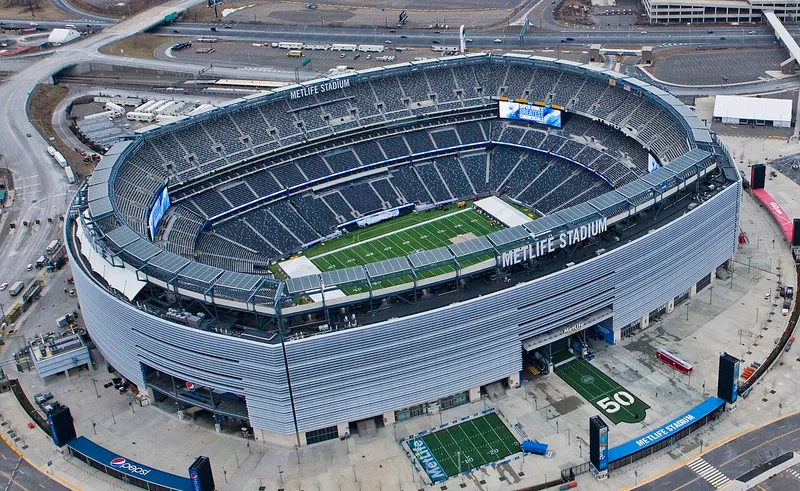
MetLife Stadium is one of the most important venues at the FIFA World Cup 2026 because it will host the tournament final on July 19, 2026.
Located in East Rutherford, New Jersey, the stadium sits just west of New York City and will be known during the tournament as New York New Jersey Stadium. That name reflects FIFA’s event branding, but football fans around the world know the venue as MetLife Stadium.
For American sports fans, it is the home of the New York Giants and New York Jets. For global football fans, it is now the stadium where the 2026 world champions will be crowned.
The venue has an official seating capacity of 82,500, making it one of the largest stadiums in the tournament. Its scale, location, transport links and history of major events make it a natural choice for the biggest match in world football.
MetLife Stadium is open-air, modern, wide and built for high-volume crowds. It has hosted the Super Bowl, Copa America matches, Club World Cup football, major concerts and huge entertainment events. But the World Cup final will be its defining global moment.
Quick Facts About MetLife Stadium
| Fact | Detail |
|---|---|
| Stadium name | MetLife Stadium |
| FIFA World Cup name | New York New Jersey Stadium |
| Location | East Rutherford, New Jersey, USA |
| Address | 1 MetLife Stadium Drive, East Rutherford, NJ 07073 |
| Capacity | 82,500 |
| Opened | April 10, 2010 |
| Roof | Open-air |
| Surface | Natural grass for FIFA World Cup 2026 |
| Main tenants | New York Giants and New York Jets |
| Competition focus | FIFA World Cup 2026 |
| World Cup matches | 8 matches |
| Biggest match | FIFA World Cup 2026 Final |
| Final date | July 19, 2026 |
| Coordinates | 40.8128°N, 74.0742°W |
| Known for | NFL, major concerts, Super Bowl XLVIII and World Cup 2026 Final |
Where Is MetLife Stadium?
MetLife Stadium is in East Rutherford, New Jersey, inside the Meadowlands Sports Complex. It is about 5 miles west of Midtown Manhattan, which makes it strongly connected to the New York metropolitan area even though the stadium itself is not in New York City.
That location matters for World Cup 2026. Fans arriving for matches will likely use New York City, Newark and the wider New Jersey region as their base. The stadium’s position gives visitors access to hotels, airports, restaurants, fan events and transport routes across both New York and New Jersey.
For many international fans, the venue will feel like a New York World Cup stadium. Officially, however, it belongs to the New York/New Jersey host region.
History of MetLife Stadium
MetLife Stadium opened on April 10, 2010, replacing the old Giants Stadium, which had stood nearby since 1976. The new venue was built to serve both the New York Giants and the New York Jets, two NFL franchises that share the same stadium.
That shared arrangement makes MetLife unusual. Most major American football stadiums have one main NFL tenant. MetLife has two. The Giants and Jets use the same field, same seating bowl and same large event infrastructure, with the stadium changing identity depending on which team is playing.
The project cost about $1.6 billion at the time of construction. It was built as a modern, neutral home for two rival franchises, rather than a stadium designed around the colours or personality of only one team.
Architecturally, that explains its balanced look. The exterior uses steel, glass and lighting in a way that allows the venue to shift between Giants blue and Jets green. The result is not a traditional football ground with one fixed club identity. It is a large multi-purpose stadium built for scale, flexibility and major-event hosting.
Construction and Design
MetLife Stadium was designed by a team that included 360 Architecture, EwingCole, Rockwell Group and Bruce Mau Design. The structural engineering work involved Thornton Tomasetti, while Skanska served as the general contractor.
The stadium was planned as a venue that could operate almost like two stadiums in one. On Giants game days, it becomes a Giants venue. On Jets game days, it becomes a Jets venue. For concerts, international football and FIFA events, it becomes a neutral global stage.
The lack of a roof was a major design choice. The Meadowlands area can be windy and cold during parts of the NFL season, but the open-air design gives the stadium a strong outdoor identity. For the World Cup, that means matches will be played in a large, uncovered bowl where weather, atmosphere and crowd noise all become part of the experience.
MetLife Stadium and World Cup 2026
MetLife Stadium will host eight matches at the FIFA World Cup 2026, including five group-stage matches, two knockout matches and the final.
That schedule gives the venue one of the most prestigious roles in the tournament. It will not only introduce fans to group-stage drama but also help decide the tournament during the knockout phase.
The final on July 19, 2026, is the headline. The FIFA World Cup final is the most watched football match on earth, and MetLife Stadium will join a legendary list of final venues that includes Wembley, Maracana, the Olympiastadion, Soccer City and Lusail Stadium.
For the United States, the match will be another major moment in football’s growth. For New York and New Jersey, it will be one of the biggest sporting events ever staged in the region.
World Cup 2026 Matches at MetLife Stadium
| Date | Match |
| June 13, 2026 | Brazil vs Morocco |
| June 16, 2026 | France vs Senegal |
| June 22, 2026 | Norway vs Senegal |
| June 25, 2026 | Ecuador vs Germany |
| June 27, 2026 | Panama vs England |
| June 30, 2026 | Round of 32 |
| July 5, 2026 | Round of 16 |
| July 19, 2026 | FIFA World Cup 2026 Final |
This schedule gives African fans several major reasons to follow the venue closely. Senegal will play two group-stage matches at MetLife Stadium, including a major meeting with France. Morocco will also open its campaign at the venue against Brazil, one of the most famous teams in World Cup history.
For Kenyan and African readers, MetLife Stadium will not only be the final venue. It will also be a stage where African teams can make major statements early in the tournament.
Why MetLife Stadium Was Chosen for the Final
MetLife Stadium was selected for the World Cup final because it offers a rare combination of size, location and event experience.
The New York metropolitan area is one of the world’s most recognisable regions. It has international airports, global media presence, major hotels and a huge multicultural population. That makes it attractive for FIFA, sponsors, broadcasters, national teams and travelling fans.
The stadium itself already has a strong major-event record. It hosted Super Bowl XLVIII in 2014, major international football matches, WrestleMania events and concerts by some of the world’s biggest artists.
A World Cup final needs more than a football pitch. It needs security planning, broadcast space, hospitality, transport, crowd control and global event management. MetLife Stadium and the wider New York/New Jersey region have experience handling events of that size.
Natural Grass for FIFA Events
MetLife Stadium normally uses an artificial surface for NFL games. For the FIFA World Cup, however, the venue will use natural grass.
That change matters because top-level international football is usually played on natural grass. FIFA requires World Cup pitches to meet strict playing standards, especially for ball movement, player safety and match consistency.
Installing natural grass at a stadium designed primarily for American football is not simple. It requires planning, pitch growth, drainage work, maintenance and careful timing. The goal is to give players a proper football surface throughout the tournament.
For fans, the switch should improve the quality of play. Passing should feel smoother, tackles should be more natural and the ball should move in a way that suits elite international football.
The Open-Air Factor
MetLife Stadium has no roof, which gives World Cup matches a different feel from games played in domes or fully covered venues.
In summer, that could mean heat, humidity, wind or changing weather. Teams will need to adapt. Coaches may think carefully about pressing intensity, hydration, substitutions and match tempo.
The open-air setting can also create a powerful atmosphere. Noise escapes differently in an uncovered stadium, but a full World Cup crowd of more than 80,000 can still create a memorable sound.
For the final, the setting could become part of the story. Weather, light, wind and pitch conditions often shape major football matches, and MetLife Stadium will offer a real outdoor test.
Major Events Hosted at MetLife Stadium
MetLife Stadium has already proved its ability to host major events.
Its biggest American football moment came in 2014, when it hosted Super Bowl XLVIII. That game was historic because it was the first outdoor cold-weather Super Bowl played in an open-air stadium.
The venue has also staged major wrestling events, international football matches and concerts. Artists such as Bruce Springsteen, U2, Taylor Swift, Beyoncé and Ed Sheeran have performed there, drawing huge crowds.
This background matters because World Cup venues must handle more than sport. They must manage global attention, broadcast demands, security requirements and fan movement before and after matches.
MetLife Stadium has done that before. The World Cup final will take it to another level.
Transport and Fan Access
Fans attending World Cup matches at MetLife Stadium should plan transport carefully. The stadium is located in East Rutherford, not central Manhattan, so match-day movement will require extra time.
Many fans will travel from New York City, Newark or other parts of New Jersey. Public transport, shuttle services, buses, ride-share zones and event-day traffic plans will be important.
The Meadowlands area can handle large crowds, but World Cup demand will be intense. Supporters should expect early arrivals, security checks and heavy movement after matches.
For international fans, the best advice is simple: do not treat the stadium as a last-minute destination. Plan the route, check match-day transport updates and arrive early.
What Fans Should Know Before Visiting
MetLife Stadium is a large venue, and World Cup visitors should prepare for a major-event experience.
The stadium bowl is open-air, so fans should check the weather before travelling. Summer conditions in New Jersey can be warm and humid. Light rain is also possible, and the lack of a roof means spectators may be exposed to the elements.
Security will be strict because the World Cup is a high-profile global event. Fans should follow official bag policies, ticket instructions and entry guidance.
The area around the stadium includes parking, event zones and nearby attractions. However, match days will be crowded. Supporters should not assume normal travel times will apply.
Why MetLife Stadium Matters to African Fans
MetLife Stadium will matter deeply to African football fans during World Cup 2026.
Senegal will play France and Norway at the venue, while Morocco will face Brazil there. These are huge matches for African football narratives. Senegal against France carries history, emotion and elite football quality. Morocco against Brazil gives African fans another chance to see whether the Atlas Lions can challenge a global giant after their historic 2022 run.
For Kenyan fans, the stadium also matters because many will follow World Cup 2026 through African teams, global stars and major final storylines. MetLife Stadium will be part of all three.
It is not just an American stadium in the tournament. It is one of the places where Africa’s World Cup campaign could gain momentum.
Key Takeaways
- MetLife Stadium is located in East Rutherford, New Jersey.
- The venue will be called New York New Jersey Stadium during World Cup 2026.
- It has an official capacity of 82,500.
- The stadium opened on April 10, 2010.
- It is home to the New York Giants and New York Jets.
- MetLife Stadium will host eight FIFA World Cup 2026 matches.
- The venue will stage the World Cup final on July 19, 2026.
- Natural grass will be used for FIFA World Cup matches.
- Brazil, Morocco, France, Senegal, Germany and England are among the teams scheduled to play there.
- The stadium has hosted the Super Bowl, major concerts and international football.
- Its location near New York City makes it one of the tournament’s most visible venues.
- African fans should watch the venue closely because Morocco and Senegal will play important matches there.
Frequently Asked Questions
Where is MetLife Stadium located?
MetLife Stadium is located in East Rutherford, New Jersey, at 1 MetLife Stadium Drive. It sits inside the Meadowlands Sports Complex near New York City.
What is MetLife Stadium’s capacity?
MetLife Stadium has an official capacity of 82,500 seats.
When did MetLife Stadium open?
MetLife Stadium opened on April 10, 2010.
Which teams play at MetLife Stadium?
The stadium is home to the New York Giants and New York Jets of the NFL.
Will MetLife Stadium host the World Cup 2026 final?
Yes. MetLife Stadium will host the FIFA World Cup 2026 Final on July 19, 2026.
How many World Cup 2026 matches will MetLife Stadium host?
MetLife Stadium will host eight matches at the FIFA World Cup 2026.
What will MetLife Stadium be called during World Cup 2026?
During the tournament, the venue will be referred to as New York New Jersey Stadium.
Does MetLife Stadium have a roof?
No. MetLife Stadium is an open-air venue.
What surface will be used for World Cup matches?
MetLife Stadium will use natural grass for FIFA World Cup 2026 matches.
Why is MetLife Stadium important for World Cup 2026?
MetLife Stadium is important because it will host the final, several group-stage matches and knockout fixtures in one of the world’s biggest media and sports markets.
Conclusion
MetLife Stadium will stand at the centre of the FIFA World Cup 2026 story. It is already a major American sports venue, but the World Cup final will give it a new place in football history.
Its location near New York City, its 82,500 capacity, its major-event experience and its final-hosting role make it one of the tournament’s most important stadiums.
For fans in Kenya, Africa and across the world, MetLife Stadium will be more than a venue. It will be the place where African teams chase group-stage statements, global stars fight for history and the 2026 world champion is crowned.
On July 19, 2026, the eyes of the football world will turn to East Rutherford, New Jersey. MetLife Stadium will be ready for its biggest night.
Read Also: World Cup 2026 Fan Festivals