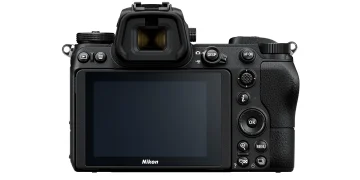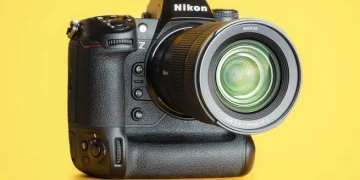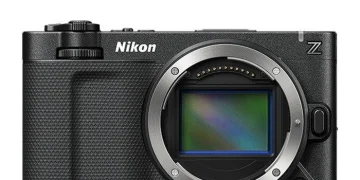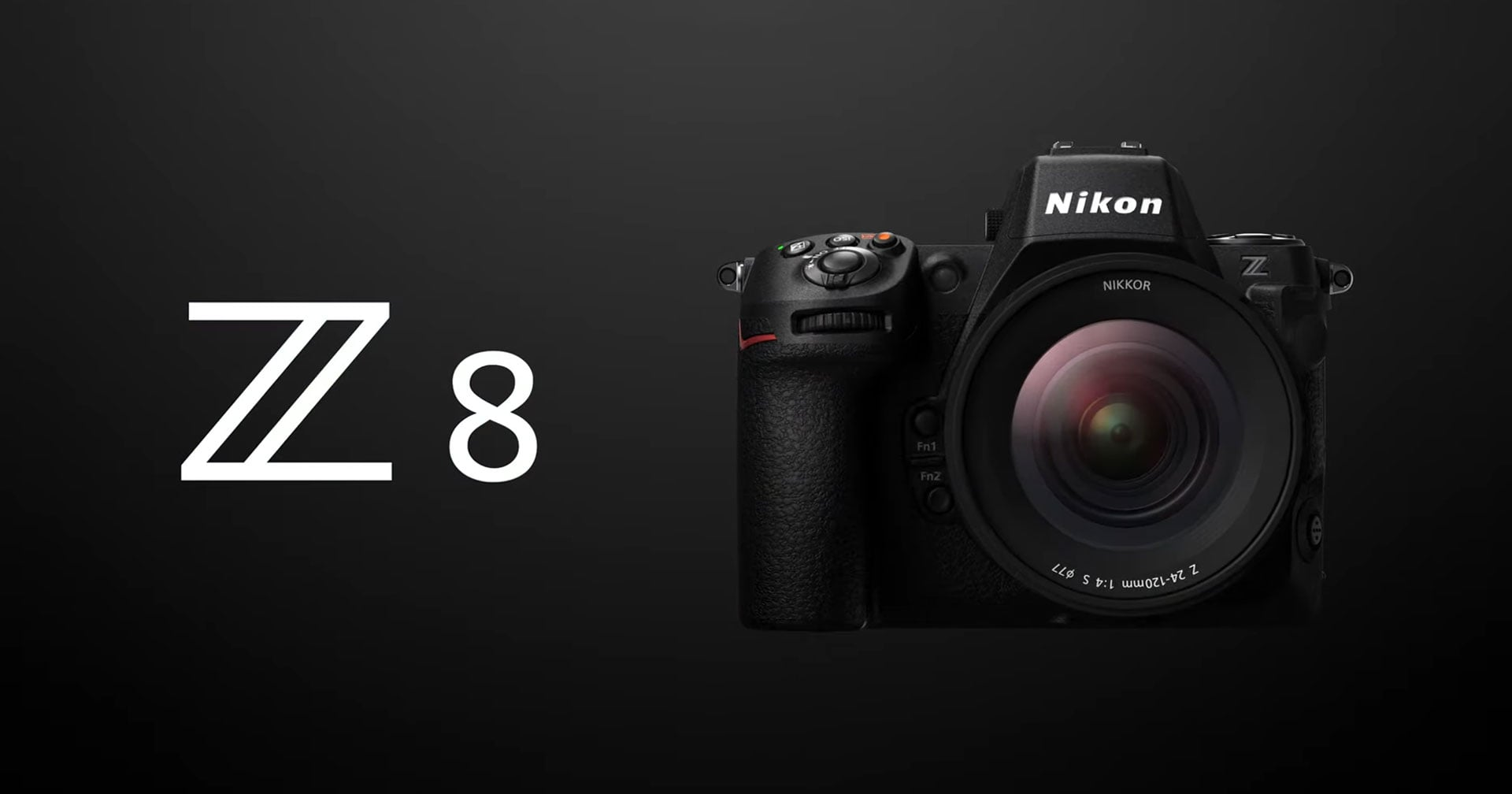
Nikon Z 8 is a full-frame professional hybrid mirrorless camera built for photographers and filmmakers who need flagship-level power in a smaller body.
Released in May 2023, the Nikon Z 8 brings much of the performance of the Nikon Z 9 into a more compact design. It is aimed at professionals, advanced creators, wedding shooters, wildlife photographers, sports photographers, documentary filmmakers and hybrid users who need both high-resolution stills and serious video tools.
The camera uses a 45.7MP full-frame stacked CMOS sensor, Nikon’s Z mount and the EXPEED 7 image processor. It supports high-resolution still photography, fast subject detection, blackout-free viewing, 8.3K RAW video, 8K UHD video and 4K UHD up to 120p.
At around $3,396.95 before tax in current retail listings, the Nikon Z 8 remains one of Nikon’s most powerful hybrid cameras for creators who want professional performance without carrying the larger Z 9 body.
Nikon Z 8 Key Specifications
| Feature | Nikon Z 8 |
|---|---|
| Camera type | Full-frame professional hybrid mirrorless camera |
| Release period | May 2023 |
| Sensor format | Full Frame 35mm |
| Sensor size | 35.9 x 23.9 mm |
| Effective resolution | 45.7MP |
| Lens mount | Nikon Z mount |
| Image processor | EXPEED 7 |
| Base sensitivity for Log | ISO 800 |
| Maximum RAW video | 8.3K, 8256 x 4644 |
| Main codecs | N-RAW, ProRes RAW HQ, ProRes 422 HQ, H.265, H.264 |
| Weight | About 820 g body only |
| Dimensions | About 144 mm x 119 mm x 83 mm |
| Current listed price | Around $3,396.95 before tax |
The Z 8 is best understood as a compact professional body. It is smaller than the Z 9 but still carries many of the same high-end imaging and video features.
Full-Frame 45.7MP Stacked Sensor
The Nikon Z 8 uses a 45.7MP full-frame stacked CMOS sensor.
This sensor gives the camera a strong balance of resolution, speed and video performance. The 8256 x 5504 full-resolution still image area gives photographers enough detail for commercial work, cropping, large prints and professional editing.
The stacked sensor design also helps the camera read data quickly. That supports fast burst shooting, advanced autofocus, reduced rolling shutter and high-end video modes.
Why the Stacked Sensor Matters
A stacked sensor is important because it improves speed.
For photographers, that means faster continuous shooting and better performance with moving subjects. For filmmakers, it helps the camera handle high-resolution video with less distortion during motion.
This is one reason the Nikon Z 8 feels closer to a flagship camera than a standard full-frame mirrorless body.
Nikon Z 8 Video Recording
The Nikon Z 8 is one of Nikon’s strongest video cameras.
It supports RAW video up to 8.3K at 59.94p, 8K UHD up to 30p, 4K UHD up to 120p and Full HD recording. It also offers several professional codecs, including N-RAW, ProRes RAW HQ, ProRes 422 HQ, H.265 and H.264.
| Recording Format | Resolution |
| FX 8.3K | 8256 x 4644 |
| FX 8K UHD | 7680 x 4320 |
| FX 4.1K | 4128 x 2322 |
| FX 4K UHD | 3840 x 2160 |
| FX HD | 1920 x 1080 |
| DX 5.4K | 5392 x 3032 |
| DX 4K UHD | 3840 x 2160 |
| DX HD | 1920 x 1080 |
| 2.3x 4K UHD | 3840 x 2160 |
This wide recording range makes the camera useful for cinema-style projects, weddings, events, documentaries, YouTube production, wildlife films and commercial video.
8.3K N-RAW and ProRes RAW
The biggest video feature of the Nikon Z 8 is internal 8.3K RAW recording.
The camera can record 8.3K N-RAW at 8256 x 4644. In the supplied recording data, 8.3K N-RAW High Quality reaches up to 59.94p, with bitrates rising to about 5.8 Gb/s at the highest frame rate.
N-RAW Normal gives users a lighter RAW option, reducing data rates while keeping 12-bit recording.
The Z 8 also supports ProRes RAW HQ in selected modes, giving editors another professional RAW workflow for post-production.
Why 8.3K RAW Matters
8.3K RAW gives filmmakers more control after shooting.
It allows stronger colour grading, white-balance adjustment, exposure correction and reframing. It also gives editors room to crop or stabilize while still delivering high-quality 4K or 8K projects.
The trade-off is storage. RAW video creates large files, so Z 8 users need fast memory cards, reliable backup drives and editing hardware that can handle heavy footage.
8K UHD and 4K 120p
The Nikon Z 8 also supports 8K UHD at 7680 x 4320 and 4K UHD up to 120p.
8K UHD is useful for high-resolution delivery, documentary work, nature footage, commercial projects and future-proof archiving. It also gives editors room to crop into the frame while still producing 4K output.
The full-frame 4K UHD 120p mode is valuable for slow motion. It allows users to capture action, sports, wildlife movement, weddings, music videos and creative scenes with a smooth slow-motion effect.
Best Uses for 4K 120p
4K 120p is useful for fast movement.
It works well for athletes, dancers, birds, cars, handheld movement, water, product shots and emotional slow-motion wedding moments. Because the Z 8 records this in a high-quality full-frame workflow, it gives creators more flexibility than many older hybrid cameras.
Dynamic Range Performance
The supplied lab-style data lists the Nikon Z 8 with a maximum measured dynamic range of 12.3 stops at SNR=2 in full-frame 8K UHD H.265 at 25fps, ISO 800 and N-Log.
Other tested modes show different results:
| Mode | Resolution | Codec | ISO | Measured Dynamic Range at SNR=2 |
| Full Frame | 3840 x 2160 | ProRes 422 HQ | ISO 800 | 12.0 stops |
| Full Frame | 8256 x 4644 | N-RAW | ISO 800 | 10.1 stops |
| Full Frame | 7680 x 4320 | H.265 | ISO 800 | 12.3 stops |
These results show that codec choice affects measured dynamic range. H.265 may show a higher lab result because of internal processing, while RAW gives more post-production control.
For filmmakers, the best mode depends on the project. N-RAW is better for grading flexibility, while H.265 is more practical for smaller files and faster turnaround.
Rolling Shutter Performance
The supplied data lists the Nikon Z 8 with a minimum full-frame rolling shutter result of 14.5 ms in 8K UHD H.265 at 25fps.
The same 14.5 ms result appears in full-frame 4K ProRes HQ and 8.3K N-RAW at 25fps. In full-frame 4K H.265 at 120p, rolling shutter improves to 4.9 ms.
| Mode | Resolution | Result |
| Full Frame H.265 | 7680 x 4320 | 14.5 ms |
| Full Frame ProRes HQ | 3840 x 2160 | 14.5 ms |
| Full Frame N-RAW | 8256 x 4644 | 14.5 ms |
| Full Frame H.265 120p | 3840 x 2160 | 4.9 ms |
This performance is strong for a high-resolution full-frame camera, especially in 4K 120p. However, users filming fast pans in 8K or 8.3K should still be aware of possible skew.
Still Photography Performance
The Nikon Z 8 is not only a video camera. It is also a powerful stills camera.
Its 45.7MP full-frame sensor gives photographers high-resolution files with strong detail. The camera is suitable for landscapes, portraits, weddings, wildlife, sports, fashion, architecture and commercial work.
The Z 8 also benefits from Nikon’s advanced autofocus and subject-detection system. It can detect multiple subject types, including people, animals, birds, vehicles and aircraft, depending on the selected mode.
Why Photographers Like the Z 8
Photographers like the Z 8 because it combines speed and resolution.
Many cameras force users to choose between high megapixels and fast performance. The Z 8 gives both. It can shoot detailed files while still handling action, movement and demanding professional environments.
That makes it especially useful for hybrid professionals who cannot afford to miss a moment.
Autofocus and Subject Detection
The Nikon Z 8 uses Nikon’s modern autofocus system with subject detection and 3D tracking.
This helps the camera follow moving subjects more confidently. It is useful for sports, wildlife, weddings, portraits, events and video production.
The camera can detect different subject categories, allowing users to adapt quickly to a scene. For example, a wildlife photographer can use bird detection, while an event shooter can rely on human subject detection.
For filmmakers, reliable autofocus can reduce stress during handheld work, interviews, gimbal shots and solo shooting.
Nikon Z Mount and Lens Options
The Nikon Z 8 uses the Nikon Z mount.
This gives users access to Nikon’s growing range of Z lenses, including professional S-line zooms, fast primes, macro lenses, telephoto lenses and compact travel options. It also supports adapted F mount lenses through Nikon’s FTZ adapter.
For video work, the Z mount is flexible. Creators can use native autofocus lenses for fast shooting or adapt manual cinema lenses for controlled productions.
Lens Coverage
Because the Z 8 uses a full-frame sensor, FX lenses are the best choice for full-frame modes.
DX lenses can be used in crop modes, but they will not cover the full-frame image area. When using adapted cinema lenses, users should check coverage before shooting high-resolution FX formats.
Body Design and Handling
The Nikon Z 8 is smaller and lighter than the Nikon Z 9, but still built for professional use.
The body weighs about 820 g without battery and card, and about 910 g when loaded. Its dimensions are about 144 mm wide, 119 mm high and 83 mm deep.
The size makes it practical for handheld work, gimbals, travel, events and documentary production. It is more compact than a flagship body with an integrated vertical grip, but it still feels robust enough for serious field work.
Price and Value
The Nikon Z 8 body is currently listed around $3,396.95 before tax in some retail channels.
That price places it above mid-range full-frame cameras but below many dedicated cinema systems. For users who need both high-resolution photography and 8K-class video, the value is strong.
A complete setup will cost more than the body alone. Buyers should budget for CFexpress cards, SD cards, lenses, batteries, cages, microphones, monitors, storage drives and editing hardware.
Even with those extra costs, the Z 8 remains one of the most complete hybrid cameras in Nikon’s lineup.
Nikon Z 8 vs Nikon Z6III
The Nikon Z 8 and Nikon Z6III serve different users.
The Z6III is more affordable, lighter and excellent for hybrid shooters who need strong 6K video and fast performance. The Z 8 is more powerful, with a higher-resolution 45.7MP sensor, 8.3K RAW, 8K UHD and stronger professional positioning.
Choose the Z6III if you want a lighter and more budget-friendly hybrid camera. Choose the Z 8 if you need higher resolution, 8K video and a more advanced professional body.
Nikon Z 8 vs Nikon ZR
The Nikon Z 8 is a professional hybrid camera, while the Nikon ZR is more video-focused.
The Z 8 is better for photographers who also need advanced video. It offers high-resolution stills, strong autofocus, 8K video and a rugged pro-style body.
The Nikon ZR is better for creators who mainly shoot video and want a compact cinema-style body with RED-inspired R3D NE workflows.
For hybrid professionals, the Z 8 is the stronger all-rounder. For cinema-first creators, the ZR may be more specialized.
Who Should Buy the Nikon Z 8?
The Nikon Z 8 is best for creators who need a professional camera for both stills and video.
It is a strong choice for:
Wedding photographers
Wildlife photographers
Sports photographers
Documentary filmmakers
Commercial creators
YouTube professionals
Travel filmmakers
Event videographers
Hybrid photo-video professionals
Nikon Z users upgrading from older bodies
It is especially useful for creators who want much of the Z 9 experience without the size and weight of a built-in vertical grip.
Key Takeaways
- Nikon Z 8 was released in May 2023.
- It uses a 45.7MP full-frame stacked CMOS sensor.
- The sensor size is 35.9 x 23.9 mm.
- The camera uses the Nikon Z mount.
- It is powered by the EXPEED 7 processor.
- It supports RAW video up to 8.3K at 59.94p.
- It supports 8K UHD up to 30p.
- It records 4K UHD up to 120p.
- Main codecs include N-RAW, ProRes RAW HQ, ProRes 422 HQ, H.265 and H.264.
- Supplied lab data shows up to 12.3 stops at SNR=2 in 8K H.265.
- Full-frame rolling shutter is listed at 14.5 ms.
- 4K 120p rolling shutter improves to 4.9 ms.
- The body weighs about 820 g.
- Current retail listings place the body around $3,396.95 before tax.
Frequently Asked Questions
What is the Nikon Z 8?
The Nikon Z 8 is a professional full-frame hybrid mirrorless camera designed for high-resolution photography and advanced video production.
When was the Nikon Z 8 released?
The Nikon Z 8 was released in May 2023.
What sensor does the Nikon Z 8 use?
It uses a 45.7MP full-frame stacked CMOS sensor measuring 35.9 x 23.9 mm.
What lens mount does the Nikon Z 8 use?
The Nikon Z 8 uses the Nikon Z mount.
Does the Nikon Z 8 shoot 8K video?
Yes. The Nikon Z 8 supports 8K UHD up to 30p and RAW video up to 8.3K at 59.94p.
Does the Nikon Z 8 support N-RAW?
Yes. The Nikon Z 8 supports 12-bit N-RAW internal recording.
Does the Nikon Z 8 support ProRes RAW?
Yes. The camera supports Apple ProRes RAW HQ in selected modes.
What is the Nikon Z 8 dynamic range?
The supplied lab data shows a maximum measured result of 12.3 stops at SNR=2 in full-frame 8K H.265 at ISO 800 using N-Log.
What is the rolling shutter of the Nikon Z 8?
The supplied data lists 14.5 ms in full-frame 8K and 8.3K modes, and 4.9 ms in full-frame 4K 120p H.265.
How much does the Nikon Z 8 cost?
The Nikon Z 8 body is currently listed around $3,396.95 before sales tax or VAT in some retail listings.
Conclusion
The Nikon Z 8 remains one of the strongest professional hybrid cameras in Nikon’s Z system.
It brings 45.7MP full-frame stills, a stacked sensor, EXPEED 7 processing, 8.3K RAW video, 8K UHD, 4K 120p, advanced autofocus and a compact pro body into one camera.
For photographers who also shoot serious video, it is a powerful all-rounder. For filmmakers who want 8K-class recording without moving to a dedicated cinema camera, it offers a strong balance of resolution, codec flexibility and Nikon Z mount lens support.
The Z 8 is not cheap, and its best video modes require fast cards and serious storage. Still, for professional creators who need one camera for high-end stills and advanced video, it remains one of the most capable full-frame hybrid cameras available.
Read Also:Nikon Z6III: Specs, Price, Dynamic Range and Video Features