FUJIFILM X-H1 is a rugged APS-C mirrorless camera designed for photographers and video creators who want strong handling, in-body stabilization, Fujifilm colour science and 4K recording in a professional-style X Series body.
Released in February 2018, the X-H1 was an important model for Fujifilm because it introduced in-body image stabilization to the X Series. Before the X-H1, Fujifilm users mainly relied on optically stabilized lenses or external support for steadier handheld footage. The X-H1 changed that by adding 5-axis IBIS to a durable body with a larger grip, top status display and video-focused features.
The camera uses Fujifilm X Mount lenses and a Super 35mm-sized APS-C sensor measuring 23.5 x 15.6 mm. Your supplied data lists the FUJIFILM X-H1 with a 600g weight, 140 x 97 x 86 mm dimensions and base sensitivity of ISO 800.
Although newer Fujifilm models now offer stronger autofocus, higher-resolution video, internal 10-bit recording and faster sensor readout, the FUJIFILM X-H1 remains a historically important camera because it helped move Fujifilm deeper into serious hybrid photography and video work.
Key FUJIFILM X-H1 Specifications
| Feature | FUJIFILM X-H1 |
|---|---|
| Camera type | APS-C mirrorless camera |
| Release period | February 2018 |
| Sensor format | APS-C / Super 35mm |
| Sensor size | 23.5 x 15.6 mm |
| Sensor resolution | 24.3MP |
| Lens mount | Fujifilm X Mount |
| Processor | X-Processor Pro |
| Base sensitivity in supplied data | ISO 800 |
| Maximum internal video | DCI 4K / UHD 4K |
| Internal recording | MPEG-4 AVC / H.264 |
| Internal colour | 4:2:0 8-bit |
| Maximum supplied bitrate | 200 Mb/s |
| Stabilization | 5-axis in-body image stabilization |
| Supplied weight | 600g |
| Supplied dimensions | 140 x 97 x 86 mm |
| Dynamic range test data | Not tested in supplied database |
| Rolling shutter test data | Not tested in supplied database |
The X-H1 is best viewed as a bridge camera in Fujifilm’s history. It brought stabilization and stronger video controls to the X Series before later models such as the X-T3, X-T4, X-H2 and X-H2S expanded Fujifilm’s video ambitions.
24.3MP APS-C Sensor
The FUJIFILM X-H1 uses a 24.3MP X-Trans CMOS III APS-C sensor.
This sensor was already respected in Fujifilm’s earlier high-end X Series cameras. It delivers sharp still images, attractive colours and good detail for everyday photography, travel, portraits, documentary work and online publishing.
While newer Fujifilm cameras now offer 26.1MP and 40.2MP sensors, the X-H1’s 24.3MP resolution remains practical for many users. It keeps file sizes manageable while still producing high-quality images.
Why the Sensor Still Works
A 24.3MP APS-C sensor is enough for many photographers.
It supports prints, web publishing, social media, portraits, events and travel photography without overwhelming storage or editing systems. For users who do not need heavy cropping or very large prints, the X-H1 still offers a useful balance of detail and efficiency.
Fujifilm X Mount
The X-H1 uses Fujifilm’s X Mount.
This gives users access to Fujifilm XF lenses, XC lenses and many third-party options. The X Mount system includes compact primes, weather-resistant zooms, fast portrait lenses, macro lenses and telephoto lenses.
Because the X-H1 includes in-body stabilization, it works well with both stabilized and non-stabilized lenses. That is one of its biggest advantages over the X-T2 and X-T3.
Why IBIS Helps X Mount Lenses
Many Fujifilm prime lenses do not include optical stabilization.
With the X-H1, those lenses become more useful for handheld stills and video. Street photographers, travel creators and documentary shooters can use compact primes while still benefiting from stabilization inside the camera body.
4K DCI Video Recording
The FUJIFILM X-H1 records 4K DCI at 4096 x 2160.
Your supplied data shows 4K DCI recording in MPEG-4 AVC/H.264 at 24p and 23.98p, with bitrate options of 200 Mb/s, 100 Mb/s and 50 Mb/s. Internal recording is 4:2:0 8-bit.
This made the X-H1 a strong video camera for its generation. It was not as advanced as later Fujifilm cameras with 10-bit internal recording, but it offered a serious step forward for filmmakers using the X Series.
Main 4K DCI Recording Options
| Recording Mode | Resolution | Aspect Ratio | Codec | Frame Rate | Datarate | Sampling | Bit Depth |
| 4K DCI | 4096 x 2160 | 17:9 | MPEG-4 AVC/H.264 | 24p | 200 Mb/s | 4:2:0 | 8-bit |
| 4K DCI | 4096 x 2160 | 17:9 | MPEG-4 AVC/H.264 | 23.98p | 200 Mb/s | 4:2:0 | 8-bit |
| 4K DCI | 4096 x 2160 | 17:9 | MPEG-4 AVC/H.264 | 24p | 100 Mb/s | 4:2:0 | 8-bit |
| 4K DCI | 4096 x 2160 | 17:9 | MPEG-4 AVC/H.264 | 23.98p | 100 Mb/s | 4:2:0 | 8-bit |
| 4K DCI | 4096 x 2160 | 17:9 | MPEG-4 AVC/H.264 | 24p | 50 Mb/s | 4:2:0 | 8-bit |
| 4K DCI | 4096 x 2160 | 17:9 | MPEG-4 AVC/H.264 | 23.98p | 50 Mb/s | 4:2:0 | 8-bit |
The 200 Mb/s option is the strongest internal setting in the supplied data and should be preferred when image quality matters.
4K UHD, 2K and Full HD Formats
The X-H1 also supports 4K UHD, 2K and Full HD recording formats.
Your supplied recording-format list includes:
| Format | Resolution |
| Full Sensor Photo | 6000 x 4000 |
| 4K DCI | 4096 x 2160 |
| 4K UHD | 3840 x 2160 |
| 2K | 2048 x 1080 |
| Full HD | 1920 x 1080 |
Full HD high-speed recording was also an important part of the X-H1’s video appeal. It gave creators slow-motion options for lifestyle clips, action details, travel footage and creative B-roll.
F-Log and Video Colour
The FUJIFILM X-H1 supports F-Log.
F-Log gives video users a flatter image for colour grading. This is useful when shooting high-contrast scenes or when the final video needs a more cinematic grade.
The X-H1 was also important because it introduced Eterna Film Simulation to Fujifilm’s stills and video workflow. Eterna gives footage a softer, lower-contrast look designed for motion work. It is useful for creators who want a pleasing image without heavy grading.
F-Log vs Eterna
F-Log is best when the footage will be colour graded.
Eterna is best when the creator wants a more finished look straight from the camera. For quick client work, documentaries, travel clips and social media videos, Eterna can save editing time. For more controlled productions, F-Log gives more room in post-production.
Dynamic Range Status
Your supplied camera database lists dynamic range as not tested for the FUJIFILM X-H1.
That means there is no measured CineD-style dynamic range result included in the supplied data. For accuracy, a published article should not invent a specific number.
Dynamic Range Summary
| Category | Status |
| Supplied database dynamic range | Not tested |
| Base sensitivity in supplied data | ISO 800 |
| Log profile | F-Log |
| Internal video | 4:2:0 8-bit |
| Best advice | Expose carefully and protect highlights |
The X-H1 can produce attractive video, but users should remember that 8-bit files have less grading flexibility than newer 10-bit Fujifilm cameras.
Rolling Shutter Status
Your supplied database also lists rolling shutter as not tested.
Rolling shutter can affect video when the camera pans quickly or when fast-moving subjects pass across the frame. Since no measured value is included in the supplied data, users should test the camera for their own work before relying on it for fast action.
Rolling Shutter Summary
| Category | Status |
| Supplied database rolling shutter | Not tested |
| Highest listed supplied mode | 4K DCI 24p |
| Practical advice | Use smooth camera movement for best results |
For interviews, portraits, travel clips and controlled motion, the X-H1 remains useful. For rapid pans or sports video, newer cameras such as the X-H2S offer much faster readout.
In-Body Image Stabilization
The most important feature of the FUJIFILM X-H1 is its in-body image stabilization.
The camera introduced 5-axis IBIS to Fujifilm’s X Series. This made the system more useful for handheld stills and video, especially with unstabilized prime lenses.
For photographers, IBIS helps reduce blur at slower shutter speeds. For video creators, it helps smooth handheld footage and makes the camera more practical for documentary work, travel and event coverage.
Why IBIS Made the X-H1 Important
Before the X-H1, many Fujifilm users loved the image quality and lenses but wanted body stabilization.
The X-H1 answered that demand. It became a practical option for creators who wanted Fujifilm colour, F-Log, 4K video and handheld stability in one body.
Body Design and Handling
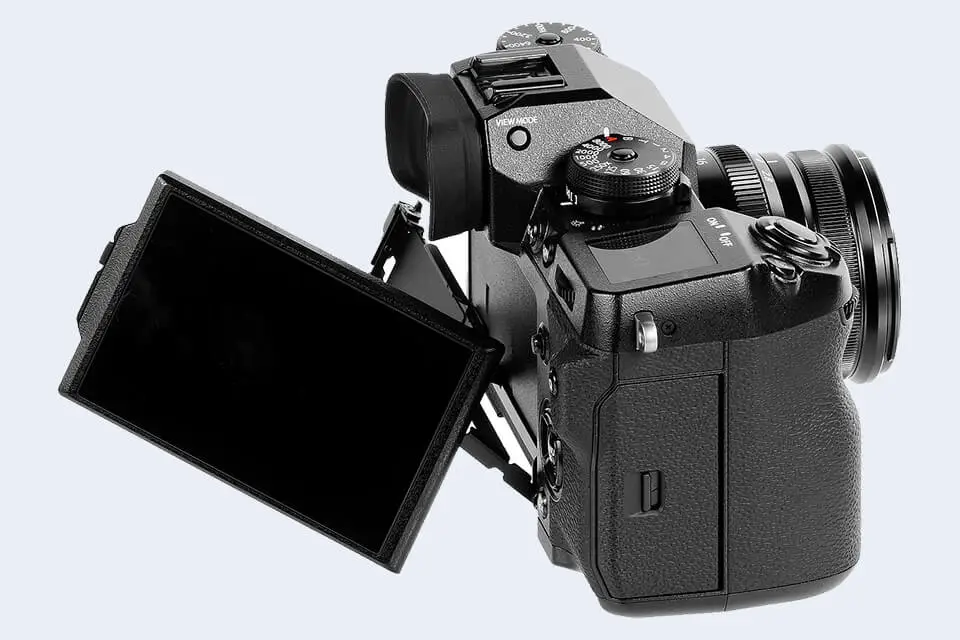
The X-H1 has a larger, tougher body than Fujifilm’s X-T cameras of the same era.
It includes a deep grip, top status display, weather-resistant construction and a more professional handling style. The supplied data lists the body at 600g with dimensions of 140 x 97 x 86 mm.
This design makes the X-H1 feel more like a rugged working camera than a compact travel body. It balances better with larger lenses and suits users who shoot for long periods.
Why the Larger Body Helps
The larger grip makes the X-H1 more comfortable with telephoto zooms and fast lenses.
That matters for weddings, documentaries, events, portraits and handheld video. Smaller bodies are easier to carry, but the X-H1 gives more confidence when working with heavier lenses.
Shutter Feel and Build Quality
Fujifilm designed the X-H1 with a softer shutter mechanism and a more robust body.
The camera was built to feel stable and professional. The shutter response is quiet and controlled, which helps during events, portraits and documentary work.
The durable body also helps users work in challenging conditions when paired with weather-resistant lenses.
Autofocus and Still Photography
The FUJIFILM X-H1 uses Fujifilm’s phase-detection autofocus system from its generation.
It supports face and eye detection and can handle many everyday still-photo situations. It is suitable for portraits, events, travel, street photography and documentary work.
However, it does not match the subject-detection autofocus found in newer X-Processor 5 cameras. Users who need the best tracking for wildlife, sports or fast action may prefer later models.
Still Photography Performance
Although the X-H1 was important for video, it is also a capable stills camera.
Its 24.3MP sensor produces detailed images with Fujifilm’s well-known colour science. It supports RAW and JPEG shooting, Film Simulations, weather-resistant use and comfortable handling.
For photographers who like Fujifilm’s classic image style but want a deeper grip and IBIS, the X-H1 remains attractive on the used market.
Film Simulations
The X-H1 includes Fujifilm Film Simulations, including Eterna.
Film Simulations are one of the main reasons photographers choose Fujifilm. They provide ready-made colour looks that work well for JPEG photography and fast-turnaround video.
Eterna was especially important because it gave video creators a softer cinematic profile without requiring a full log workflow.
Screen, Viewfinder and Displays
The X-H1 includes a high-resolution electronic viewfinder, rear touchscreen and top status display.
The EVF helps with accurate composition and manual focus. The rear screen supports flexible shooting angles, while the top display gives quick access to settings.
The top display is one reason the X-H1 feels closer to later professional X-H bodies than to the classic dial-heavy X-T line.
Memory Cards and Storage
The FUJIFILM X-H1 uses SD memory cards.
Because your supplied data lists 4K DCI video up to 200 Mb/s, users should choose reliable high-speed cards for video recording. Slower cards may limit recording performance or cause errors.
For still photography, RAW files from the 24.3MP sensor are easier to manage than files from newer 40MP or 102MP cameras.
Battery and Vertical Grip
The X-H1 uses Fujifilm’s NP-W126S battery.
Battery life is acceptable, but video users should carry spares. Fujifilm also offered a vertical power booster grip for the X-H1, which improved handling, extended battery life and helped support longer shooting sessions.
For video and event work, the grip made the camera more practical.
Weather Resistance
The X-H1 has weather-resistant construction.
This helps protect the camera against dust, moisture and cold conditions when used with compatible weather-resistant Fujifilm lenses. It is not waterproof, but it is built for serious field use.
Travel photographers, documentary shooters and event creators benefit from this durability.
Price and Value
Your supplied camera data does not list a current price for the FUJIFILM X-H1.
Today, the camera is mostly found on the used market. Its value depends on condition, shutter count, included accessories, battery grip, batteries and local availability.
The X-H1 can be attractive for buyers who want Fujifilm colour, IBIS, 4K DCI, F-Log and a rugged body at a lower used price. However, buyers who need 10-bit internal video, 4K/60p, open gate recording or advanced autofocus should consider newer models such as the X-T4, X-S20, X-H2 or X-H2S.
Who Should Buy the FUJIFILM X-H1?
The FUJIFILM X-H1 is best for users who want an affordable used Fujifilm body with IBIS and strong handling.
It makes sense for:
Travel photographers
Portrait photographers
Documentary creators
Hybrid photo and video users
Event photographers
Beginner filmmakers
Fujifilm users with unstabilized primes
Creators who want Eterna and F-Log
Buyers looking for a rugged used X Series body
Users who do not need the latest autofocus
It may not be ideal for users who need 4K/60p, 10-bit internal recording, F-Log2, open gate video or the newest subject-detection autofocus.
FUJIFILM X-H1 Strengths and Weaknesses
The biggest strengths of the X-H1 are IBIS, build quality, handling, Eterna, F-Log, 4K DCI recording and Fujifilm colour.
It remains a practical camera for photographers and creators who value stabilization and a strong grip more than the newest video specifications.
The main weaknesses are its older sensor generation, internal 8-bit recording, no 4K/60p, no F-Log2, no open gate and no tested dynamic range or rolling-shutter data in your supplied database.
Key Takeaways
- FUJIFILM X-H1 was released in February 2018.
- It uses a 24.3MP APS-C X-Trans CMOS III sensor.
- The sensor measures 23.5 x 15.6 mm.
- It uses Fujifilm X Mount lenses.
- The supplied base sensitivity is ISO 800.
- The supplied weight is 600g.
- The supplied dimensions are 140 x 97 x 86 mm.
- It records 4K DCI at 4096 x 2160.
- Internal recording uses MPEG-4 AVC/H.264.
- Internal recording is 4:2:0 8-bit.
- Supplied 4K DCI bitrates include 200 Mb/s, 100 Mb/s and 50 Mb/s.
- It supports F-Log for grading.
- It includes Eterna Film Simulation.
- It was Fujifilm’s first X Series body with in-body stabilization.
- The supplied database lists dynamic range as not tested.
- The supplied database lists rolling shutter as not tested.
- It has a rugged body, deep grip and top status display.
- It remains a useful used-market camera for Fujifilm creators.
Frequently Asked Questions
What is the FUJIFILM X-H1?
The FUJIFILM X-H1 is an APS-C mirrorless camera designed for hybrid photography and video, with in-body stabilization, 4K DCI recording, F-Log and Fujifilm X Mount support.
When was the FUJIFILM X-H1 released?
The camera was released in February 2018.
What sensor does the FUJIFILM X-H1 use?
It uses a 24.3MP APS-C X-Trans CMOS III sensor measuring 23.5 x 15.6 mm.
What lens mount does the X-H1 use?
The FUJIFILM X-H1 uses Fujifilm’s X Mount.
Does the FUJIFILM X-H1 shoot 4K video?
Yes. The X-H1 records 4K DCI and 4K UHD video.
Does the X-H1 support 10-bit internal video?
No. The supplied data lists internal recording as 4:2:0 8-bit H.264.
Does the FUJIFILM X-H1 support F-Log?
Yes. The X-H1 supports F-Log for colour grading.
Does the X-H1 have Eterna?
Yes. The X-H1 includes Eterna Film Simulation, which is useful for video creators who want a softer cinematic look.
What is the tested dynamic range of the X-H1?
Your supplied database lists dynamic range as not tested, so no measured figure is included in the supplied data.
What is the rolling shutter result?
Your supplied database lists rolling shutter as not tested, so no measured value is included.
Does the FUJIFILM X-H1 have IBIS?
Yes. The X-H1 was Fujifilm’s first X Series camera with in-body image stabilization.
Is the FUJIFILM X-H1 good for video?
It is still useful for 4K DCI video, F-Log and Eterna, but newer Fujifilm cameras offer stronger video features such as 10-bit internal recording, 4K/60p, F-Log2 and open gate video.
Is the FUJIFILM X-H1 good for photography?
Yes. It is good for photography thanks to its 24.3MP sensor, Fujifilm colour science, IBIS, weather-resistant build and strong handling.
Is the FUJIFILM X-H1 still worth buying?
Yes, if found at the right used price. It remains a strong choice for creators who want Fujifilm colour, IBIS and a rugged body, but users who need modern video specs should look at newer models.
Conclusion
FUJIFILM X-H1 remains one of the most important cameras in Fujifilm’s X Series history.
It introduced in-body image stabilization to Fujifilm’s APS-C mirrorless line and gave creators a stronger video-focused body with 4K DCI, F-Log, Eterna Film Simulation and rugged handling. It also kept Fujifilm’s strong still-image quality and X Mount lens flexibility.
The X-H1 is now older and lacks features found in newer cameras, including internal 10-bit recording, 4K/60p, open gate video, F-Log2 and modern subject detection. Even so, for photographers and beginner filmmakers looking for an affordable used Fujifilm body with IBIS and solid build quality, the FUJIFILM X-H1 remains a capable and meaningful option.
Read Also: FUJIFILM X-T3: Specs, Price, Dynamic Range and Video Features