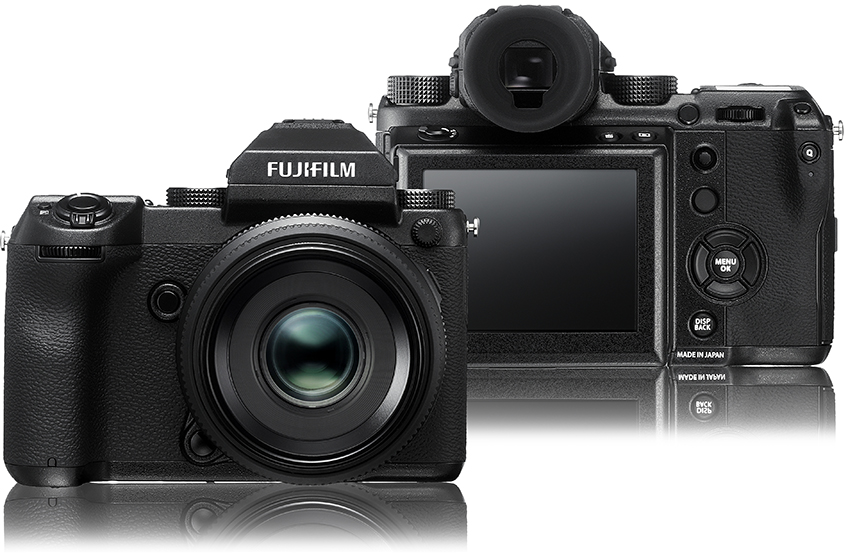
FUJIFILM GFX50S is a large-format mirrorless camera built for photographers who want high-resolution image quality, rich tonal detail and the distinctive look of Fujifilm’s GFX system.
Released in February 2017, the GFX50S was Fujifilm’s first GFX mirrorless camera and one of the most important models in the company’s move beyond APS-C. It introduced the Fujifilm G Mount and gave professional photographers access to a 51.4MP large-format sensor in a mirrorless body.
The camera uses a 43.8 x 32.9 mm sensor, which is much larger than a full-frame sensor. This gives the FUJIFILM GFX50S its main appeal: high resolution, smooth tonal transitions and a large-format image character suited to commercial photography, portraiture, landscapes, fashion, architecture and fine-art work.
Unlike later GFX models, the GFX50S is not a video-focused camera. Its movie features are limited to Full HD recording, with no 4K option in the supplied recording data. That makes it strongest as a professional stills camera rather than a hybrid video body.
Key FUJIFILM GFX50S Specifications
| Feature | FUJIFILM GFX50S |
|---|---|
| Camera type | Large-format mirrorless camera |
| Release period | February 2017 |
| Sensor format | Large format GFX |
| Sensor size | 43.8 x 32.9 mm |
| Sensor resolution | 51.4MP |
| Lens mount | Fujifilm G Mount |
| Image processor | X-Processor Pro |
| Base sensitivity in supplied data | ISO 800 |
| Maximum still resolution | 8256 x 6192 |
| Maximum supplied video format | Full HD 1920 x 1080 |
| Internal video codec | MPEG-4 AVC / H.264 |
| Internal video sampling | 4:2:0 |
| Internal video bit depth | 8-bit |
| Maximum supplied bitrate | 36 Mb/s |
| Supplied weight | 740g |
| Supplied dimensions | 148 x 94 x 91 mm |
| Dynamic range test data | Not tested in supplied database |
| Rolling shutter test data | Not tested in supplied database |
The GFX50S is best understood as a high-resolution photography camera with basic video support. It was built for image quality first, not for advanced filmmaking.
51.4MP Large-Format Sensor
The most important feature of the FUJIFILM GFX50S is its 51.4MP large-format sensor.
The sensor measures 43.8 x 32.9 mm, giving it a much larger imaging area than 35mm full frame. This larger sensor size helps the camera produce a different image character, especially in tonal transitions, depth rendering and fine detail.
For photographers, 51.4MP provides plenty of resolution for large prints, editorial work, commercial campaigns, studio portraits and high-end retouching. It also gives room to crop images while keeping strong detail.
Why 51.4MP Still Matters
A 51.4MP file remains useful even years after the camera’s release.
It gives photographers flexibility for print, web, social media, gallery work and client delivery. A portrait can be cropped tighter. A landscape can be printed large. A product image can be retouched without quickly losing detail.
While newer GFX cameras now offer 102MP sensors, the GFX50S still delivers more than enough resolution for many professional uses.
Large Format Image Character
The FUJIFILM GFX50S sensor is often described as large format or medium-format-style.
Its sensor area is significantly larger than full frame, which affects the way images look. With the right lens, the camera can produce smooth tonal transitions, strong subject separation and a spacious rendering style.
This look is one reason photographers continue to value the original GFX50S. It is not only about megapixels. It is also about the way the larger sensor draws light, depth and detail.
Best Uses for the Large Sensor
The GFX50S is especially strong for:
Commercial photography
Studio portraits
Fashion photography
Landscape photography
Architecture photography
Fine-art printing
Product photography
Editorial campaigns
Artwork reproduction
High-resolution travel photography
It is less suited to fast action, sports and handheld video work compared with newer, faster cameras.
Fujifilm G Mount
The GFX50S introduced Fujifilm’s G Mount system.
G Mount lenses are designed to cover the large GFX sensor and deliver enough detail for high-resolution stills. Fujifilm’s GF lens lineup includes primes, zooms and specialty lenses for portrait, landscape, studio, macro and commercial work.
Lens quality matters on a camera like this. A large-format 51.4MP sensor can reveal weak optics, poor focus and corner softness more easily than lower-resolution cameras.
Lens Choice Matters
To get the best from the FUJIFILM GFX50S, users should pair it with high-quality GF lenses.
A portrait photographer may prefer GF primes for shallow depth and sharp subject rendering. A landscape photographer may choose wide GF lenses for detail across the frame. A studio photographer may use macro or standard lenses for product and commercial work.
The GFX system was designed around image quality, and the GFX50S benefits from lenses that match that purpose.
Full HD Video Recording
The FUJIFILM GFX50S records Full HD video at 1920 x 1080.
Your supplied recording data shows Full HD recording in MPEG-4 AVC/H.264 at 29.97p, 25p and 23.98p. The bitrate is listed at 36 Mb/s, with 4:2:0 8-bit internal recording.
This video specification is modest by modern standards. The GFX50S does not offer 4K, 10-bit internal recording, F-Log2, ProRes or RAW video workflows in the supplied data.
Main Full HD Recording Options
| Recording Mode | Resolution | Codec | Frame Rate | Datarate | Sampling | Bit Depth |
| HD | 1920 x 1080 | MPEG-4 AVC/H.264 | 29.97p | 36 Mb/s | 4:2:0 | 8-bit |
| HD | 1920 x 1080 | MPEG-4 AVC/H.264 | 25p | 36 Mb/s | 4:2:0 | 8-bit |
| HD | 1920 x 1080 | MPEG-4 AVC/H.264 | 23.98p | 36 Mb/s | 4:2:0 | 8-bit |
The video mode is useful for simple behind-the-scenes clips, interviews, documentation and casual recording, but it is not the main reason to buy the GFX50S.
Recording Formats
The supplied recording-format list for the FUJIFILM GFX50S is simple.
| Format | Resolution |
| Full Sensor Photo | 8256 x 6192 |
| HD | 1920 x 1080 |
| HD | 1280 x 720 |
This confirms the camera’s stills-first identity. The GFX50S was designed before Fujifilm turned the GFX line into a more serious hybrid video platform with cameras such as the GFX100, GFX100S and GFX100 II.
Video Limitations
The FUJIFILM GFX50S is not a strong video camera by current standards.
It records only Full HD in the supplied data, using 8-bit 4:2:0 H.264. It does not offer 4K recording, 4K/60p, internal 10-bit video, open gate recording, advanced log profiles or high-speed video modes.
For video creators, this means the GFX50S should be treated as a basic video tool rather than a production camera.
Who Can Still Use the Video Mode?
The Full HD video mode can still be useful for:
Behind-the-scenes clips
Simple studio documentation
Short interviews
Social media teasers
Reference footage
Personal projects
Client previews
For professional video production, newer Fujifilm cameras are much better choices.
Dynamic Range Status
Your supplied camera database lists dynamic range as not tested for the FUJIFILM GFX50S.
That means there is no CineD-style measured dynamic range result included in the pasted data. Since the camera is mainly a stills tool, it is safer to avoid inventing a video dynamic range figure.
Dynamic Range Summary
| Category | Status |
| Supplied dynamic range test | Not tested |
| Base sensitivity in supplied data | ISO 800 |
| Maximum supplied video format | Full HD |
| Internal video bit depth | 8-bit |
| Best practical advice | Expose carefully and prioritize still-image quality |
For photography, the GFX50S is known for strong tonal detail. For video, the supplied data does not provide measured dynamic range results.
Rolling Shutter Status
Your supplied database also lists rolling shutter as not tested.
Rolling shutter is less central to the GFX50S than to modern hybrid video cameras because the camera’s video feature set is limited. Still, users should avoid fast pans and rapid movement if they record video.
Rolling Shutter Summary
| Category | Status |
| Supplied rolling-shutter test | Not tested |
| Maximum supplied video format | Full HD |
| Practical advice | Use slow, controlled camera movement |
For still photography, rolling shutter is not a major concern when using the mechanical shutter. For video, testing is recommended before using the camera on paid work.
Still Photography Performance
Still photography is where the FUJIFILM GFX50S is strongest.
The 51.4MP sensor delivers large, detailed files with strong colour and tonal flexibility. It is ideal for controlled photography where image quality matters more than speed.
The camera is especially useful in studio environments, where lighting, focus and composition can be carefully controlled. It is also excellent for landscapes and architecture when used with a tripod and high-quality lenses.
Best Photography Genres
The GFX50S suits photographers who shoot:
Portraits
Fashion
Commercial products
Fine art
Landscapes
Architecture
Studio still life
Editorial campaigns
Large prints
Museum and artwork reproduction
It is less suitable for high-speed sports, wildlife action or fast documentary shooting.
Autofocus and Shooting Speed
The FUJIFILM GFX50S uses contrast-detection autofocus.
It is accurate for still subjects and controlled work, but it is not as fast as newer phase-detection systems. This matters if the subject moves quickly or if the photographer needs continuous tracking.
The camera is better for slow, deliberate photography than fast action. That fits its purpose as a large-format image-quality camera.
Practical Autofocus Advice
Use single-point autofocus for controlled portraits, products and landscapes.
For studio work, magnified manual focus can also be helpful. For moving subjects, users should expect slower performance than modern mirrorless cameras.
Body Design and Modularity
The GFX50S has a modular professional-style body.
It includes a removable electronic viewfinder, top status display and a rugged design suited to studio and field work. Your supplied data lists the body at 740g with dimensions of 148 x 94 x 91 mm.
The design is larger than APS-C mirrorless cameras but smaller than many traditional medium-format systems.
Why the Modular Design Matters
The removable EVF gives photographers more flexibility.
Studio photographers can configure the camera for tripod work, tethered shooting or waist-level-style viewing with optional accessories. This made the GFX50S feel like a serious professional system rather than a simple compact camera.
Viewfinder, Screen and Displays
The GFX50S includes a high-resolution electronic viewfinder and a tilting rear touchscreen.
The EVF helps with precise composition, exposure preview and manual focusing. The rear screen supports low-angle and high-angle shooting. The top status display makes it easy to check settings quickly during professional work.
These features are especially useful in studio, landscape and commercial photography.
No In-Body Image Stabilization
Unlike later GFX models, the FUJIFILM GFX50S does not include in-body image stabilization.
This is an important limitation. With 51.4MP resolution, small camera movements can reduce sharpness, especially when shooting handheld at slower shutter speeds.
Users should rely on good technique, faster shutter speeds, a tripod, or lenses with optical stabilization where available.
How to Get Sharper Results
Use a tripod for landscapes, architecture and studio work.
For handheld portraits, keep shutter speeds high enough to avoid motion blur. Use careful focusing, stable posture and good lens support. High-resolution large-format files reward careful technique.
Film Simulations and Fujifilm Colour
The GFX50S includes Fujifilm Film Simulation modes.
These profiles give photographers attractive JPEG colour straight from the camera. They are useful for previews, client reviews and faster delivery when RAW editing is not required.
Fujifilm’s colour science is one of the main reasons photographers choose the GFX system. Even with an older camera like the GFX50S, the colour output remains a major strength.
RAW Files and Workflow
The GFX50S produces large RAW files from its 51.4MP sensor.
Photographers should plan for storage, backup and editing performance. Large-format RAW files require more disk space and benefit from a capable computer.
For commercial work, that larger file size is often worth it because it gives retouchers more room to adjust exposure, colour, crop and detail.
Workflow Advice
Use fast SD cards, maintain a reliable backup system and edit on a computer with enough memory.
For professional shoots, it is also wise to shoot tethered when possible. Tethering helps clients and creative teams review focus, composition and detail during the session.
Weather Resistance
The FUJIFILM GFX50S was designed for professional use and includes weather-resistant construction.
When paired with compatible weather-resistant GF lenses, it can be used in challenging outdoor conditions. It is not waterproof, but it is built for serious field work.
This makes it useful for landscapes, travel, documentary projects and outdoor commercial assignments.
Price and Value
The supplied camera data does not include a current FUJIFILM GFX50S price.
At launch, the GFX50S was a premium large-format camera aimed at professional photographers. Today, it is mainly found on the used market, where its value depends on condition, shutter count, included viewfinder, accessories, batteries and local availability.
Its strongest value is image quality. Buyers who want 51.4MP large-format stills at a lower price than newer GFX models may find it attractive.
Used Market Appeal
The GFX50S can make sense for photographers who do not need modern video, IBIS or fast autofocus.
It offers the large-format GFX look at a potentially lower cost. For slow, careful photography, it can still produce excellent results.
Who Should Buy the FUJIFILM GFX50S?
The FUJIFILM GFX50S is best for photographers who care more about image quality than speed or video features.
It makes sense for:
Studio photographers
Portrait photographers
Fashion photographers
Commercial photographers
Landscape photographers
Architecture photographers
Fine-art print makers
Product photographers
Photographers entering the GFX system used
Creators who want large-format image quality
It may not be ideal for sports photographers, vloggers, event videographers or creators who need 4K video and modern autofocus.
FUJIFILM GFX50S Strengths and Weaknesses
The biggest strengths of the FUJIFILM GFX50S are its 51.4MP large-format sensor, G Mount lens system, modular body, Fujifilm colour, strong still-image quality and professional handling.
Its main weaknesses are video limitations, no IBIS, slower autofocus and older processing. It records only Full HD in the supplied data and does not compete with modern hybrid cameras for video production.
Even so, for still photography, it remains a meaningful camera because image quality does not age as quickly as video specifications.
Key Takeaways
- FUJIFILM GFX50S was released in February 2017.
- It was Fujifilm’s first GFX mirrorless camera.
- It uses a 51.4MP large-format sensor.
- The sensor measures 43.8 x 32.9 mm.
- It uses Fujifilm G Mount lenses.
- The image processor is X-Processor Pro.
- The supplied base sensitivity is ISO 800.
- The supplied weight is 740g.
- The supplied dimensions are 148 x 94 x 91 mm.
- Maximum still resolution is 8256 x 6192.
- It records Full HD video at 1920 x 1080.
- Supplied Full HD frame rates include 29.97p, 25p and 23.98p.
- Internal video uses MPEG-4 AVC/H.264.
- Internal video is 4:2:0 8-bit.
- Supplied Full HD bitrate is 36 Mb/s.
- The supplied database lists dynamic range as not tested.
- The supplied database lists rolling shutter as not tested.
- It does not offer 4K video in the supplied recording data.
- It remains strongest as a professional still-photography camera.
Frequently Asked Questions
What is the FUJIFILM GFX50S?
The FUJIFILM GFX50S is a 51.4MP large-format mirrorless camera designed mainly for professional still photography.
When was the FUJIFILM GFX50S released?
The camera was released in February 2017.
What sensor does the FUJIFILM GFX50S use?
It uses a 51.4MP large-format sensor measuring 43.8 x 32.9 mm.
What lens mount does the GFX50S use?
The GFX50S uses Fujifilm’s G Mount.
Does the FUJIFILM GFX50S shoot 4K video?
No. The supplied recording data lists Full HD and HD video modes, but not 4K recording.
What is the maximum video resolution of the GFX50S?
The supplied data lists Full HD 1920 x 1080 as the maximum video recording format.
Does the GFX50S support 10-bit video?
No. The supplied data lists MPEG-4 AVC/H.264 recording at 4:2:0 8-bit.
What is the tested dynamic range of the GFX50S?
Your supplied database lists dynamic range as not tested, so no measured video dynamic range figure is included.
What is the rolling shutter result?
Your supplied database lists rolling shutter as not tested.
Does the FUJIFILM GFX50S have IBIS?
No. The GFX50S does not include in-body image stabilization.
Is the FUJIFILM GFX50S good for video?
It is limited for video because it only records Full HD in the supplied data. It is much better suited to still photography.
Is the FUJIFILM GFX50S good for photography?
Yes. It remains a strong photography camera thanks to its 51.4MP large-format sensor, G Mount lenses and Fujifilm colour science.
Who should buy the FUJIFILM GFX50S?
It is best for portrait, studio, fashion, landscape, architecture, product and fine-art photographers who want large-format image quality at a used-market price.
Conclusion
FUJIFILM GFX50S remains an important camera because it launched Fujifilm’s GFX mirrorless system and brought 51.4MP large-format image quality to a new generation of photographers.
Its strengths are clear: a large 43.8 x 32.9 mm sensor, G Mount lenses, detailed still files, Fujifilm colour, professional handling and a modular body design. It is excellent for studio, portrait, landscape, fashion, product, architecture and fine-art work.
Its weaknesses are also clear. It is not a modern hybrid camera. It lacks 4K video, IBIS, fast autofocus, 10-bit video and advanced rolling-shutter performance. But for photographers who value image quality above speed and video features, the FUJIFILM GFX50S can still be a rewarding large-format camera when found at the right used price.
Read Also: FUJIFILM X-H1: Specs, Price, Sensor and Video Features