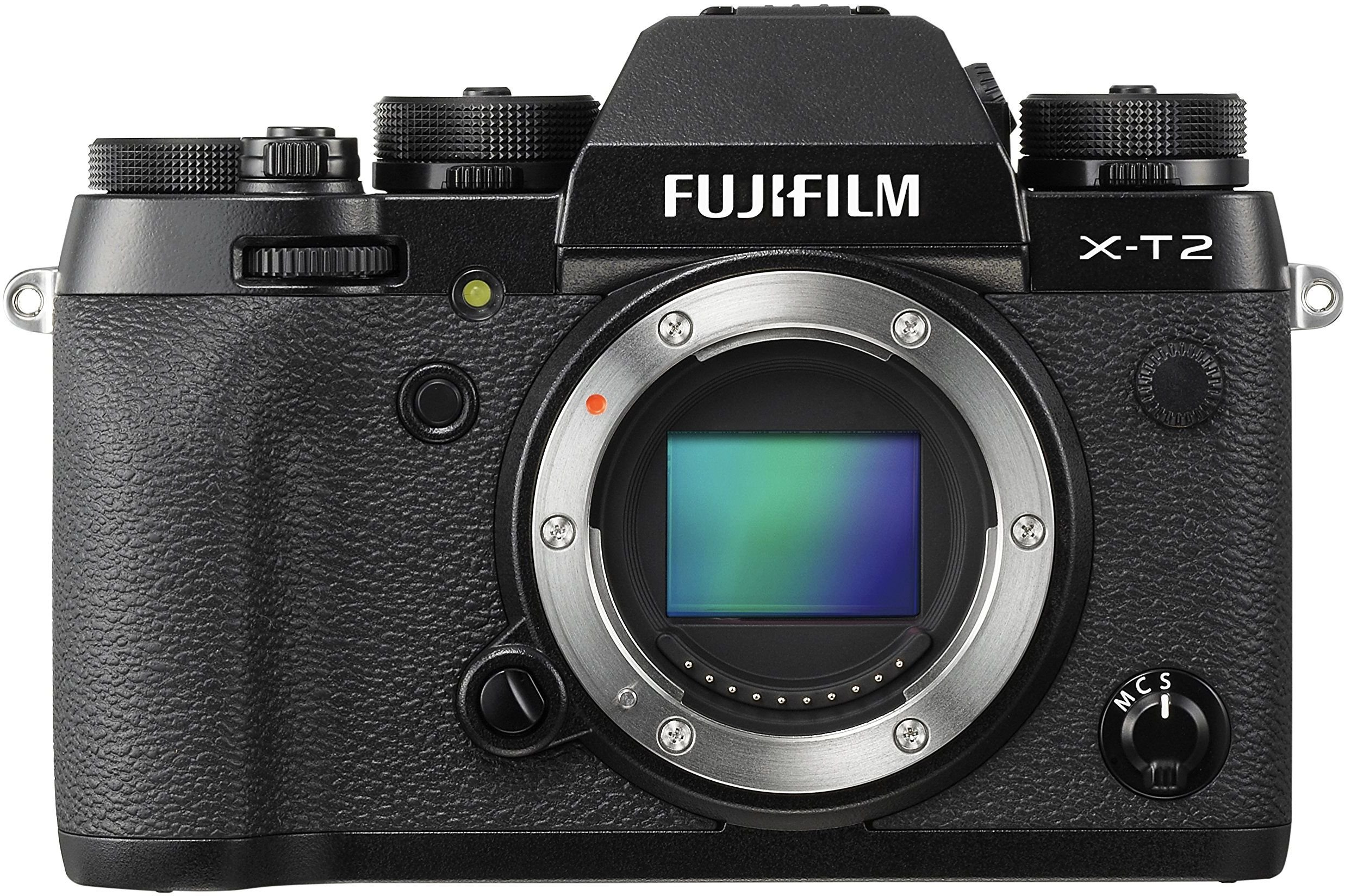
FUJIFILM X-T2 is an APS-C mirrorless camera built for photographers who want classic controls, strong image quality, weather resistance and Fujifilm’s distinctive colour science in a compact X Series body.
Released in July 2016, the X-T2 became one of Fujifilm’s most important early mirrorless cameras. It improved on the X-T1 with a higher-resolution 24.3MP X-Trans CMOS III sensor, better autofocus, faster performance and 4K video recording.
The camera uses Fujifilm X Mount lenses and a Super 35mm-sized APS-C sensor measuring 23.6 x 15.6 mm. Your supplied data lists the FUJIFILM X-T2 with a 457g weight, 133 x 92 x 49 mm dimensions and base sensitivity of ISO 800.
Although the X-T2 is now older than later models such as the X-T3, X-T4 and X-T5, it remains attractive on the used market. It offers a strong photography experience, classic top dials, weather-resistant construction, dual card slots and enough video capability for basic 4K work.
Key FUJIFILM X-T2 Specifications
| Feature | FUJIFILM X-T2 |
|---|---|
| Camera type | APS-C mirrorless camera |
| Release period | July 2016 |
| Sensor format | APS-C / Super 35mm |
| Sensor size | 23.6 x 15.6 mm |
| Sensor resolution | 24.3MP |
| Lens mount | Fujifilm X Mount |
| Processor | X-Processor Pro |
| Base sensitivity in supplied data | ISO 800 |
| Maximum supplied video | 4K UHD up to 29.97p |
| Internal codec | MPEG-4 AVC / H.264 |
| Internal recording | 4:2:0 8-bit |
| Maximum supplied bitrate | 100 Mb/s |
| Stabilization | Lens-based OIS only |
| Supplied weight | 457g |
| Supplied dimensions | 133 x 92 x 49 mm |
| Tested dynamic range | 11.5 stops at SNR=2 |
| Rolling shutter test data | Not tested in supplied database |
The X-T2 is best viewed as a stills-first camera with useful 4K video features. It does not match newer Fujifilm bodies for video depth, but it still delivers excellent photo quality for many users.
24.3MP APS-C Sensor
The FUJIFILM X-T2 uses a 24.3MP X-Trans CMOS III sensor.
This sensor was a major improvement for Fujifilm when it arrived. It gave the X-T2 more resolution than the earlier X-T1 and helped improve detail, colour, autofocus performance and overall image quality.
For photography, 24.3MP is still practical. It is enough for portraits, street photography, weddings, travel, landscapes, family images, online publishing and moderate prints.
Why 24.3MP Still Works
A 24.3MP APS-C sensor remains useful because it keeps file sizes manageable while still offering good detail.
Newer cameras now offer 26MP or 40MP sensors, but many creators do not need that extra resolution. For everyday photography and web publishing, the X-T2 still provides enough image quality when paired with good lenses.
Fujifilm X Mount
The FUJIFILM X-T2 uses Fujifilm’s X Mount.
This gives users access to a large lens ecosystem, including Fujifilm XF lenses, XC lenses and many third-party options. The system includes compact primes, weather-resistant zooms, portrait lenses, macro lenses and telephoto options.
Since the X-T2 does not have in-body image stabilization, lens choice matters. Optical image stabilization is useful for handheld video and low-light still photography.
Best Lens Types for the X-T2
The X-T2 works well with compact Fujifilm primes for travel and street photography.
For video, stabilized zooms are more practical. For portraits, fast primes such as 35mm, 50mm and 56mm-style lenses can help create strong subject separation. For landscapes, wide-angle XF lenses can make the most of the sensor’s detail.
4K UHD Video Recording
The FUJIFILM X-T2 records 4K UHD video at 3840 x 2160.
Your supplied recording data shows 4K UHD recording at 29.97p, 25p, 24p and 23.98p using MPEG-4 AVC/H.264. Internal recording is 4:2:0 8-bit at 100 Mb/s.
This was an important feature in 2016 because the X-T2 was one of Fujifilm’s early cameras to make 4K video part of the X Series experience.
Main 4K Recording Options
| Recording Mode | Resolution | Aspect Ratio | Codec | Frame Rate | Datarate | Sampling | Bit Depth |
| 4K UHD | 3840 x 2160 | 16:9 | MPEG-4 AVC/H.264 | 29.97p | 100 Mb/s | 4:2:0 | 8-bit |
| 4K UHD | 3840 x 2160 | 16:9 | MPEG-4 AVC/H.264 | 25p | 100 Mb/s | 4:2:0 | 8-bit |
| 4K UHD | 3840 x 2160 | 16:9 | MPEG-4 AVC/H.264 | 24p | 100 Mb/s | 4:2:0 | 8-bit |
| 4K UHD | 3840 x 2160 | 16:9 | MPEG-4 AVC/H.264 | 23.98p | 100 Mb/s | 4:2:0 | 8-bit |
The video files are not as flexible as newer 10-bit Fujifilm footage, but they are still usable for basic content creation, YouTube, travel videos and simple documentary work.
4K Crop and Video Field of View
Your supplied data shows that the FUJIFILM X-T2 uses a 1.17x crop in the tested 4K mode.
This means the field of view becomes slightly tighter when recording 4K compared with the full still-photo sensor area. For most users, the crop is manageable, but wide-angle video shooters should consider it when choosing lenses.
Why the Crop Matters
A 1.17x crop slightly narrows the image.
For interviews, portraits and general clips, this may not be a problem. For vlogging, interiors, landscapes or handheld wide shots, users may need a wider lens to maintain the desired framing.
F-Log and Dynamic Range
The FUJIFILM X-T2 supports F-Log for video recording.
F-Log gives users a flatter image profile for colour grading. It helps preserve more highlight and shadow information compared with standard picture profiles, although the X-T2’s internal 8-bit files still require careful exposure.
Your supplied test data shows a maximum dynamic range of 11.5 stops at SNR=2 in 4K crop mode at 25fps, using H.264, ISO 800 and F-Log.
Tested Dynamic Range Result
| Sensor Mode | Resolution | Codec | Frame Rate | ISO | Gamma | SNR=2 Result |
| 4K crop 1.17x | 3840 x 2160 | H.264 | 25p | 800 | F-Log | 11.5 stops |
This is a respectable result for an older APS-C hybrid camera. However, creators should avoid heavy grading mistakes because 8-bit footage has less colour flexibility than modern 10-bit video.
Rolling Shutter Status
Your supplied camera database lists rolling shutter as not tested for the FUJIFILM X-T2.
That means no measured rolling-shutter result is included in the supplied data. Rolling shutter can affect fast pans, handheld movement and quick action, so users should test the camera before using it for demanding video work.
Rolling Shutter Summary
| Category | Status |
| Supplied rolling-shutter test | Not tested |
| Tested video mode | 4K crop 1.17x |
| Maximum supplied 4K frame rate | 29.97p |
| Practical advice | Use slow, controlled camera movement |
For interviews, travel clips and static shots, the X-T2 remains usable. For fast sports or action video, newer cameras such as the X-T4 or X-H2S are stronger choices.
Recording Formats
The supplied recording-format list for the FUJIFILM X-T2 is simple and reflects the camera’s generation.
| Format | Resolution |
| Full Sensor Photo | 6000 x 4000 |
| 4K UHD | 3840 x 2160 |
| HD | 1920 x 1080 |
| HD | 1280 x 720 |
This makes the X-T2 suitable for still photography, 4K video and basic Full HD work. It does not offer 4K/60p, 10-bit internal recording, open gate video, ProRes or F-Log2.
Video Strengths and Limits
The FUJIFILM X-T2 was a major video step for Fujifilm in 2016.
It brought 4K UHD recording, F-Log support and strong image quality into a compact APS-C body. However, by modern standards, its video tools are limited.
The main limitations are 8-bit internal recording, no 4K/60p, no in-body stabilization, no open gate and no modern high-speed 4K slow motion.
Who Can Still Use the X-T2 for Video?
The X-T2 can still work for:
YouTube videos
Travel clips
Simple interviews
Behind-the-scenes footage
Short documentary scenes
Social media content
Personal projects
Learning manual video exposure
For more serious video production, newer Fujifilm models offer better codecs, stabilization and autofocus.
No In-Body Image Stabilization
The FUJIFILM X-T2 does not include in-body image stabilization.
This is one of the biggest differences between the X-T2 and later models such as the X-H1 and X-T4. Users must rely on optically stabilized lenses, tripods, monopods, gimbals or careful handheld technique.
For still photography, this is manageable. For video, it can be more limiting.
How to Work Around No IBIS
Use stabilized Fujifilm lenses when recording handheld video.
A tripod is best for interviews and landscapes. A gimbal can help with walking shots. For still photography, use faster shutter speeds when shooting handheld, especially with telephoto lenses.
Autofocus and Performance
The X-T2 improved autofocus over earlier Fujifilm bodies.
It includes phase-detection autofocus and improved subject tracking for its generation. It also offers useful AF-C custom settings, which helped photographers adjust tracking behaviour for different subjects.
While it cannot match modern AI subject-detection systems, the X-T2 remains capable for portraits, travel, street photography, events and general everyday shooting.
Still Photography Performance
Still photography is the strongest reason to buy the FUJIFILM X-T2 today.
The 24.3MP sensor produces detailed images with Fujifilm’s well-known colour science. The camera also has classic top dials, a strong viewfinder, dual card slots and weather-resistant construction.
It is suitable for travel, street, portraits, weddings, events, landscapes, family photography and editorial work.
Why Photographers Still Like It
The X-T2 feels like a traditional camera.
Its dedicated ISO, shutter speed and exposure compensation dials make shooting direct and enjoyable. Many photographers prefer this hands-on control layout over deeper menu-driven designs.
Film Simulations and Fujifilm Colour
Fujifilm Film Simulations are a major part of the X-T2 experience.
The camera includes classic Fujifilm looks that help photographers create attractive JPEGs straight out of camera. These profiles are useful for quick turnaround, travel photography, social media, portraits and editorial work.
For video, F-Log is better for grading, while Film Simulations can help users get a finished look faster.
Body Design and Handling
The FUJIFILM X-T2 has a compact but rugged body.
Your supplied data lists the weight at 457g and dimensions at 133 x 92 x 49 mm. This makes it lighter than many later hybrid bodies, especially models with in-body stabilization.
The camera’s design follows Fujifilm’s classic X-T layout, with physical controls and a central electronic viewfinder. It feels familiar to photographers who like traditional camera handling.
Weather Resistance
The X-T2 has weather-resistant construction.
When paired with compatible weather-resistant Fujifilm lenses, it can be used in dust, moisture and cold conditions. It is not waterproof, but it is built for serious outdoor photography.
This makes it useful for travel, landscapes, street photography, documentary work and events.
Screen and Viewfinder
The X-T2 uses a tilting rear screen and an electronic viewfinder.
The tilting screen helps with low-angle and high-angle shooting, while the viewfinder supports careful composition and manual focusing. It is not a fully articulating screen, so it is less useful for vlogging or self-recording.
For still photographers, the tilting screen design remains practical and less bulky than a fully articulating display.
Dual SD Card Slots
The FUJIFILM X-T2 includes dual SD card slots.
This is a strong feature for a camera of its age. Dual slots help photographers create backups, separate file types or extend shooting capacity.
For professional events, weddings and travel assignments, dual card slots add confidence.
Battery Grip and Extended Shooting
The X-T2 supported an optional vertical power booster grip.
This grip improved handling, added extra battery capacity and helped extend video recording time. It also made the camera more comfortable with larger lenses.
For users buying the X-T2 used, a bundle that includes the grip can add value, especially for event work and longer shoots.
Price and Value
Your supplied camera data does not include a current FUJIFILM X-T2 price.
Today, the X-T2 is mainly a used-market camera. Its value depends on condition, shutter count, included batteries, accessories, card slots, viewfinder condition and local availability.
The X-T2 is attractive for buyers who want Fujifilm colour, classic controls, weather sealing and 4K video at a lower cost. However, users who need IBIS, 10-bit recording or better autofocus should consider newer bodies.
Who Should Buy the FUJIFILM X-T2?
The FUJIFILM X-T2 is best for photographers who want an affordable used Fujifilm body with classic handling and strong image quality.
It makes sense for:
Street photographers
Travel photographers
Portrait photographers
Landscape photographers
Documentary creators
Students learning photography
Hybrid users with basic video needs
Fujifilm fans who like classic dials
Buyers looking for used-market value
Creators who do not need IBIS
It may not be ideal for vloggers, action videographers, filmmakers who need 10-bit video or users who require advanced subject-detection autofocus.
FUJIFILM X-T2 Strengths and Weaknesses
The biggest strengths of the FUJIFILM X-T2 are image quality, classic controls, weather resistance, dual card slots, Fujifilm colour and solid 4K video for its age.
Its weaknesses are also clear. It lacks IBIS, 4K/60p, internal 10-bit recording, a front-facing screen, F-Log2 and modern autofocus intelligence.
Even so, it remains a capable camera for photographers who value handling and image quality more than the latest video features.
Key Takeaways
- FUJIFILM X-T2 was released in July 2016.
- It uses a 24.3MP X-Trans CMOS III APS-C sensor.
- The sensor measures 23.6 x 15.6 mm.
- It uses Fujifilm X Mount lenses.
- The supplied base sensitivity is ISO 800.
- The supplied weight is 457g.
- The supplied dimensions are 133 x 92 x 49 mm.
- It records 4K UHD at 3840 x 2160.
- Supplied 4K frame rates include 29.97p, 25p, 24p and 23.98p.
- Internal recording uses MPEG-4 AVC/H.264.
- Internal video is 4:2:0 8-bit.
- Supplied 4K bitrate is 100 Mb/s.
- It supports F-Log for video grading.
- The tested dynamic range is 11.5 stops at SNR=2.
- The tested mode uses a 1.17x 4K crop.
- Rolling shutter is not tested in the supplied data.
- It has dual SD card slots.
- It has a weather-resistant body.
- It does not include in-body image stabilization.
- It remains a strong used-market stills camera.
Frequently Asked Questions
What is the FUJIFILM X-T2?
The FUJIFILM X-T2 is an APS-C mirrorless camera designed for still photography and basic hybrid video work, with 4K UHD recording, F-Log and Fujifilm X Mount support.
When was the FUJIFILM X-T2 released?
The camera was released in July 2016.
What sensor does the FUJIFILM X-T2 use?
It uses a 24.3MP X-Trans CMOS III APS-C sensor measuring 23.6 x 15.6 mm.
What lens mount does the X-T2 use?
The X-T2 uses Fujifilm’s X Mount.
Does the FUJIFILM X-T2 shoot 4K video?
Yes. The X-T2 records 4K UHD video at up to 29.97p.
Does the X-T2 support 10-bit video?
No. The supplied data lists internal recording as MPEG-4 AVC/H.264 at 4:2:0 8-bit.
Does the FUJIFILM X-T2 support F-Log?
Yes. The X-T2 supports F-Log for video grading.
What is the tested dynamic range of the X-T2?
Your supplied test data shows 11.5 stops at SNR=2 in 4K crop mode at 25fps using H.264, ISO 800 and F-Log.
What is the rolling shutter result?
Your supplied database lists rolling shutter as not tested, so no measured result is included.
Does the FUJIFILM X-T2 have IBIS?
No. The X-T2 does not include in-body image stabilization.
Is the FUJIFILM X-T2 good for video?
It is useful for basic 4K video, F-Log and learning video workflows, but newer Fujifilm cameras are much better for serious video production.
Is the FUJIFILM X-T2 good for photography?
Yes. It remains a strong photography camera thanks to its 24.3MP sensor, Fujifilm colour, classic controls, weather resistance and dual card slots.
Is the FUJIFILM X-T2 still worth buying?
Yes, if found at a good used price. It is best for photographers who want Fujifilm image quality and classic handling without paying for newer features.
Conclusion
FUJIFILM X-T2 remains one of Fujifilm’s most important early X Series cameras.
It brought a 24.3MP X-Trans CMOS III sensor, improved autofocus, 4K UHD video, F-Log, dual card slots, weather resistance and classic Fujifilm controls into a compact APS-C body. For still photography, it can still produce excellent images when paired with good lenses.
Its age is most visible in video. It lacks IBIS, 10-bit internal recording, 4K/60p, open gate, F-Log2 and modern subject detection. Even so, for photographers and learners who want an affordable used Fujifilm camera with strong image quality and traditional handling, the FUJIFILM X-T2 remains a worthwhile option.
Read Also: FUJIFILM GFX50S: Specs, Price, Sensor and Video Features