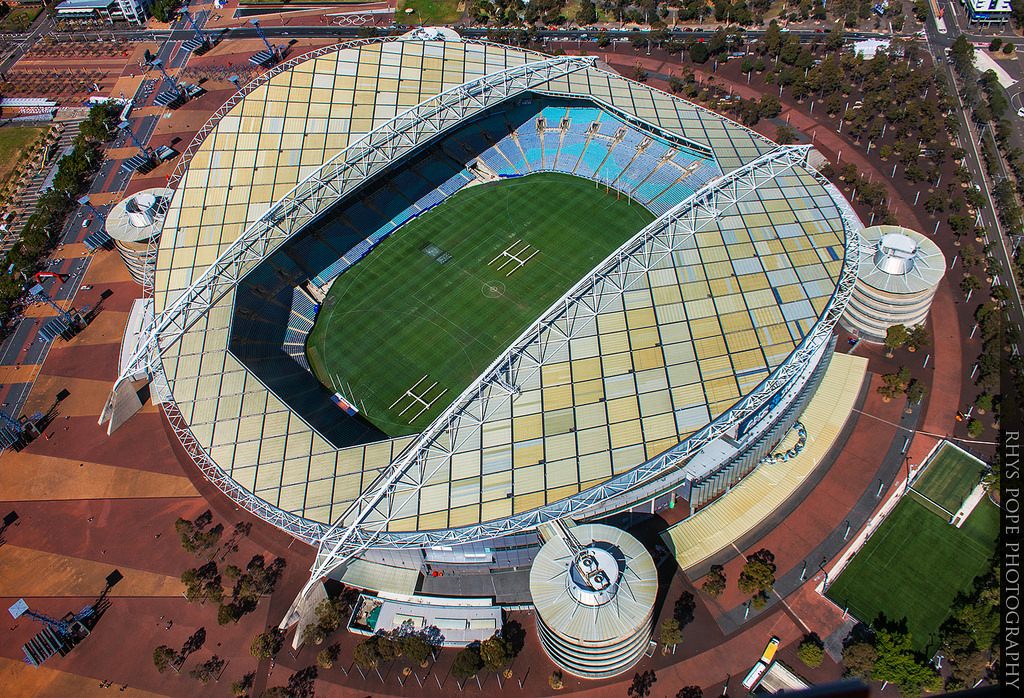
Stadium Australia, currently known as Accor Stadium, is one of Sydney’s most iconic sports and entertainment venues. With a capacity of 83,000, it has played host to a wide range of events, from the 2000 Summer Olympics to rugby, football, and concerts. Originally built for the Sydney Olympics, the stadium has undergone significant transformations to meet the needs of modern sports and entertainment.
The History and Development of Stadium Australia
Sydney was awarded the 2000 Summer Olympics in 1993, prompting the construction of what would become the largest stadium in Olympic history. Architects Populous and Bligh Lobb Sports Architects designed the stadium to accommodate up to 120,000 spectators for the Games. However, it was downsized post-Olympics to a more manageable 83,000 for legacy use. The project’s total cost was AU$690 million, and construction took place from 1996 to 1999.
The stadium opened in March 1999, just a year before the Olympics, and became a major venue for the Games, hosting the opening and closing ceremonies, as well as numerous sports events. Over the years, the stadium has been known by several names, including Telstra Stadium (2002–2007) and ANZ Stadium (2008–2020), before being rebranded as Accor Stadium in recent years.
- Inauguration Date: March 6, 1999
- Renovations: 2001–2003 (roof and seating upgrades)
- Cost: AU$690 million (1999)
- Capacity: 83,000 (permanent seating)
- Record Attendance: 114,714 (2000 Sydney Olympic Games, Closing Ceremony)
Design and Architecture of Stadium Australia
The design of Stadium Australia features two large arches that span 295 meters from north to south, a striking aesthetic feature inspired by Sydney’s landmarks like the Harbour Bridge and the Opera House. The roof is one of the first in the world to collect and reuse rainwater effectively, making it both an architectural and environmental feat.
The original design included temporary sections for increased capacity during the Olympics, but after the Games, these temporary stands were removed and the stadium was enclosed. A retractable roof was added to accommodate a variety of sports and events, though this feature has been a challenge in terms of pitch quality for sports like cricket and Australian rules football. The installation of retractable end zones on both sides of the stadium further improved its versatility, allowing it to host a wide range of events.
- Architectural Features: Two large arches, retractable roof, rainwater collection system
- Key Renovations: Roof enclosure, retractable end zones (2001–2003), seating upgrades
Major Events at Stadium Australia
Stadium Australia has hosted some of the most iconic events in Australian sporting history. As the main venue for the 2000 Summer Olympics, it set a record with 114,714 spectators at the closing ceremony. The stadium has also hosted the Rugby World Cup (2003), AFC Asian Cup (2015), and multiple NRL Grand Finals.
The stadium’s versatility has made it the preferred location for AFL matches, rugby, football, and concerts. It has served as the home venue for several teams, including the Western Sydney Wanderers and Sydney FC, and is regularly used for international events, further cementing its role as one of the world’s premier multi-purpose venues.
- Notable Events: 2000 Olympic Games (Opening/Closing Ceremonies), Rugby World Cup (2003), AFC Asian Cup Final (2015), NRL Grand Finals
The Future of Stadium Australia
Stadium Australia’s future looks bright with continued upgrades and the potential to host even more high-profile events. The stadium’s retractable roof and mobile end zones make it adaptable to a variety of sports and entertainment formats. With a capacity of 83,000 and the ongoing development of its facilities, the stadium remains a central hub for major international events, including the 2023 FIFA Women’s World Cup.
- Upcoming Events: 2023 FIFA Women’s World Cup, continuing sports and entertainment events
Conclusion
Stadium Australia (Accor Stadium) is one of the most iconic and versatile sports venues in the world. From its origins as the centerpiece of the 2000 Sydney Olympics to its ongoing role as a hub for major sports and entertainment events, it has cemented its place in Australian sporting history. With continued renovations and upgrades, Stadium Australia will remain a key venue for international and local events for many years to come.