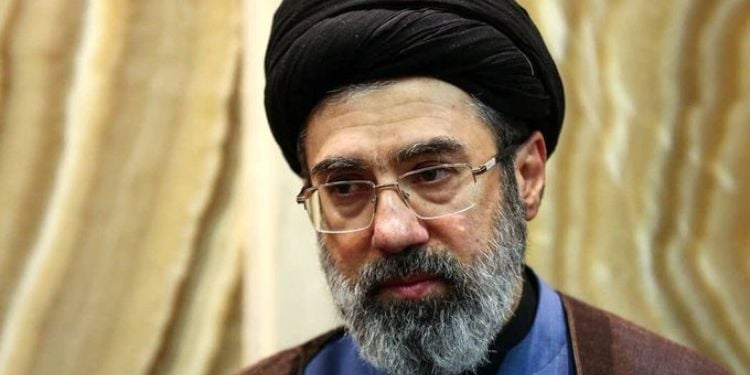
Mojtaba Khamenei has assumed Iran’s top leadership role following the death of his father, Ali Khamenei. However, his appointment immediately drew criticism from U.S. President Donald Trump, who publicly stated he was “not happy” with the choice.
The leadership transition places Mojtaba Khamenei at the center of escalating regional tensions. At a time when U.S.–Iran hostilities have intensified, Washington’s reaction signals that relations could harden further rather than stabilize.
Mojtaba Khamenei and Iran’s Leadership Shift
Mojtaba Khamenei was appointed Supreme Leader by Iran’s Assembly of Experts on March 8, 2026. Born in Mashhad in 1969, he studied at the Qom seminary and holds the clerical rank of Hojjatoleslam.
Although he never held elected office, he built influence through close ties with conservative clerics and the Islamic Revolutionary Guard Corps. Over the years, analysts often described him as a power broker operating behind the scenes.
The United States sanctioned Mojtaba Khamenei in 2019, citing his role in supporting Iran’s political structure. Therefore, his elevation to Supreme Leader carries immediate diplomatic implications.
Trump’s Response and Strategic Ambiguity
President Trump publicly rejected Mojtaba Khamenei’s appointment but declined to outline a specific policy response. While he expressed dissatisfaction, he avoided signaling direct retaliation.
That ambiguity appears deliberate. By withholding details, the White House retains strategic flexibility. However, markets and regional governments interpret silence differently during conflict.
U.S.–Israel Coordination
Trump also emphasized close coordination with Israeli Prime Minister Benjamin Netanyahu regarding military decisions. He described decisions about ending hostilities as collaborative, though ultimately under U.S. authority.
Such remarks reinforce the perception of deep U.S.–Israel alignment on Iran. Meanwhile, Iranian officials frame the leadership transition as an internal constitutional process unaffected by foreign pressure.
Regional Security Context
The leadership change occurs amid intensified military exchanges across the region. According to Israeli officials, multiple attacks have been launched by Iran-linked groups, including Hezbollah and Hamas.
Iran, for its part, accuses adversaries of escalating strikes against its territory and infrastructure. The conflict has already disrupted oil transit and shaken energy markets.
Therefore, Mojtaba Khamenei’s tenure begins under extraordinary geopolitical strain. Unlike his father’s earlier years in office, he assumes leadership during active confrontation rather than relative strategic balance.
Economic and Global Implications
Leadership transitions in Iran often influence sanctions policy, energy markets and diplomatic channels. If Washington adopts a tougher posture toward Mojtaba Khamenei, negotiations over nuclear or regional security issues may stall further.
Higher geopolitical risk premiums already push energy prices upward. Consequently, emerging markets that depend on oil imports, including many African nations, face inflationary pressure.
Additionally, Gulf states may recalibrate security partnerships depending on how the new Iranian leadership signals its priorities.
Historical Parallel
Iran’s last major leadership transition occurred in 1989 after Ayatollah Ruhollah Khomeini’s death. At that time, internal consolidation preceded shifts in foreign policy tone.
Today’s environment differs sharply. The regional landscape features sanctions, proxy conflicts and fragile energy routes. Therefore, even symbolic statements from Washington carry amplified weight.
Why This Matters
Mojtaba Khamenei’s appointment reshapes the strategic calculus in Tehran and Washington alike. Leadership continuity may preserve Iran’s core policy direction, yet external reactions could redefine the conflict’s trajectory.
For global markets, uncertainty around Iran’s leadership adds another layer to already volatile energy and security dynamics.
What Happens Next
Diplomatic channels will likely test early signals from Tehran. If the new leadership emphasizes continuity, escalation may persist. However, if Tehran seeks recalibration, backchannel diplomacy could emerge.
Meanwhile, Washington’s next move remains unclear. Policy responses may unfold through sanctions adjustments, military posture shifts or regional alliance coordination.
In the short term, Mojtaba Khamenei’s rise ensures that U.S.–Iran relations enter a new and unpredictable chapter.