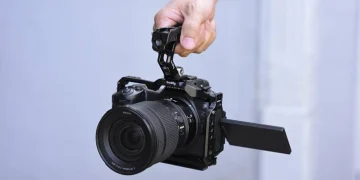
FUJIFILM X-T50 is a compact mirrorless camera built for photographers and hybrid creators who want high-resolution image quality, strong video features and Fujifilm’s classic shooting experience in a smaller body.
Released in May 2024, the X-T50 sits below Fujifilm’s higher-end X-T5 but brings many serious features into a lighter and more approachable package. It uses a 40.2MP APS-C sensor, Fujifilm X Mount, 6.2K video recording, F-Log2, 10-bit internal video and in-body image stabilization.
The camera is designed for travel photographers, street shooters, content creators, family photographers, beginner filmmakers and Fujifilm fans who want strong performance without carrying a large professional body.
At about 438g, the FUJIFILM X-T50 is light enough for daily carry but powerful enough for high-resolution stills and advanced video production.
Key FUJIFILM X-T50 Specifications
The X-T50 uses Fujifilm’s fifth-generation imaging platform, pairing the 40.2MP X-Trans CMOS 5 HR sensor with the X-Processor 5. This gives the camera detailed stills, fast autofocus, strong colour processing and flexible video performance.
| Feature | FUJIFILM X-T50 |
|---|---|
| Camera type | Mirrorless hybrid camera |
| Release period | May 2024 |
| Sensor format | APS-C / Super 35mm |
| Sensor size | 23.5 x 15.7 mm |
| Lens mount | Fujifilm X Mount |
| Sensor resolution | 40.2MP |
| Processor | X-Processor 5 |
| Base sensitivity for F-Log2 | ISO 1000 |
| Maximum internal video | 6.2K 16:9 |
| Maximum 4K video | 4K/60p |
| High-speed Full HD | Up to 1080/240p |
| Internal recording | Up to 4:2:2 10-bit |
| Stabilization | Up to 7-stop in-body image stabilization |
| Weight | About 438g |
| Dimensions | About 124 x 84 x 49 mm |
| Listed price | Around €1,251.15 before tax in supplied database |
These specifications make the X-T50 one of Fujifilm’s most attractive compact cameras for users who want both photography and video performance.
40.2MP APS-C Sensor
The FUJIFILM X-T50 uses a 40.2MP X-Trans CMOS 5 HR sensor.
This is a major strength because most compact APS-C cameras use lower-resolution sensors. The extra resolution gives photographers more detail for landscapes, portraits, street scenes, product shots and travel images.
It also gives users more freedom to crop images while keeping enough resolution for prints and online publishing.
Why 40.2MP Matters
A 40.2MP sensor gives creators more flexibility.
Photographers can crop tighter, straighten images, create vertical versions from horizontal shots and still keep strong detail. This is especially useful for travel, wildlife, event coverage and social media work where framing needs can change after the shoot.
For video users, the high-resolution sensor also helps support detailed 6.2K recording.
6.2K Video Recording
The FUJIFILM X-T50 can record 6.2K video at 6240 x 3510 in a 16:9 format.
This makes the camera useful for creators who want more detail than standard 4K. Recording in 6.2K also gives editors extra room for cropping, stabilization and reframing in post-production.
The supplied recording data shows 6.2K H.265 Long GOP and H.265 ALL-I options at up to 29.97p, 25p, 24p and 23.98p. The camera supports 10-bit recording with both 4:2:2 and 4:2:0 sampling options, depending on the selected mode.
Main 6.2K Recording Options
| Recording Mode | Resolution | Codec | Frame Rate | Sampling | Bit Depth | Datarate |
| 6.2K | 6240 x 3510 | H.265 Long GOP | Up to 29.97p | 4:2:2 | 10-bit | Up to 360 Mb/s |
| 6.2K | 6240 x 3510 | H.265 ALL-I | Up to 29.97p | 4:2:2 | 10-bit | 360 Mb/s |
| 6.2K | 6240 x 3510 | H.265 Long GOP | Up to 29.97p | 4:2:0 | 10-bit | Up to 360 Mb/s |
| 6.2K | 6240 x 3510 | H.265 ALL-I | Up to 29.97p | 4:2:0 | 10-bit | 360 Mb/s |
This gives creators more control over quality, file size and editing performance.
4K and Full HD Video Modes
The X-T50 also supports 4K UHD, 4K DCI, 2K and Full HD recording modes.
For many creators, 4K will be the main everyday recording format. It is easier to edit than 6.2K, produces smaller files and still delivers excellent detail for YouTube, social media, documentaries and client work.
The camera can also record 4K/60p, which is useful for smoother motion or slow-motion playback in a 24p or 30p timeline. Full HD high-speed recording up to 240fps gives creators more flexibility for sports, lifestyle footage, product shots and creative slow motion.
Main Recording Formats
| Format | Resolution |
| Full Sensor Photo | 7728 x 5152 |
| 6.2K | 6240 x 3510 |
| 4K UHD HQ | 3840 x 2160 |
| 4K UHD | 3840 x 2160 |
| 4K DCI HQ | 4096 x 2160 |
| 4K DCI | 4096 x 2160 |
| HD | 1920 x 1080 |
| 2K | 2048 x 1080 |
The range of recording modes makes the X-T50 a strong hybrid camera for both casual and serious video work.
F-Log2 and Dynamic Range
The FUJIFILM X-T50 supports F-Log2, giving video users more flexibility when colour grading.
F-Log2 uses a flatter image profile that preserves more highlight and shadow detail for post-production. This is useful when shooting high-contrast scenes, outdoor footage, bright skies, window light or cinematic projects that need custom colour grading.
The supplied test data shows the X-T50 reaching a maximum of 11.9 stops at SNR=2 in 6.2K and 4K HQ modes, while the full-sensor 4K mode reaches 10.9 stops at SNR=2.
Tested Dynamic Range Results
| Mode | Resolution | Codec | Frame Rate | ISO | Gamma | SNR=2 Result |
| 6.2K crop | 6240 x 3510 | H.265 ALL-I | 25p | 1000 | F-Log2 | 11.9 stops |
| 4K HQ crop | 3840 x 2160 | H.265 ALL-I | 25p | 1000 | F-Log2 | 11.9 stops |
| Full Sensor 4K | 3840 x 2160 | H.265 ALL-I | 25p | 1000 | F-Log2 | 10.9 stops |
| 4K 60p crop | 3840 x 2160 | H.265 ALL-I | 60p | 1000 | F-Log2 | 11.1 stops |
These results show that the X-T50 performs best in its cropped high-quality modes, while full-sensor 4K offers slightly lower measured dynamic range.
Rolling Shutter Performance
Rolling shutter affects how fast motion and quick camera movements appear in video.
The supplied test data shows the FUJIFILM X-T50 reaching a minimum rolling-shutter result of 13.3 ms in 4K 60p crop mode. Full-sensor 4K at 25p measures 15.3 ms, while 6.2K and 4K HQ modes measure 24.8 ms.
Tested Rolling Shutter Results
| Mode | Resolution | Frame Rate | Rolling Shutter |
| 6.2K crop | 6240 x 3510 | 25p | 24.8 ms |
| 4K HQ crop | 3840 x 2160 | 25p | 24.8 ms |
| Full Sensor 4K | 3840 x 2160 | 25p | 15.3 ms |
| 4K 60p crop | 3840 x 2160 | 60p | 13.3 ms |
For static shots, interviews, travel footage and controlled camera moves, these results should be manageable. For fast pans, sports and action, the faster 4K modes will be safer than 6.2K or 4K HQ.
In-Body Image Stabilization
One of the biggest advantages of the FUJIFILM X-T50 is its in-body image stabilization.
Fujifilm rates the system at up to 7 stops of compensation. This is impressive for a compact camera body and makes the X-T50 more useful for handheld photography and video.
IBIS helps reduce blur in still images and smooths small movements in video. It is especially useful for travel, street photography, indoor shooting, handheld B-roll and low-light scenes.
Why IBIS Matters
A stabilized camera gives creators more confidence when shooting without a tripod.
It helps photographers use slower shutter speeds and allows video creators to capture steadier handheld footage. For a small camera like the X-T50, this is a major advantage over models that rely only on lens stabilization or digital stabilization.
Autofocus and Subject Detection
The X-T50 uses Fujifilm’s subject-detection autofocus powered by X-Processor 5.
The camera can detect and track different subjects, including people, animals, birds, cars, motorcycles, bicycles, airplanes, trains, insects and drones. This makes it easier to shoot moving subjects without constantly adjusting focus manually.
For family photography, travel, events and content creation, reliable autofocus makes the camera easier to use.
Film Simulation Dial
The FUJIFILM X-T50 introduces a dedicated Film Simulation dial on the top plate.
This is one of the camera’s most distinctive design features. Fujifilm’s Film Simulations are popular because they give users ready-made colour looks based on classic film styles.
The X-T50 includes 20 Film Simulation modes, including REALA ACE. This gives photographers and creators quick access to Fujifilm colour without spending much time editing.
Why the Dial Is Useful
The Film Simulation dial makes Fujifilm’s colour system more visible and easier to use.
Instead of hiding colour modes inside menus, the X-T50 lets users switch looks quickly. This is useful for street photography, travel, portraits and everyday shooting where mood and colour matter.
Design, Viewfinder and Handling
The X-T50 keeps the classic Fujifilm design language but adds a rounded body shape.
It includes a 2.36-million-dot electronic viewfinder, a tilting LCD and traditional control dials for a more tactile shooting experience. The body is compact, but it still feels like a serious photography tool rather than a basic entry-level camera.
At 438g including battery and memory card, it is portable enough for everyday use.
The main limitation is weather sealing. The X-T50 is not positioned as a rugged weather-sealed body, so users should be careful in dust, rain or harsh outdoor environments.
Price and Value
The supplied database lists the FUJIFILM X-T50 at €1,251.15 before sales tax or VAT.
That places it above entry-level mirrorless cameras but below many professional hybrid bodies. Its value depends on what the buyer needs.
For photographers, the 40.2MP sensor, IBIS and Film Simulation dial are major selling points. For video creators, 6.2K, 10-bit recording, F-Log2 and 4K/60p make it more capable than many compact cameras in its class.
The X-T50 is especially strong for users who want high image quality in a stylish, lightweight and travel-friendly camera.
Who Should Buy the FUJIFILM X-T50?
The FUJIFILM X-T50 is best for users who want a compact camera with strong photo quality and reliable video features.
It makes sense for:
Travel photographers
Street photographers
Family and lifestyle shooters
Content creators
Beginner filmmakers
Hybrid photo and video users
Fujifilm fans upgrading from older X Series bodies
Creators who want strong colour straight out of camera
It may not be ideal for users who need dual card slots, weather sealing, long record times in hot conditions or professional cinema camera controls.
FUJIFILM X-T50 Strengths and Weaknesses
The biggest strengths of the X-T50 are resolution, portability, IBIS, Fujifilm colour and video flexibility.
Its 40.2MP sensor gives it excellent detail. The 6.2K video mode gives creators extra room for editing. The Film Simulation dial makes creative colour control easier. IBIS makes the camera more useful for handheld work.
Its weaknesses include limited weather resistance, only one card slot and rolling-shutter limits in some high-resolution modes. Users who shoot heavy professional video may prefer a larger body with stronger heat management and more production controls.
Key Takeaways
- FUJIFILM X-T50 was released in May 2024.
- It uses a 40.2MP APS-C X-Trans CMOS 5 HR sensor.
- The sensor measures about 23.5 x 15.7 mm.
- It uses Fujifilm X Mount lenses.
- The camera weighs about 438g.
- It includes up to 7-stop in-body image stabilization.
- It records 6.2K video at up to 30p.
- It supports 4K/60p and Full HD up to 240p.
- Internal recording supports up to 4:2:2 10-bit.
- F-Log2 base sensitivity is ISO 1000.
- Supplied test data shows up to 11.9 stops at SNR=2 in 6.2K and 4K HQ modes.
- Rolling shutter reaches 13.3 ms in cropped 4K 60p mode.
- The camera includes a dedicated Film Simulation dial.
- It has a 2.36-million-dot EVF and tilting LCD.
- The supplied database price is €1,251.15 before tax.
Frequently Asked Questions
What is the FUJIFILM X-T50?
The FUJIFILM X-T50 is a compact APS-C mirrorless camera designed for photographers, creators and hybrid shooters.
When was the FUJIFILM X-T50 released?
The camera was released in May 2024.
What sensor does the FUJIFILM X-T50 use?
It uses a 40.2MP APS-C X-Trans CMOS 5 HR sensor measuring about 23.5 x 15.7 mm.
What lens mount does the X-T50 use?
The camera uses Fujifilm’s X Mount.
Does the FUJIFILM X-T50 shoot 6.2K video?
Yes. It records 6.2K video at up to 30p.
Does the X-T50 support 10-bit video?
Yes. The camera supports internal recording at up to 4:2:2 10-bit.
Does the FUJIFILM X-T50 support F-Log2?
Yes. It supports F-Log2, with a base sensitivity of ISO 1000.
What is the tested dynamic range of the X-T50?
The supplied test data shows up to 11.9 stops at SNR=2 in 6.2K and 4K HQ modes, while full-sensor 4K reaches 10.9 stops.
What is the rolling shutter result?
The supplied test data shows rolling shutter as low as 13.3 ms in 4K 60p crop mode and 15.3 ms in full-sensor 4K 25p.
Does the X-T50 have in-body stabilization?
Yes. The camera includes up to 7-stop in-body image stabilization.
Is the FUJIFILM X-T50 good for video?
Yes. It is good for video creators who need 6.2K recording, 4K/60p, F-Log2 and 10-bit colour in a compact body.
Is the X-T50 weather sealed?
No. The X-T50 is not positioned as a weather-sealed camera body.
How much does the FUJIFILM X-T50 cost?
The supplied database lists the camera at €1,251.15 before sales tax or VAT, though pricing varies by market and kit.
Conclusion
FUJIFILM X-T50 is a strong compact mirrorless camera for creators who want high-resolution photography and serious video features in a stylish, lightweight body.
Its 40.2MP APS-C sensor, 6.2K recording, 10-bit colour, F-Log2, 7-stop IBIS and dedicated Film Simulation dial make it one of Fujifilm’s most appealing hybrid cameras for everyday use.
It is not a full professional cinema camera, and it lacks some higher-end features such as weather sealing and dual card slots. Even so, for travel, street photography, family content, YouTube, social media and hybrid creative work, the FUJIFILM X-T50 offers an excellent balance of portability, image quality and creative control.

Read Also: FUJIFILM X-M5: Specs, Price, Dynamic Range and Video Features