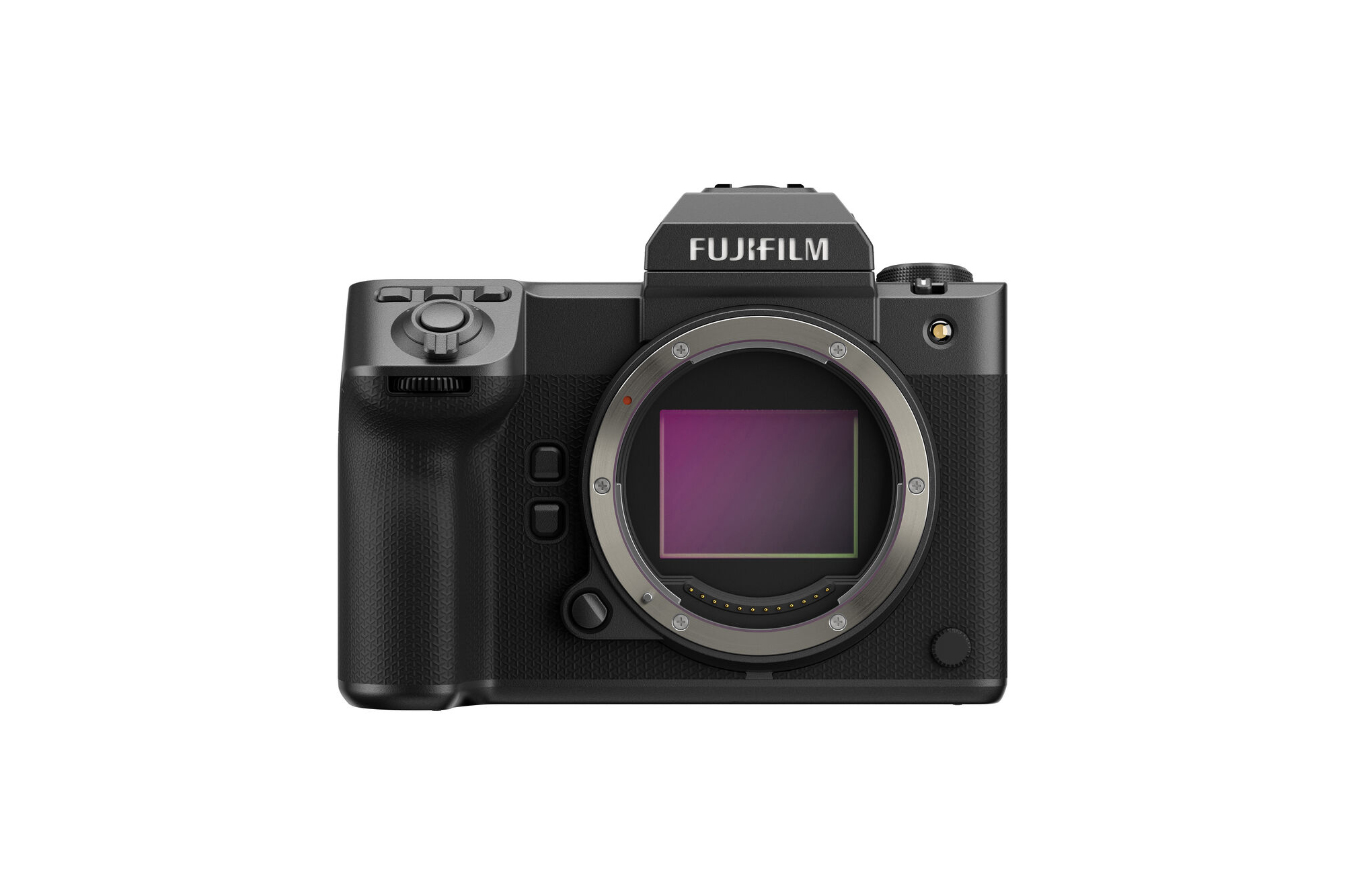
FUJIFILM GFX100 II is a flagship large-format mirrorless camera built for photographers and filmmakers who need extreme resolution, strong video tools and Fujifilm colour science in one professional body.
Released in September 2023, the GFX100 II sits at the top of Fujifilm’s GFX system. It uses a 102MP large-format sensor that measures 43.8 x 32.9 mm, making it much larger than a standard full-frame sensor. That sensor gives photographers huge detail, wide tonal range and a distinctive large-format look.
The camera is also one of Fujifilm’s most advanced video bodies. It supports internal 8K recording, 4K/60p, Apple ProRes, H.265, F-Log2 and external RAW workflows. It is not only a high-resolution stills camera; it is also a serious hybrid tool for commercial video, documentaries, fashion films, studio work, landscapes and premium content production.
With a launch price around $7,999.95 and a supplied European listing of €6,182.44 before tax, the FUJIFILM GFX100 II is clearly aimed at professionals and high-end creators rather than casual users.
Key FUJIFILM GFX100 II Specifications
The GFX100 II brings Fujifilm’s newer high-speed 102MP sensor and X-Processor 5 into a professional GFX body.
| Feature | FUJIFILM GFX100 II |
|---|---|
| Camera type | Large-format mirrorless camera |
| Release period | September 2023 |
| Sensor format | Large format GFX |
| Sensor size | 43.8 x 32.9 mm |
| Sensor resolution | 102MP |
| Lens mount | Fujifilm G Mount |
| Base sensitivity | ISO 800 for F-Log2 video testing data |
| Processor | X-Processor 5 |
| Maximum internal video | 8K DCI / 8K UHD |
| Main video codecs | ProRes, H.265, H.264 |
| External RAW | ProRes RAW and Blackmagic RAW |
| Stabilization | In-body image stabilization |
| Weight | About 867g in supplied camera data |
| Dimensions | About 152 x 104 x 74 mm |
| Supplied US price | $7,999.95 before tax |
| Supplied EU price | €6,182.44 before tax |
The GFX100 II is designed for users who want more than a typical full-frame hybrid camera. Its large sensor, high resolution and advanced video modes make it one of Fujifilm’s most ambitious cameras.
102MP Large-Format Sensor
The biggest strength of the FUJIFILM GFX100 II is its 102MP large-format sensor.
The sensor measures 43.8 x 32.9 mm, which is about 1.7 times larger than a 35mm full-frame sensor. This larger surface area gives the camera a different image character, especially in tonal transitions, depth rendering and field of view.
For still photography, 102MP gives photographers enormous detail. It allows large prints, heavy cropping and high-end commercial output. For product, fashion, landscape, architecture and studio photography, that resolution is a major advantage.
Why Large Format Matters
Large-format sensors can create a more spacious image.
They allow photographers to use wider fields of view while maintaining subject separation. They also help produce smoother tonal transitions and a premium look that is hard to match with smaller sensors.
For professional photographers, the GFX100 II offers the kind of image quality that can support demanding clients, large campaigns and fine-art printing.
8K Video Recording
The FUJIFILM GFX100 II is one of the most video-capable GFX cameras Fujifilm has released.
It supports 8K DCI recording at 8192 x 4320 and 8K UHD at 7680 x 4320. These modes give filmmakers huge resolution for cropping, reframing, downsampling and future-proof delivery.
The supplied recording data shows 8K DCI options in ProRes RAW, Blackmagic RAW, ProRes HQ, ProRes, ProRes LT and H.265 modes, depending on internal or external workflow.
Main 8K Recording Options
| Recording Mode | Resolution | Codec Options | Frame Rate | Bit Depth |
| 8K DCI | 8192 x 4320 | ProRes RAW | Up to 29.97p | 12-bit external |
| 8K DCI | 8192 x 4320 | Blackmagic RAW | Up to 29.97p | 12-bit external |
| 8K DCI | 8192 x 4320 | ProRes HQ / ProRes / ProRes LT | Up to 24p | 10-bit |
| 8K DCI | 8192 x 4320 | H.265 ALL-I / Long GOP | Up to 24p | 10-bit |
This makes the GFX100 II useful for commercial filmmakers, studio content, high-resolution interviews, premium YouTube production and projects that need flexibility in post-production.
4K, 5.8K and Anamorphic Formats
The GFX100 II is not limited to 8K.
It also supports several professional video formats, including GF 5.8K 2.35:1, GF 4K DCI, GF 4K UHD, 35mm crop modes, Premista modes and anamorphic formats.
Main Recording Formats
| Format | Resolution |
| Full Sensor Photo | 11648 x 8736 |
| GF 8K DCI | 8192 x 4320 |
| GF 8K UHD | 7680 x 4320 |
| GF 5.8K 2.35:1 | 5824 x 2476 |
| GF 4K DCI | 4096 x 2160 |
| GF 4K UHD | 3840 x 2160 |
| Premista 5.4K | 5440 x 2868 |
| 35mm 4.8K 3:2 | 4776 x 3184 |
| ANA 8K 2X | 8192 x 2968 |
| ANA 4.6K | 4664 x 3380 |
These options make the camera flexible for different lens types and production styles. A filmmaker can use the full GF image area, crop for 35mm lenses, use Premista cinema zooms or work with anamorphic formats.
ProRes, H.265 and RAW Workflows
The FUJIFILM GFX100 II supports several codec workflows.
Apple ProRes is useful for editors who want strong image quality and smoother post-production performance. H.265 gives smaller file sizes while maintaining 10-bit recording options. External RAW output gives advanced users more flexibility for colour grading.
The supplied data includes ProRes HQ, ProRes, ProRes LT, H.265 ALL-I, H.265 Long GOP, ProRes RAW and Blackmagic RAW options.
Why Codec Choice Matters
Different productions need different codecs.
A commercial shoot may prefer ProRes for faster editing. A documentary may use H.265 to manage storage. A high-end colour workflow may choose external RAW for more control in post.
The GFX100 II gives creators several options, which makes it easier to adapt the camera to different jobs.
F-Log2 and Dynamic Range
The GFX100 II supports F-Log2, Fujifilm’s flatter video profile for professional grading.
The supplied test data shows a maximum measured dynamic range of 12.8 stops at SNR=2 in Premista mode at 25fps, using 5440 x 2868 ProRes at ISO 800 and F-Log2.
Other tested modes range from 11.3 stops to 12.7 stops at SNR=2, depending on crop mode, resolution and settings.
Tested Dynamic Range Results
| Sensor Mode | Resolution | Codec | Frame Rate | ISO | Gamma | SNR=2 Result |
| 35mm | 4776 x 3184 | ProRes | 24p | 800 | F-Log2 | 12.4 stops |
| GF | 3840 x 2160 | ProRes | 25p | 800 | F-Log2 | 11.7 stops |
| GF with D Range Priority | 3840 x 2160 | ProRes | 25p | 800 | F-Log2 | 12.4 stops |
| GF | 5824 x 2476 | ProRes | 25p | 800 | F-Log2 | 12.7 stops |
| GF | 7680 x 4320 | ProRes | 25p | 800 | F-Log2 | 11.3 stops |
| Premista | 5440 x 2868 | ProRes | 25p | 800 | F-Log2 | 12.8 stops |
These figures show that the camera performs especially well in selected cropped or cinema-oriented modes.
Rolling Shutter Performance
Rolling shutter is important for video shooters because it affects fast movement, handheld pans and quick subject motion.
The supplied data shows the FUJIFILM GFX100 II reaching a minimum rolling-shutter result of 15 ms in GF 4K mode at 25fps, using ProRes with Dynamic Range Priority off.
The slower results appear in higher-resolution modes, especially 8K and 5.8K.
Tested Rolling Shutter Results
| Sensor Mode | Resolution | Codec | Frame Rate | Rolling Shutter |
| GF | 7680 x 4320 | ProRes | 25p | 31.7 ms |
| GF | 5824 x 2476 | ProRes | 25p | 25.9 ms |
| GF | 3840 x 2160 | ProRes | 25p | 15 ms |
| GF with D Range Priority | 3840 x 2160 | ProRes | 25p | 26.5 ms |
For static shots, interviews, landscapes and controlled camera movement, these results are manageable. For fast action, sports or rapid handheld pans, the 4K mode with the faster 15 ms readout is the safer option.
In-Body Image Stabilization
The GFX100 II includes in-body image stabilization, which is especially valuable on a high-resolution large-format camera.
At 102MP, even small movement can affect still-image sharpness. IBIS helps reduce camera shake when shooting handheld. It also helps video users capture more stable footage.
For travel, documentary, portrait and handheld commercial work, stabilization makes the GFX100 II more practical than earlier medium-format-style systems.
Autofocus and Subject Detection
The GFX100 II uses Fujifilm’s X-Processor 5, which improves autofocus performance and subject detection.
The camera can detect and track different subjects, including people, animals, birds, cars, motorcycles, bicycles, airplanes and trains. This makes it more useful for moving subjects than older GFX cameras.
For a 102MP large-format camera, reliable autofocus matters. High resolution exposes focus errors quickly, so better subject detection improves real-world usability.
Still Photography Performance
Although the GFX100 II has serious video tools, it remains a photography powerhouse.
The 102MP sensor is ideal for commercial photography, landscapes, fashion, portraits, product work, architecture and fine art. Files from the camera give editors and retouchers a lot of room to crop, adjust colour and prepare images for large-format output.
The camera also supports high-speed shooting compared with earlier GFX models. That makes it more responsive for portrait sessions, fashion movement and events where timing matters.
Film Simulations and Fujifilm Colour
The GFX100 II includes Fujifilm’s popular Film Simulation modes.
These colour profiles help photographers and filmmakers create attractive images straight out of camera. They are useful for JPEG shooters, quick client previews, editorial work and creators who want a distinct Fujifilm look without heavy grading.
For video, F-Log2 remains the better choice for maximum post-production flexibility. For fast-turnaround projects, Film Simulations can help reduce editing time.
Lens Mount and Lens Coverage
The camera uses Fujifilm’s G Mount.
G Mount lenses are designed for the large GFX sensor and can deliver the resolution needed for 102MP stills. Fujifilm’s GF lens system includes primes, zooms and specialty lenses for portrait, landscape, studio, macro and commercial work.
The GFX100 II also includes video crop modes that support different lens workflows, including 35mm and Premista formats. This helps filmmakers use cinema lenses in selected modes.
Why Lens Choice Matters
A 102MP sensor demands strong glass.
Lower-quality lenses may not fully resolve the camera’s detail. For professional results, users should pair the GFX100 II with high-quality GF lenses or carefully tested cinema lenses in supported crop modes.
Price and Value
The supplied camera data lists the FUJIFILM GFX100 II at $7,999.95 and €6,182.44 before sales tax or VAT.
That makes it expensive compared with most full-frame mirrorless cameras, but competitive for a 102MP large-format hybrid camera with 8K video and ProRes support.
For photographers who need extreme resolution, the price may be easier to justify. For filmmakers, the camera is attractive because it brings a large-format look, 8K recording and professional codecs into a mirrorless body.
Who Should Buy the FUJIFILM GFX100 II?
The GFX100 II is best suited for professionals and advanced creators who need high-resolution stills and serious video capability.
It makes sense for:
Commercial photographers
Fashion photographers
Landscape photographers
Studio portrait photographers
Architecture photographers
Fine-art print creators
Hybrid photo and video professionals
Premium content studios
Filmmakers who want a large-format look
Creators who need 8K recording and ProRes workflows
It may not be the best choice for casual users, sports specialists or creators who need a smaller, cheaper and faster everyday camera.
FUJIFILM GFX100 II Strengths and Weaknesses
The biggest strengths of the GFX100 II are image quality, resolution, sensor size and professional video flexibility.
Its 102MP sensor gives it exceptional still-image detail. Its 8K and ProRes recording options make it more serious for video than earlier GFX cameras. Its crop modes also help filmmakers adapt it to different production needs.
The main weaknesses are price, file size, lens cost and rolling shutter in higher-resolution modes. The camera also demands strong storage, powerful computers and careful workflow planning.
Key Takeaways
- FUJIFILM GFX100 II was released in September 2023.
- It uses a 102MP large-format sensor.
- The sensor measures 43.8 x 32.9 mm.
- It uses Fujifilm G Mount lenses.
- The supplied body weight is 867g.
- The camera records up to 8K DCI and 8K UHD.
- It supports Apple ProRes, H.265 and external RAW workflows.
- It offers ProRes RAW and Blackmagic RAW support through external recorders.
- F-Log2 gives more flexibility for colour grading.
- The supplied test data shows up to 12.8 stops at SNR=2.
- Rolling shutter reaches 15 ms in GF 4K mode.
- Higher-resolution modes show slower rolling-shutter results.
- The camera supports GF, Premista, 35mm and anamorphic recording formats.
- It includes in-body image stabilization.
- The supplied prices are $7,999.95 and €6,182.44 before tax.
Frequently Asked Questions
What is the FUJIFILM GFX100 II?
The FUJIFILM GFX100 II is a flagship large-format mirrorless camera designed for professional photography and high-end hybrid video production.
When was the FUJIFILM GFX100 II released?
The camera was released in September 2023.
What sensor does the GFX100 II use?
It uses a 102MP large-format sensor measuring 43.8 x 32.9 mm.
What lens mount does the GFX100 II use?
The camera uses Fujifilm’s G Mount.
Does the FUJIFILM GFX100 II shoot 8K video?
Yes. It supports 8K DCI and 8K UHD recording.
Does the GFX100 II support ProRes?
Yes. The camera supports Apple ProRes recording, including ProRes HQ, ProRes and ProRes LT in selected modes.
Does the GFX100 II support external RAW?
Yes. It supports ProRes RAW and Blackmagic RAW through compatible external recorders.
What is the tested dynamic range of the GFX100 II?
The supplied test data shows a maximum of 12.8 stops at SNR=2 in Premista mode at 5440 x 2868, using ProRes, ISO 800 and F-Log2.
What is the rolling shutter result?
The supplied test data shows a minimum rolling-shutter result of 15 ms in GF 4K mode at 25fps with ProRes.
Is the FUJIFILM GFX100 II good for video?
Yes. It is one of Fujifilm’s strongest hybrid video cameras, with 8K recording, ProRes, H.265, F-Log2 and external RAW support.
Is the GFX100 II good for photography?
Yes. Its 102MP large-format sensor makes it excellent for commercial, fashion, landscape, studio, fine-art and architecture photography.
How much does the FUJIFILM GFX100 II cost?
The supplied camera data lists the GFX100 II at $7,999.95 and €6,182.44 before sales tax or VAT.
Who should buy the GFX100 II?
It is best for professional photographers, advanced hybrid creators, commercial studios and filmmakers who need large-format image quality and high-resolution video.
Conclusion
FUJIFILM GFX100 II is one of the most powerful hybrid cameras in Fujifilm’s line-up.
It combines a 102MP large-format sensor, 8K video, ProRes recording, external RAW support, F-Log2, in-body stabilization and advanced autofocus in a professional GFX body. For photographers, it offers huge resolution and exceptional detail. For filmmakers, it provides a large-format look with serious codec flexibility.
It is not cheap, and its large files demand a strong workflow. However, for professionals who need both elite stills and advanced video in one system, the FUJIFILM GFX100 II remains one of the most capable large-format mirrorless cameras available.
Read Also: FUJIFILM X100VI: Specs, Price, Dynamic Range and Video Features