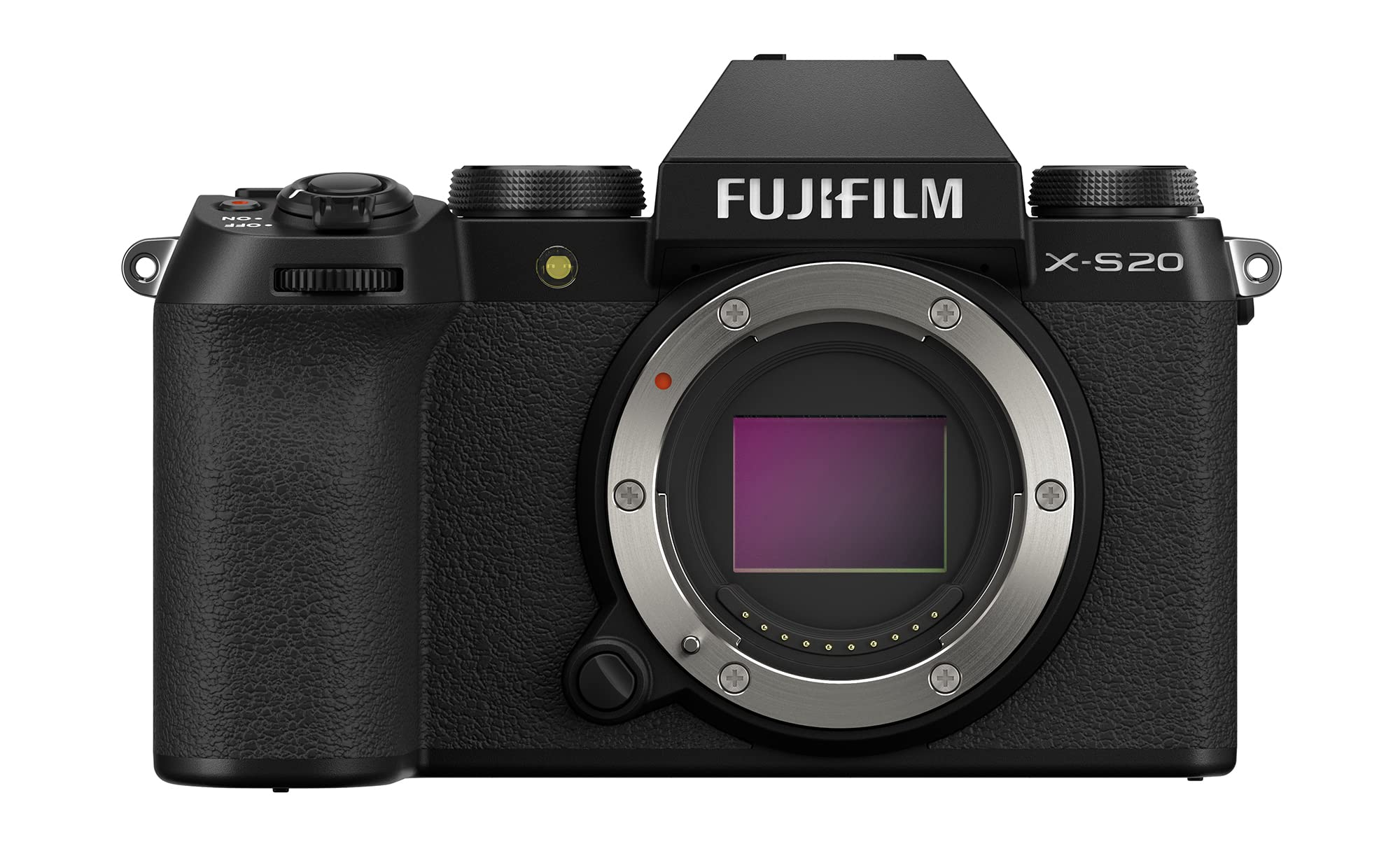
FUJIFILM X-S20 is a compact hybrid mirrorless camera built for creators who want strong video features, reliable still-image quality and Fujifilm colour science in a lightweight body.
Released in May 2023, the X-S20 replaced the popular X-S10 and pushed Fujifilm’s mid-range creator line much closer to serious video production. It keeps a small DSLR-style body, but adds a newer processor, stronger autofocus, a larger battery, improved stabilization and 6.2K open gate video.
The camera uses a 26.1MP APS-C sensor measuring 23.5 x 15.6 mm. Fujifilm and many cinema-focused databases also refer to this sensor size as Super 35mm for video coverage purposes. It uses the Fujifilm X Mount, giving users access to a wide range of compact primes, zooms and third-party lenses.
At about 410g, the FUJIFILM X-S20 is light enough for travel, vlogging and everyday content creation. It is also capable enough for YouTube, interviews, short films, social media production and documentary-style shooting.
Key FUJIFILM X-S20 Specifications
The X-S20 combines Fujifilm’s proven X-Trans CMOS 4 sensor with the newer X-Processor 5. That pairing gives the camera better autofocus and video performance than its predecessor while keeping file sizes and rolling shutter more manageable than higher-resolution models.
| Feature | FUJIFILM X-S20 |
|---|---|
| Camera type | APS-C hybrid mirrorless camera |
| Release period | May 2023 |
| Sensor format | APS-C / Super 35mm |
| Sensor size | 23.5 x 15.6 mm |
| Sensor resolution | 26.1MP |
| Lens mount | Fujifilm X Mount |
| Processor | X-Processor 5 |
| Base sensitivity for F-Log2 | ISO 1250 |
| Maximum internal video | 6.2K 3:2 open gate |
| Maximum 4K video | 4K/60p |
| High-speed Full HD | Up to 240p |
| Internal recording | Up to 4:2:2 10-bit |
| Stabilization | Up to 7-stop in-body image stabilization |
| Weight | About 410g |
| Dimensions | About 128 x 85 x 65 mm |
| Supplied price | $1,399 before tax for the listed kit |
These specifications make the X-S20 one of Fujifilm’s most useful compact cameras for hybrid shooters who need both stills and strong video.
26.1MP APS-C Sensor
The FUJIFILM X-S20 uses a 26.1MP X-Trans CMOS 4 sensor.
This sensor has appeared in several respected Fujifilm cameras, and it remains a strong choice for hybrid use. It offers enough resolution for photography while keeping video readout and file handling more practical than a 40MP sensor.
For stills, 26.1MP is enough for travel, portraits, family photography, events, product images, online publishing and moderate printing. For video, the sensor supports 6.2K open gate recording, 4K modes and high-speed Full HD.
Why This Sensor Works Well for Video
The X-S20’s sensor is not Fujifilm’s highest-resolution APS-C chip, but that can be an advantage.
A 26.1MP sensor can provide strong detail without creating unnecessary processing strain. It also supports open gate recording, which gives creators more framing flexibility for modern content formats.
For vloggers and hybrid creators, this balance matters more than headline megapixels.
6.2K Open Gate Video
The most important video feature on the FUJIFILM X-S20 is 6.2K 3:2 open gate recording.
The camera can record 6240 x 4160 video using the full sensor height. This is useful because creators often need to deliver one project in several formats, including YouTube, TikTok, Instagram Reels, vertical shorts and widescreen edits.
Open gate recording gives editors extra room to crop, stabilize and reframe footage in post-production.
Main 6.2K Recording Options
| Recording Mode | Resolution | Aspect Ratio | Codec | Frame Rate | Sampling | Bit Depth |
| 6.2K Open Gate | 6240 x 4160 | 3:2 | H.265 ALL-I | Up to 29.97p | 4:2:2 | 10-bit |
| 6.2K Open Gate | 6240 x 4160 | 3:2 | H.265 Long GOP | Up to 29.97p | 4:2:2 | 10-bit |
| 6.2K Open Gate | 6240 x 4160 | 3:2 | H.265 ALL-I | Up to 29.97p | 4:2:0 | 10-bit |
| 6.2K Open Gate | 6240 x 4160 | 3:2 | H.265 Long GOP | Up to 29.97p | 4:2:0 | 10-bit |
The supplied recording data shows 6.2K modes at up to 360 Mb/s, depending on codec and sampling choice. That gives creators options for quality, storage and editing speed.
4K, 2K and Full HD Video Modes
The X-S20 is not only a 6.2K camera.
It also supports 4K UHD, 4K DCI, 2K DCI and Full HD recording modes. For many creators, 4K will be the most practical everyday format because it is easier to edit, easier to store and widely accepted across platforms.
The camera also supports Full HD high-speed recording up to 240p. That makes it useful for slow-motion shots, sports details, product clips, lifestyle footage and creative B-roll.
Main Recording Formats
| Format | Resolution |
| Full Sensor Photo | 6240 x 4160 |
| 6.2K Open Gate | 6240 x 4160 |
| 4K UHD | 3840 x 2160 |
| 4K DCI | 4096 x 2160 |
| Full HD | 1920 x 1080 |
| Full HD High Speed | 1920 x 1080 up to 240p |
| 2K DCI | 2048 x 1080 |
This range gives the X-S20 enough flexibility for creators who shoot long-form videos, vertical content, cinematic B-roll and quick social media clips.
10-Bit H.265 Recording
The FUJIFILM X-S20 supports internal 10-bit recording.
That is a major advantage over basic creator cameras that only record 8-bit video. With 10-bit colour, the camera captures more tonal information, which helps when grading F-Log2 footage, correcting skin tones or matching shots from different scenes.
The camera supports both H.265 ALL-I and H.265 Long GOP recording. ALL-I is easier for some editing workflows but creates larger files. Long GOP is more storage-efficient and useful for longer recording sessions.
ALL-I vs Long GOP
ALL-I records each frame with more independence, which can make editing smoother on powerful systems. Long GOP compresses across groups of frames, which saves space but may require more processing during editing.
For client work and heavier grading, ALL-I can be useful. For travel, vlogging and longer content, Long GOP may be more practical.
F-Log2 and Dynamic Range
The X-S20 supports F-Log2, Fujifilm’s flatter profile for colour grading.
F-Log2 starts at ISO 1250 on this camera. It gives creators more room to adjust contrast, highlights, shadows and colour in post-production.
The test data you supplied shows the X-S20 reaching 10.5 stops at SNR=2 in full-sensor 4K at 25fps. In 4K HS crop mode at 60fps, it reaches 10.8 stops. In 6.2K open gate, it reaches 10.1 stops.
Tested Dynamic Range Results
| Mode | Resolution | Codec | Frame Rate | ISO | Gamma | SNR=2 Result |
| Full Sensor 4K | 3840 x 2160 | H.265 | 25p | 1250 | F-Log2 | 10.5 stops |
| 4K HS Crop | 3840 x 2160 | H.265 | 60p | 1250 | F-Log2 | 10.8 stops |
| 6.2K Open Gate | 6240 x 4160 | H.265 | 25p | 1250 | F-Log2 | 10.1 stops |
These results show that the X-S20 is capable, but users should not expect it to match higher-end cinema cameras in measured dynamic range.
Rolling Shutter Performance
Rolling shutter affects how footage looks when the camera or subject moves quickly.
The supplied test data shows the X-S20 reaching 20.3 ms in full-sensor 4K at 25fps, 16.1 ms in 4K 60p and 24.1 ms in 6.2K open gate.
Tested Rolling Shutter Results
| Mode | Resolution | Frame Rate | Rolling Shutter |
| Full Sensor 4K | 3840 x 2160 | 25p | 20.3 ms |
| 4K 60p | 3840 x 2160 | 60p | 16.1 ms |
| 6.2K Open Gate | 6240 x 4160 | 25p | 24.1 ms |
For talking-head videos, travel clips, interviews and controlled handheld movement, these results are manageable. For fast pans, quick sports movement or action footage, 4K 60p is the safer mode because it has the fastest listed rolling-shutter performance.
External RAW Recording
The FUJIFILM X-S20 can output RAW video to compatible external recorders.
The supplied data lists ProRes RAW and Blackmagic RAW support in 6.2K 3:2 at up to 29.97p. This gives advanced users more flexibility for colour grading and post-production.
External RAW is not necessary for every creator. Most users will be satisfied with internal 10-bit H.265. However, RAW output gives the X-S20 extra value for short films, music videos and more demanding projects.
In-Body Image Stabilization
The X-S20 includes in-body image stabilization rated up to 7 stops.
This is one of its strongest practical features. IBIS helps reduce shake when shooting handheld stills and also helps smooth handheld video footage.
For travel creators, vloggers and everyday shooters, stabilization makes the camera much easier to use without a tripod or gimbal.
Why IBIS Matters for Creators
Many creators shoot alone and move quickly.
They may not always have time to set up support equipment. A stabilized body helps users capture sharper photos and smoother video in real-world situations. It also makes compact prime lenses more useful because stabilization is available even when the lens itself has no optical stabilization.
Autofocus and Subject Detection
The FUJIFILM X-S20 uses X-Processor 5, which brings improved autofocus and subject detection.
The camera can detect and track different subjects, including people, animals, birds, cars, motorcycles, bicycles, airplanes, trains, insects and drones. This helps solo creators keep subjects in focus without constant manual adjustment.
For vlogging, interviews, travel clips and family videos, reliable autofocus can matter more than resolution.
Vlog Mode and Creator Tools
The X-S20 includes a dedicated Vlog mode on the top dial.
This mode gives users easier access to creator-focused controls, including product-priority style shooting and background defocus options. It is designed for users who may not want to dig through menus while recording themselves.
The camera also has a fully articulating screen, which is important for vlogging, self-recording, vertical clips and low-angle shooting.
Why Vlog Mode Helps Beginners
A dedicated Vlog mode makes the X-S20 easier for new creators.
Instead of learning every manual video setting immediately, users can access common creator tools quickly. This lowers the learning curve while still allowing advanced users to switch to manual controls when needed.
Battery Life
The X-S20 uses Fujifilm’s NP-W235 battery.
This is a major upgrade compared with smaller batteries used in some older compact Fujifilm bodies. The larger battery helps with long shooting days, travel, video recording and event coverage.
For creators, better battery life means fewer interruptions and fewer spare batteries to carry.
Still Photography Performance
Although the X-S20 is strongly marketed to creators, it is also a capable stills camera.
Its 26.1MP sensor provides enough detail for portraits, travel, street photography, family photos, events and online publishing. Fujifilm’s colour science and Film Simulation modes make it easy to produce attractive JPEGs straight out of camera.
The camera also supports fast burst shooting and strong autofocus tracking, making it more versatile than its compact size suggests.
Film Simulations and Fujifilm Colour
The X-S20 includes Fujifilm’s popular Film Simulation modes.
These profiles help users create distinctive looks in-camera. They are useful for JPEG shooters, casual creators, travel photographers and people who want finished-looking images without heavy editing.
For video, creators can use F-Log2 for grading or choose more finished looks when they need faster turnaround.
Price and Value
The supplied camera data lists the FUJIFILM X-S20 at $1,399 before tax.
At launch, the body-only price was commonly listed around $1,299, while kit pricing depended on the bundled lens. Pricing may vary by country, retailer, lens kit and availability.
The X-S20 offers strong value because it combines 6.2K open gate video, 10-bit recording, IBIS, external RAW support, strong autofocus and a large battery in a compact body.
It is more expensive than entry-level creator cameras, but it offers far more video flexibility.
Who Should Buy the FUJIFILM X-S20?
The FUJIFILM X-S20 is best for creators who want one compact camera for both photos and videos.
It makes sense for:
Vloggers
YouTubers
Travel creators
Hybrid photo and video shooters
Beginner filmmakers
Students learning video production
Small business content creators
Family and lifestyle shooters
Creators who want Fujifilm colour science
Users who need IBIS in a compact body
It may not be ideal for users who need weather sealing, dual card slots, full-size HDMI, built-in ND filters or professional cinema camera controls.
FUJIFILM X-S20 Strengths and Weaknesses
The biggest strengths of the X-S20 are portability, 6.2K open gate recording, 10-bit colour, IBIS, battery life and creator-friendly controls.
It is small enough to carry daily but powerful enough for serious hybrid work. Its 6.2K mode gives editors more flexibility, while 4K/60p and 240p Full HD give creators strong motion options.
The main weaknesses are limited weather resistance, single-card recording, micro HDMI and rolling-shutter limits in 6.2K. The camera is excellent for creators, but it is not built like a full professional cinema body.
Key Takeaways
- FUJIFILM X-S20 was introduced in May 2023.
- It uses a 26.1MP APS-C X-Trans CMOS 4 sensor.
- The sensor measures 23.5 x 15.6 mm.
- It uses Fujifilm X Mount lenses.
- The camera weighs about 410g.
- It uses the newer X-Processor 5.
- It records 6.2K 3:2 open gate video.
- It supports internal 4:2:2 10-bit recording.
- It supports H.265 ALL-I and H.265 Long GOP.
- F-Log2 base sensitivity is ISO 1250.
- The supplied test data shows up to 10.8 stops at SNR=2.
- Rolling shutter measures as low as 16.1 ms in 4K 60p.
- External ProRes RAW and Blackmagic RAW are supported through HDMI.
- The camera includes up to 7-stop in-body image stabilization.
- It has a dedicated Vlog mode and fully articulating screen.
- The supplied price is $1,399 before tax.
Frequently Asked Questions
What is the FUJIFILM X-S20?
The FUJIFILM X-S20 is a compact APS-C mirrorless camera designed for hybrid creators, vloggers, photographers and video shooters.
When was the FUJIFILM X-S20 released?
The camera was introduced in May 2023, with market availability following afterward.
What sensor does the X-S20 use?
It uses a 26.1MP APS-C X-Trans CMOS 4 sensor measuring 23.5 x 15.6 mm.
What lens mount does the FUJIFILM X-S20 use?
The camera uses Fujifilm’s X Mount.
Does the FUJIFILM X-S20 shoot 6.2K video?
Yes. It records 6.2K 3:2 open gate video at up to 29.97p.
Does the X-S20 support 10-bit recording?
Yes. It supports internal H.265 recording at up to 4:2:2 10-bit.
Does the FUJIFILM X-S20 support F-Log2?
Yes. The camera supports F-Log2, with a base sensitivity of ISO 1250.
What is the tested dynamic range of the X-S20?
The supplied test data shows up to 10.8 stops at SNR=2 in 4K HS crop mode and 10.5 stops in full-sensor 4K.
What is the rolling shutter result?
The supplied test data shows rolling shutter as low as 16.1 ms in 4K 60p and 24.1 ms in 6.2K open gate.
Does the X-S20 have in-body stabilization?
Yes. The camera includes in-body image stabilization rated up to 7 stops.
Does the X-S20 support external RAW?
Yes. It supports ProRes RAW and Blackmagic RAW output to compatible external recorders.
Is the FUJIFILM X-S20 good for vlogging?
Yes. The X-S20 is strong for vlogging because it has a fully articulating screen, Vlog mode, IBIS, strong autofocus, 6.2K recording and good battery life.
How much does the FUJIFILM X-S20 cost?
The supplied camera data lists the X-S20 at $1,399 before sales tax or VAT, while body-only and kit pricing vary by market.
Conclusion
FUJIFILM X-S20 is one of the best compact hybrid cameras in Fujifilm’s X Series line-up for creators who need both photos and video.
It offers a 26.1MP APS-C sensor, 6.2K open gate recording, 4K/60p, 10-bit colour, F-Log2, external RAW output, 7-stop IBIS, a fully articulating screen and strong subject-detection autofocus. It also adds a larger battery and creator-friendly controls that make it more practical than many small mirrorless cameras.
It is not a full cinema camera, and it lacks some professional features such as weather sealing, built-in ND and dual card slots. Even so, for vloggers, travel creators, YouTubers, beginner filmmakers and hybrid shooters, the FUJIFILM X-S20 offers an excellent balance of portability, performance and value.
Read Also: FUJIFILM GFX100 II: Specs, Price, Dynamic Range and Video Features