
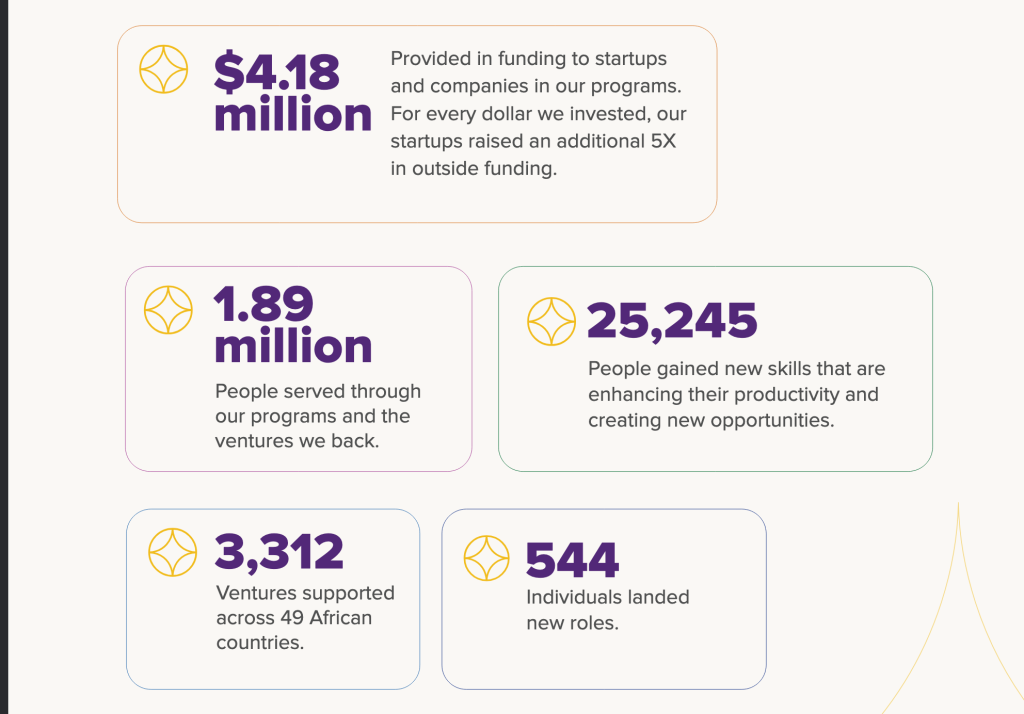
CcHUB startups expanded across the continent in 2025, with 3,312 ventures supported in 49 African countries. However, the headline numbers only tell part of the story. The deeper insight lies in how the Co-creation Hub structures ecosystems that allow startups to scale beyond grant cycles.
In its 2025 impact report, CcHUB revealed it reached 1.89 million people through its portfolio and programs. It also disbursed $4.18 million directly to founders. More importantly, for every dollar invested, portfolio companies attracted five more from external sources. That leverage ratio signals market credibility rather than dependency.
CcHUB Startups and the Infrastructure Model
CcHUB operates hubs in Lagos, Nairobi, Kigali and Windhoek. Instead of focusing solely on product incubation, the organization builds enabling systems.
That distinction matters. Many African startups struggle not because of weak ideas, but because they lack access to infrastructure, government integration and institutional trust.
Therefore, CcHUB startups benefit from sandbox testing environments, research-backed design and structured capital pathways.
Health Tech on Real Digital Infrastructure
The most technically ambitious work in 2025 emerged from the AI and Digital Public Infrastructure health program, supported by the Gates Foundation.
Nine startups entered sandbox environments connected to live digital public infrastructure. Rather than testing in isolated pilots, they built within interoperable systems.
Two products illustrate this shift:
God’s Eye, developed by Eight Medical, uses AI to assess emergency urgency, dispatch ambulances and track hospital bed availability. It operates via mobile apps, WhatsApp, USSD and voice channels to reduce smartphone barriers.
Mediloan, built by MyItura, integrates AI-powered credit decisions into healthcare payments. By 2025, it had onboarded 25 primary health facilities and processed $16,000 in credit requests.
These CcHUB startups demonstrate coordinated infrastructure design. Instead of building standalone apps, they function within shared data ecosystems.
Education Technology at Scale
Through the re:learn program, CcHUB trained 800 teachers, with 90% reporting classroom use of EdTech tools. Meanwhile, 2,000 teachers engaged through a peer learning network.
On the startup side, 27 EdTech ventures were accelerated, while 15 new products launched in 2025.
Student-built platforms such as LeAi and Okaluli reflect grounded innovation. LeAi offers AI-powered sprint learning for university students, while Okaluli delivers lessons via WhatsApp for rural learners without computer access.
Together, these platforms served thousands of active users and delivered hundreds of thousands of learning interactions.
Creative Economy as Structured Business
CcHUB startups in the creative industries reveal a different intervention strategy. Rather than focusing on artistic output, programs emphasize pricing, financial modeling and legal structuring.
In 2025 alone, 640 women launched or scaled ventures across fashion, film and media cohorts. The Fashionomics Africa Accelerator, funded by the African Development Bank, helped designers restructure pricing models and unlock revenue growth.
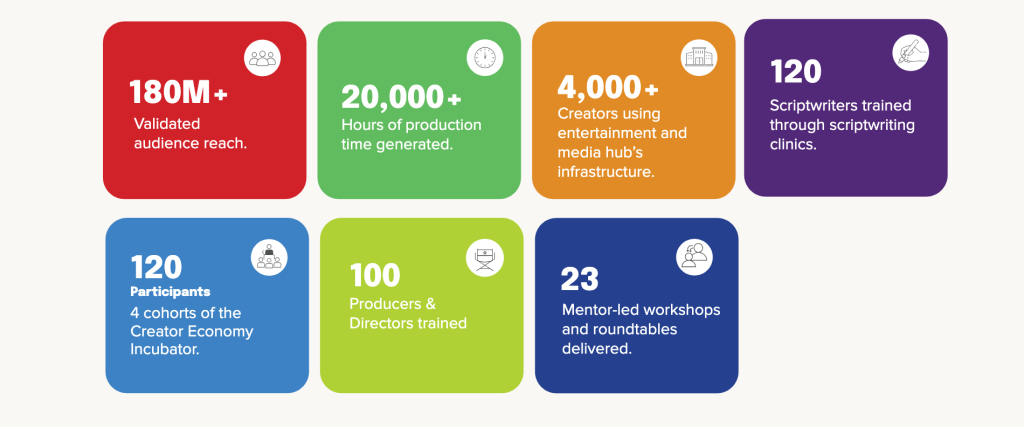
Meanwhile, entertainment hubs in Nigeria and Kenya trained producers and scriptwriters, generating over 180 million validated audience reach.
Investment and Workforce Levers
Beyond startup acceleration, CcHUB trained 25,245 individuals across AI, blockchain and data science programs. It developed 27 specialized curricula and facilitated 544 verified job placements.
This workforce strategy complements venture support. Without skilled talent, startups cannot scale sustainably.
Companies such as Chpter, Ecobarter and Koolboks illustrate the pipeline effect. Chpter raised $1 million and expanded regionally. Koolboks secured an $11 million Series A after international exposure.
African Ecosystem Implications
The 5x leverage ratio positions CcHUB startups as capital-efficient ventures. In African markets where venture funding cycles fluctuate, leverage signals resilience.
Moreover, sandbox access to government systems shortens time to market. That advantage could determine whether African health and education platforms compete globally.
However, sustainability depends on diversified funding sources. Development-backed programs remain critical, yet private capital must deepen to maintain momentum.
Why This Matters
CcHUB startups show that infrastructure, not just funding, drives scalable innovation. By connecting talent, capital and public systems, the model reduces fragmentation.
For African policymakers, the report offers a blueprint: build connective tissue first, then fund ventures.
What Happens Next
The open question remains whether this ecosystem model can expand without heavy donor support. If leverage ratios hold and private capital participation grows, CcHUB startups may anchor durable innovation networks.
In 2025, the organization demonstrated a concrete output: interoperable health systems, scalable EdTech platforms and capital-ready creative businesses.
The next test will be whether those systems compound over time across the continent.