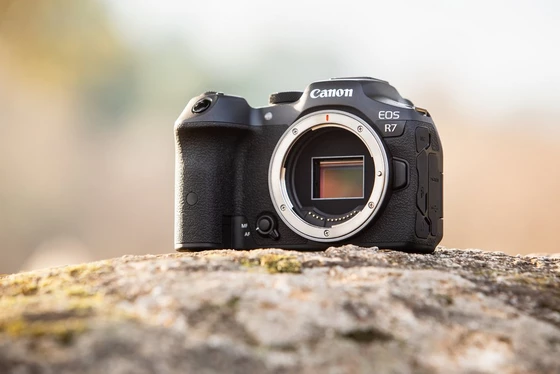
Canon EOS R7 is a high-resolution APS-C mirrorless camera built for creators who want speed, reach, strong autofocus and 4K video in a compact RF-mount body.
Released in May 2022, the Canon EOS R7 became one of Canon’s most important APS-C mirrorless cameras because it brought the RF system to users who did not need a full-frame body. It uses a 22.3 x 14.8mm APS-C sensor, which is also close to the Super 35mm format used in many video workflows.
The camera offers a 32.5MP still-photo resolution, 4K UHD video, 4K Fine oversampled from a higher-resolution sensor readout, 4K60, Canon Log 3, in-body image stabilisation and fast continuous shooting. It is designed for wildlife photographers, travel creators, sports shooters, YouTubers, hybrid filmmakers and users moving from Canon DSLR systems.
In the provided lab data, the Canon EOS R7 reaches 11 stops of dynamic range at SNR=2 in 4K UHD H.265 at ISO 800 and Canon Log 3. Rolling shutter measures 15ms in normal 4K, 15ms in 4K crop 50p and 30ms in 4K Fine.
Key Camera Specifications
| Feature | Canon EOS R7 |
|---|---|
| Camera type | APS-C / Super 35-class mirrorless camera |
| Release period | May 2022 |
| Sensor format | APS-C / Super 35-class |
| Sensor size | 22.3 x 14.8mm |
| Maximum photo resolution | 6960 x 4640 |
| Effective resolution | 32.5MP class |
| Lens mount | Canon RF |
| Native APS-C lens line | RF-S |
| Base sensitivity | ISO 800 in provided video data |
| Internal video | 4K UHD up to 60p |
| Oversampled mode | 4K Fine from 7K oversampling |
| Log profile | Canon Log 3 |
| Best listed dynamic range | 11 stops at SNR=2 |
| Best listed rolling shutter | 15ms in normal 4K and 4K crop modes |
| 4K Fine rolling shutter | 30ms |
| Stabilisation | In-body image stabilisation |
| Body weight | About 530 g |
| Dimensions | About 132 mm x 90 mm x 92 mm |
| Listed price | Around $1,449 before taxes |
| Best use | Wildlife, sports, travel, hybrid video and APS-C RF shooting |
The Canon EOS R7 is best viewed as a fast, high-resolution APS-C hybrid camera rather than a cinema camera.
APS-C / Super 35 Sensor
The Canon EOS R7 uses a 22.3 x 14.8mm APS-C CMOS sensor.
This sensor size gives the camera a 1.6x crop factor compared with full frame. For photographers, that crop factor is useful for wildlife, birds, sports and distant subjects because it makes telephoto lenses feel tighter.
For video creators, the sensor size is close to Super 35. That makes it familiar for many cinema-style workflows, especially when using lenses that cover APS-C or Super 35.
Why the Sensor Matters
The EOS R7 sensor gives creators reach and resolution.
The 32.5MP photo resolution allows cropping while still keeping useful detail. This is important for bird photography, wildlife, sports and travel images where the subject may be far away.
For video, the sensor supports oversampled 4K Fine and 4K60, making the R7 more capable than entry-level APS-C bodies.
4K UHD Video
The Canon EOS R7 records 4K UHD at 3840 x 2160.
The camera offers both 4K Fine and standard 4K recording. 4K Fine is oversampled from a higher-resolution sensor readout and gives more detail. Standard 4K reads faster and is better for motion.
| Recording Format | Resolution |
| 4K UHD | 3840 x 2160 |
| 4K Crop | 3840 x 2160 |
| HD | 1920 x 1080 |
| Full Sensor Photo | 6960 x 4640 |
The EOS R7 does not record internal 6K or 8K video. Its strongest internal video feature is high-quality 4K, especially when used with Canon Log 3.
4K Fine Mode
4K Fine is one of the most important video features of the Canon EOS R7.
This mode uses oversampling from a higher-resolution sensor readout to create a sharper 4K image. It is useful for interviews, product videos, travel films, YouTube content, documentary scenes and controlled shots where maximum detail matters.
However, the provided data shows that 4K Fine has a slower rolling-shutter result of 30ms.
Best Use for 4K Fine
4K Fine is best for controlled scenes.
Use it for tripod interviews, landscapes, product shots, talking-head videos, slow camera moves and static scenes. Avoid it for fast pans, action, quick handheld movement or sports-style video because the slower readout can show more rolling-shutter distortion.
For movement-heavy scenes, normal 4K is safer.
4K60 Recording
The EOS R7 supports 4K recording up to 59.94p and 50p.
In the provided data, 4K60 H.265 IPB records at up to 340 Mb/s in 10-bit 4:2:2. Light IPB options reduce data rates for easier storage.
| Mode | Resolution | Codec | Frame Rate | Data Rate | Sampling | Bit Depth |
| Full Sensor 4K UHD | 3840 x 2160 | IPB H.265 | 59.94p / 50p | 340 Mb/s | 4:2:2 | 10-bit |
| Full Sensor 4K UHD | 3840 x 2160 | IPB H.265 | 29.97p / 25p / 23.97p | 170 Mb/s | 4:2:2 | 10-bit |
| Crop 4K UHD | 3840 x 2160 | IPB H.265 | 59.94p / 50p | 340 Mb/s | 4:2:2 | 10-bit |
| Full Sensor 4K UHD | 3840 x 2160 | Light IPB H.265 | 59.94p / 50p | 170 Mb/s | 4:2:2 | 10-bit |
| Full Sensor 4K UHD | 3840 x 2160 | Light IPB H.265 | 29.97p / 25p / 23.97p | 85 Mb/s | 4:2:2 | 10-bit |
4K60 is useful for action, wildlife, sports, travel footage and slow-motion delivery in 24p, 25p or 30p timelines.
Canon Log 3
The Canon EOS R7 supports Canon Log 3.
Canon Log 3 gives creators a flatter image profile for colour grading. It helps preserve more highlight and shadow detail than standard picture styles and gives editors more flexibility in post-production.
The provided lab data uses Canon Log 3 at ISO 800.
Why Canon Log 3 Matters
Canon Log 3 makes the EOS R7 more useful for serious video.
It helps creators match the R7 with other Canon cameras that support log recording. It is also useful for weddings, travel films, YouTube content, outdoor interviews and branded videos where grading flexibility matters.
For fast delivery, standard colour profiles are easier. For serious editing, Canon Log 3 is the better choice.
Dynamic Range Performance
In the provided lab data, the Canon EOS R7 reaches a maximum dynamic range of 11 stops at SNR=2 in full-sensor 3840 x 2160 H.265 at 25fps, ISO 800 and Canon Log 3.
The same 11-stop result appears in both 4K Fine and standard 4K modes.
| Sensor Mode | Resolution | Codec | Frame Rate | ISO | Gamma | Comment | Measured Dynamic Range |
| Full Sensor | 3840 x 2160 | H.265 | 25p | 800 | CLog3 | 4K Fine | 11 stops at SNR=2 |
| Full Sensor | 3840 x 2160 | H.265 | 25p | 800 | CLog3 | 4K not Fine | 11 stops at SNR=2 |
These results are modest compared with Canon’s newer full-frame cameras and Cinema EOS models, but they are useful for an APS-C hybrid camera in this price class.
What Dynamic Range Means for Creators
Dynamic range affects how much detail a camera can preserve in bright highlights and dark shadows.
This matters when filming skies, windows, backlit subjects, bright outdoor scenes, wedding dresses, concerts and high-contrast interiors. The EOS R7 gives usable grading flexibility in Canon Log 3, but it needs careful exposure.
For best results, protect highlights, avoid deep underexposure and keep ISO 800 as the main video reference point when possible.
Rolling Shutter Performance
Rolling shutter is one of the most important video considerations on the Canon EOS R7.
The provided lab data lists 15ms in normal full-sensor 4K at 25p. Crop 4K at 50p also measures 15ms. However, 4K Fine is much slower at 30ms.
| Sensor Mode | Resolution | Codec | Frame Rate | Comment | Rolling Shutter |
| Full Sensor APS-C | 3840 x 2160 | H.265 | 25p | 4K not Fine CLog3 | 15ms |
| 4K Crop | 3840 x 2160 | H.265 | 50p | CLog3 | 15ms |
| Full Sensor APS-C | 3840 x 2160 | H.265 | 25p | 4K Fine CLog3 | 30ms |
This means normal 4K is better for movement, while 4K Fine is better for static detail.
Why Rolling Shutter Matters
Rolling shutter can distort fast movement.
Quick pans may bend vertical lines, and fast-moving subjects may appear skewed. This is especially important for sports, wildlife, handheld video, vehicles, dance and fast gimbal movement.
Use normal 4K or crop 4K for faster movement. Use 4K Fine when sharpness matters more than motion readout.
Photography Performance
The Canon EOS R7 is a strong stills camera.
Its 32.5MP sensor gives excellent detail for wildlife, birds, sports, portraits, landscapes, travel and everyday photography. It supports fast continuous shooting, making it useful for unpredictable subjects.
The APS-C crop factor is especially useful with telephoto lenses because it gives tighter framing without needing a full-frame crop in post.
Best Photography Uses
The EOS R7 is ideal for:
Wildlife photography
Bird photography
Sports photography
Travel photography
Family photography
Event photography
Portraits
Nature photography
Social media stills
Hybrid photo-video work
Student creators
Budget Canon RF users
The R7 is one of Canon’s strongest options for users who want reach and resolution at a lower price than full-frame bodies.
Autofocus and Subject Tracking
The Canon EOS R7 uses Canon’s Dual Pixel CMOS AF II system.
It supports subject detection and tracking for people, animals and vehicles. This makes it useful for wildlife, pets, sports, portraits, video, YouTube and travel content.
Why Autofocus Matters
Autofocus is critical for hybrid creators.
Wildlife and sports subjects move quickly. Video creators often work alone. Reliable autofocus helps keep subjects sharp without requiring constant manual focus pulling.
The EOS R7’s autofocus system is one of its strongest advantages over older DSLR-style APS-C cameras.
In-Body Image Stabilisation
The Canon EOS R7 includes in-body image stabilisation.
IBIS helps reduce camera shake for stills and video. When used with compatible stabilised RF or RF-S lenses, coordinated stabilisation can improve handheld results.
Why IBIS Matters
IBIS is useful for travel, wildlife, events and handheld video.
It helps when shooting with unstabilised lenses, longer focal lengths or slower shutter speeds. It is not a replacement for a tripod or gimbal, but it gives creators more flexibility in the field.
For an APS-C camera in this class, IBIS is a major benefit.
RF and RF-S Lens Mount
The Canon EOS R7 uses the RF mount and supports RF-S lenses.
RF-S lenses are designed for Canon APS-C RF cameras. Full-frame RF lenses also work, often giving wildlife and sports shooters more reach because of the crop factor. EF and EF-S lenses can be used through Canon EF-EOS R adapters.
| Lens Workflow | Best For |
| RF-S lenses | Compact APS-C shooting |
| RF lenses | Higher-end optics and full-frame compatibility |
| RF telephoto lenses | Wildlife and sports |
| EF lenses with adapter | Existing Canon DSLR users |
| EF-S lenses with adapter | Budget APS-C lens workflows |
| Manual cine lenses | Video and controlled focus |
The RF mount makes the EOS R7 flexible, but lens choice matters because the APS-C crop changes field of view.
Crop Factor and Lens Reach
The EOS R7 has a 1.6x crop factor compared with full frame.
This is one of the biggest reasons wildlife and sports shooters like the camera. A 400mm lens gives framing similar to a 640mm lens on full frame.
Why Crop Factor Helps
Crop factor gives more reach without buying larger lenses.
For birds, wildlife, motorsport and field sports, this can be a major advantage. It also helps keep kits smaller and more affordable.
The trade-off is that wide-angle shooting is harder than on full frame, so creators need wider lenses for landscapes, interiors and vlogging.
Media and Storage
The Canon EOS R7 uses SD card media.
The 4K H.265 recording modes can require fast cards, especially at 340 Mb/s. UHS-II SD cards are recommended for reliable 4K60 recording and fast still-photo bursts.
Media Planning Tips
Use fast UHS-II SD cards for 4K60 and high-speed stills.
Use lower data-rate Light IPB modes when storage space matters more than maximum quality. For paid work, test cards before shooting and always back up footage before formatting.
Good media planning is important because 10-bit 4K video can fill cards quickly.
Body Design
The Canon EOS R7 is compact and lightweight.
It weighs about 530 g and measures about 132 mm x 90 mm x 92 mm in the provided database data. This makes it practical for travel, wildlife walks, handheld filming, gimbal work and long shooting days.
The body includes a viewfinder, vari-angle screen, comfortable grip and Canon’s familiar controls.
Who Will Like the Body
The EOS R7 is ideal for creators who want a serious camera without moving to full frame.
Wildlife photographers will like the reach. Video creators will like 4K60 and CLog3. Travel users will like the smaller body. Canon DSLR users will like the ability to adapt EF and EF-S lenses.
It is a strong bridge between budget APS-C cameras and more expensive full-frame models.
Limitations of the Canon EOS R7
The EOS R7 is powerful, but it has limits.
The 4K Fine mode has a slow 30ms rolling shutter in the provided data. The dynamic-range result is 11 stops at SNR=2, which is behind newer full-frame and Cinema EOS models. The RF-S lens system is still smaller than Canon’s full-frame RF lens range, and the APS-C crop makes wide-angle shooting harder.
What This Means in Practice
Use the EOS R7 for its strengths.
It is excellent for wildlife, reach, hybrid shooting, 4K60 and compact travel. It is less ideal for heavy cinema work, high-end grading, ultra-wide full-frame looks or fast-motion 4K Fine shooting.
For advanced video production, Canon’s Cinema EOS cameras offer stronger tools.
Best Uses for the Canon EOS R7
The Canon EOS R7 is best for creators who want a fast APS-C camera with strong stills and capable 4K video.
It is ideal for:
Wildlife photography
Bird photography
Sports photography
Travel videos
YouTube content
Hybrid photo-video work
Family events
Student filmmaking
Social media campaigns
Nature films
Outdoor creators
Budget Canon RF users
Documentary clips
Vlogging with wide lenses
Telephoto video
The camera is strongest when reach, speed and portability matter.
Canon EOS R7 vs Canon EOS R10
The EOS R7 is the higher-end APS-C body compared with the EOS R10.
| Feature | Canon EOS R7 | Canon EOS R10 |
| Sensor resolution | 32.5MP class | 24MP class |
| Stabilisation | IBIS included | No in-body stabilisation |
| Video | 4K Fine and 4K60 | More basic 4K options |
| Body class | Higher-end APS-C | Entry-level APS-C |
| Best advantage | Speed, resolution and stabilisation | Lower price and smaller body |
The EOS R7 is better for serious wildlife, sports and hybrid creators. The EOS R10 is better for beginners and lighter budgets.
Canon EOS R7 vs Canon EOS R6 Mark II
The EOS R6 Mark II is full frame, while the EOS R7 is APS-C.
| Feature | Canon EOS R7 | Canon EOS R6 Mark II |
| Sensor format | APS-C / Super 35-class | Full frame |
| Resolution | 32.5MP class | 24.2MP class |
| Crop factor | 1.6x | None |
| Main video | 4K60, CLog3 | Oversampled 4K60, CLog3 |
| Low-light flexibility | Lower | Better full-frame advantage |
| Best advantage | Reach and value | Full-frame look and low light |
The R7 is better for reach and price. The R6 Mark II is better for full-frame depth of field, wider views and low-light flexibility.
Canon EOS R7 vs Canon EOS R5 Mark II
The EOS R5 Mark II is a much higher-end full-frame hybrid camera.
| Feature | Canon EOS R7 | Canon EOS R5 Mark II |
| Sensor format | APS-C | Full frame |
| Resolution | 32.5MP class | 45MP class |
| Maximum video | 4K60 | 8K RAW and 4K120 |
| Canon Log | CLog3 | CLog2 and CLog3 |
| Price class | Lower | Much higher |
| Best advantage | Affordable reach | High-end stills and video |
The R5 Mark II is stronger for professional hybrid work. The R7 is better for affordable telephoto shooting and lighter kits.
Canon EOS R7 vs Canon EOS C50
The EOS C50 is a dedicated cinema camera, while the EOS R7 is a hybrid APS-C mirrorless camera.
| Feature | Canon EOS R7 | Canon EOS C50 |
| Camera type | Hybrid mirrorless | Cinema EOS |
| Sensor format | APS-C / Super 35-class | Full frame |
| Main video | 4K60 | 7K RAW and Open Gate |
| Built-in cooling | No cinema cooling | Yes |
| Professional audio | Accessory-based | XLR handle workflow |
| Best advantage | Affordable stills and reach | Professional video workflow |
The R7 is better for budget hybrid creators. The C50 is better for video-first production crews.
Key Takeaways
- Canon EOS R7 was released in May 2022.
- It uses a 22.3 x 14.8mm APS-C sensor.
- The sensor size is close to Super 35 for video workflows.
- Maximum still-photo resolution is 6960 x 4640.
- The camera uses the Canon RF mount and supports RF-S lenses.
- Canon Log 3 is supported.
- 4K Fine uses 7K oversampling.
- 4K UHD recording is available up to 59.94p and 50p.
- The provided lab data lists 11 stops at SNR=2 in 4K Fine and normal 4K.
- Normal 4K rolling shutter is listed at 15ms.
- Crop 4K 50p rolling shutter is listed at 15ms.
- 4K Fine rolling shutter is listed at 30ms.
- The camera records 10-bit 4:2:2 H.265 in supported modes.
- In-body image stabilisation is included.
- The body weighs about 530 g.
- It is best for wildlife, sports, travel, YouTube and hybrid creators who want APS-C reach.
Frequently Asked Questions
What is the Canon EOS R7?
Canon EOS R7 is a high-resolution APS-C RF-mount mirrorless camera with 32.5MP stills, 4K60 video, Canon Log 3, in-body stabilisation and fast autofocus.
When was the Canon EOS R7 released?
The Canon EOS R7 was released in May 2022.
What sensor does the Canon EOS R7 use?
It uses a 22.3 x 14.8mm APS-C CMOS sensor, which is close to Super 35 size for video workflows.
What is the maximum photo resolution?
The maximum listed still-photo resolution is 6960 x 4640.
What lens mount does it use?
The Canon EOS R7 uses the RF mount and supports RF-S lenses. EF and EF-S lenses can also be used with Canon adapters.
Does the Canon EOS R7 shoot 4K60?
Yes. The EOS R7 records 4K UHD up to 59.94p and 50p.
Does the EOS R7 have Canon Log?
Yes. The EOS R7 supports Canon Log 3.
What dynamic range did the provided lab data show?
The provided lab data lists 11 stops at SNR=2 in full-sensor 4K UHD H.265 at ISO 800 and Canon Log 3.
What is the rolling-shutter result?
The provided lab data lists 15ms in normal 4K and 30ms in 4K Fine. Crop 4K 50p is listed at 15ms.
Is 4K Fine better than normal 4K?
4K Fine gives more detail because it is oversampled, but it has slower 30ms rolling shutter in the provided data. Normal 4K is better for movement.
Is the Canon EOS R7 good for wildlife?
Yes. Its 32.5MP APS-C sensor, 1.6x crop factor, fast shooting and strong autofocus make it a strong wildlife and bird photography camera.
Who should buy the Canon EOS R7?
The Canon EOS R7 is best for wildlife photographers, sports shooters, travel creators, YouTubers and hybrid users who want APS-C reach, 4K60 video and Canon RF-mount compatibility.
Conclusion
Canon EOS R7 remains one of Canon’s most useful APS-C hybrid cameras.
Its 32.5MP sensor, RF mount, 4K Fine, 4K60, Canon Log 3, 10-bit H.265 recording, in-body image stabilisation, fast autofocus and lightweight body make it attractive for wildlife, sports, travel and hybrid content creation.
The lab data shows a practical but not class-leading video image. Dynamic range reaches 11 stops at SNR=2 in 4K H.265 at ISO 800 and Canon Log 3. Rolling shutter depends heavily on mode, with normal 4K at 15ms and 4K Fine at 30ms.
That makes the EOS R7 a camera that rewards smart mode selection. Use 4K Fine for controlled detail, normal 4K for movement and crop modes when faster readout or tighter framing matters.
For creators who want Canon autofocus, APS-C reach, 4K60 video and a compact RF-mount body without paying full-frame prices, the Canon EOS R7 remains a strong and practical choice.
Read Also: Canon EOS R6 Mark II: Specs, Dynamic Range, Rolling Shutter and Video Features