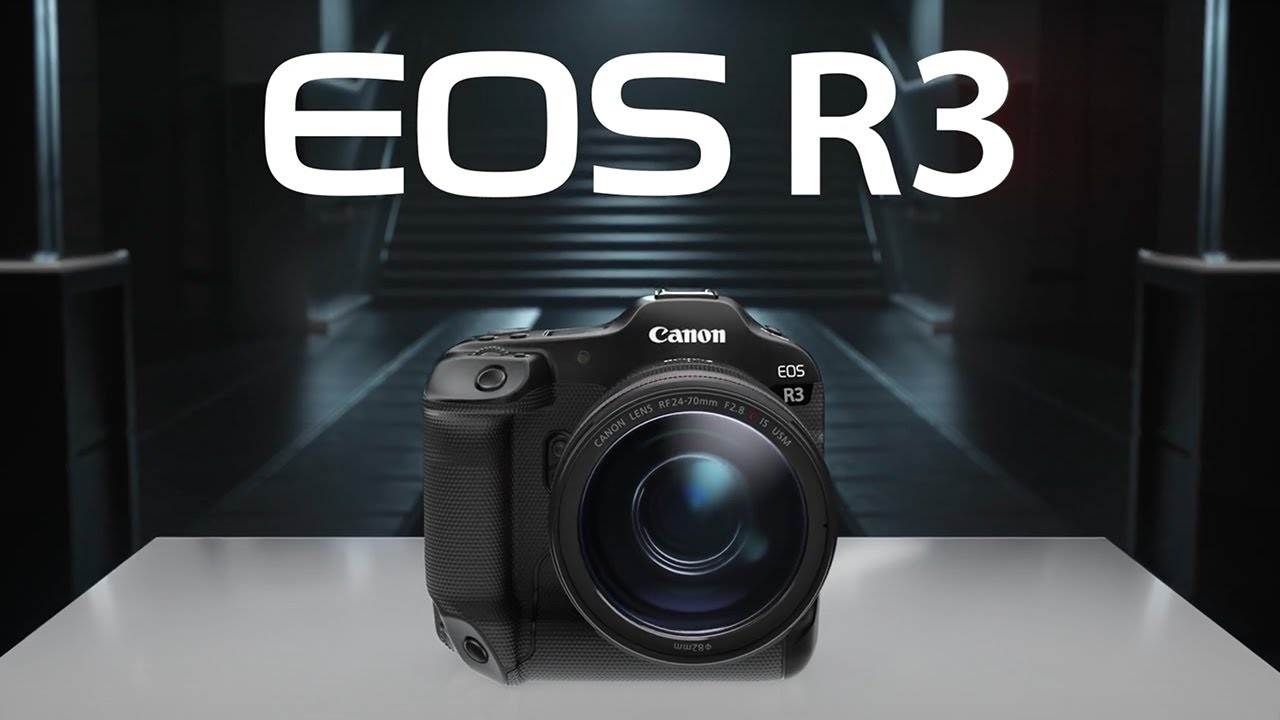
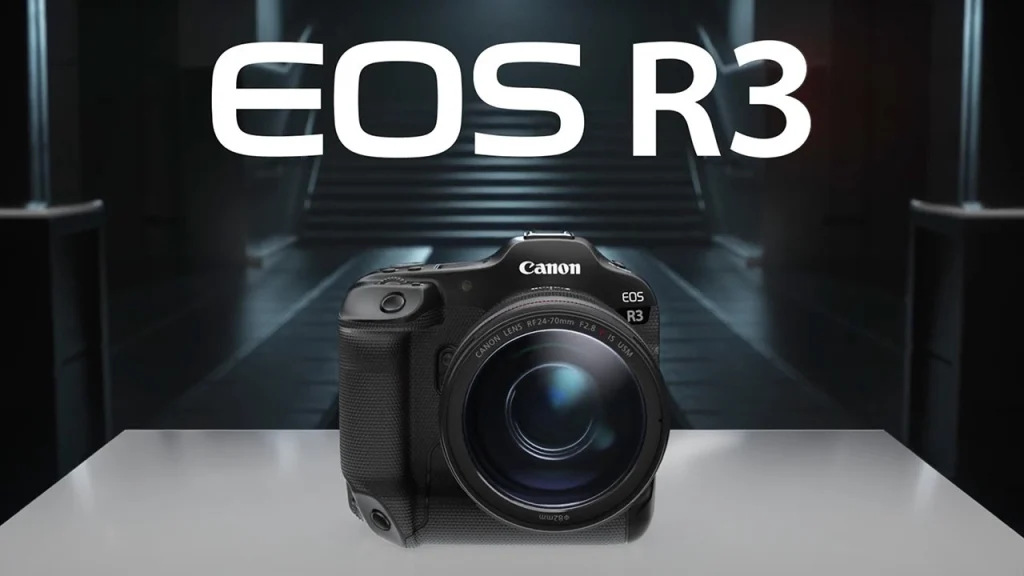
Canon EOS R3 is a professional full-frame mirrorless camera built for speed, action, sports, wildlife, news and hybrid photo-video production.
Released in September 2021, the Canon EOS R3 introduced a 24.1MP-class back-illuminated stacked full-frame sensor, Canon RF mount, integrated vertical grip, advanced autofocus, fast electronic shooting and serious video tools. It sits below the later EOS R1 but remains one of Canon’s most important professional mirrorless cameras.
The camera records full-frame 6K Canon RAW, 4K DCI, 4K UHD, Super 35 crop video and high-quality H.265 files. It also supports Canon Log 3 internally, while Canon RAW files can be developed into Canon Log 2 in post-production workflows.
In the provided lab data, the Canon EOS R3 reaches 11.2 stops of dynamic range at SNR=2 in full-frame 4K DCI H.265 at ISO 800 and Canon Log 3. In 6K Canon RAW, it measures 10.9 stops at SNR=2. Rolling shutter is strong, with a listed 9.5ms result in full-frame 6K Canon RAW.
Key Camera Specifications
| Feature | Canon EOS R3 |
|---|---|
| Camera type | Professional full-frame mirrorless camera |
| Release period | September 2021 |
| Sensor format | Full frame 35mm |
| Sensor size | 36 x 24mm |
| Photo resolution | 6000 x 4000 |
| Sensor type | Back-illuminated stacked CMOS |
| Lens mount | Canon RF |
| Base sensitivity | ISO 800 in provided lab data |
| Main video headline | 6K Canon RAW |
| Internal compressed codec | H.265 |
| Log profile in 4K H.265 | Canon Log 3 |
| Best listed dynamic range | 11.2 stops at SNR=2 |
| Best listed rolling shutter | 9.5ms in 6K CRAW |
| Body style | Integrated vertical-grip professional body |
| Body weight | About 822 g |
| Dimensions | About 87 mm x 143 mm x 150 mm |
| Listed price | Around $4,399 before taxes |
| Best use | Sports, wildlife, news, events and hybrid production |
The EOS R3 is designed for professional field use, not casual portability. Its main value is speed, reliability and action performance.
Full-Frame Stacked Sensor
The Canon EOS R3 uses a 36 x 24mm full-frame stacked CMOS sensor.
Its photo resolution is 6000 x 4000, placing it in the 24MP class. That resolution may look modest compared with 45MP and 50MP cameras, but the EOS R3 is built for speed rather than maximum pixel count.
The stacked sensor helps improve readout speed, autofocus performance, electronic shutter shooting and video rolling-shutter behaviour.
Why the Sensor Matters
The EOS R3 sensor is built for action.
Sports and news photographers often need fast bursts, reliable tracking and quick file delivery more than very large files. A 24MP stacked sensor gives a practical balance of resolution, speed and manageable storage.
For video, the fast readout helps the camera achieve strong rolling-shutter performance in full-frame 6K RAW.
Photography Performance
The Canon EOS R3 is first a professional stills camera.
It supports fast electronic shooting and is designed for photographers who cannot afford to miss decisive moments. Its integrated vertical grip improves handling with large RF telephoto lenses and makes vertical shooting more comfortable during long assignments.
Best Photography Uses
The EOS R3 is ideal for:
Sports photography
Wildlife photography
News coverage
Motorsport
Football and athletics
Bird photography
Professional events
Concert photography
Action documentary work
Editorial assignments
Agency photography
Low-light event coverage
The camera is strongest when speed, autofocus and durability matter more than maximum megapixels.
Autofocus and Eye Control AF
Autofocus is one of the EOS R3’s most important features.
The camera includes deep-learning subject detection and Eye Control AF. Eye Control AF allows the camera to respond to where the photographer is looking through the viewfinder, helping users select subjects quickly in fast-moving scenes.
It also supports subject tracking for people, animals and vehicles, making it useful for sports, wildlife and action photography.
Why Autofocus Matters
Professional action work is unpredictable.
Subjects move quickly, cross in front of each other and change direction suddenly. Strong autofocus helps photographers keep sharp focus during moments that cannot be repeated.
For sports and wildlife shooters, autofocus reliability can decide whether an image is usable.
6K Canon RAW Video
The Canon EOS R3 supports full-frame 6K Canon RAW recording.
In the provided recording data, full-format 6K is listed at 6000 x 3164 in 17:9. Canon RAW and Canon RAW Light options are listed at frame rates from 23.98p to 59.94p.
| Mode | Resolution | Codec | Frame Rates Listed | Bit Depth |
| Full Format 6K | 6000 x 3164 | Canon RAW | 23.98p to 59.94p | 12-bit |
| Full Format 6K | 6000 x 3164 | Canon RAW Light | 23.98p to 59.94p | 12-bit |
This gives video creators a serious RAW option in a stills-focused professional body.
Why 6K RAW Matters
6K RAW gives editors more control in post-production.
It allows more flexibility for colour, exposure, white balance, cropping and 4K delivery. It also helps when the camera is used as a hybrid tool for sports features, documentaries, branded videos and high-end event coverage.
The trade-off is storage. RAW files are larger and need faster media, more drive space and a stronger editing workflow.
4K DCI and 4K UHD Recording
The Canon EOS R3 also records 4K DCI and 4K UHD.
The provided recording formats include 4K DCI at 4096 x 2160 and 4K UHD at 3840 x 2160. These modes are more practical than 6K RAW for many jobs because they reduce data size and simplify editing.
| Recording Format | Resolution |
| 6K DCI | 6000 x 3164 |
| 4K DCI | 4096 x 2160 |
| 4K UHD | 3840 x 2160 |
| S35 4K DCI | 4096 x 2160 |
| S35 4K UHD | 3840 x 2160 |
| S35 HD | 1920 x 1080 |
| Full Sensor Photo | 6000 x 4000 |
For many hybrid creators, 4K H.265 is the most practical everyday video format.
Canon Log 3 and Canon Log 2 Context
The EOS R3’s 4K H.265 lab result uses Canon Log 3.
The provided lab notes also state that there is no Canon Log 2 option in-camera for the 4K H.265 mode. However, Canon RAW files can be developed to Canon Log 2 in post-production software, which is why the 6K RAW lab result is listed with CLog2.
Why This Matters
Canon Log 3 is easier to grade and is useful for fast hybrid video work.
Canon Log 2 can offer more grading latitude in RAW workflows, but it requires a RAW pipeline and more post-production effort. This makes the EOS R3 a camera with two different video personalities: simpler 4K H.265 for speed, and 6K RAW for maximum flexibility.
Dynamic Range Performance
In the provided lab data, the Canon EOS R3 reaches a maximum dynamic range of 11.2 stops at SNR=2 in full-frame 4096 x 2160 H.265 at 25fps, ISO 800 and Canon Log 3.
In full-frame 6K Canon RAW at ISO 800 and CLog2, it measures 10.9 stops at SNR=2.
| Sensor Mode | Resolution | Codec | Frame Rate | ISO | Gamma | Measured Dynamic Range |
| Full Frame | 6000 x 3164 | CRAW | 25p | 800 | CLog2 | 10.9 stops at SNR=2 |
| Full Frame | 4096 x 2160 | H.265 | 25p | 800 | CLog3 | 11.2 stops at SNR=2 |
The 4K H.265 result is slightly higher in SNR=2 terms, while 6K RAW gives more post-production flexibility and better recovery potential when handled carefully.
What Dynamic Range Means for Creators
Dynamic range affects how much detail a camera can preserve in bright highlights and dark shadows.
This matters when filming stadium lights, bright skies, concerts, indoor arenas, outdoor sports, backlit subjects and night events. The EOS R3 gives useful latitude, but it does not match newer Cinema EOS cameras in their strongest CLog2 4K modes.
For best results, protect highlights, avoid heavy underexposure and expose carefully in high-contrast scenes.
Rolling Shutter Performance
Rolling shutter is one of the strongest video results for the Canon EOS R3.
The provided data lists 9.5ms in full-frame 6000 x 3164 Canon RAW at 25fps. This is fast for a full-frame camera and supports the EOS R3’s action-focused identity.
| Sensor Mode | Resolution | Codec | Frame Rate | Rolling Shutter |
| Full Frame | 6000 x 3164 | CRAW | 25p | 9.5ms |
This strong readout makes the EOS R3 useful for handheld video, sports clips, wildlife movement and fast documentary coverage.
Why Rolling Shutter Matters
Rolling shutter can distort fast movement.
Quick pans may bend vertical lines, and fast-moving subjects may appear skewed. A faster readout reduces those problems.
The EOS R3’s 9.5ms result helps when filming fast scenes, though camera movement should still be controlled for the cleanest results.
H.265 Recording
The EOS R3 records 4K H.265 video.
H.265 gives a smaller file size than RAW while keeping strong image quality. It is useful for hybrid creators who need high-quality video without the heavy workflow of 6K RAW.
RAW vs H.265
Canon RAW is best when maximum post-production control matters.
H.265 is better for quick delivery, events, social content, sports clips and documentary work where storage and editing speed matter. It is also the mode that gives the best listed SNR=2 dynamic-range result in the provided data.
For many creators, H.265 is the practical choice. RAW is the premium choice.
Super 35 Crop Modes
The EOS R3 supports Super 35 crop recording formats.
The provided format list includes S35 HD, S35 4K UHD and S35 4K DCI. Crop modes can be useful when creators want a tighter field of view or when using lenses designed for smaller formats.
Why Super 35 Crop Helps
Crop modes give extra reach.
For sports and wildlife video, a crop can make distant subjects appear closer. It can also help when matching with Super 35 cinema cameras or lenses.
The trade-off is that crop modes reduce the full-frame field of view.
RF Lens Mount
The Canon EOS R3 uses the RF mount.
RF mount gives professionals access to Canon’s modern mirrorless lens system, including fast primes, L-series zooms, stabilised telephotos and super-telephoto lenses. EF lenses can also be used through Canon adapters.
| Lens Workflow | Best For |
| RF L-series zooms | Events, sports, news and professional work |
| RF super-telephotos | Wildlife and field sports |
| RF fast primes | Portraits, events and low light |
| RF hybrid lenses | Video and stills workflows |
| EF lenses with adapter | Existing Canon DSLR users |
| Manual cinema lenses | Controlled video work |
The RF mount makes the R3 useful for professionals already invested in Canon glass.
In-Body Image Stabilisation
The Canon EOS R3 includes in-body image stabilisation.
This helps reduce camera shake for stills and video. When combined with compatible RF lenses, coordinated stabilisation can improve handheld shooting.
Why IBIS Matters
IBIS helps in real-world shooting.
Sports and wildlife photographers often use long lenses, monopods or handheld positions. Event and documentary creators may work quickly without time for full rigging. Stabilisation helps reduce small movements and improves usability.
It is not a replacement for a tripod or gimbal, but it is valuable for field work.
Professional Body Design
The Canon EOS R3 uses an integrated vertical-grip body.
This design makes the camera larger than standard mirrorless bodies, but it improves handling for professional work. It balances better with large lenses, supports vertical shooting and gives users more confidence during long assignments.
Who Will Like the Body
The body is made for professionals.
Sports photographers, agency shooters, wildlife professionals and event photographers will appreciate the grip, battery capacity and rugged handling. Travel creators and casual users may prefer a smaller camera.
The EOS R3 is a field camera for demanding work.
Viewfinder and Controls
The EOS R3 includes a professional electronic viewfinder and Canon’s advanced control layout.
Fast action photography requires quick access to settings. The camera body gives users direct controls for exposure, autofocus, drive mode and video operation.
Why Controls Matter
Professional cameras must be fast to operate.
A photographer covering sports or news cannot stop to search through menus. The R3’s physical controls and pro-style body help users respond quickly.
This is one reason the camera still feels relevant even after the release of newer Canon models.
Media and Storage
The EOS R3 requires fast media for demanding video and burst shooting.
6K RAW, 4K video and high-speed stills can create large files quickly. Users should plan card speed, storage capacity and backup workflows before important jobs.
Media Planning Tips
Use fast cards for 6K RAW and high-speed shooting.
For event and sports work, carry enough storage for long sessions. For video, plan both camera cards and editing storage. Always test media before paid work and back up files before formatting cards.
Professional cameras need professional data management.
Best Uses for the Canon EOS R3
The Canon EOS R3 is best for professionals who need speed, autofocus, durability and strong hybrid video.
It is ideal for:
Sports photography
Wildlife photography
News coverage
Motorsport
Professional events
Bird photography
Concerts
Action documentary work
Hybrid photo-video assignments
Editorial work
Agency photography
Fast event video
Sports features
Outdoor documentary clips
The camera is strongest when the subject moves quickly and reliability matters.
Canon EOS R3 vs Canon EOS R1
The Canon EOS R1 is newer and more advanced, but the EOS R3 remains highly capable.
| Feature | Canon EOS R3 | Canon EOS R1 |
| Sensor format | Full-frame stacked | Full-frame stacked |
| Photo resolution | 24MP class | 24MP class |
| Continuous shooting | Up to 30fps electronic | Up to 40fps electronic |
| Video headline | 6K RAW | 6K RAW and stronger newer processing |
| Body style | Integrated grip | Integrated grip flagship |
| Best advantage | Lower used-market cost | Newer flagship AF and speed |
The R1 is the stronger flagship. The R3 remains attractive for professionals who want speed and 6K RAW at a lower price.
Canon EOS R3 vs Canon EOS R5 C
The EOS R5 C is more video-focused, while the EOS R3 is more action-focused.
| Feature | Canon EOS R3 | Canon EOS R5 C |
| Main audience | Sports and action photographers | Video-first hybrid creators |
| Sensor resolution | 24MP class | 45MP class |
| Maximum video | 6K RAW | 8K RAW |
| Cooling | No dedicated cinema cooling | Active cooling |
| IBIS | Yes | No |
| Best advantage | Speed and autofocus | 8K video and cooling |
The R3 is better for professional action stills. The R5 C is better for high-resolution video and longer recording sessions.
Canon EOS R3 vs Canon EOS R5 Mark II
The EOS R5 Mark II offers more resolution and newer video tools, while the R3 has the integrated pro sports body.
| Feature | Canon EOS R3 | Canon EOS R5 Mark II |
| Sensor resolution | 24MP class | 45MP class |
| Body style | Integrated grip | Compact hybrid body |
| Main video | 6K RAW | 8K RAW and 4K120 |
| Main audience | Sports and wildlife pros | Hybrid creators and commercial shooters |
| Best advantage | Pro handling and action speed | Resolution and 8K workflow |
The R5 Mark II is better for resolution and high-end hybrid video. The R3 is better for photographers who prioritise pro sports ergonomics.
Canon EOS R3 vs Canon EOS R6 Mark II
The EOS R6 Mark II is smaller and cheaper, while the EOS R3 is a professional action body.
| Feature | Canon EOS R3 | Canon EOS R6 Mark II |
| Sensor format | Full frame stacked | Full frame CMOS |
| Resolution | 24MP class | 24MP class |
| Body style | Integrated professional body | Compact hybrid body |
| Maximum internal RAW video | 6K RAW | No internal 6K RAW |
| Action performance | Higher-end | Strong but consumer-pro class |
| Best advantage | Speed and pro durability | Lower price and portability |
The R6 Mark II is better for most hybrid creators. The R3 is better for demanding sports, wildlife and professional field work.
Key Takeaways
- Canon EOS R3 was released in September 2021.
- It uses a 36 x 24mm full-frame stacked CMOS sensor.
- Maximum still-photo resolution is 6000 x 4000.
- The camera uses the Canon RF mount.
- Base sensitivity in the provided lab data is ISO 800.
- It records full-frame 6K Canon RAW and Canon RAW Light.
- 6K recording is listed at 6000 x 3164.
- It also records 4K DCI, 4K UHD and Super 35 crop modes.
- The provided lab data lists 10.9 stops at SNR=2 in 6K CRAW.
- The provided lab data lists 11.2 stops at SNR=2 in 4K H.265 Canon Log 3.
- The 4K H.265 test notes that CLog2 is not available in-camera for that mode.
- Rolling shutter is listed at 9.5ms in full-frame 6K CRAW.
- The camera supports fast professional stills shooting.
- Eye Control AF and advanced subject tracking are key features.
- It includes in-body image stabilisation.
- It is best for sports, wildlife, news, events and action hybrid work.
Frequently Asked Questions
What is the Canon EOS R3?
Canon EOS R3 is a professional full-frame mirrorless camera with a stacked sensor, RF mount, 6K Canon RAW video, fast autofocus and an integrated vertical-grip body.
When was the Canon EOS R3 released?
The Canon EOS R3 was released in September 2021.
What sensor does the Canon EOS R3 use?
It uses a 36 x 24mm full-frame stacked CMOS sensor with a 6000 x 4000 still-photo resolution.
What lens mount does it use?
The Canon EOS R3 uses the RF mount and supports EF lenses through Canon adapters.
Does the Canon EOS R3 shoot 6K RAW?
Yes. The EOS R3 records full-frame 6K Canon RAW and Canon RAW Light.
What is the maximum 6K resolution?
The provided recording data lists 6K at 6000 x 3164 in a 17:9 format.
Does the Canon EOS R3 support Canon Log?
Yes. The provided data lists 4K H.265 with Canon Log 3. Canon RAW files can be developed to Canon Log 2 in post workflows.
What dynamic range did the provided lab data show?
The provided lab data lists 11.2 stops at SNR=2 in full-frame 4096 x 2160 H.265 at ISO 800 and Canon Log 3.
What is the 6K RAW dynamic-range result?
The provided data lists 10.9 stops at SNR=2 in full-frame 6000 x 3164 CRAW at ISO 800 and CLog2.
What is the rolling-shutter result?
The provided lab data lists 9.5ms in full-frame 6000 x 3164 CRAW at 25fps.
Is the Canon EOS R3 good for video?
Yes. It is strong for hybrid video because it offers 6K RAW, 4K DCI, 4K UHD, Canon Log 3 and fast rolling-shutter performance, though dedicated Cinema EOS cameras offer better video ergonomics.
Who should buy the Canon EOS R3?
The Canon EOS R3 is best for professional sports, wildlife, news and event photographers who also need serious video tools in a rugged full-frame mirrorless body.
Conclusion
Canon EOS R3 remains one of Canon’s most capable professional mirrorless cameras for action and hybrid work.
Its 24MP-class full-frame stacked sensor, RF mount, integrated grip, fast autofocus, Eye Control AF, 6K Canon RAW, 4K H.265, Canon Log 3, in-body stabilisation and 9.5ms rolling-shutter result make it a strong choice for sports, wildlife, news and events.
The lab data shows a clear split between formats. The 4K H.265 Canon Log 3 mode gives the highest listed SNR=2 dynamic-range result at 11.2 stops, while 6K Canon RAW gives slightly lower measured SNR=2 performance but more post-production flexibility. Rolling shutter is excellent for a full-frame camera of its class, especially in 6K RAW.
The EOS R3 is not the highest-resolution Canon body, and newer cameras such as the EOS R1 and EOS R5 Mark II offer stronger headline specs in some areas. However, for professional photographers who need speed, pro handling and 6K RAW in one rugged Canon RF body, the Canon EOS R3 remains a powerful and relevant camera.
Read Also: Canon EOS R5 C: Specs, Dynamic Range, Rolling Shutter and Video Features