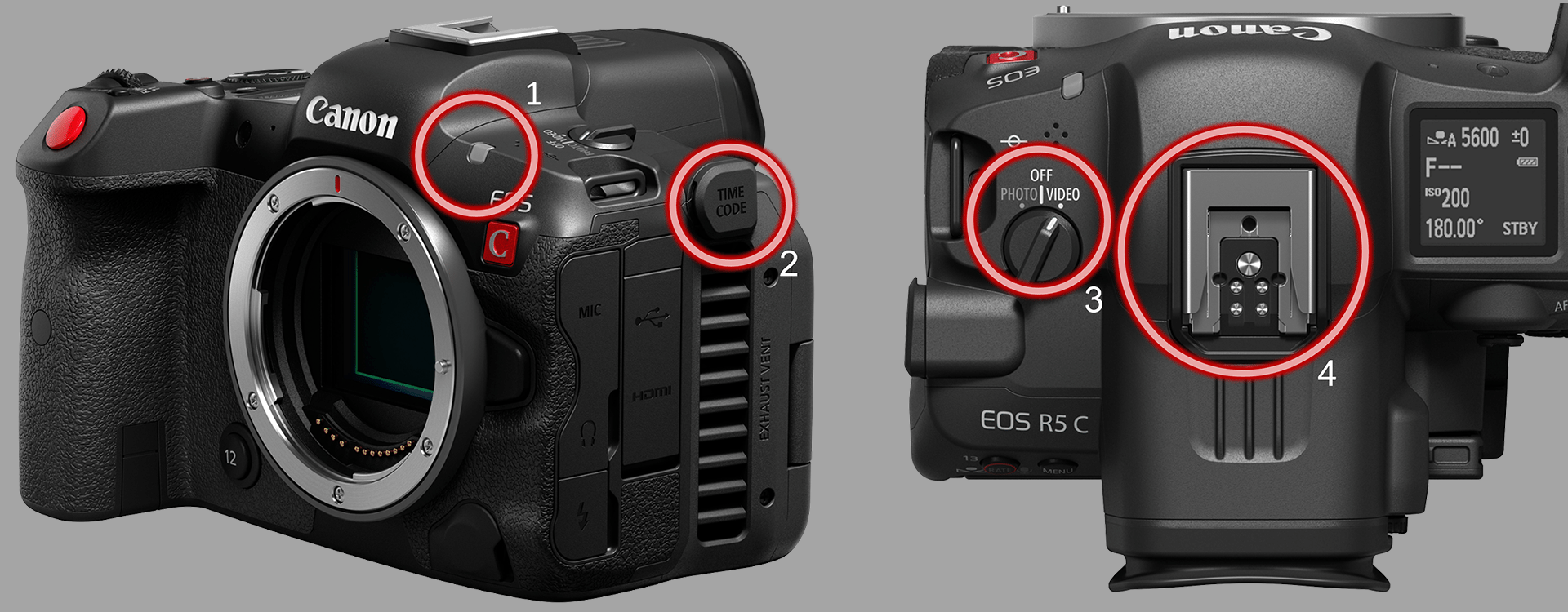
Canon EOS R5 C is a full-frame Cinema EOS hybrid camera built for creators who need high-resolution stills and serious video features in one compact body.
Released in January 2022, the Canon EOS R5 C takes the high-resolution foundation of the EOS R5 and adds a more video-focused design. Its biggest upgrade is active cooling, which allows longer recording times in demanding video modes compared with a standard stills-first mirrorless body.
The camera uses a 36 x 24mm full-frame sensor, Canon RF mount, dual base ISO in video workflows, 8K DCI recording, Cinema RAW Light, H.265, Canon Log profiles, Super 35 crop modes and a dedicated Cinema EOS-style video operating system.
In the provided lab data, the Canon EOS R5 C reaches a maximum dynamic range of 11.7 stops at SNR=2 in full-frame 8192 x 4320 H.265 at ISO 800 and Canon Log 3. Rolling shutter measures 15.5ms in full-frame 8K RAW and improves to 11.5ms in APS-C RAW mode.
The EOS R5 C is not the easiest Canon camera for casual users. It lacks in-body image stabilisation, has a split photo/video operating system and needs careful power planning for demanding modes. However, for creators who want 8K RAW, active cooling and high-resolution stills in one RF-mount body, it remains a powerful hybrid cinema option.
Key Camera Specifications
| Feature | Canon EOS R5 C |
|---|---|
| Camera type | Full-frame Cinema EOS hybrid camera |
| Release period | January 2022 |
| Sensor format | Full frame 35mm |
| Sensor size | 36 x 24mm |
| Maximum still-photo resolution | 8192 x 5464 |
| Lens mount | Canon RF |
| Base sensitivity | ISO 800 and 3200 listed in provided data |
| Main video headline | 8K DCI and 8K UHD recording |
| Main RAW workflow | Cinema RAW Light |
| Compressed codec | H.265 / HEVC |
| Log profiles in provided data | Canon Log 2 for RAW test entries, Canon Log 3 for H.265 entries |
| Best listed dynamic range | 11.7 stops at SNR=2 |
| Full-frame rolling shutter | 15.5ms in 8K RAW |
| APS-C rolling shutter | 11.5ms in APS-C RAW |
| Active cooling | Yes |
| Body weight | About 680 g |
| Dimensions | About 112 mm x 102 mm x 142 mm |
| Listed price | Around $2,999 before taxes |
| Best use | 8K video, hybrid production, commercial work, documentaries and high-resolution stills |
The Canon EOS R5 C is best understood as a compact Cinema EOS camera with strong still-photo capability, not simply an EOS R5 with a fan.
Full-Frame 45MP Sensor
The Canon EOS R5 C uses a 36 x 24mm full-frame sensor with a maximum listed still-photo resolution of 8192 x 5464.
This places the camera in the 45MP class. For photographers, that means strong detail for portraits, landscapes, commercial work, weddings, editorial images and large prints. For video creators, the same high-resolution sensor supports 8K capture.
Why the Sensor Matters
The sensor gives the EOS R5 C its hybrid identity.
It can shoot high-resolution stills and high-resolution video from the same body. This is useful for creators who need campaign stills, thumbnails, social images, behind-the-scenes photos and premium video from one camera system.
The trade-off is that high-resolution video produces large files and requires more storage, power and editing performance.
8K DCI and 8K UHD Recording
The Canon EOS R5 C supports full-frame 8K recording.
The provided recording formats include Full Frame 8K DCI at 8192 x 4320 and Full Frame 8K UHD at 7680 x 4320. These formats give editors room to crop, stabilise, reframe and downsample to sharp 4K delivery.
| Recording Format | Resolution |
| Full Frame 8K DCI | 8192 x 4320 |
| Full Frame 8K UHD | 7680 x 4320 |
| Full Frame 4K DCI | 4096 x 2160 |
| Full Frame 4K UHD | 3840 x 2160 |
| Full Frame 2K | 2048 x 1080 |
| Full Frame HD | 1920 x 1080 |
| Full Frame HD | 1280 x 720 |
8K is not necessary for every project, but it is useful when creators need maximum detail or extra room in post-production.
Cinema RAW Light Recording
Cinema RAW Light is one of the most important features of the Canon EOS R5 C.
The camera records 8K RAW internally using Canon’s Cinema RAW Light workflow. RAW recording gives filmmakers more control over colour, white balance and exposure in post-production than standard compressed video.
The provided data also lists 8K ProRes RAW entries at 8192 x 4320, but for internal Canon workflow, Cinema RAW Light is the safer and more accurate wording.
| Mode | Resolution | RAW Workflow | Frame Rates Listed |
| 8K DCI | 8192 x 4320 | ProRes RAW listing in provided database context | 23.98p to 29.97p |
| Full Frame 8K | 8192 x 4320 | Canon RAW Light LT in lab data | 25p |
| APS-C crop RAW | 5952 x 3140 | CRAW in lab data | 25p |
RAW is powerful, but it creates heavier files than H.265 or other compressed formats.
H.265 Recording
The EOS R5 C also supports H.265 recording.
H.265 is more compressed than RAW, but it is much more practical for many creators. It reduces file size while still allowing high-quality 10-bit video workflows in supported modes.
In the provided lab data, the best dynamic-range result comes from 8K H.265 at ISO 800 and Canon Log 3.
RAW vs H.265
Cinema RAW Light is best for maximum post-production flexibility.
H.265 is better for many real-world jobs because it is lighter, easier to store and still capable of strong image quality. The provided lab data also shows that H.265 gives the strongest measured SNR=2 dynamic-range result for this camera.
For many creators, H.265 is the better everyday format, while RAW is best for premium projects.
Dynamic Range Performance
In the provided lab data, the Canon EOS R5 C reaches a maximum dynamic range of 11.7 stops at SNR=2 in full-frame 8192 x 4320 H.265 at 25fps, ISO 800 and Canon Log 3.
In Canon RAW Light LT, the result is lower, with 10.2 stops at SNR=2 at ISO 800 and 9.61 stops at SNR=2 at ISO 3200.
| Sensor Mode | Resolution | Codec | Frame Rate | ISO | Gamma | Measured Dynamic Range |
| Full Frame | 8192 x 4320 | Canon RAW Light LT | 25p | 800 | Canon Log 2 | 10.2 stops at SNR=2 |
| Full Frame | 8192 x 4320 | Canon RAW Light LT | 25p | 3200 | Canon Log 2 | 9.61 stops at SNR=2 |
| Full Frame | 8192 x 4320 | H.265 | 25p | 800 | Canon Log 3 | 11.7 stops at SNR=2 |
| Full Frame | 8192 x 4320 | H.265 | 25p | 3200 | Canon Log 3 | 11.3 stops at SNR=2 |
The key takeaway is that the EOS R5 C performs best in the provided data when recording 8K H.265 at ISO 800 and Canon Log 3.
What Dynamic Range Means for Filmmakers
Dynamic range affects how much highlight and shadow detail a camera can preserve.
This matters when filming skies, windows, wedding dresses, dark interiors, concerts, backlit scenes and bright practical lights. The EOS R5 C gives useful latitude, but it does not match newer Canon Cinema EOS models in their strongest 4K CLog2 modes.
For the best result, protect highlights, avoid heavy underexposure and use careful exposure monitoring.
Dual Base ISO
The provided camera data lists dual base sensitivity at ISO 800 and ISO 3200.
Dual base ISO helps the camera work in different lighting conditions. ISO 800 is the stronger choice for normal lighting and maximum quality. ISO 3200 can help in darker scenes, but the provided lab data shows some reduction in measured dynamic range.
| Mode | ISO 800 | ISO 3200 |
| 8K Canon RAW Light LT | 10.2 stops at SNR=2 | 9.61 stops at SNR=2 |
| 8K H.265 | 11.7 stops at SNR=2 | 11.3 stops at SNR=2 |
ISO 800 is the best starting point when lighting can be controlled. ISO 3200 is useful when available light is limited.
Rolling Shutter Performance
Rolling shutter is an important part of the EOS R5 C video story.
In the provided lab data, full-frame 8K CRAW at 25fps measures 15.5ms. APS-C 5952 x 3140 CRAW at 25fps measures 11.5ms.
| Sensor Mode | Resolution | Codec | Frame Rate | Rolling Shutter |
| Full Frame | 8192 x 4320 | CRAW | 25p | 15.5ms |
| APS-C | 5952 x 3140 | CRAW | 25p | 11.5ms |
The APS-C crop mode reads faster, which makes it better for motion-heavy scenes.
Why Rolling Shutter Matters
Rolling shutter can distort fast movement.
Quick pans may bend vertical lines, and fast-moving subjects may appear skewed. This matters for handheld action, cars, sports, dance, wildlife, gimbal moves and fast documentary scenes.
For controlled shots, full-frame 8K can work well. For faster movement, APS-C crop modes may be safer.
Active Cooling
Active cooling is one of the biggest reasons the Canon EOS R5 C exists.
The camera includes a built-in cooling fan, making it more suitable for long video recording sessions than the original EOS R5. This is important when shooting 8K, high-bitrate codecs and long takes.
Why Active Cooling Matters
Heat can interrupt video production.
A cooled body helps with interviews, events, long takes, lectures, corporate videos, documentaries and extended filming days. This makes the EOS R5 C more dependable for video-first work than many stills-first hybrid bodies.
For creators who need 8K recording without short thermal limits, active cooling is a major advantage.
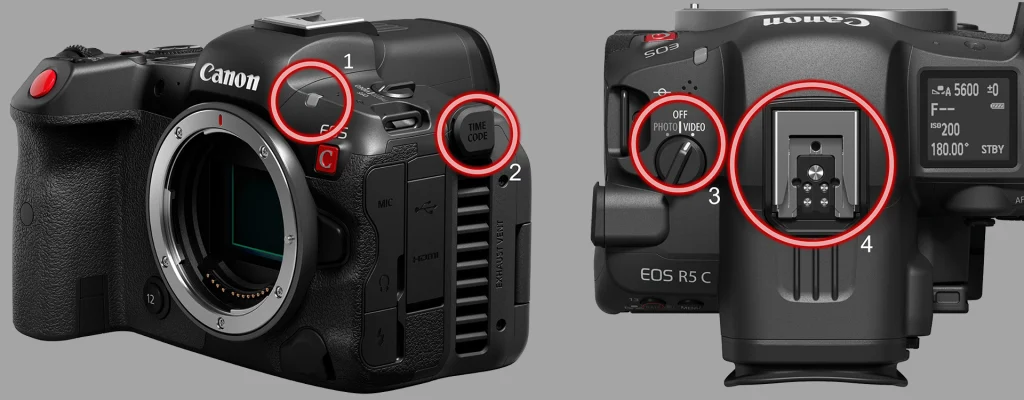
Cinema EOS Video Interface
The EOS R5 C uses a video-focused Cinema EOS operating system when switched into video mode.
This gives users access to more cinema-style controls, waveform-style tools, shutter angle, timecode, audio controls and video-oriented menus. In photo mode, it behaves more like a traditional EOS stills camera.
Why the Dual Interface Matters
The split interface gives the camera two personalities.
Photographers get a familiar EOS stills experience. Videographers get a more cinema-oriented video workflow. The downside is that switching between photo and video modes is slower than on a normal hybrid camera.
For dedicated video work, the Cinema EOS interface is a strength. For fast hybrid switching, it can feel less convenient.
Canon Log 2 and Canon Log 3 Context
The provided lab table labels RAW measurements as Canon Log 2 and H.265 measurements as Canon Log 3.
In practical use, Canon Log profiles are important because they create flatter files for colour grading. Canon Log 3 is easier to grade and widely used by Canon hybrid shooters. Canon Log 2 can offer more grading latitude in workflows where it is available.
Why Log Recording Matters
Log recording helps preserve highlight and shadow detail.
It also helps match the EOS R5 C with other Canon cameras in multi-camera projects. For fast delivery, standard profiles are easier. For professional grading, log recording is usually the better choice.
Creators should confirm the exact profile options available in their firmware and chosen recording mode.
RF Lens Mount
The Canon EOS R5 C uses the RF mount.
RF mount gives creators access to Canon’s modern mirrorless lenses, including L-series zooms, fast primes, stabilised lenses, macro lenses and hybrid video lenses. EF lenses can also be used through Canon adapters.
| Lens Workflow | Best For |
| RF lenses | Native autofocus and modern optics |
| RF L-series lenses | Professional stills and video |
| RF hybrid lenses | Video-focused creators |
| EF lenses with adapter | Existing Canon DSLR lens owners |
| Manual cine lenses | Controlled video production |
| RF cinema primes | Cinema-style full-frame work |
The RF mount makes the R5 C useful for both hybrid creators and small cinema crews.
Super 35 and Super 16 Crop Modes
The Canon EOS R5 C supports multiple crop recording formats.
These include Super 35 4K DCI, Super 35 4K UHD, Super 35 2K, Super 35 HD, Super 16 2K and Super 16 HD.
| Crop Format | Resolution |
| S35 4K DCI | 4096 x 2160 |
| S35 4K UHD | 3840 x 2160 |
| S35 2K | 2048 x 1080 |
| S35 HD | 1920 x 1080 |
| S35 HD | 1280 x 720 |
| S16 2K | 2048 x 1080 |
| S16 HD | 1920 x 1080 |
| S16 HD | 1280 x 720 |
These crop modes are useful for lens compatibility, extra reach and faster sensor readout.
Photography Performance
The Canon EOS R5 C is also a capable stills camera.
Its 45MP-class sensor can capture high-resolution photos for portraits, weddings, landscapes, commercial work, product images, travel and editorial projects. It can also shoot fast bursts for action, though the body is more video-focused than a standard EOS R5.
Best Photo Uses
The EOS R5 C is useful for:
Portrait photography
Landscape photography
Commercial stills
Travel photography
Wedding photography
Product images
Behind-the-scenes photos
YouTube thumbnails
Social media stills
Hybrid client work
Photographers who mainly shoot stills may prefer the EOS R5 Mark II or EOS R5, but the R5 C remains strong for creators who need both stills and cinema-style video.
No In-Body Image Stabilisation
One major difference between the EOS R5 C and the standard EOS R5 is the lack of in-body image stabilisation.
This makes the R5 C less convenient for handheld stills and video. Users can still rely on optically stabilised RF lenses, digital stabilisation in selected modes, tripods, gimbals, shoulder rigs or monopods.
What This Means in Practice
The EOS R5 C benefits from support gear.
For handheld video, use stabilised lenses or a rig. For professional video, a tripod, gimbal or shoulder setup will often be better. For stills, stabilised lenses help when shooting slower shutter speeds.
Creators moving from an IBIS-equipped camera should test handheld work carefully.
Audio and Production Workflow
The EOS R5 C supports more video-focused production tools than a normal stills hybrid.
It can work with Canon’s multi-function shoe accessories, external microphones, timecode workflows and professional monitoring setups. It is not as complete as a larger Cinema EOS body with built-in XLR and ND filters, but it offers more cinema-oriented tools than a standard photo camera.
Why Audio Planning Matters
Good video needs good sound.
For interviews, documentaries, weddings and corporate work, users should plan microphones, monitoring and audio levels carefully. External audio gear may be necessary depending on the shoot.
The EOS R5 C can deliver excellent images, but audio still needs proper setup.
Media and Storage
The EOS R5 C uses high-speed media for demanding video modes.
8K RAW and high-bitrate H.265 require fast cards and large storage capacity. A full 8K workflow can fill cards quickly and demands a strong backup plan.
Media Planning Tips
Use fast CFexpress media for 8K RAW and high-bitrate workflows.
Use SD cards for lighter modes where supported. Always test cards before paid work. For serious productions, copy footage to multiple storage locations before formatting media.
High-resolution video is not only a camera choice. It is also a storage and post-production choice.
Best Uses for the Canon EOS R5 C
The Canon EOS R5 C is best for creators who need high-resolution video and stills in one compact Cinema EOS-style body.
It is ideal for:
Commercial videos
YouTube production
Music videos
Short films
Documentaries
Corporate videos
Travel films
Hybrid client work
Product videos
Studio interviews
8K capture projects
High-resolution stills
B-camera use
Social media campaigns
Event highlight videos
The camera is strongest when users need 8K recording and active cooling in a compact RF-mount body.
Canon EOS R5 C vs Canon EOS R5
The EOS R5 C is more video-focused than the original EOS R5.
| Feature | Canon EOS R5 C | Canon EOS R5 |
| Camera type | Cinema EOS hybrid | Stills-first hybrid |
| Cooling | Active cooling fan | Passive cooling |
| Video interface | Cinema EOS-style video OS | Standard EOS video menus |
| IBIS | No | Yes |
| 8K recording | Stronger long-form workflow | More heat-limited |
| Best advantage | Video reliability | Stills convenience and IBIS |
The R5 C is better for video-first work. The R5 is better for photographers who occasionally shoot video.
Canon EOS R5 C vs Canon EOS R5 Mark II
The EOS R5 Mark II is newer and more advanced as a hybrid camera, but the R5 C still has a dedicated video identity.
| Feature | Canon EOS R5 C | Canon EOS R5 Mark II |
| Sensor class | 45MP full frame | 45MP stacked full frame |
| Cooling | Active cooling built in | Improved hybrid body, optional cooling accessories |
| Maximum video | 8K RAW | 8K RAW and stronger hybrid workflow |
| Canon Log 2 | Workflow depends on mode/firmware | Supported |
| IBIS | No | Yes |
| Best advantage | Dedicated video cooling | Faster sensor and stronger hybrid features |
The R5 Mark II is better for modern hybrid users. The R5 C remains useful for creators who want a dedicated cooled 8K Cinema EOS-style body.
Canon EOS R5 C vs Canon EOS C80
The EOS C80 is a dedicated cinema camera, while the R5 C is a hybrid cinema-stills body.
| Feature | Canon EOS R5 C | Canon EOS C80 |
| Camera type | Cinema EOS hybrid | Cinema EOS camera |
| Sensor format | Full frame | Full frame |
| Maximum video | 8K RAW | 6K RAW |
| Built-in ND filters | No | Yes |
| Professional audio | Accessory-based | Built-in cinema workflow |
| SDI | No cinema-style SDI workflow | Yes |
| Best advantage | 8K and stills | Production ergonomics |
The R5 C is better for 8K and stills. The C80 is better for dedicated video production.
Canon EOS R5 C vs Canon EOS C400
The EOS C400 is a more complete production camera, while the R5 C is a smaller hybrid option.
| Feature | Canon EOS R5 C | Canon EOS C400 |
| Camera type | Hybrid Cinema EOS | Cinema EOS production camera |
| Maximum video | 8K RAW | 6K RAW |
| Built-in ND filters | No | Yes |
| Triple base ISO | No | Yes |
| Professional I/O | More limited | Stronger SDI and Ethernet workflow |
| Best advantage | Compact 8K hybrid | Full production feature set |
The C400 is better for professional crews. The R5 C is better for creators who need 8K in a smaller hybrid body.
Key Takeaways
- Canon EOS R5 C was released in January 2022.
- It uses a 36 x 24mm full-frame sensor.
- Maximum still-photo resolution is 8192 x 5464.
- The camera uses the Canon RF mount.
- Dual base sensitivity is listed as ISO 800 and ISO 3200 in the provided data.
- It records full-frame 8K DCI and 8K UHD.
- Cinema RAW Light is the main internal RAW workflow.
- H.265 recording is available for compressed high-resolution video.
- The provided lab data lists 11.7 stops at SNR=2 in 8K H.265 at ISO 800 and Canon Log 3.
- Canon RAW Light LT measures 10.2 stops at SNR=2 at ISO 800 in the provided data.
- Full-frame 8K RAW rolling shutter is listed at 15.5ms.
- APS-C RAW rolling shutter improves to 11.5ms.
- Active cooling is one of the camera’s biggest advantages.
- The camera does not have in-body image stabilisation.
- It is best for 8K video creators, hybrid stills/video work and compact Cinema EOS production.
Frequently Asked Questions
What is the Canon EOS R5 C?
Canon EOS R5 C is a full-frame Cinema EOS hybrid camera with 8K recording, Cinema RAW Light, active cooling, RF mount and high-resolution still-photo capability.
When was the Canon EOS R5 C released?
The Canon EOS R5 C was released in January 2022.
What sensor does the Canon EOS R5 C use?
It uses a 36 x 24mm full-frame sensor with a maximum listed still-photo resolution of 8192 x 5464.
What lens mount does it use?
The Canon EOS R5 C uses the RF mount and supports EF lenses through Canon adapters.
Does the Canon EOS R5 C shoot 8K?
Yes. It records full-frame 8K DCI and 8K UHD video.
Does the EOS R5 C record RAW internally?
Yes. The camera records Cinema RAW Light internally.
Does the EOS R5 C have active cooling?
Yes. The camera has an internal cooling fan, which helps with longer recording in demanding video modes.
Does the Canon EOS R5 C have IBIS?
No. The EOS R5 C does not include in-body image stabilisation.
What dynamic range did the provided lab data show?
The provided lab data lists a maximum of 11.7 stops at SNR=2 in full-frame 8192 x 4320 H.265 at ISO 800 and Canon Log 3.
What is the rolling-shutter result?
The provided lab data lists 15.5ms in full-frame 8192 x 4320 CRAW at 25fps and 11.5ms in APS-C 5952 x 3140 CRAW at 25fps.
Is the Canon EOS R5 C good for video?
Yes. It is strong for video because of 8K recording, Cinema RAW Light, active cooling, Canon Log workflows and Cinema EOS-style controls.
Who should buy the Canon EOS R5 C?
The Canon EOS R5 C is best for creators who need 8K video, high-resolution stills, active cooling and a compact RF-mount Cinema EOS hybrid body.
Conclusion
Canon EOS R5 C remains one of Canon’s most interesting hybrid cinema cameras.
It combines a 45MP-class full-frame sensor, 8K DCI, 8K UHD, Cinema RAW Light, H.265, Canon Log workflows, active cooling, RF mount flexibility and high-resolution stills in a compact body.
The lab data shows that its best measured dynamic-range result is 11.7 stops at SNR=2 in 8K H.265 at ISO 800 and Canon Log 3. RAW recording gives more post-production flexibility, but the provided Canon RAW Light LT result is lower at 10.2 stops. Rolling shutter is 15.5ms in full-frame 8K RAW and improves to 11.5ms in APS-C RAW.
The EOS R5 C is not perfect. It lacks IBIS, needs careful power and storage planning, and does not offer the production ergonomics of larger Cinema EOS bodies with built-in ND filters and SDI. However, its active cooling and 8K recording still give it a clear role.
For creators who want a compact Canon camera that can handle both high-resolution stills and serious 8K video, the Canon EOS R5 C remains a powerful and distinctive Cinema EOS hybrid.
Read Also: Canon EOS R7: Specs, Dynamic Range, Rolling Shutter and Video Features