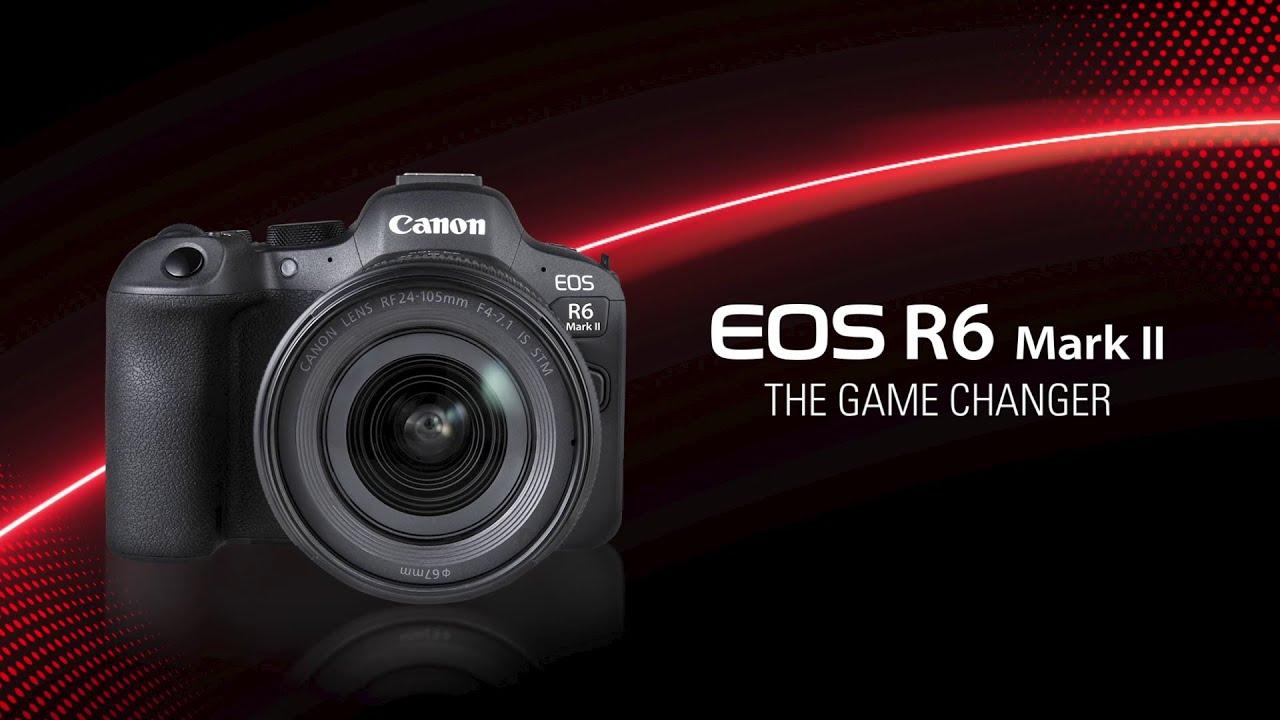
Canon EOS R6 Mark II is a full-frame mirrorless camera built for hybrid creators who need strong still-photo performance and dependable video features in one compact body.
Released in November 2022, the Canon EOS R6 Mark II replaced the original EOS R6 with a new 24.2MP full-frame CMOS sensor, faster electronic shooting, improved autofocus, uncropped oversampled 4K 60p video, Canon Log 3, Full HD 180p and external 6K RAW output through HDMI.
The camera uses Canon’s RF mount and supports modern RF lenses, EF lenses through adapters and a wide range of creator workflows. It is not a cinema camera like the EOS C80 or EOS C50, but it remains one of Canon’s most practical full-frame hybrid cameras for weddings, events, portraits, travel, wildlife, social video and YouTube production.
In the provided lab data, the Canon EOS R6 Mark II reaches 10.8 stops of dynamic range at SNR=2 in full-frame 4K UHD H.265 at ISO 800 and Canon Log 3. Rolling shutter measures 16.5ms in full-frame 4K 25p and improves to 15ms in full-frame 4K 50p. Crop 4K modes read faster, with 10.3ms at 25p and 9.4ms at 50p.
Key Camera Specifications
| Feature | Canon EOS R6 Mark II |
|---|---|
| Camera type | Full-frame hybrid mirrorless camera |
| Release period | November 2022 |
| Sensor format | Full frame 35mm |
| Sensor size | 35.9 x 23.9mm |
| Maximum photo resolution | 6000 x 4000 |
| Effective resolution | 24.2MP class |
| Lens mount | Canon RF |
| Base sensitivity | ISO 800 in provided video data |
| Main processor | DIGIC X |
| Internal video | 4K UHD up to 60p |
| External RAW | 6K RAW output over HDMI |
| High frame rate | Full HD up to 180p |
| Best listed dynamic range | 10.8 stops at SNR=2 |
| Best listed rolling shutter | 9.4ms in 4K crop 50p |
| Full-frame rolling shutter | 16.5ms at 25p, 15ms at 50p |
| Stabilisation | In-body image stabilisation |
| Body weight | About 588 g |
| Dimensions | About 138 mm x 88 mm x 98 mm |
| Listed price | Around $1,999 before taxes |
| Best use | Weddings, events, portraits, travel, wildlife and hybrid content |
The EOS R6 Mark II is not the highest-resolution Canon body, but it is a well-balanced camera for creators who need speed, autofocus, low-light flexibility and strong 4K video.
Full-Frame 24.2MP Sensor
The Canon EOS R6 Mark II uses a 35.9 x 23.9mm full-frame CMOS sensor with a maximum listed photo resolution of 6000 x 4000.
The 24.2MP resolution gives photographers enough detail for weddings, events, portraits, travel, news, social media, web publishing and moderate cropping. It also keeps file sizes smaller than the 45MP EOS R5 Mark II, which can help with faster editing and storage.
Why the Sensor Matters
The sensor is designed for balance.
It does not chase extreme resolution. Instead, it gives creators a practical mix of image quality, speed, autofocus performance and video readout. This makes the EOS R6 Mark II especially useful for creators who shoot both photos and video during the same job.
For weddings, events and documentary work, that balance is often more important than maximum megapixels.
4K UHD Video
The Canon EOS R6 Mark II records 4K UHD at up to 60p.
Canon’s official materials describe the 4K image as being created from 6K oversampling. That means the camera uses more sensor information than a simple native 4K readout, helping improve detail and reduce noise.
| Recording Format | Resolution |
| 4K UHD | 3840 x 2160 |
| HD | 1920 x 1080 |
| Crop 4K UHD | 3840 x 2160 |
| Crop HD | 1920 x 1080 |
The camera does not record internal 6K or 8K video. Its strongest internal video mode is oversampled 4K.
External 6K RAW Output
The EOS R6 Mark II can output 6K RAW through HDMI to a compatible external recorder.
In the provided recording data, 6K ProRes RAW is listed at 6000 x 3374 in 17:9 with frame rates up to 59.94p. Since this is an external workflow, it should be described as 6K RAW HDMI output rather than internal 6K recording.
| Mode | Resolution | Codec Workflow | Frame Rates Listed |
| 6K 17:9 | 6000 x 3374 | ProRes RAW via external workflow | 23.98p to 59.94p |
This makes the EOS R6 Mark II more flexible for creators who want a RAW workflow but do not need a Cinema EOS body.
Why External RAW Matters
External RAW gives video creators more post-production control.
It can help with colour grading, exposure adjustment and high-quality 4K delivery. However, it also requires extra gear, including a compatible external recorder, HDMI cable, storage media, power setup and rigging.
For many users, internal 4K H.265 will be simpler. External RAW is best for controlled shoots where image flexibility matters more than a small setup.
Canon Log 3
The Canon EOS R6 Mark II supports Canon Log 3.
Canon Log 3 gives creators a flatter image profile with more grading flexibility than standard picture styles. It is easier to grade than Canon Log 2 and works well for hybrid creators, event shooters, YouTubers and commercial videographers.
The provided lab data uses CLog3 at ISO 800.
Why CLog3 Matters
CLog3 helps preserve highlight and shadow detail for post-production.
It is useful for weddings, outdoor interviews, concerts, corporate videos and social campaigns where lighting can change quickly. It also helps match the EOS R6 Mark II with other Canon cameras that support similar log workflows.
For faster delivery, users can shoot standard profiles. For serious grading, CLog3 is the better choice.
Dynamic Range Performance
In the provided lab data, the Canon EOS R6 Mark II achieves a maximum dynamic range of 10.8 stops at SNR=2 in full-frame 3840 x 2160 H.265 at 25fps, ISO 800 and Canon Log 3.
In crop 4K UHD mode, the result is 10.4 stops at SNR=2.
| Sensor Mode | Resolution | Codec | Frame Rate | ISO | Gamma | Measured Dynamic Range |
| Full Frame | 3840 x 2160 | H.265 | 25p | 800 | CLog3 | 10.8 stops at SNR=2 |
| Crop 4K UHD | 3840 x 2160 | H.265 | 25p | 800 | CLog3 | 10.4 stops at SNR=2 |
These results are lower than newer Canon cameras such as the EOS R5 Mark II, EOS C80 and EOS C400 in their strongest 4K CLog2 modes. However, the EOS R6 Mark II still gives useful grading flexibility for many real-world hybrid jobs.
What Dynamic Range Means for Creators
Dynamic range affects how much detail a camera can hold between bright highlights and dark shadows.
This matters when filming skies, windows, wedding dresses, stage lights, outdoor interviews and high-contrast interiors. The EOS R6 Mark II can handle many everyday scenes well, but it needs careful exposure in difficult light.
For best results, protect highlights, avoid heavy underexposure and use zebras or false colour when available.
Rolling Shutter Performance
Rolling shutter depends heavily on the recording mode.
In the provided data, full-frame 4K H.265 at 25p measures 16.5ms. Full-frame 4K at 50p improves slightly to 15ms. Crop 4K is faster, measuring 10.3ms at 25p and 9.4ms at 50p.
| Sensor Mode | Resolution | Codec | Frame Rate | Rolling Shutter |
| Full Frame | 3840 x 2160 | H.265 | 25p | 16.5ms |
| Full Frame | 3840 x 2160 | H.265 | 50p | 15ms |
| 4K crop | 3840 x 2160 | H.265 | 25p | 10.3ms |
| 4K crop | 3840 x 2160 | H.265 | 50p | 9.4ms |
Full-frame rolling shutter is manageable for many scenes, but crop 4K is better for fast movement.
Why Rolling Shutter Matters
Rolling shutter can make fast movement look distorted.
Quick pans may bend vertical lines, and fast-moving subjects can appear skewed. This matters for sports, handheld action, vehicles, dance and fast gimbal movement.
For interviews, weddings, travel films and controlled camera movement, full-frame 4K should be usable. For faster action, crop 4K gives a cleaner readout.
Full HD 180p Slow Motion
The EOS R6 Mark II supports Full HD recording up to 180p.
This is useful for dramatic slow motion, action clips, sports, wedding details, music videos and social content. Full HD is lower resolution than 4K, but the high frame rate gives creators more creative control.
Best Uses for 180p
Full HD 180p is useful for:
Sports details
Wedding moments
Dance clips
Product movement
Music video inserts
Social media reels
Travel footage
Wildlife movement
Action B-roll
For the best quality, 4K60 remains stronger. For slow motion, 180p gives more creative flexibility.
Photography Performance
The Canon EOS R6 Mark II is a strong stills camera.
It supports up to 40fps electronic shooting and up to 12fps with the mechanical shutter. This makes it useful for weddings, wildlife, sports, children, pets, events and fast-moving documentary moments.
The 24.2MP files are easier to manage than higher-resolution bodies and still provide enough detail for most professional and online publishing work.
Best Photography Uses
The EOS R6 Mark II is ideal for:
Wedding photography
Event photography
Portraits
Travel photography
Wildlife
Sports in good light
Family photography
Social media work
Editorial assignments
Behind-the-scenes stills
Lifestyle content
It is especially useful for photographers who want a fast full-frame camera without the larger files of the R5 series.
Autofocus and Subject Tracking
Canon EOS R6 Mark II uses Dual Pixel CMOS AF II.
The camera improves subject detection and tracking compared with earlier Canon mirrorless bodies. It can recognise and track people, animals and vehicles, making it useful for both stills and video.
Why Autofocus Matters
Hybrid creators often work quickly and alone.
Reliable autofocus helps during weddings, interviews, YouTube production, wildlife shooting, events and travel content. It also helps when shooting wide open with fast RF lenses.
Manual focus is still important for cinema-style work, but autofocus is one of the camera’s biggest everyday strengths.
In-Body Image Stabilisation
The Canon EOS R6 Mark II includes 5-axis in-body image stabilisation.
Canon lists up to 8 stops of stabilisation when the body works with compatible lenses. This helps with handheld stills, low-light photography and smoother video.
Why IBIS Matters
IBIS helps creators shoot with smaller kits.
It can reduce small camera movements when filming handheld and help photographers use slower shutter speeds. It is not a full replacement for a tripod, gimbal or shoulder rig, but it improves real-world shooting.
For travel, weddings and run-and-gun work, stabilisation is a major benefit.
RF Lens Mount
The EOS R6 Mark II uses Canon’s RF mount.
RF mount gives users access to Canon’s modern full-frame mirrorless lenses, including L-series zooms, fast primes, stabilised lenses, compact primes and hybrid video lenses. EF lenses can also be used through Canon adapters.
| Lens Workflow | Best For |
| RF L-series lenses | Professional stills and video |
| RF compact primes | Travel and lightweight shooting |
| RF hybrid lenses | Video creators |
| RF super-telephotos | Wildlife and sports |
| EF lenses with adapter | Existing Canon DSLR users |
| Manual cine lenses | Video production and controlled focus |
The RF mount makes the R6 Mark II flexible for both photographers and video creators.
Dual SD Card Slots
The Canon EOS R6 Mark II uses dual SD card slots.
This keeps media costs lower than CFexpress-based cameras. It also supports professional workflows such as backup recording, overflow recording or separating photos and videos across cards.
Media Planning Tips
Use fast UHS-II SD cards for 4K video.
External 6K RAW workflows require a compatible recorder and external media. For paid work, always test SD cards before filming and carry enough storage for long shoots.
Good media management is important even when the camera uses affordable SD cards.
Body Design
The EOS R6 Mark II uses a compact full-frame mirrorless body.
It weighs about 588 g in the provided data and measures about 138 mm x 88 mm x 98 mm. This makes it small enough for travel, handheld work, weddings, gimbals and long event days.
The body includes a viewfinder, vari-angle screen, comfortable grip and familiar Canon controls.
Who Will Like the Body
Photographers moving from Canon DSLRs or earlier EOS R cameras will find the R6 Mark II easy to use.
Video creators will appreciate the lightweight body, but may need accessories for monitoring, audio, power and external RAW recording. It is a strong hybrid body, but not a dedicated cinema camera.
Heat and Recording Limits
The EOS R6 Mark II improved video reliability compared with the original EOS R6.
Canon promoted longer recording times and removed the old 29-minute 59-second clip limit. However, high-resolution and high-frame-rate video can still depend on ambient temperature, battery life and media capacity.
What This Means for Creators
For weddings, events, interviews and YouTube production, users should test the exact recording mode before paid work.
Oversampled 4K60, long takes and warm environments can increase heat pressure. For long-form video, a dedicated cinema camera with active cooling may still be better.
Best Uses for the Canon EOS R6 Mark II
The Canon EOS R6 Mark II is best for creators who need a balanced full-frame camera for both stills and video.
It is ideal for:
Wedding photography
Event photography
Portraits
Travel content
YouTube videos
Hybrid client work
Wildlife photography
Sports in selected conditions
Social media campaigns
Corporate video
Family photography
Documentary clips
Behind-the-scenes content
Online education
Lifestyle photography
It is strongest when users need speed, autofocus, stabilisation and 4K video in a compact full-frame body.
Canon EOS R6 Mark II vs Canon EOS R6
The EOS R6 Mark II improves the original EOS R6 in resolution, autofocus, video and recording reliability.
| Feature | Canon EOS R6 Mark II | Canon EOS R6 |
| Sensor resolution | 24.2MP class | 20.1MP class |
| Maximum internal 4K | 4K60 oversampled | 4K60 with more limits |
| External RAW | 6K RAW HDMI output | More limited workflow |
| Electronic shooting | Up to 40fps | Up to 20fps |
| Autofocus | Improved subject detection | Earlier AF system |
| Main advantage | Better hybrid performance | Lower used-market cost |
The R6 Mark II is the better choice for most users unless price is the main concern.
Canon EOS R6 Mark II vs Canon EOS R6 Mark III
The EOS R6 Mark III is the newer and more advanced camera, but the R6 Mark II remains strong for value.
| Feature | Canon EOS R6 Mark II | Canon EOS R6 Mark III |
| Sensor resolution | 24.2MP class | 32.5MP class |
| Maximum internal video | 4K60 | 7K RAW and Open Gate |
| Canon Log | Canon Log 3 | Canon Log 2 and Canon Log 3 |
| Card slots | Dual SD | CFexpress Type B + SD |
| Best advantage | Lower price and simpler files | Higher resolution and stronger video |
The R6 Mark III is better for advanced video and more resolution. The R6 Mark II remains attractive for creators who want a capable full-frame hybrid at a lower price.
Canon EOS R6 Mark II vs Canon EOS R5 Mark II
The EOS R5 Mark II is a higher-resolution, more advanced hybrid body.
| Feature | Canon EOS R6 Mark II | Canon EOS R5 Mark II |
| Sensor resolution | 24.2MP class | 45MP class |
| Maximum internal video | 4K60 | 8K RAW and 4K120 |
| Canon Log 2 | No | Yes |
| File sizes | Smaller | Much larger |
| Best advantage | Better value and simpler workflow | Resolution and high-end video |
The R5 Mark II is better for commercial creators who need 45MP stills and 8K video. The R6 Mark II is better for everyday hybrid work and lower storage demands.
Canon EOS R6 Mark II vs Canon EOS C50
The EOS C50 is a dedicated video-first Cinema EOS camera, while the R6 Mark II is a stills/video hybrid.
| Feature | Canon EOS R6 Mark II | Canon EOS C50 |
| Camera type | Hybrid mirrorless | Cinema EOS |
| Sensor format | Full frame | Full frame |
| Main video | 4K60 internal, 6K RAW HDMI | 7K RAW and Open Gate |
| Built-in cooling | No dedicated cinema cooling | Yes |
| Professional audio | Accessory-based | Detachable XLR handle |
| Best advantage | Stills and portability | Video production workflow |
The EOS R6 Mark II is better for creators who shoot photos and video. The EOS C50 is better for video-first production.
Key Takeaways
- Canon EOS R6 Mark II was released in November 2022.
- It uses a 35.9 x 23.9mm full-frame CMOS sensor.
- Maximum still-photo resolution is 6000 x 4000.
- The camera uses the Canon RF mount.
- It records internal 4K UHD up to 60p.
- 4K is oversampled from a 6K sensor readout.
- External 6K RAW output is available through HDMI.
- Canon Log 3 is supported.
- Full HD recording reaches up to 180p.
- The provided lab data lists 10.8 stops at SNR=2 in full-frame 4K H.265 at ISO 800.
- Crop 4K measures 10.4 stops at SNR=2.
- Full-frame rolling shutter is 16.5ms at 25p and 15ms at 50p.
- Crop 4K rolling shutter improves to 10.3ms at 25p and 9.4ms at 50p.
- The camera includes in-body image stabilisation.
- It supports up to 40fps electronic stills shooting.
- It is best for weddings, events, travel, portraits, wildlife and hybrid content creation.
Frequently Asked Questions
What is the Canon EOS R6 Mark II?
Canon EOS R6 Mark II is a full-frame hybrid mirrorless camera with a 24.2MP sensor, RF mount, 4K60 video, Canon Log 3, external 6K RAW output and fast autofocus.
When was the Canon EOS R6 Mark II released?
The Canon EOS R6 Mark II was released in November 2022.
What sensor does the Canon EOS R6 Mark II use?
It uses a 35.9 x 23.9mm full-frame CMOS sensor with 24.2MP-class resolution.
What is the maximum photo resolution?
The maximum listed still-photo resolution is 6000 x 4000.
What lens mount does it use?
The Canon EOS R6 Mark II uses the Canon RF mount and supports EF lenses through Canon adapters.
Does the Canon EOS R6 Mark II shoot 4K60?
Yes. It records 4K UHD up to 60p using 6K oversampling.
Does the EOS R6 Mark II shoot 6K RAW?
It can output 6K RAW through HDMI to a compatible external recorder. It does not record internal 6K RAW.
Does it support Canon Log?
Yes. The EOS R6 Mark II supports Canon Log 3.
What dynamic range did the provided lab data show?
The provided lab data lists 10.8 stops at SNR=2 in full-frame 3840 x 2160 H.265 at ISO 800 and CLog3.
What is the rolling-shutter result?
The provided lab data lists 16.5ms in full-frame 4K 25p, 15ms in full-frame 4K 50p, 10.3ms in crop 4K 25p and 9.4ms in crop 4K 50p.
Is the Canon EOS R6 Mark II good for video?
Yes. It is good for hybrid video work, with oversampled 4K60, Canon Log 3, FHD 180p and external 6K RAW output. Dedicated cinema cameras remain better for long-form video, XLR audio, built-in ND filters and active cooling.
Who should buy the Canon EOS R6 Mark II?
It is best for photographers and hybrid creators who need a reliable full-frame camera for weddings, events, portraits, travel, social video and everyday professional work.
Conclusion
Canon EOS R6 Mark II remains one of Canon’s most practical full-frame hybrid cameras.
Its 24.2MP sensor, RF mount, oversampled 4K60, Canon Log 3, external 6K RAW output, Full HD 180p, fast autofocus, IBIS and 40fps electronic shooting make it a strong all-round camera for creators who work across photos and video.
The lab data shows that it does not match newer Canon bodies for measured video dynamic range. It reaches 10.8 stops at SNR=2 in full-frame 4K H.265 and 10.4 stops in crop 4K. Rolling shutter is also mode-dependent, with full-frame 4K at 16.5ms and crop 4K improving to 10.3ms or faster.
Even with those limits, the EOS R6 Mark II remains a smart choice for many creators. It is lighter, more affordable and easier to manage than higher-end Canon bodies, while still offering the core full-frame look, strong autofocus and dependable 4K video that most hybrid shooters need.
Read Also: Canon EOS C400: Specs, Dynamic Range, Rolling Shutter and Video Features