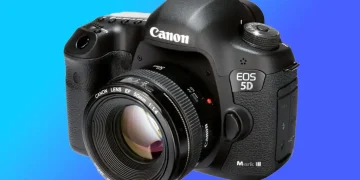
Canon EOS 5D Mark II is one of the most influential DSLR cameras ever made because it helped change both photography and filmmaking.
Released in November 2008, the Canon EOS 5D Mark II succeeded the original EOS 5D and brought a higher-resolution full-frame sensor, better image processing, expanded ISO performance and a major new feature for Canon’s EOS line: Full HD video recording.
The camera uses a 21.1MP full-frame CMOS sensor measuring 36 x 24 mm, Canon’s EF lens mount and the DIGIC 4 image processor. It records Full HD video at 1920 x 1080 using MPEG-4 AVC/H.264 compression and also captures full-resolution stills at 5616 x 3744.
The EOS 5D Mark II is now outdated by modern standards. It lacks 4K video, modern autofocus, in-body stabilization, touchscreen controls, 10-bit recording and advanced mirrorless features. Even so, it remains historically important because it gave filmmakers a full-frame DSLR look at a time when affordable digital cinema tools were limited.
Key Canon EOS 5D Mark II Specifications
The Canon EOS 5D Mark II was designed as a high-resolution full-frame DSLR for advanced photographers, but its video mode made it famous far beyond the still-photo world.
| Feature | Canon EOS 5D Mark II |
|---|---|
| Release period | November 2008 |
| Camera type | Full-frame DSLR |
| Sensor size | 36 x 24 mm |
| Effective resolution | About 21.1MP |
| Maximum photo resolution | 5616 x 3744 |
| Lens mount | Canon EF |
| Image processor | DIGIC 4 |
| Official ISO range | ISO 100–6400 |
| Expanded ISO range | ISO 50, 12800 and 25600 equivalent |
| Video working note | Many DSLR video users preferred ISO 160-style increments |
| Video formats | Full HD and SD |
| Maximum video resolution | 1920 x 1080 |
| Main video codec | MPEG-4 AVC/H.264 |
| Internal sampling | 4:2:0 |
| Internal bit depth | 8-bit |
| Listed Full HD bitrate | About 44 Mb/s |
| Continuous shooting | About 3.9fps |
| Recording media | CompactFlash |
| Body weight | About 800g |
| Dimensions | About 152 x 114 x 75 mm |
| Dynamic range lab status | Not tested in the pasted dataset |
| Rolling shutter lab status | Not tested in the pasted dataset |
The EOS 5D Mark II is not a modern hybrid camera. It is a landmark DSLR that became important because of its full-frame look, Canon EF lens support and Full HD video capability.
Full-Frame Sensor and Image Quality
The Canon EOS 5D Mark II uses a 21.1MP full-frame CMOS sensor.
The 36 x 24 mm sensor gives the camera a classic full-frame look, wide field of view and strong control over depth of field. Its maximum still-image resolution of 5616 x 3744 remains useful for portraits, weddings, events, landscapes, travel photography and online publishing.
The sensor was a major upgrade over the original EOS 5D, which used a 12.8MP full-frame sensor. The Mark II gave photographers more detail while also improving processing through Canon’s DIGIC 4 engine.
Why the 21MP Sensor Still Matters
A 21MP full-frame sensor can still produce strong still images when paired with good EF lenses.
It is not as flexible as newer high-resolution sensors, but it remains useful for many real-world jobs. The files are large enough for web, editorial, social media, albums and moderate prints while remaining easier to manage than modern 45MP or 60MP files.
For photographers who want a low-cost full-frame Canon DSLR, the 5D Mark II still has appeal on the used market.
Canon EF Mount
The Canon EOS 5D Mark II uses the Canon EF lens mount.
This gives the camera access to one of the largest DSLR lens ecosystems ever made. Canon EF lenses include fast primes, professional L-series zooms, macro lenses, tilt-shift lenses, super-telephoto lenses and many third-party options.
The camera does not support EF-S lenses because it is a full-frame DSLR.
Why EF Lenses Keep the 5D Mark II Useful
Canon EF lenses remain widely available.
Many photographers still own EF lenses, and used EF glass can be affordable compared with newer RF lenses. The EOS 5D Mark II allows users to shoot full-frame Canon images natively without adapters.
This is one of the biggest reasons the camera still attracts students, hobbyists and photographers who want a budget full-frame setup.
Full HD Video Recording
The Canon EOS 5D Mark II records Full HD video at 1920 x 1080.
This feature made the camera famous. It was the first EOS camera to include a movie function and helped prove that a DSLR could create cinematic-looking video using interchangeable lenses and a large full-frame sensor.
The camera records video using MPEG-4 AVC/H.264 compression with 8-bit 4:2:0 internal sampling. It supports Full HD frame rates including 29.97p, 25p and 23.98p depending on firmware and region.
Recording Modes and Bitrates
| Recording Mode | Resolution | Codec | Frame Rates | Bitrate | Sampling | Bit Depth |
| Full HD | 1920 x 1080 | MPEG-4 AVC/H.264 | 23.98p, 25p, 29.97p | About 44 Mb/s | 4:2:0 | 8-bit |
| SD | 640 x 480 | MPEG-4 AVC/H.264 | Selected modes | Varies | 4:2:0 | 8-bit |
The Full HD mode was groundbreaking in 2008, but it is very limited today. Modern cameras offer 4K, 6K, 10-bit recording, Log profiles, RAW output, better compression and stronger autofocus.
Why the 5D Mark II Changed Filmmaking
The Canon EOS 5D Mark II became a major filmmaking tool because it made full-frame video more accessible.
Before cameras like the 5D Mark II, many independent filmmakers had to use small-sensor camcorders, expensive cinema cameras or complicated lens adapters to get shallow depth of field. The 5D Mark II made it possible to shoot cinematic-looking video with Canon EF lenses on a relatively affordable stills camera.
Filmmakers used it for short films, music videos, documentaries, wedding films, commercials and web productions. It also influenced the growth of DSLR rigs, external monitors, follow-focus systems and the modern hybrid-camera market.
What Made the Look Popular
The 5D Mark II look became popular because of:
Full-frame depth of field
Canon EF lens compatibility
Strong low-light potential for its time
Small camera body
Affordable access to cinematic framing
Simple Full HD recording
A photographic image style that felt different from camcorders
Its video quality had flaws, but the look was attractive and influential.
Video Limitations
The Canon EOS 5D Mark II has major video limitations by modern standards.
It does not record 4K. It does not record 10-bit video. It does not have Canon Log. It does not have Dual Pixel CMOS AF. It does not have built-in ND filters, waveform monitoring, focus peaking or professional audio inputs.
The camera also suffers from common DSLR-era video issues such as moiré, aliasing, rolling shutter and limited recording controls compared with cinema cameras.
For serious modern video work, newer Canon EOS R and Cinema EOS cameras are much stronger. For learning the history of DSLR filmmaking, however, the 5D Mark II remains important.
Dynamic Range and Rolling Shutter
The pasted lab dataset lists dynamic range and rolling shutter as not tested for the Canon EOS 5D Mark II.
That means there is no ranking figure in that dataset for direct comparison with tested cinema cameras or newer mirrorless models.
In practical use, the camera should be treated as an older 8-bit DSLR video body. Users should expose carefully, avoid heavy shadow recovery in video and protect highlights in contrasty scenes.
Rolling shutter can appear during fast pans or quick movement. Slow, controlled camera movement works better.
ISO and Low-Light Performance
Canon lists the EOS 5D Mark II with a standard ISO range of ISO 100–6400, expandable to ISO 50, ISO 12800 and ISO 25600 equivalent.
For still photography, this was a strong ISO range when the camera launched. Wedding photographers, event shooters and available-light photographers valued the full-frame sensor and high-ISO flexibility.
For video, many DSLR users preferred ISO 160-style increments because of noise behaviour in early Canon video workflows. The supplied camera data lists ISO 640 as a video-style base reference, but Canon’s official base still-photo ISO remains ISO 100.
Best Low-Light Uses
The 5D Mark II can still work for:
Indoor portraits
Wedding receptions
Documentary stills
Low-light street photography
Available-light travel photography
Event coverage
Simple interview setups with controlled lighting
Modern cameras perform better in low light, but the 5D Mark II still produces usable results when exposed carefully.
Autofocus System
The Canon EOS 5D Mark II uses a 9-point autofocus system with 6 assist points.
For still photography, this system is usable but dated. It is not as advanced as the autofocus system in the later EOS 5D Mark III or modern mirrorless bodies.
For video, autofocus is very limited. Serious video users usually focus manually. This is one of the biggest differences between the 5D Mark II and newer Canon cameras with Dual Pixel CMOS AF.
What This Means for Buyers
The 5D Mark II is not ideal for fast action or modern video autofocus.
It works best for portraits, landscapes, studio work, controlled documentary shooting and manual-focus video. Users who need strong subject tracking should choose a newer Canon camera.
Photography Performance
The Canon EOS 5D Mark II remains strongest as a stills camera.
It can shoot at about 3.9 frames per second, which is not fast by modern standards but is enough for portraits, landscapes, weddings, travel and studio work.
The camera’s full-frame sensor, EF mount and Canon colour still give it value for photography students and budget-conscious creators.
Best Photography Uses
The Canon EOS 5D Mark II is useful for:
Portrait photography
Wedding photography
Landscape photography
Travel photography
Studio photography
Editorial work
Product photography
Documentary stills
Learning full-frame photography
It is less suitable for sports, wildlife and fast action compared with newer Canon bodies.
Body Design and Handling
The Canon EOS 5D Mark II has a rugged DSLR body with a deep grip, optical viewfinder, top LCD and physical controls.
It weighs about 800g, making it solid but still manageable. The body balances well with EF lenses and feels familiar to Canon DSLR users.
The camera includes a 3.0-inch Clear View LCD, Live View and Canon’s EOS Integrated Cleaning System. It also uses the LP-E6 battery, which became widely used across Canon camera systems.
Why DSLR Handling Still Appeals
Some photographers still prefer DSLR handling because of the optical viewfinder, battery life and physical controls.
The 5D Mark II offers a classic full-frame DSLR experience. It does not feel as modern as a mirrorless camera, but it remains satisfying for still photography.
CompactFlash Storage
The Canon EOS 5D Mark II records to CompactFlash cards.
Canon’s own materials mention improved performance when using UDMA cards, especially for long bursts. For video, reliable and fast CompactFlash cards are important because Full HD recording creates larger files than basic still shooting.
CompactFlash is now an older media format, so buyers should use trusted cards and avoid unreliable second-hand media for important shoots.
Canon EOS 5D Mark II vs 5D Mark III
The Canon EOS 5D Mark III is the stronger camera overall.
The Mark III improved autofocus, continuous shooting, video compression options, low-light handling, screen quality and professional usability. It also added a much more advanced 61-point autofocus system.
However, the 5D Mark II remains cheaper on the used market and has strong historical importance. It is still a good learning tool for full-frame photography and early DSLR-style filmmaking.
Canon EOS 5D Mark II vs 5D Mark IV
The Canon EOS 5D Mark IV is much more advanced.
The Mark IV adds a 30.4MP sensor, 4K DCI video, Dual Pixel CMOS AF, touchscreen controls, better autofocus, Wi-Fi, GPS and stronger still-photo performance.
The 5D Mark II is mainly worth considering if price is the priority or if the buyer wants a classic Canon full-frame DSLR for stills and basic Full HD video.
Price and Availability
The Canon EOS 5D Mark II is no longer sold new by major retailers.
It is now mainly a used-market camera. Prices vary depending on shutter count, condition, included batteries, charger, CompactFlash cards, straps and body wear.
Before buying, users should check shutter count, sensor condition, mirror box, card slot, buttons, LCD, viewfinder, hot shoe, battery door and overall body condition.
A clean used EOS 5D Mark II can still be a useful photography camera, but buyers should not expect modern video quality or autofocus performance.
Who Should Buy the Canon EOS 5D Mark II?
The Canon EOS 5D Mark II is best for users who want a low-cost full-frame Canon DSLR with historic value and EF lens support.
It makes sense for:
Photography students
Portrait photographers on a budget
Canon EF lens owners
Creators learning DSLR filmmaking history
Wedding photographers needing a backup body
Travel photographers who prefer DSLR handling
Studio photographers
Collectors of important Canon cameras
It may not be ideal for users who need 4K video, modern autofocus, in-body stabilization, silent shooting, strong video tools or reliable action tracking.
Key Takeaways
- Canon EOS 5D Mark II was marketed in November 2008.
- It uses a 21.1MP full-frame CMOS sensor measuring 36 x 24 mm.
- The camera uses Canon’s EF lens mount.
- Maximum photo resolution is 5616 x 3744.
- It records Full HD video at 1920 x 1080.
- Full HD recording uses MPEG-4 AVC/H.264.
- Internal video is 8-bit 4:2:0.
- The listed Full HD bitrate is about 44 Mb/s.
- Canon lists ISO 100–6400, expandable to ISO 50, 12800 and 25600.
- Many DSLR video users preferred ISO 160-style increments.
- The camera uses a DIGIC 4 image processor.
- Continuous shooting reaches about 3.9fps.
- Autofocus uses 9 AF points plus 6 assist points.
- Recording media is CompactFlash.
- Dynamic range and rolling shutter are listed as not tested in the pasted dataset.
- The 5D Mark II is now mainly a used-market camera.
Frequently Asked Questions
What is the Canon EOS 5D Mark II?
The Canon EOS 5D Mark II is a full-frame DSLR camera known for 21.1MP stills, Canon EF lens support and its historic role in Full HD DSLR filmmaking.
When was the Canon EOS 5D Mark II released?
Canon Camera Museum lists the EOS 5D Mark II as marketed in November 2008.
What sensor does the Canon EOS 5D Mark II use?
It uses a 21.1MP full-frame CMOS sensor measuring 36 x 24 mm.
What lens mount does the Canon EOS 5D Mark II use?
The camera uses Canon’s EF lens mount.
Can the Canon EOS 5D Mark II record 4K video?
No. The Canon EOS 5D Mark II records up to Full HD at 1920 x 1080.
What video codec does the Canon EOS 5D Mark II use?
It records MPEG-4 AVC/H.264 video internally.
What is the maximum photo resolution?
The maximum still-photo resolution is 5616 x 3744.
Does the Canon EOS 5D Mark II have Canon Log?
No. The EOS 5D Mark II does not include Canon Log.
What is the dynamic range of the Canon EOS 5D Mark II?
The pasted dataset lists dynamic range as not tested. In practical use, it should be treated as an older 8-bit DSLR video camera with limited grading flexibility.
Is the Canon EOS 5D Mark II still worth buying?
Yes, it can still be worth buying for photography students, Canon EF lens owners, budget full-frame shooters and collectors. Most serious video creators should choose a newer Canon mirrorless or Cinema EOS camera.
Conclusion
The Canon EOS 5D Mark II remains one of the most important DSLR cameras ever made.
It combined a 21.1MP full-frame sensor, Canon EF lens support, DIGIC 4 processing, strong still-image quality and Full HD video in a body that helped reshape digital filmmaking.
Today, its video tools are dated and its autofocus is limited, but its influence remains huge. For photographers and collectors, it is still a meaningful Canon DSLR. For filmmakers, it stands as the camera that helped bring the cinematic full-frame DSLR look into the mainstream.

Read Also: Canon EOS 7D: Specs, Sensor, Full HD Video and DSLR Features