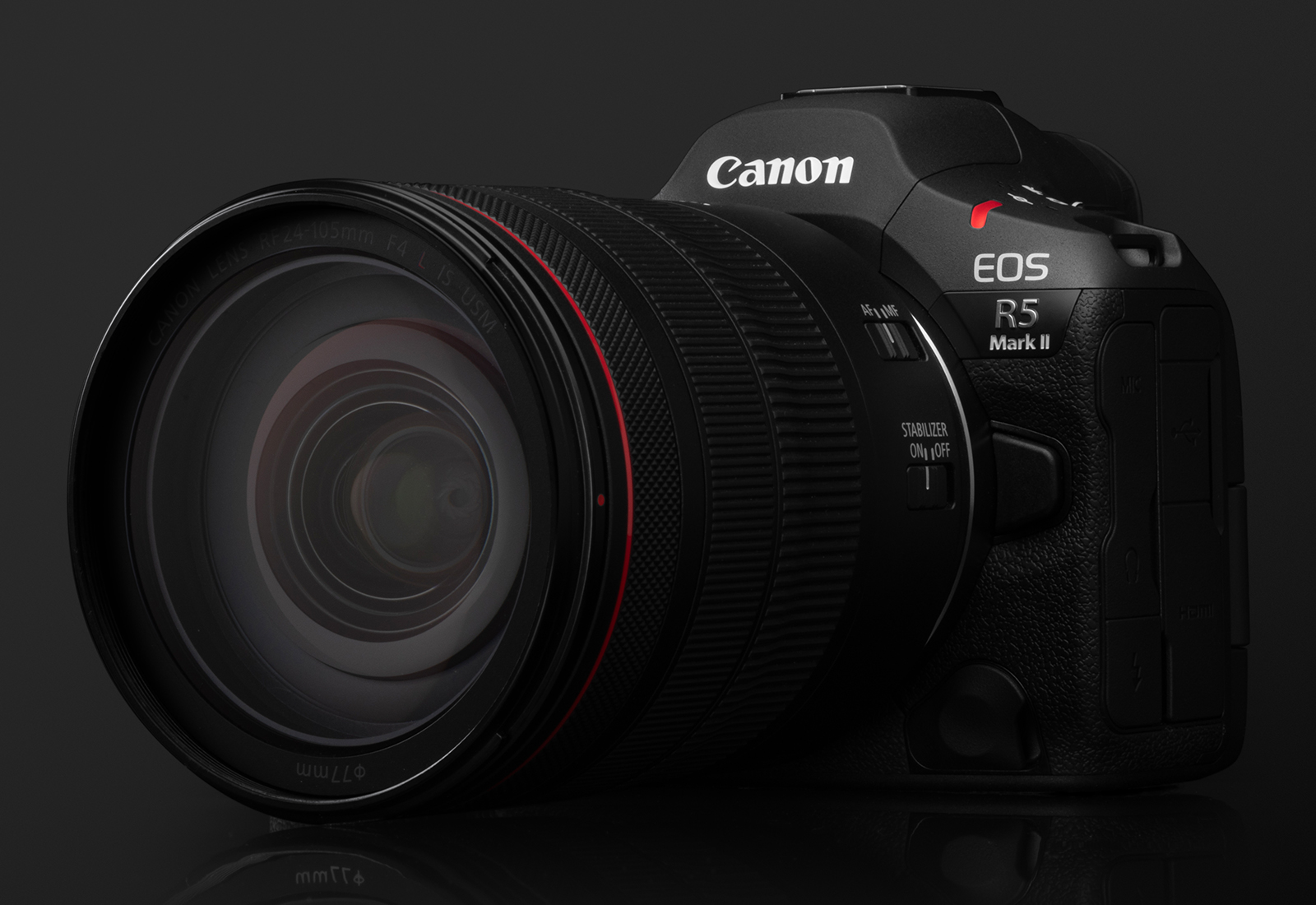
Canon EOS R5 Mark II is a high-resolution full-frame mirrorless camera built for creators who need serious photography and advanced video in one body.
Released in August 2024, the Canon EOS R5 Mark II improves on the original EOS R5 with a new stacked full-frame sensor, faster processing, stronger autofocus, Canon Log 2, 8K RAW recording, 4K 120p slow motion and better integration with Canon’s Cinema EOS-style video workflow.
The camera uses a 36 x 24mm full-frame sensor and records still images up to 8192 x 5464. It uses the Canon RF mount and supports professional Canon RF lenses, hybrid RF lenses, EF lenses through adapters and selected cinema-style workflows.
For photographers, the EOS R5 Mark II is a 45MP-class camera for portraits, weddings, wildlife, events, landscapes, commercial work and editorial assignments. For video creators, it offers 8K DCI, 8K UHD, 4K DCI, 4K UHD, Canon RAW, XF-AVC, XF-HEVC, Canon Log 2 and Canon Log 3.
The camera is not a dedicated cinema body like the EOS C80 or EOS C50, but it is one of Canon’s most powerful hybrid cameras for users who need both high-resolution stills and professional video.
Key Camera Specifications
| Feature | Canon EOS R5 Mark II |
|---|---|
| Camera type | Full-frame hybrid mirrorless camera |
| Release period | August 2024 |
| Sensor format | Full frame 35mm |
| Sensor size | 36 x 24mm |
| Maximum photo resolution | 8192 x 5464 |
| Lens mount | Canon RF |
| Base sensitivity | ISO 800 in Canon Log 2 workflow |
| Main processing system | DIGIC Accelerator plus DIGIC X |
| Main video headline | 8K RAW and 4K120 |
| Best listed dynamic range | 13.3 stops at SNR=2 in provided lab data |
| Fastest listed rolling shutter | 7.1ms in 4K120 |
| 8K / 4K Fine rolling shutter | 17.3ms |
| Normal 4K rolling shutter | 9.7ms |
| Body weight | About 588 g |
| Dimensions | About 94 mm x 101 mm x 139 mm |
| Listed price | Around $3,899 before taxes |
| Best use | Hybrid stills, 8K video, weddings, portraits, wildlife and commercial work |
The EOS R5 Mark II is designed for creators who need more resolution than the EOS R6 line and more portability than a dedicated cinema camera.
Full-Frame 45MP Stacked Sensor
The Canon EOS R5 Mark II uses a full-frame stacked CMOS sensor with a maximum listed still-photo resolution of 8192 x 5464.
This resolution gives photographers strong detail for cropping, large prints, commercial images, landscapes, portraits and wildlife. It also supports 8K video capture, which gives editors more flexibility for reframing and oversampled 4K delivery.
The stacked sensor design is important because it improves readout speed compared with older sensor designs. That helps with autofocus, burst shooting, rolling shutter control and video capture.
Why the Sensor Matters
The EOS R5 Mark II sensor is built for hybrid work.
Photographers get high-resolution stills. Videographers get 8K capture and strong 4K modes. Hybrid creators get one camera that can handle client photos, social video, YouTube, commercial clips and professional campaigns.
The sensor also helps Canon position the R5 Mark II between the action-focused EOS R1 and the more affordable EOS R6-series cameras.
8K RAW Video
The Canon EOS R5 Mark II supports internal 8K RAW recording.
In the provided recording data, full-frame 8K DCI is listed at 8192 x 4320. Canon RAW is shown at 23.98p, 24p, 25p and 29.97p, while RAW Light extends to higher frame rates including 50p and 59.94p.
| Mode | Resolution | Codec | Maximum Listed Frame Rate |
| 8K DCI | 8192 x 4320 | Canon RAW | Up to 29.97p |
| 8K DCI | 8192 x 4320 | Canon RAW Light | Up to 59.94p |
| 8K DCI | 8192 x 4320 | XF-HEVC S | Up to 29.97p |
| 4K DCI | 4096 x 2160 | XF-AVC / XF-HEVC | Up to 120p |
| 4K UHD | 3840 x 2160 | XF-AVC / XF-HEVC | Up to 120p |
The pasted camera database also includes ProRes RAW entries. For accuracy, users should treat Canon RAW and RAW Light as the core internal Canon workflow, while ProRes RAW may depend on external recording or specific database context.
8K DCI and 8K UHD
The EOS R5 Mark II supports both 8K DCI and 8K UHD formats.
8K DCI uses a wider 17:9 cinema frame, while 8K UHD is suited to 16:9 video delivery. This gives creators flexibility depending on whether the project is cinema-style, online, broadcast or client-focused.
Why 8K Matters
Most creators will still deliver in 4K, but 8K capture gives extra room.
Editors can crop, stabilise, reframe, create vertical versions, pull stills and downsample to a detailed 4K master. For commercials, wildlife, interviews and high-end online content, that extra resolution can be valuable.
The trade-off is storage. 8K RAW and high-bitrate 8K files need fast cards, large drives and a strong editing system.
4K Fine and Normal 4K
The EOS R5 Mark II offers more than one type of 4K recording.
4K Fine uses a higher-quality readout and gives strong detail, but it has slower rolling-shutter performance. Normal 4K has faster readout, making it better for movement, handheld work and documentary-style shooting.
| 4K Mode | Main Advantage | Main Trade-Off |
| 4K Fine | Higher image detail and strong dynamic range | Slower 17.3ms rolling shutter |
| Normal 4K | Faster 9.7ms rolling shutter | Potentially less fine detail |
| 4K120 | Slow motion and fastest 7.1ms rolling shutter | Higher data and possible workflow limits |
This means the best 4K mode depends on the project. Interviews and controlled scenes may benefit from 4K Fine. Action, gimbal work and handheld movement may benefit from normal 4K or 4K120.
Dynamic Range Performance
The provided lab data lists a maximum dynamic range of 13.3 stops at SNR=2 in full-frame 4096 x 2160 XF-AVC at ISO 800 and Canon Log 2 in 4K Fine mode.
The data also shows 13.2 stops at SNR=2 in 4K XF-HEVC and 12.5 stops at SNR=2 in 4K120 XF-AVC. In 8K Canon RAW, the measured result is lower at 10.8 stops at SNR=2.
| Sensor Mode | Resolution | Codec | Frame Rate | ISO | Gamma | Measured Dynamic Range |
| Full Frame | 8192 x 4320 | XF-HEVC | 25p | 800 | CLog2 | 11.9 stops at SNR=2 |
| Full Frame | 8192 x 4320 | Canon RAW | 25p | 800 | CLog2 | 10.8 stops at SNR=2 |
| Full Frame | 4096 x 2160 | XF-HEVC | 25p | 800 | CLog2 | 13.2 stops at SNR=2 |
| Full Frame | 4096 x 2160 | XF-AVC | 25p | 800 | CLog2 | 13.1 stops at SNR=2 |
| Full Frame | 4096 x 2160 | Canon SRAW | 25p | 800 | CLog2 | 11.4 stops at SNR=2 |
| Full Frame 4K Fine | 4096 x 2160 | XF-HEVC | 25p | 800 | CLog2 | 13.2 stops at SNR=2 |
| Full Frame 4K Fine | 4096 x 2160 | XF-AVC | 25p | 800 | CLog2 | 13.3 stops at SNR=2 |
| Full Frame | 4096 x 2160 | XF-AVC | 120p | 800 | CLog2 | 12.5 stops at SNR=2 |
The key lesson is that compressed 4K modes show the strongest measured dynamic-range results. RAW offers more post-production control, but the measured SNR=2 figure is lower because RAW output is less processed and noisier.
What Dynamic Range Means for Creators
Dynamic range affects how much detail a camera can hold between bright highlights and dark shadows.
This matters when filming skies, windows, wedding dresses, concerts, night scenes, outdoor interviews and backlit subjects. The EOS R5 Mark II performs strongly in Canon Log 2, especially in 4K Fine XF-AVC.
For best results, protect highlights, avoid deep underexposure and monitor exposure carefully with waveform, zebras or false-colour tools when available.
Rolling Shutter Performance
Rolling shutter varies strongly by recording mode on the Canon EOS R5 Mark II.
The provided data lists 17.3ms in 8K Canon RAW, 8K XF-HEVC, Canon SRAW and full-frame 4K Fine. Normal 4K XF-AVC and XF-HEVC improve to 9.7ms, while 4K120 improves further to 7.1ms.
| Sensor Mode | Resolution | Codec | Frame Rate | Rolling Shutter |
| Full Sensor | 8192 x 4320 | Canon RAW | 25p | 17.3ms |
| Full Sensor | 8192 x 4320 | XF-HEVC | 25p | 17.3ms |
| Full Sensor 4K Fine | 4096 x 2160 | XF-AVC | 25p | 17.3ms |
| Full Sensor 4K Fine | 4096 x 2160 | XF-HEVC | 25p | 17.3ms |
| Full Sensor | 4096 x 2160 | Canon SRAW | 25p | 17.3ms |
| Full Sensor | 4096 x 2160 | XF-AVC | 25p | 9.7ms |
| Full Sensor | 4096 x 2160 | XF-AVC | 60p | 9.7ms |
| Full Sensor | 4096 x 2160 | XF-HEVC | 25p | 9.7ms |
| Full Sensor | 4096 x 2160 | XF-AVC | 120p | 7.1ms |
This makes mode choice important. The sharpest and highest-resolution modes have slower readout, while normal 4K and 4K120 are better for motion.
Why Rolling Shutter Matters
Rolling shutter can distort fast movement.
Quick pans may bend vertical lines, and fast-moving subjects may appear skewed. This matters for sports, dance, wildlife, vehicles, handheld documentary shooting and fast gimbal moves.
For controlled interviews, product videos and static scenes, 8K or 4K Fine may be ideal. For action, normal 4K or 4K120 is safer.
Canon Log 2 and Canon Log 3
The EOS R5 Mark II supports Canon Log 2 and Canon Log 3.
Canon Log 2 is best for maximum grading flexibility and dynamic-range control. Canon Log 3 is easier to grade and works better for faster delivery workflows.
| Profile | Best For |
| Canon Log 2 | Maximum grading flexibility |
| Canon Log 3 | Faster grading and easier matching |
| HDR PQ | HDR delivery |
| Standard profiles | Quick turnaround with less grading |
For creators working with Cinema EOS cameras, Canon Log 2 helps the EOS R5 Mark II fit better into a multi-camera Canon workflow.
XF-AVC and XF-HEVC Recording
The Canon EOS R5 Mark II supports XF-AVC and XF-HEVC S recording.
XF-AVC is a professional 10-bit codec that is easier to edit than RAW while still giving strong image quality. XF-HEVC S gives efficient compression, especially for high-resolution recording such as 8K.
In the provided data, 8K DCI XF-HEVC S options include 10-bit 4:2:2 and 10-bit 4:2:0 modes with different data rates.
RAW vs XF-AVC
Canon RAW is best when maximum post-production control is required.
XF-AVC is better for many real-world jobs because it is easier to manage, records strong dynamic range in lab results and reduces workflow pressure. XF-HEVC is useful when 8K recording needs more efficient compression.
For many creators, 4K XF-AVC may be the best everyday mode.
High Frame Rates
The EOS R5 Mark II supports 4K up to 120fps.
4K120 is useful for slow motion in sports, wildlife, weddings, music videos, product shots and commercial content. It also gives the fastest rolling-shutter result in the provided data at 7.1ms.
Why 4K120 Matters
4K120 gives creators smooth slow motion while keeping high resolution.
Footage can be slowed down in a 24p, 25p or 30p timeline for dramatic movement. This is useful for action, dancing, animals, water, fashion, sports and emotional wedding details.
For hybrid creators, 4K120 is one of the most practical video features of the EOS R5 Mark II.
Photography Performance
The Canon EOS R5 Mark II is also a serious photography camera.
Its 45MP-class full-frame sensor gives high-resolution stills for landscapes, portraits, events, wildlife, commercial work and editorial photography. The camera also supports fast burst shooting, advanced autofocus and Canon’s newer action-recognition features.
Best Photo Uses
The EOS R5 Mark II is ideal for:
Portrait photography
Wedding photography
Landscape photography
Wildlife photography
Commercial stills
Travel photography
Event coverage
Fashion shoots
Editorial work
Sports in selected situations
Hybrid content production
It is especially strong when the user needs high-resolution stills and advanced video from one body.
Autofocus and Subject Tracking
Canon EOS R5 Mark II uses Canon’s advanced autofocus system with newer subject detection and tracking features.
The camera is designed to recognise people, animals and vehicles. It also benefits from Canon’s action-focused processing improvements, making it more capable than the original EOS R5 for fast-moving scenes.
Why Autofocus Matters
Hybrid creators often work without a focus puller.
Strong autofocus helps during weddings, interviews, events, wildlife, travel, YouTube production and documentary work. It also helps photographers capture unpredictable subjects.
Manual focus still matters for cinema-style production, but autofocus is a major everyday strength of the EOS R5 Mark II.
In-Body Image Stabilisation
The Canon EOS R5 Mark II includes in-body image stabilisation.
IBIS helps reduce camera shake for both stills and video. When paired with compatible RF lenses, coordinated stabilisation can improve handheld shooting.
Why IBIS Matters
IBIS helps creators work with smaller rigs.
It can improve handheld video, low-light stills, travel content and event coverage. It is not a replacement for a tripod or gimbal, but it makes the camera more flexible for real-world work.
For solo creators, stabilisation is a major advantage.
RF Lens Mount
The EOS R5 Mark II uses Canon’s RF mount.
RF mount gives creators access to Canon’s modern mirrorless lenses, including fast primes, L-series zooms, hybrid video lenses, macro lenses and super-telephoto options. EF lenses can also be used through Canon adapters.
| Lens Workflow | Best For |
| RF L-series lenses | Professional stills and video |
| RF hybrid lenses | Video-focused creators |
| RF compact primes | Travel and lightweight shooting |
| RF super-telephotos | Wildlife and sports |
| EF lenses with adapter | Existing Canon DSLR owners |
| Cinema lenses | Manual-focus video work |
The RF mount makes the R5 Mark II part of Canon’s modern stills and video ecosystem.
Media and Storage
The EOS R5 Mark II uses high-speed media for demanding recording modes.
8K RAW, 8K XF-HEVC, 4K120 and high-resolution stills require fast cards and strong storage planning. The camera’s advanced modes can create large files quickly.
Media Planning Tips
Use fast CFexpress cards for 8K RAW and high-bitrate modes.
Use SD cards for lighter recording, stills or backup workflows where supported. Always test media before paid work.
High-resolution video needs a full backup plan, not just a camera card.
Heat and Long Recording
The EOS R5 Mark II improves on the original R5, but it is still a compact hybrid camera.
Demanding modes such as 8K RAW, 8K XF-HEVC and 4K120 can create heat and large files. Canon offers cooling accessory options for users who need longer recording times.
What This Means for Creators
The camera is powerful, but mode choice matters.
For short clips, commercials, social video, weddings and hybrid work, the EOS R5 Mark II is very capable. For long interviews, events or continuous recording, creators should test the exact mode, card type, ambient temperature and power setup before production.
A dedicated Cinema EOS camera may still be better for long-form video.
Body Design
The Canon EOS R5 Mark II uses a compact mirrorless body.
At about 588 g in the provided database extract, it is much lighter than a Cinema EOS camera. This makes it useful for travel, handheld shooting, gimbals, weddings, events and hybrid photo-video work.
The body includes a traditional stills-camera shape, electronic viewfinder, rear screen and familiar Canon controls.
Who Will Like the Body
Photographers moving from Canon EOS R or EOS DSLR systems will find the camera familiar.
Video creators will appreciate the compact size and high-end video modes, but may need accessories for audio, cooling, monitoring, power and rigging.
The EOS R5 Mark II is best when portability and hybrid flexibility matter.
Best Uses for the Canon EOS R5 Mark II
The Canon EOS R5 Mark II is best for creators who need high-resolution photos and advanced video from one compact body.
It is ideal for:
Wedding photography
Portrait photography
Landscape photography
Wildlife photography
Commercial stills
Fashion shoots
Travel filmmaking
YouTube production
Music videos
Documentary clips
Social media campaigns
Corporate video
Product videos
Hybrid client work
Editorial assignments
The camera is strongest when users need both 45MP stills and 8K/4K video tools.
Canon EOS R5 Mark II vs Canon EOS R5
The EOS R5 Mark II improves the original EOS R5 in processing, autofocus, video tools and workflow.
| Feature | Canon EOS R5 Mark II | Canon EOS R5 |
| Sensor class | 45MP stacked full-frame | 45MP full-frame |
| Processing | DIGIC Accelerator plus DIGIC X | DIGIC X |
| Maximum internal RAW video | 8K 60p class | 8K RAW up to 30p class |
| Canon Log 2 | Yes | No |
| 4K120 | Yes | Yes |
| Autofocus | Newer action-focused system | Earlier Dual Pixel CMOS AF II |
| Main advantage | Faster hybrid workflow | Lower used-market price |
The original R5 remains capable, but the Mark II is better for creators who need stronger video and action performance.
Canon EOS R5 Mark II vs Canon EOS R1
The EOS R1 is the flagship action camera, while the EOS R5 Mark II is the higher-resolution hybrid.
| Feature | Canon EOS R5 Mark II | Canon EOS R1 |
| Sensor resolution | 45MP class | 24MP class |
| Body style | Compact hybrid body | Integrated-grip flagship |
| Main audience | Hybrid creators | Sports and news professionals |
| Video headline | 8K RAW | 6K RAW |
| Best advantage | Resolution and 8K workflow | Speed, durability and action AF |
The R5 Mark II is better for resolution and 8K capture. The R1 is better for professional action and rugged field use.
Canon EOS R5 Mark II vs Canon EOS C80
The EOS C80 is a dedicated cinema camera, while the R5 Mark II is a hybrid stills/video body.
| Feature | Canon EOS R5 Mark II | Canon EOS C80 |
| Camera type | Hybrid mirrorless | Cinema EOS |
| Sensor format | Full frame | Full frame |
| Maximum video | 8K RAW | 6K RAW |
| Built-in ND filters | No | Yes |
| Professional audio | Accessory-based | Built-in cinema workflow |
| Best advantage | High-resolution stills and 8K | Cinema ergonomics and ND filters |
The R5 Mark II is better for hybrid creators. The C80 is better for video-first productions that need built-in ND filters, SDI and production audio.
Key Takeaways
- Canon EOS R5 Mark II was released in August 2024.
- It uses a 36 x 24mm full-frame stacked sensor.
- Maximum still-photo resolution is 8192 x 5464.
- The camera uses the Canon RF mount.
- Canon Log 2 base sensitivity is ISO 800.
- It supports internal 8K RAW and 8K RAW Light workflows.
- It supports 4K recording up to 120fps.
- Canon Log 2 and Canon Log 3 are supported.
- The provided lab data lists 13.3 stops at SNR=2 in 4K Fine XF-AVC.
- 8K Canon RAW measured 10.8 stops at SNR=2 in the provided data.
- 8K XF-HEVC measured 11.9 stops at SNR=2.
- Rolling shutter is 17.3ms in 8K and 4K Fine modes.
- Normal 4K improves to 9.7ms.
- 4K120 improves to 7.1ms.
- The camera includes in-body image stabilisation.
- It is best for hybrid creators who need 45MP stills and advanced video tools.
Frequently Asked Questions
What is the Canon EOS R5 Mark II?
Canon EOS R5 Mark II is a high-resolution full-frame hybrid mirrorless camera with 45MP-class stills, 8K RAW recording, 4K120, Canon Log 2 and advanced autofocus.
When was the Canon EOS R5 Mark II released?
The Canon EOS R5 Mark II was released in August 2024.
What sensor does it use?
It uses a 36 x 24mm full-frame stacked CMOS sensor.
What is the maximum photo resolution?
The maximum listed still-photo resolution is 8192 x 5464.
What lens mount does it use?
The camera uses the Canon RF mount and can use EF lenses through Canon adapters.
Does the Canon EOS R5 Mark II shoot 8K RAW?
Yes. It supports internal 8K RAW and RAW Light recording workflows.
Does it shoot 4K120?
Yes. The EOS R5 Mark II supports 4K recording up to 120fps.
Does it support Canon Log 2?
Yes. Canon Log 2 and Canon Log 3 are supported.
What dynamic range did the provided lab data show?
The provided lab data lists a maximum of 13.3 stops at SNR=2 in full-frame 4K Fine XF-AVC at ISO 800 and Canon Log 2.
What is the rolling-shutter result?
The provided lab data lists 17.3ms in 8K and 4K Fine modes, 9.7ms in normal 4K modes and 7.1ms in 4K120.
Is the EOS R5 Mark II good for video?
Yes. It is one of Canon’s strongest hybrid video cameras, with 8K RAW, 4K120, CLog2, CLog3, strong autofocus and high-resolution full-frame capture.
Who should buy the Canon EOS R5 Mark II?
It is best for hybrid creators, photographers, filmmakers, wedding shooters, commercial creators and content producers who need high-resolution stills and advanced video in one body.
Conclusion
Canon EOS R5 Mark II is one of Canon’s most capable hybrid cameras.
Its 45MP-class stacked full-frame sensor, RF mount, 8K RAW, 4K120, Canon Log 2, Canon Log 3, in-body image stabilisation, advanced autofocus and compact body make it a serious tool for photographers and video creators.
The lab data shows that the camera performs best in compressed 4K modes for dynamic range, with 4K Fine XF-AVC reaching 13.3 stops at SNR=2. RAW modes offer more post-production control, but they measure lower in SNR=2 dynamic range because they are noisier and less processed. Rolling shutter also depends heavily on mode, with 8K and 4K Fine at 17.3ms, normal 4K at 9.7ms and 4K120 at 7.1ms.
The EOS R5 Mark II is not a replacement for a dedicated Cinema EOS body when built-in ND filters, SDI, XLR audio and long-form video ergonomics matter. However, for creators who need high-resolution photos, 8K video and strong Canon colour in one compact system, the Canon EOS R5 Mark II is one of the most complete hybrid cameras available.
Read Also: Canon EOS C80: Specs, Dynamic Range, Rolling Shutter and Video Features