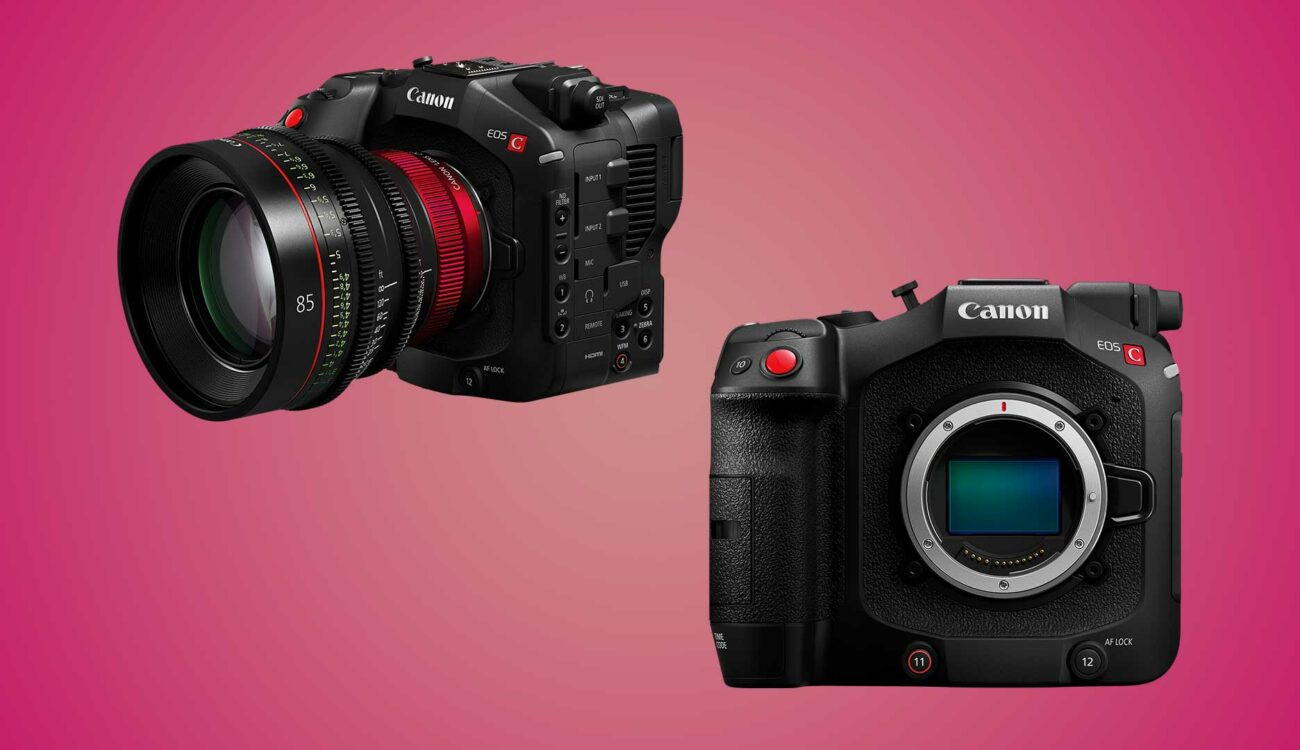
Canon EOS C80 is a compact full-frame Cinema EOS camera built for filmmakers, documentary shooters, commercial creators and small production teams that need professional video features in a portable RF-mount body.
Released in September 2024, the Canon EOS C80 sits between the smaller creator-focused hybrid cameras and Canon’s larger cinema production bodies. It brings a 6K full-frame back-illuminated sensor, triple base ISO, Cinema RAW Light, XF-AVC, 4K120, built-in ND filters, 12G-SDI, Ethernet, professional audio and Dual Pixel CMOS AF II into a body that remains close to the compact C70 style.
The camera uses a full-frame sensor area of about 36 x 19 mm for its main 17:9 recording modes. It records 6K 17:9 at 6000 x 3164, 4K DCI at 4096 x 2160, 4K UHD at 3840 x 2160, 2K and HD. It also supports Super 35 crop modes, including 4.3K RAW and 4K DCI.
The Canon EOS C80 is designed for video-first production. It is not a stills hybrid like the EOS R5 Mark II or EOS R6 Mark III. It is a cinema camera for users who need built-in ND filters, professional connections, reliable audio, long recording workflows and Canon colour in a smaller full-frame body.
Key Camera Specifications
| Feature | Canon EOS C80 |
|---|---|
| Camera type | Full-frame Cinema EOS camera |
| Release period | September 2024 |
| Sensor format | Full frame 35mm |
| Main sensor area | 36 x 19 mm |
| Maximum full-frame recording | 6000 x 3164 |
| Lens mount | Canon RF |
| Adapter support | EF and PL workflows through adapters |
| Processor | DIGIC DV7 |
| Base sensitivity | ISO 800, 3200 and 12800 |
| Main RAW codec | Cinema RAW Light |
| Other codecs | XF-AVC, XF-AVC S and XF-HEVC S |
| Built-in ND filters | Yes |
| Best listed dynamic range | 13.3 stops at SNR=2 in provided lab data |
| Best listed rolling shutter | 6.9ms in S35 crop modes |
| Full-frame rolling shutter | 9.5ms in provided lab data |
| Body weight | About 1.31 kg |
| Dimensions | About 116 mm x 138 mm x 160 mm |
| Launch price | Around $5,499 before taxes |
| Best use | Documentaries, commercials, cinema, events and compact production |
The EOS C80’s strongest advantage is its balance. It offers many C400-style capabilities in a smaller body while keeping important cinema features that mirrorless bodies often lack.
Full-Frame 6K Sensor
The Canon EOS C80 uses a 6K full-frame back-illuminated CMOS sensor.
In full-frame 17:9 mode, the camera records up to 6000 x 3164. This gives filmmakers enough resolution for 6K capture, oversampled 4K delivery, cropping, stabilisation and high-quality post-production.
The 36 x 19 mm sensor area gives the camera a wide cinematic field of view while keeping the 17:9 cinema aspect ratio. It also gives creators a shallower depth-of-field look than Super 35 cameras when using the same field of view and aperture.
Why the 6K Sensor Matters
A 6K full-frame sensor gives editors more flexibility than a native 4K sensor.
Footage can be downsampled to detailed 4K, reframed for different deliverables or cropped for stabilisation. This is useful for commercials, interviews, documentaries, online campaigns, music videos and corporate productions.
The 6K sensor also supports better oversampled 4K recording, which is one of the most practical reasons to choose the EOS C80 over older Cinema EOS models.
Cinema RAW Light Recording
The Canon EOS C80 records Cinema RAW Light internally.
Cinema RAW Light gives users a 12-bit RAW workflow with more grading flexibility than standard compressed codecs. It is especially useful for high-end commercial work, music videos, documentary projects and productions that need strong colour control.
In the provided data, the camera supports 6K 17:9 ProRes RAW listings at up to 59.94p, but Canon’s internal camera workflow is best described as Cinema RAW Light. For editorial accuracy, the safest production wording is 6K RAW and Cinema RAW Light rather than treating every database label as the same internal recording path.
| Recording Mode | Resolution | Sensor Area |
| FF 6K 17:9 | 6000 x 3164 | Full frame |
| S35 4.3K 17:9 | 4368 x 2304 | Super 35 crop |
| FF 4K 17:9 | 4096 x 2160 | Full frame |
| S35 4K 17:9 | 4096 x 2160 | Super 35 crop |
Cinema RAW Light is best when the project needs maximum flexibility. XF-AVC is better for faster turnaround and smaller files.
XF-AVC and XF-HEVC Workflows
The EOS C80 also supports XF-AVC, XF-AVC S and XF-HEVC S.
These formats make the camera practical for jobs where RAW is unnecessary or too heavy. XF-AVC gives editors a robust 10-bit 4:2:2 workflow, while XF-HEVC S offers more efficient compression for longer recording and smaller files.
RAW vs XF-AVC
Cinema RAW Light is best for maximum grading control.
XF-AVC is better for documentaries, interviews, corporate shoots, social campaigns and broadcast-style jobs where reliability, file size and turnaround speed matter. Many working crews will use XF-AVC as the everyday format and reserve RAW for premium scenes.
The EOS C80 gives both choices, which is one reason it fits many production styles.
Dynamic Range Performance
Canon promotes the EOS C80 as a high-dynamic-range Cinema EOS camera, especially when shooting in Canon Log 2.
In the provided lab data, the Canon EOS C80 reaches a maximum full-frame result of 13.3 stops at SNR=2 in 4096 x 2160 XF-AVC at ISO 800 and CLog2. In 4K XF-AVC at 60fps, it measures 13.1 stops at SNR=2. In 6K Canon RAW at ISO 800, it measures 10.7 stops at SNR=2.
| Sensor Mode | Resolution | Codec | Frame Rate | ISO | Gamma | Measured Dynamic Range |
| Full Frame | 6000 x 3164 | Canon RAW | 25p | 800 | CLog2 | 10.7 stops at SNR=2 |
| Full Frame | 6000 x 3164 | Canon RAW | 25p | 3200 | CLog2 | 9.58 stops at SNR=2 |
| Full Frame | 6000 x 3164 | Canon RAW | 25p | 12800 | CLog2 | 8.25 stops at SNR=2 |
| Full Frame | 4096 x 2160 | XF-AVC | 25p | 800 | CLog2 | 13.3 stops at SNR=2 |
| Full Frame | 4096 x 2160 | XF-AVC | 25p | 3200 | CLog2 | 11.3 stops at SNR=2 |
| Full Frame | 4096 x 2160 | XF-AVC | 25p | 12800 | CLog2 | 10.6 stops at SNR=2 |
| Full Frame | 4096 x 2160 | XF-AVC | 60p | 800 | CLog2 | 13.1 stops at SNR=2 |
| Full Frame | 4096 x 2160 | XF-AVC | 60p | 3200 | CLog2 | 11.6 stops at SNR=2 |
| Full Frame | 4096 x 2160 | XF-AVC | 60p | 12800 | CLog2 | 10.6 stops at SNR=2 |
The most important takeaway is that the EOS C80 performs best in full-frame 4K XF-AVC at ISO 800. RAW modes give more post-production flexibility, but the provided lab data shows lower measured SNR=2 dynamic range in 6K RAW.
What Dynamic Range Means for Filmmakers
Dynamic range affects how much detail a camera can preserve in bright highlights and dark shadows.
This matters when filming skies, windows, practical lights, stage lighting, night streets, reflective surfaces and backlit interviews. The Canon EOS C80 gives strong results in CLog2, especially in 4K XF-AVC, but it still rewards careful exposure.
The best workflow is to protect highlights, avoid deep underexposure and use waveform, false colour or zebras during production.
Triple Base ISO
The Canon EOS C80 has triple base ISO settings of 800, 3200 and 12800.
Triple base ISO is one of the camera’s most important features. It allows the camera to shift to different gain stages for different lighting conditions. ISO 800 is best for normal lighting and maximum image quality. ISO 3200 helps in dim interiors. ISO 12800 is useful for very low-light scenes.
However, the provided lab data shows that dynamic range drops at higher base ISO settings.
| Mode | ISO 800 | ISO 3200 | ISO 12800 |
| 6K Canon RAW 25p | 10.7 stops | 9.58 stops | 8.25 stops |
| 4K XF-AVC 25p | 13.3 stops | 11.3 stops | 10.6 stops |
| 4K XF-AVC 60p | 13.1 stops | 11.6 stops | 10.6 stops |
ISO 800 remains the strongest choice when lighting can be controlled. ISO 3200 and ISO 12800 are valuable when the scene cannot be lit easily.
Rolling Shutter Performance
The Canon EOS C80 has strong rolling-shutter performance for a full-frame cinema camera.
In the provided lab data, full-frame 6K Canon RAW, full-frame 4K XF-AVC 25p and full-frame 4K XF-AVC 60p all measure 9.5ms. In Super 35 crop modes, the result improves to 6.9ms.
| Sensor Mode | Resolution | Codec | Frame Rate | Rolling Shutter |
| Full Sensor | 6000 x 3164 | Canon RAW | 25p | 9.5ms |
| Full Sensor | 4096 x 2160 | XF-AVC | 25p | 9.5ms |
| Full Sensor | 4096 x 2160 | XF-AVC | 60p | 9.5ms |
| S35 crop | 4368 x 2304 | Canon RAW | 25p | 6.9ms |
| S35 crop | 4368 x 2304 | Canon RAW | 60p | 6.9ms |
| S35 crop | 4096 x 2160 | XF-AVC | 25p | 6.9ms |
| S35 crop | 4096 x 2160 | XF-AVC | 60p | 6.9ms |
These figures make the EOS C80 more suitable for movement than many slower full-frame cameras.
Why Rolling Shutter Matters
Rolling shutter can make fast movement look distorted.
Quick pans may bend vertical lines, and fast-moving subjects can appear skewed. The EOS C80’s 9.5ms full-frame readout is strong enough for many documentary, handheld, gimbal and commercial workflows.
For faster action, the S35 crop modes offer even better readout performance.
Recording Formats
The Canon EOS C80 supports full-frame and Super 35 recording formats.
| Recording Format | Resolution |
| FF 6K 17:9 | 6000 x 3164 |
| FF 4K 17:9 | 4096 x 2160 |
| FF 4K 16:9 | 3840 x 2160 |
| FF 2K 17:9 | 2048 x 1080 |
| FF HD 16:9 | 1920 x 1080 |
| S35 4.3K 17:9 | 4368 x 2304 |
| S35 4K 17:9 | 4096 x 2160 |
| S35 4K 16:9 | 3840 x 2160 |
| S35 2K 17:9 | 2048 x 1080 |
| S35 HD 16:9 | 1920 x 1080 |
This makes the EOS C80 useful for full-frame projects, Super 35 lens workflows and multi-camera setups where different lenses or formats are required.
4K120 and Slow Motion
The Canon EOS C80 supports 4K recording up to 120fps.
4K120 is useful for slow motion in commercials, music videos, wedding films, sports, fashion, product shots and cinematic B-roll. Depending on mode, high frame rates may use crop or compression settings, so users should confirm the exact field of view before production.
Why 4K120 Matters
Slow motion helps add visual impact.
A 120fps clip can be slowed in a 24p, 25p or 30p timeline for dramatic movement. It is especially useful for motion details, sports-style visuals, dance, pouring liquids, product reveals and emotional wedding moments.
For a compact cinema body, 4K120 is a major creative advantage.
Built-In ND Filters
Built-in ND filters are one of the strongest practical reasons to choose the Canon EOS C80 over a hybrid mirrorless camera.
The camera includes internal ND filters with standard 2-stop, 4-stop and 6-stop options, plus extended ND settings up to 10 stops.
Why ND Filters Matter
ND filters help control exposure without changing shutter angle, aperture or ISO.
This is essential for professional video. In bright daylight, ND filters allow filmmakers to keep natural motion blur and the desired depth of field. Without ND filters, users may need to stop down the lens or increase shutter speed, which changes the image style.
For documentary and outdoor production, built-in ND filters save time and reduce rigging.
RF Lens Mount
The Canon EOS C80 uses the RF mount.
RF mount gives filmmakers access to Canon’s modern mirrorless lenses, including L-series zooms, compact primes, hybrid video lenses and stabilised optics. The camera can also work with EF and PL lenses through adapters.
| Lens Workflow | Best For |
| RF lenses | Native autofocus, stabilisation and modern optics |
| RF L-series zooms | Professional documentary and commercial work |
| RF primes | Lightweight cinema-style shooting |
| EF lenses with adapter | Existing Canon DSLR lens owners |
| PL lenses with adapter | Cinema primes and production lenses |
| Drop-in EF adapter | ND or polariser workflows with EF lenses |
The RF mount makes the EOS C80 flexible for both solo creators and larger crews.
Dual Pixel CMOS AF II
The Canon EOS C80 supports Dual Pixel CMOS AF II.
This is a major benefit for documentary, interview, event, gimbal and solo production. Canon’s autofocus system can track people and other subjects, making the camera more usable when there is no focus puller.
Why Autofocus Matters
Cinema cameras are often used with manual focus, but modern production is changing.
Solo filmmakers, wedding shooters, YouTubers, event creators and documentary operators often need reliable autofocus. The EOS C80 gives those users Canon’s strong AF performance in a cinema body.
Manual focus remains important for narrative and controlled work, but autofocus gives the C80 more flexibility.
Professional Audio
The Canon EOS C80 includes professional audio tools.
It has two mini XLR inputs with phantom power, a 3.5mm microphone input and dedicated audio controls. This allows users to connect professional microphones, wireless systems and mixers directly to the camera.
Why XLR Audio Matters
Good audio is essential for professional video.
XLR inputs are more reliable than simple consumer microphone connections. They support professional microphones and give crews better control over sound levels.
For interviews, documentaries, corporate shoots and events, the EOS C80’s audio system is a major advantage.
SDI, Ethernet and Production Connectivity
The EOS C80 includes 12G-SDI output and Ethernet.
This makes it more production-ready than smaller mirrorless cameras. SDI is useful for professional monitoring and video transmission. Ethernet helps with remote operation, live production and network workflows.
Why Professional I/O Matters
Professional sets need reliable connections.
SDI is more secure than HDMI for long cable runs and production monitors. Ethernet supports remote camera control and production environments where cameras need to integrate with network systems.
These features make the EOS C80 useful for documentary crews, live production, virtual production and multi-camera setups.
Media and Storage
The Canon EOS C80 records to dual SD card slots.
This keeps the camera compact and media costs more manageable than CFexpress-based systems. However, fast V90-class SD cards are important for the most demanding modes.
The camera supports relay recording, simultaneous recording and proxy workflows depending on settings.
Media Planning Tips
Use fast, approved SD cards for paid work.
RAW, 4K and high-frame-rate modes need reliable media. Slower cards may limit recording options or fail during capture. For professional work, test cards before production and back up footage before reusing media.
Dual SD slots are useful, but they do not remove the need for careful data management.
Body Design and Handling
The Canon EOS C80 uses a compact Cinema EOS body.
At about 1.31 kg, it is heavier than small mirrorless cameras but much lighter than many full-size cinema cameras. Its body design is well suited to handheld rigs, tripods, shoulder setups, gimbals and compact documentary kits.
Why the Body Works
The EOS C80 gives users physical controls and cinema ergonomics without becoming too large.
It improves on the compact C70-style concept by adding full-frame recording and stronger production connections. For small crews, this balance is very important.
It is a camera that can be stripped down for travel or built up for serious production.
Image Stabilisation
The EOS C80 does not use sensor-shift IBIS like many hybrid mirrorless cameras.
Instead, it supports optical and digital stabilisation workflows depending on lens and mode. With supported lenses, electronic stabilisation and lens stabilisation can help reduce handheld shake.
What This Means in Practice
The camera can work handheld, but it benefits from support.
Use stabilised RF lenses, a shoulder rig, tripod, monopod or gimbal when movement needs to be smoother. Digital stabilisation can help, but it may introduce a crop.
For the most stable results, physical support is still the best option.
Best Uses for the Canon EOS C80
The Canon EOS C80 is best for video professionals who need a compact but serious cinema camera.
It is ideal for:
Documentaries
Commercial videos
Corporate films
Music videos
Interviews
Live production
Virtual production
Wedding films
Event coverage
YouTube production
Small film crews
Gimbal work
Travel productions
B-camera setups
Social media campaigns
Educational content
The camera is especially strong when users need built-in ND filters, professional audio, SDI, triple base ISO and 6K full-frame capture in one body.
Canon EOS C80 vs Canon EOS C70
The EOS C80 is the more advanced full-frame successor-style option for many C70 users.
| Feature | Canon EOS C80 | Canon EOS C70 |
| Sensor format | Full frame | Super 35 |
| Maximum RAW resolution | 6K | 4K class |
| Lens mount | RF | RF |
| Base ISO system | Triple base ISO | DGO-style Super 35 workflow |
| Built-in ND filters | Yes | Yes |
| SDI output | Yes | No built-in SDI |
| Best advantage | Full frame, 6K and SDI | Strong Super 35 image and value |
The C70 remains useful, especially for Super 35 users. The C80 is better for creators who want full-frame 6K capture and stronger production connectivity.
Canon EOS C80 vs Canon EOS C50
The EOS C80 is larger and more production-focused than the EOS C50.
| Feature | Canon EOS C80 | Canon EOS C50 |
| Camera line | Cinema EOS | Cinema EOS |
| Sensor format | Full frame | Full frame |
| Maximum RAW mode | 6K 17:9 | 7K Open Gate |
| Built-in ND filters | Yes | No |
| IBIS | No sensor-shift IBIS | No sensor-shift IBIS |
| Audio | Built into cinema body | Detachable handle workflow |
| Best advantage | Built-in ND and production body | Smaller size and Open Gate |
The C50 is better for users who need the smallest full-frame Cinema EOS body and Open Gate. The C80 is better for crews that need built-in ND filters, SDI and a more complete production camera.
Canon EOS C80 vs Canon EOS C400
The EOS C400 sits higher in Canon’s Cinema EOS lineup.
| Feature | Canon EOS C80 | Canon EOS C400 |
| Sensor format | Full frame | Full frame |
| Maximum RAW mode | 6K 30p class | 6K 60p class |
| Body size | Smaller | Larger |
| Production features | Strong compact cinema body | More complete cinema body |
| Price class | Lower | Higher |
| Best advantage | Compact value | Higher-end production flexibility |
The C400 is better for productions that need more high-end features and 6K60 RAW. The C80 is better for users who want many of the same core image benefits in a smaller and cheaper body.
Canon EOS C80 vs Canon EOS R5 C
The EOS R5 C is a hybrid cinema-stills camera, while the EOS C80 is a dedicated cinema body.
| Feature | Canon EOS C80 | Canon EOS R5 C |
| Camera type | Cinema EOS video camera | Hybrid cinema-stills body |
| Sensor format | Full frame | Full frame |
| Maximum resolution | 6K video | 8K video |
| Built-in ND filters | Yes | No |
| Professional audio | Stronger built-in cinema workflow | Accessory-based |
| Best advantage | Production ergonomics | Higher-resolution hybrid capture |
The R5 C is better for users who need 8K and stills capability. The C80 is better for dedicated video production.
Key Takeaways
- Canon EOS C80 was released in September 2024.
- It uses a full-frame 36 x 19 mm sensor area for its main recording modes.
- The camera records 6K 17:9 at 6000 x 3164.
- The Canon RF mount is used.
- EF and PL workflows are possible through adapters.
- Triple base ISO settings are 800, 3200 and 12800.
- The provided lab data lists 13.3 stops at SNR=2 in full-frame 4K XF-AVC at ISO 800.
- The provided lab data lists 13.1 stops at SNR=2 in full-frame 4K XF-AVC 60p at ISO 800.
- 6K Canon RAW measured 10.7 stops at SNR=2 in the provided data.
- Full-frame rolling shutter is listed at 9.5ms.
- Super 35 crop rolling shutter improves to 6.9ms.
- The camera supports Cinema RAW Light, XF-AVC, XF-AVC S and XF-HEVC S.
- Built-in ND filters are included.
- Dual Pixel CMOS AF II is supported.
- The camera includes SDI, Ethernet and professional audio.
- It records to dual SD cards.
- It is best for documentaries, commercials, events, interviews and compact cinema production.
Frequently Asked Questions
What is the Canon EOS C80?
Canon EOS C80 is a compact full-frame Cinema EOS camera with 6K RAW recording, triple base ISO, RF mount, built-in ND filters, SDI and professional video tools.
When was the Canon EOS C80 released?
The Canon EOS C80 was released in September 2024.
What sensor does the Canon EOS C80 use?
It uses a full-frame back-illuminated CMOS sensor with a 36 x 19 mm recording area in its main full-frame 17:9 modes.
What is the maximum recording resolution?
The maximum listed full-frame recording format is 6000 x 3164 in 6K 17:9.
What lens mount does it use?
The EOS C80 uses the Canon RF mount. EF and PL lens workflows are possible through adapters.
Does the Canon EOS C80 record RAW?
Yes. It supports Cinema RAW Light recording.
Does the EOS C80 shoot 4K120?
Yes. The camera supports 4K recording up to 120fps depending on format and sensor mode.
What is triple base ISO?
Triple base ISO gives the camera three base sensitivity settings: ISO 800, ISO 3200 and ISO 12800. These settings help the camera work across different lighting conditions.
What dynamic range did the provided lab data show?
The provided lab data lists a maximum of 13.3 stops at SNR=2 in full-frame 4096 x 2160 XF-AVC at ISO 800 and CLog2.
What is the rolling-shutter result?
The provided lab data lists 9.5ms in full-frame modes and 6.9ms in Super 35 crop modes.
Does the Canon EOS C80 have built-in ND filters?
Yes. The camera includes built-in ND filters, including extended ND options up to 10 stops.
Who should buy the Canon EOS C80?
The Canon EOS C80 is best for filmmakers, documentary shooters, commercial crews, event videographers and small production teams that need a compact full-frame cinema camera with built-in ND filters, professional audio and strong Canon colour.
Conclusion
Canon EOS C80 is one of Canon’s most balanced compact Cinema EOS cameras.
It combines a 6K full-frame sensor, RF mount, Cinema RAW Light, XF-AVC, triple base ISO, built-in ND filters, Dual Pixel CMOS AF II, SDI, Ethernet, professional audio and a compact body that suits real production work.
The lab data shows that its strongest dynamic-range performance comes from full-frame 4K XF-AVC at ISO 800, while 6K RAW gives more post-production flexibility but lower measured SNR=2 results. Rolling shutter is strong, especially at 9.5ms in full-frame and 6.9ms in Super 35 crop modes.
The EOS C80 is not the smallest Canon cinema camera, and it does not offer the 7K Open Gate workflow of the EOS C50. However, it has something many compact cameras lack: built-in ND filters, SDI, professional audio, strong ergonomics and a practical full-frame cinema workflow.
For creators who want a compact but serious Canon cinema camera for documentaries, commercials, interviews, events and small-crew production, the Canon EOS C80 is one of the strongest choices in the Cinema EOS lineup.
Read Also: Canon EOS R1: Specs, Dynamic Range, Rolling Shutter and Video Features