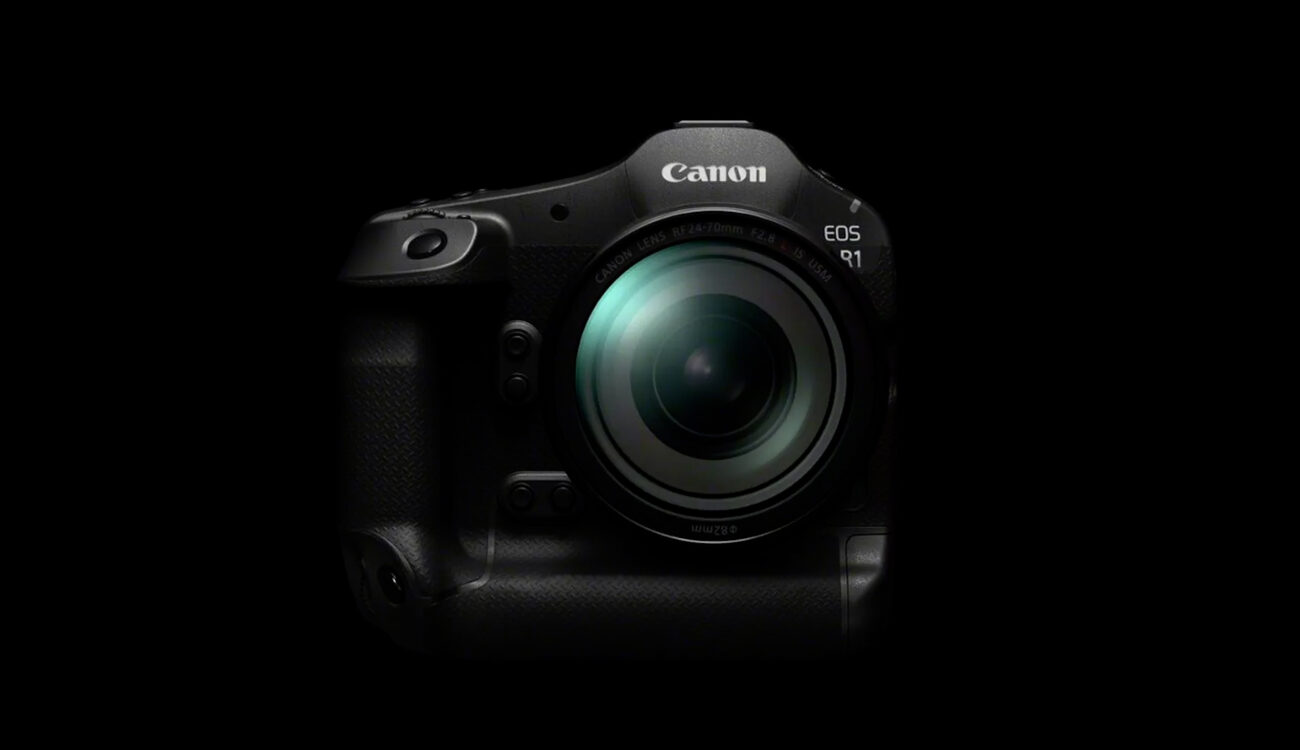
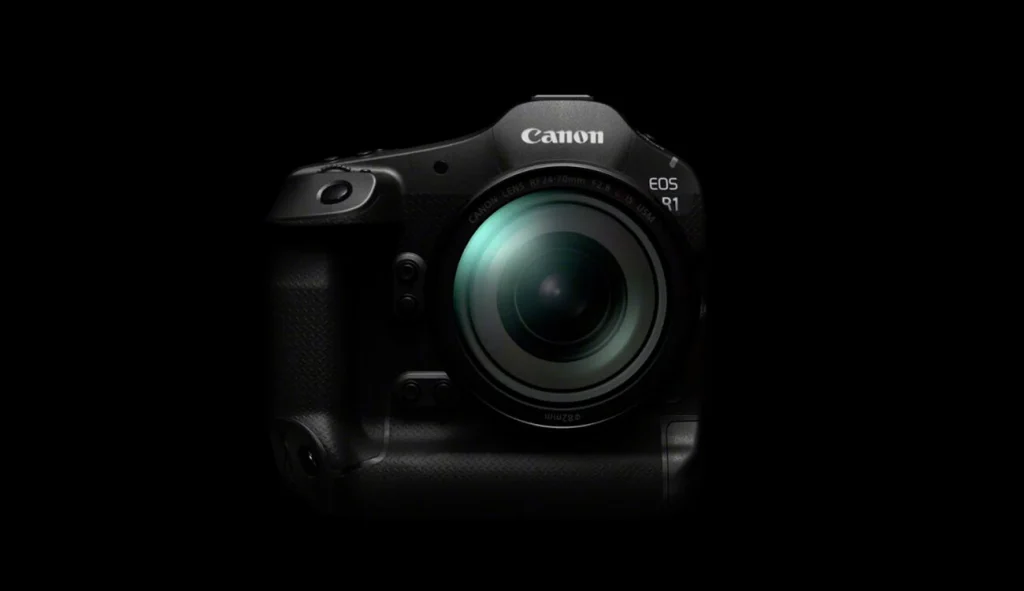
Canon EOS R1 is Canon’s flagship full-frame mirrorless camera for professional photographers and hybrid creators.
Released in November 2024, the Canon EOS R1 was built for sports, news, wildlife, action, events and high-pressure professional work. It uses a 36 x 24mm full-frame stacked sensor, Canon RF lens mount, DIGIC Accelerator plus DIGIC X processing and a rugged integrated-grip body.
The camera is not only a stills flagship. It also offers serious video tools, including 6K RAW recording, 4K DCI, 4K UHD, APS-C crop video modes, 2K, HD, Canon Log 2 and high-frame-rate capture. CineD lab data also shows strong rolling-shutter performance, with 8.3ms in 6K RAW and 4K Fine modes, and 4.1ms in 4K120.
The EOS R1 is best understood as a professional hybrid flagship. It is not a cinema camera like the EOS C50 or EOS C400, but it gives working photographers a powerful video tool inside a stills-first body.
Key Camera Specifications
| Feature | Canon EOS R1 |
|---|---|
| Camera type | Full-frame flagship mirrorless camera |
| Release period | November 2024 |
| Sensor format | Full frame 35mm |
| Sensor size | 36 x 24mm |
| Photo resolution | 6000 x 4000 |
| Lens mount | Canon RF |
| Base sensitivity | ISO 800 in CLog2 workflow |
| Main processor system | DIGIC Accelerator plus DIGIC X |
| Maximum stills burst | Up to 40fps electronic shutter |
| Maximum RAW video | 6K up to 60p class |
| Maximum 4K video | 4K up to 120p class |
| Best listed dynamic range | 13.4 stops at SNR=2 in provided lab data |
| Best listed rolling shutter | 4.1ms in 4K120 |
| 6K/4K Fine rolling shutter | 8.3ms |
| Body weight | About 920 g body-only class |
| Dimensions | About 87 mm x 150 mm x 158 mm |
| Listed price | Around $6,799 before taxes |
The Canon EOS R1 is designed for speed, reliability and professional capture more than maximum megapixels.
Full-Frame Stacked Sensor
The Canon EOS R1 uses a full-frame stacked sensor measuring 36 x 24mm.
Its photo resolution is 6000 x 4000, which places it in the 24MP class. That may seem modest compared with high-resolution bodies, but the R1 is built around speed, readout performance, autofocus and low-light reliability rather than pure pixel count.
For sports and news photographers, 24MP remains practical. It keeps file sizes manageable, supports fast transmission and gives enough resolution for publishing, editorial work and agency delivery.
Why the Sensor Matters
The stacked sensor is central to the EOS R1’s identity.
A faster readout helps reduce rolling shutter, supports rapid electronic shooting and improves video performance. This is why the camera can deliver strong stills speed and competitive video readout figures.
The sensor is also important for autofocus because fast sensor readout helps tracking systems react quickly to subject movement.
Photography Performance
The Canon EOS R1 is first and foremost a professional stills camera.
It supports up to 40fps electronic shooting and is designed for fast action. This makes it suitable for sports, wildlife, news, motorsport, football, athletics, indoor events and fast-moving professional assignments.
The integrated vertical grip gives the camera better balance with large RF telephoto lenses. It also improves battery handling and makes vertical shooting easier.
Best Photo Uses
The EOS R1 is ideal for:
Sports photography
Wildlife photography
News coverage
Professional events
Motorsport
Football and athletics
Bird photography
Low-light action
Agency work
Editorial photography
Olympic-style assignments
High-speed documentary work
This is a camera built for moments that cannot be repeated.
Autofocus and Action Tracking
Autofocus is one of the most important features of the Canon EOS R1.
Canon built the camera around advanced subject tracking, deep-learning detection, Action Priority and improved Eye Control AF. These features help the camera identify subjects, track movement and support photographers working in fast scenes.
For sports photographers, this matters because the subject can change direction quickly. A flagship body must keep focus during movement, crowd interference, changing light and unpredictable action.
Why Action Priority Matters
Action Priority helps the camera understand sport-specific movement.
Instead of only tracking a face or body, the system can help prioritise the subject involved in the action. This is valuable in sports such as football, basketball and volleyball, where several players may cross the frame at once.
For professional sports shooters, stronger subject recognition can improve keeper rate.
6K RAW Video
The Canon EOS R1 supports 6K RAW video.
In the provided lab and database context, 6K recording is listed around 6000 x 3164 and 6024 x 3184 in 17:9 workflows, with frame rates up to 59.94p. This gives video users more detail than standard 4K and more flexibility for cropping, stabilisation and 4K delivery.
| Mode | Resolution | Codec / RAW Workflow | Maximum Listed Frame Rate |
| 6K 17:9 | 6024 x 3184 | RAW / ProRes RAW listed in provided data | Up to 59.94p |
| 6K lab mode | 6000 x 3164 | CRAW | Up to 50p in provided lab table |
| 4K DCI | 4096 x 2160 | XF-AVC | Up to 120p |
| 4K UHD | 3840 x 2160 | Video codec workflow | Up to 120p class |
| 2K | 2048 x 1080 | Video codec workflow | High-frame-rate support |
| HD | 1920 x 1080 | Video codec workflow | High-frame-rate support |
The safest editorial phrasing is 6K RAW rather than assuming one universal RAW format across every workflow, because official Canon materials and third-party databases may label RAW options differently.
4K DCI and 4K Fine
The EOS R1 supports 4K DCI at 4096 x 2160 and 4K UHD at 3840 x 2160.
The 4K Fine mode is especially important because CineD measured strong dynamic range and fast rolling shutter in that setting. 4K Fine is oversampled from the higher-resolution sensor readout, which can improve detail and reduce aliasing.
Why 4K Fine Matters
Many creators will finish in 4K, not 6K.
A strong 4K Fine mode gives editors a detailed image without forcing them into heavy RAW workflows. It is useful for documentaries, interviews, sports features, branded content, YouTube, commercial clips and hybrid production.
For many users, 4K Fine may be the best balance of quality, file size and editing speed.
Dynamic Range Performance
The provided lab data lists a maximum dynamic range of 13.4 stops at SNR=2 in full-frame 4096 x 2160 XF-AVC at ISO 800 and CLog2.
CineD also reports 13.3 stops at SNR=2 in 4K Fine XF-AVC CLog2, while the provided database table lists 13.4 stops in a full-frame 4K XF-AVC mode. The 6K CRAW result is lower at 11.3 stops at SNR=2.
| Sensor Mode | Resolution | Codec | Frame Rate | ISO | Gamma | Measured Dynamic Range |
| Full Frame | 6000 x 3164 | CRAW | 25p | 800 | CLog2 | 11.3 stops at SNR=2 |
| Full Frame | 6000 x 3164 | CRAW | 50p | 800 | CLog2 | 10.7 stops at SNR=2 |
| Full Frame | 4096 x 2160 | XF-AVC | 25p | 800 | CLog2 | 13.4 stops at SNR=2 |
| Full Frame 4K Fine | 4096 x 2160 | XF-AVC | 25p | 800 | CLog2 | 13.3 stops at SNR=2 |
| Full Frame | 4096 x 2160 | XF-AVC | 120p | 800 | CLog2 | 12.5 stops at SNR=2 |
| APS-C crop | 4096 x 2160 | XF-AVC | 25p | 800 | CLog2 | 11.9 stops at SNR=2 |
The key point is that the compressed 4K XF-AVC modes show stronger measured dynamic range than the 6K RAW/CRAW results.
What Dynamic Range Means for Filmmakers
Dynamic range affects how much detail a camera can hold between bright highlights and dark shadows.
This matters in stadiums, concerts, outdoor sports, backlit interviews, bright skies, stage lighting and night events. The EOS R1 performs strongly in CLog2, especially in 4K XF-AVC modes, but exposure still matters.
For best results, protect highlights, avoid heavy underexposure and use waveform or zebras where possible.
Rolling Shutter Performance
Rolling shutter is one of the Canon EOS R1’s strongest video features.
The provided lab data lists 8.3ms in full-frame 6K CRAW at 25fps and 8.3ms in full-frame 4K Fine XF-AVC at 25fps. In 4K120, rolling shutter improves to 4.1ms.
| Sensor Mode | Resolution | Codec | Frame Rate | Rolling Shutter |
| Full Frame | 6000 x 3164 | CRAW | 25p | 8.3ms |
| Full Frame 4K Fine | 4096 x 2160 | XF-AVC | 25p | 8.3ms |
| Full Frame | 4096 x 2160 | XF-AVC | 120p | 4.1ms |
These are strong figures for a full-frame hybrid camera. They make the EOS R1 more useful for action video than many slower-readout cameras.
Why Fast Rolling Shutter Matters
Rolling shutter can distort fast movement.
Quick pans may bend vertical lines, and fast-moving subjects can look skewed. The EOS R1’s fast readout helps reduce those artifacts.
This is especially useful for sports, wildlife, handheld action, motorsport, dance, news footage and fast event coverage.
Canon Log 2 Video
The Canon EOS R1 supports Canon Log 2.
CLog2 is important because it gives colourists more room to grade highlights and shadows. It is more flexible than standard picture profiles and better suited to professional workflows.
The provided lab data uses CLog2 at ISO 800, which makes it a useful reference point for video shooters evaluating the camera.
Why CLog2 Matters
CLog2 helps match the EOS R1 with Canon’s cinema-oriented cameras.
For productions using multiple Canon bodies, CLog2 can make colour matching easier. It also gives filmmakers more control over contrast, highlight roll-off and skin tone treatment.
For fast delivery, users can choose easier profiles. For serious grading, CLog2 is the stronger option.
4K120 and High-Speed Video
The EOS R1 supports 4K recording up to 120p.
This is useful for slow motion, sports replays, wildlife movement, action scenes, product shots, wedding details and cinematic B-roll. The provided lab data also shows that 4K120 has the fastest rolling-shutter result at 4.1ms.
Why 4K120 Matters
4K120 gives creators smooth slow motion while keeping high resolution.
A clip recorded at 120fps can be slowed down in a 24p, 25p or 30p timeline for dramatic effect. This is valuable for action and sports because it reveals movement in more detail.
For a flagship camera like the R1, 4K120 is not just a creative feature. It is part of its professional action workflow.
APS-C Crop Modes
The Canon EOS R1 also supports APS-C crop video modes.
These modes include APS-C 4K DCI, APS-C 4K UHD, APS-C 2K and APS-C HD. Crop modes can be useful when users want more reach from lenses or need a smaller readout area.
Why APS-C Crop Helps
Crop modes are useful for sports and wildlife.
A long lens becomes tighter, which can help when subjects are far away. APS-C crop modes can also support specific lens workflows and reduce file demands.
However, crop modes change field of view, so users should test framing before production.
RF Lens Mount
The Canon EOS R1 uses the RF mount.
RF mount gives professionals access to Canon’s modern mirrorless lens ecosystem, including fast primes, L-series zooms, super-telephoto lenses, hybrid lenses and stabilised optics.
EF lenses can also be used through Canon adapters.
| Lens Workflow | Best For |
| RF L-series lenses | Professional sports, news and events |
| RF super-telephoto lenses | Wildlife and stadium sports |
| RF hybrid lenses | Video and stills creators |
| Compact RF primes | Travel and documentary work |
| EF lenses with adapter | Existing Canon DSLR users |
| Cinema lenses | Manual-focus video workflows |
The RF mount is one of the reasons the EOS R1 fits professional Canon systems so well.
In-Body Image Stabilisation
The EOS R1 includes 5-axis in-body image stabilisation.
Canon lists strong stabilisation performance when the body works with compatible optically stabilised lenses. This helps with handheld stills, low-light shooting and video capture.
Why IBIS Matters
IBIS is useful when shooting handheld.
Sports and wildlife photographers often use long stabilised lenses, while video creators may work handheld or on monopods. Stabilisation can reduce small movements and make footage more usable.
It is not a replacement for a tripod, gimbal or proper rig, but it helps in real-world work.
Professional Body Design
The Canon EOS R1 uses a flagship integrated-grip body.
This design is larger and heavier than compact EOS R cameras, but it is built for professional reliability. It balances better with large lenses, improves vertical shooting and gives users better battery capacity.
The body weighs about 920 g in the provided database extract, though real-world kit weight depends on battery, cards, lens and accessories.
Who Will Like the Body
Professional photographers will appreciate the integrated grip.
It is ideal for long events, sports sidelines, press work and wildlife shoots. Smaller creators may prefer lighter cameras, but the R1 is not built for casual portability. It is built for demanding assignments.
Viewfinder and Controls
The EOS R1 includes a high-resolution professional electronic viewfinder and advanced controls.
A flagship camera needs a viewfinder that works for fast action, bright conditions and long shooting days. It also needs durable buttons, custom controls and quick access to exposure and AF settings.
Why Pro Controls Matter
Professional work moves quickly.
Photographers need to change settings without looking through menus. Video users also benefit from dedicated controls, tally-style behaviour and reliable monitoring options.
The R1’s body design supports speed and repetition under pressure.
Media and Storage
The Canon EOS R1 uses high-speed professional media.
For 6K RAW and fast stills shooting, fast cards are essential. High-bitrate video and rapid RAW bursts can fill cards quickly, so storage planning matters.
Media Planning Tips
Use high-quality CFexpress cards for demanding workflows.
Carry enough storage for long events, and always test cards before paid work. For 6K RAW and 4K120, plan for large files and a reliable backup process.
Professional users should copy footage and images to more than one secure location before formatting cards.
Best Uses for the Canon EOS R1
The Canon EOS R1 is best for professionals who need speed, autofocus, reliability and strong hybrid video.
It is ideal for:
Sports photography
Wildlife photography
News coverage
Agency work
Motorsport
Football and athletics
Professional events
Concert photography
Fast documentary work
Hybrid photo-video assignments
Broadcast support
Action video
High-end editorial work
Press photography
The camera is strongest when missing the moment is not an option.
Canon EOS R1 vs Canon EOS R3
The EOS R1 is the true flagship successor above the EOS R3.
| Feature | Canon EOS R1 | Canon EOS R3 |
| Sensor class | Full-frame stacked | Full-frame stacked |
| Resolution | 24MP class | 24MP class |
| Maximum burst | Up to 40fps | Up to 30fps electronic |
| Video | 6K RAW and 4K120 | 6K RAW and 4K high frame rates |
| AF system | Newer flagship AF | Earlier pro AF system |
| Main advantage | Faster and more advanced flagship | Lower used price |
The EOS R3 remains capable, but the EOS R1 brings Canon’s newer flagship processing and action-focused features.
Canon EOS R1 vs Canon EOS R5 Mark II
The EOS R5 Mark II is higher resolution, while the EOS R1 is faster and more action-focused.
| Feature | Canon EOS R1 | Canon EOS R5 Mark II |
| Main audience | Sports and action professionals | High-resolution hybrid creators |
| Resolution | 24MP class | 45MP class |
| Body design | Integrated grip flagship | Smaller hybrid body |
| Best advantage | Speed, AF and durability | Resolution and 8K class workflow |
| Best use | Sports, news and wildlife | Commercial, portrait and hybrid work |
The R1 is the better action flagship. The R5 Mark II is better when resolution matters more.
Canon EOS R1 vs Canon EOS C50
The EOS R1 and EOS C50 both offer strong video tools, but they serve different users.
| Feature | Canon EOS R1 | Canon EOS C50 |
| Camera type | Flagship hybrid mirrorless | Cinema EOS camera |
| Main use | Sports, news and hybrid work | Video-first production |
| Sensor | Full-frame stacked | Full-frame cinema-oriented |
| Video headline | 6K RAW and 4K120 | 7K Open Gate RAW |
| Built-in ND filters | No | No |
| Audio workflow | Hybrid camera style | Detachable XLR handle |
| Best advantage | Stills speed and AF | Cinema workflow and Open Gate |
The EOS R1 is better for professional stills and hybrid assignments. The EOS C50 is better for dedicated video production.
Key Takeaways
- Canon EOS R1 was released in November 2024.
- It uses a 36 x 24mm full-frame stacked sensor.
- Photo resolution is 6000 x 4000.
- The camera uses the Canon RF mount.
- Base sensitivity for CLog2 video is ISO 800.
- It supports 6K RAW video up to 60p class.
- It supports 4K recording up to 120p class.
- Canon Log 2 is supported.
- The provided lab data lists up to 13.4 stops at SNR=2 in full-frame 4K XF-AVC.
- CineD reports 13.3 stops at SNR=2 in 4K Fine XF-AVC CLog2.
- 6K CRAW measured 11.3 stops at SNR=2 in CineD’s lab test.
- Rolling shutter measured 8.3ms in 6K CRAW.
- Rolling shutter also measured 8.3ms in 4K Fine.
- Rolling shutter improves to 4.1ms in 4K120.
- The camera supports up to 40fps electronic stills shooting.
- It is best for sports, wildlife, news, action and hybrid professional work.
Frequently Asked Questions
What is the Canon EOS R1?
Canon EOS R1 is Canon’s flagship full-frame mirrorless camera for professional sports, news, wildlife and hybrid photo-video work.
When was the Canon EOS R1 released?
The Canon EOS R1 was released in November 2024.
What sensor does the Canon EOS R1 use?
It uses a 36 x 24mm full-frame stacked sensor with 6000 x 4000 still-photo resolution.
What lens mount does it use?
The Canon EOS R1 uses the Canon RF mount and supports EF lenses through Canon adapters.
Does the Canon EOS R1 shoot 6K RAW?
Yes. The EOS R1 supports 6K RAW recording up to 60p class.
Does the Canon EOS R1 shoot 4K120?
Yes. The camera supports 4K recording up to 120p.
What dynamic range did the provided lab data show?
The provided lab data lists a maximum of 13.4 stops at SNR=2 in full-frame 4096 x 2160 XF-AVC at ISO 800 and CLog2.
What dynamic range did CineD report in 4K Fine?
CineD reported 13.3 stops at SNR=2 in 4K Fine XF-AVC CLog2.
What is the rolling-shutter result?
CineD reported 8.3ms in 6K RAW and 4K Fine modes, while 4K120 improved to 4.1ms.
Is the EOS R1 good for video?
Yes. It is a strong hybrid video camera with 6K RAW, 4K120, CLog2 and fast rolling-shutter performance, though dedicated cinema cameras still offer more video-focused ergonomics and audio tools.
Who should buy the Canon EOS R1?
The EOS R1 is best for professional sports, wildlife, action, news and event photographers who also need strong video features.
Conclusion
Canon EOS R1 is a true professional flagship built for speed, reliability and high-pressure shooting.
Its full-frame stacked sensor, RF mount, DIGIC Accelerator plus DIGIC X processing, advanced autofocus, up to 40fps electronic shooting, 6K RAW, 4K120, CLog2 and fast rolling-shutter performance make it one of Canon’s strongest hybrid cameras for action professionals.
The lab data shows an important distinction. The 6K RAW/CRAW modes deliver maximum resolution and a cleaner unprocessed workflow, while 4K XF-AVC and 4K Fine modes deliver stronger measured dynamic-range results. Rolling shutter is also excellent for a full-frame hybrid body, especially in 4K120.
The EOS R1 is not the best choice for users who need maximum megapixels or a dedicated cinema body. However, for professionals who shoot sports, news, wildlife and fast-moving events while also needing serious video, the Canon EOS R1 is one of the most capable mirrorless cameras Canon has ever made.
Read Also: Canon EOS C50: Specs, Dynamic Range, Rolling Shutter and Video Features