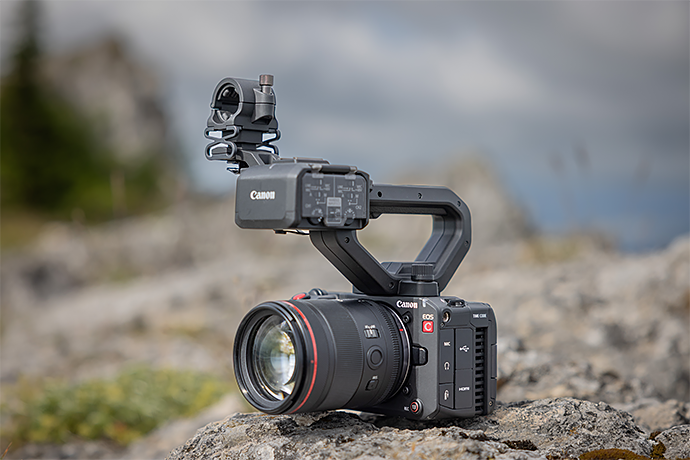
Canon EOS C50 is a compact full-frame Cinema EOS camera built for filmmakers, content creators, documentary shooters and small production crews that need professional video tools in a lightweight RF-mount body.
Released in September 2025, the Canon EOS C50 sits between Canon’s hybrid mirrorless cameras and larger Cinema EOS models. It offers a 35.9 x 23.9mm full-frame sensor, 7K RAW recording, 3:2 Open Gate capture, Canon Log 2, Canon Log 3, dual base ISO, crop recording options, professional audio through a detachable handle and a compact body that weighs about 670 g.
The camera is especially interesting because it gives creators a 7K full-frame workflow in a body much smaller than traditional cinema cameras. It is not a stills-first hybrid like the EOS R6 Mark III, and it is not a larger production camera like the EOS C80 or EOS C400. Instead, the EOS C50 is designed for video-first users who want a small cinema camera with Canon colour, autofocus and RAW recording.
Its biggest strengths are 7K Open Gate, Cinema RAW Light, compact size, Canon RF lens support and professional video ergonomics. Its main limitations are the lack of built-in ND filters, no built-in EVF, no IBIS and lab performance that does not fully match Canon’s higher-end cinema cameras.
Key Camera Specifications
| Feature | Canon EOS C50 |
|---|---|
| Camera type | Compact full-frame Cinema EOS camera |
| Release period | September 2025 |
| Sensor format | Full frame 35mm |
| Sensor size | 35.9 x 23.9mm |
| Photo resolution | Approx. 32.3MP |
| Maximum listed resolution | 6960 x 4640 |
| Lens mount | Canon RF |
| Adapter support | EF and PL support through adapters |
| Base sensitivity | ISO 800 and 6400 in RAW / Canon Log workflows |
| Main codec | Cinema RAW Light |
| Other codecs | XF-AVC, XF-AVC S and XF-HEVC S |
| Open Gate | Yes, full-frame 3:2 |
| Best full-frame lab dynamic range | 12.5 stops at SNR=2 in provided data |
| Best listed S35 XF-AVC lab result | 14 stops at SNR=2 in provided data |
| Rolling shutter | 18.1ms in 7K 3:2 RAW, 14.3ms in most 17:9 modes |
| Fastest listed rolling shutter | 7.1ms in 4K120 |
| Body weight | About 670 g |
| Dimensions | About 88 mm x 95 mm x 142 mm |
| Launch price | Around $3,899 before taxes |
| Best use | Cinema, documentaries, social video, commercial work and B-camera production |
The EOS C50 is built for serious video users who want Canon’s cinema workflow without carrying a much larger camera body.
Full-Frame 7K Sensor
The Canon EOS C50 uses a full-frame CMOS sensor measuring 35.9 x 23.9mm.
In full-frame 3:2 Open Gate mode, the camera records up to 6960 x 4640. In full-frame 17:9 mode, it records up to 6960 x 3672. The camera also supports Super 35, Super 16 and lower-resolution crop modes.
This sensor gives creators a wide field of view, strong shallow-depth-of-field potential and enough resolution for oversampled 4K delivery.
Why the 7K Sensor Matters
A 7K sensor gives editors more room in post-production.
Footage can be cropped, stabilised, reframed or downsampled to sharp 4K. This is useful for commercials, music videos, interviews, YouTube content, documentaries and social-first production.
The high-resolution sensor also supports 32MP stills, making the EOS C50 more flexible than many dedicated cinema cameras.
Open Gate Recording
Open Gate is one of the most important features of the Canon EOS C50.
In full-frame 3:2 mode, the camera uses the full height and width of the sensor. This is useful because editors can create multiple aspect ratios from one recording.
A single Open Gate clip can become a widescreen YouTube video, a vertical TikTok, an Instagram Reel, a square social ad or an anamorphic-style composition.
| Open Gate Feature | Canon EOS C50 |
| Sensor mode | Full Frame 3:2 |
| RAW resolution | 6960 x 4640 |
| XF-HEVC Open Gate resolution | 6914 x 4608 |
| Best use | Reframing, vertical video, anamorphic work and multi-platform delivery |
Open Gate is especially useful for creators who shoot once and deliver content in many formats.
Cinema RAW Light Recording
The Canon EOS C50 records 12-bit Cinema RAW Light internally.
In the provided recording data, full-frame 3:2 7K RAW supports Canon RAW ST and Canon RAW LT options. RAW ST gives stronger quality but larger files. RAW LT reduces data rate and is more storage-friendly.
| Mode | Resolution | Codec | Frame Rate | Approximate Data Rate |
| FF 3:2 7K | 6960 x 4640 | Canon RAW ST | 29.97p | 1.8 Gb/s |
| FF 3:2 7K | 6960 x 4640 | Canon RAW ST | 25p | 1.5 Gb/s |
| FF 3:2 7K | 6960 x 4640 | Canon RAW ST | 24p | 1.5 Gb/s |
| FF 3:2 7K | 6960 x 4640 | Canon RAW ST | 23.98p | 1.4 Gb/s |
| FF 3:2 7K | 6960 x 4640 | Canon RAW LT | 29.97p | 1.2 Gb/s |
| FF 3:2 7K | 6960 x 4640 | Canon RAW LT | 25p | 976 Mb/s |
| FF 3:2 7K | 6960 x 4640 | Canon RAW LT | 24p | 937 Mb/s |
| FF 3:2 7K | 6960 x 4640 | Canon RAW LT | 23.98p | 936 Mb/s |
These are serious data rates. The camera is compact, but 7K RAW still needs fast cards, large storage and a reliable backup workflow.
XF-AVC and XF-HEVC Workflows
The EOS C50 also supports compressed professional video formats such as XF-AVC, XF-AVC S and XF-HEVC S.
These formats are useful when RAW is too heavy. XF-AVC gives editors a robust 10-bit workflow with smaller files and faster turnaround. XF-HEVC S can be useful when efficient compression is important.
For commercial jobs, interviews, documentaries and social content, many users will choose XF-AVC instead of RAW because it is easier to manage.
RAW vs XF-AVC
Cinema RAW Light is best when maximum grading flexibility matters.
XF-AVC is better when the production needs smaller files, faster editing and a more practical workflow. For many paid jobs, XF-AVC will be the safer everyday format.
The best choice depends on storage, deadline, grading needs and final delivery format.
Dynamic Range Performance
Canon promotes the EOS C50 as a high-dynamic-range cinema camera, especially in Canon Log 2. The provided lab data gives a more detailed picture.
In full-frame 4K DCI XF-AVC at 25fps, ISO 800 and Canon Log 2, the camera measured 12.5 stops at SNR=2. In the same full-frame 4K DCI XF-AVC mode at 60fps, the provided table lists 13.3 stops at SNR=2. In Super 35 XF-AVC 4K DCI at ISO 800, the provided data lists 14 stops at SNR=2.
Because the summary ranking highlights 12.5 stops in full-frame 25fps mode, this article treats 12.5 stops as the safest full-frame reference point.
| Sensor Mode | Resolution | Codec | Frame Rate | ISO | Gamma | Measured Dynamic Range |
| Full Frame 3:2 | 6960 x 4640 | CRAW | 25p | 800 | CLog2 | 10.1 stops at SNR=2 |
| Full Frame | 6960 x 3672 | CRAW | 25p | 800 | CLog2 | 9.98 stops at SNR=2 |
| Full Frame | 4096 x 2160 | XF-AVC | 25p | 800 | CLog2 | 12.5 stops at SNR=2 |
| Full Frame | 4096 x 2160 | XF-AVC | 60p | 800 | CLog2 | 13.3 stops at SNR=2 |
| Full Frame | 4096 x 2160 | XF-AVC | 120p | 800 | CLog2 | 11.8 stops at SNR=2 |
| Super 35 | 4096 x 2160 | XF-AVC | 25p | 800 | CLog2 | 14 stops at SNR=2 |
| Super 35 | 4096 x 2160 | XF-AVC | 60p | 800 | CLog2 | 14 stops at SNR=2 |
The key lesson is clear: the EOS C50 performs better in processed XF-AVC 4K modes than in high-resolution RAW lab measurements.
What Dynamic Range Means for Filmmakers
Dynamic range affects how much highlight and shadow detail a camera can preserve.
This matters when shooting skies, windows, stage lights, reflective surfaces, night scenes and backlit subjects. The EOS C50 gives useful latitude in Canon Log 2, but it still rewards careful exposure.
For best results, use waveform, false colour or zebras, protect highlights and avoid heavy underexposure.
Dual Base ISO
The Canon EOS C50 has dual base ISO settings of 800 and 6400 for RAW and Canon Log workflows.
ISO 800 is the best starting point for normal lighting and maximum image quality. ISO 6400 is useful in low light, but the provided lab data shows that dynamic range drops at the higher base setting.
| Mode | ISO 800 Result | ISO 6400 Result |
| FF 3:2 7K CRAW 25p | 10.1 stops | 8.8 stops |
| FF 7K CRAW 25p | 9.98 stops | 8.67 stops |
| FF 4K XF-AVC 25p | 12.5 stops | 10.9 stops |
| S35 4K XF-AVC 25p | 14 stops | 12.1 stops |
ISO 6400 is useful, but ISO 800 remains the stronger choice when the scene can be lit properly.
Rolling Shutter Performance
Rolling shutter is an important part of the Canon EOS C50 story.
In full-frame 3:2 Open Gate 7K RAW at 25fps, the provided data lists 18.1ms. In full-frame 17:9 7K RAW and most 4K DCI modes, it lists 14.3ms. In full-frame 4K DCI XF-AVC at 120fps, rolling shutter improves to 7.1ms.
| Sensor Mode | Resolution | Codec | Frame Rate | Rolling Shutter |
| Full Frame 3:2 | 6960 x 4640 | Canon RAW | 25p | 18.1ms |
| Full Frame | 6960 x 3672 | Canon RAW | 25p | 14.3ms |
| Full Frame | 6960 x 3672 | Canon RAW | 60p | 14.3ms |
| Full Frame | 4096 x 2160 | XF-AVC | 25p | 14.3ms |
| Full Frame | 4096 x 2160 | XF-AVC | 60p | 14.3ms |
| Full Frame | 4096 x 2160 | XF-AVC | 120p | 7.1ms |
| S35 | 5036 x 2656 | Canon RAW | 25p | 14.3ms |
| S35 | 4096 x 2160 | XF-AVC | 25p | 14.3ms |
| S35 | 4096 x 2160 | XF-AVC | 60p | 14.3ms |
The Open Gate mode has the slowest readout. The 4K120 mode is much faster and better for motion.
Why Rolling Shutter Matters
Rolling shutter can make fast movement look distorted.
Quick pans may bend vertical lines, and fast-moving subjects may appear skewed. This matters for action, vehicles, handheld documentary scenes, sports and dance.
For controlled interviews, tripod shots and slow camera moves, the EOS C50’s rolling shutter is easier to manage.
Recording Formats
The Canon EOS C50 supports a wide range of recording formats across full frame, Super 35 and Super 16.
| Recording Format | Resolution |
| FF 3:2 7K RAW | 6960 x 4640 |
| FF 3:2 7K XF-HEVC | 6914 x 4608 |
| FF 7K RAW | 6960 x 3672 |
| FF 4K DCI | 4096 x 2160 |
| FF 4K UHD | 3840 x 2160 |
| FF 2K | 2048 x 1080 |
| FF HD | 1920 x 1080 |
| S35 5K RAW | 5036 x 2656 |
| S35 4K DCI | 4096 x 2160 |
| S35 4K UHD | 3840 x 2160 |
| S35 2K | 2048 x 1080 |
| S35 HD | 1920 x 1080 |
| S16 2.5K RAW | 2524 x 1332 |
| S16 2K | 2048 x 1080 |
| S16 HD | 1920 x 1080 |
This flexibility makes the EOS C50 useful for full-frame cinema work, Super 35 lens workflows, Super 16-style crops and multi-format delivery.
High Frame Rates
The Canon EOS C50 supports 4K recording up to 120fps and 2K recording up to 180fps.
4K120 is especially useful because it also gives the fastest listed rolling-shutter result in the provided data. This makes it a strong mode for slow motion, sports-style visuals, action inserts, product shots and music videos.
Why 4K120 Matters
4K120 gives filmmakers smooth slow motion while keeping a high-quality image.
Footage can be slowed down in 24p, 25p or 30p timelines for dramatic movement. It is useful for commercials, fashion films, wedding details, sports clips, dance, travel footage and social video.
For creators who need motion flexibility, 4K120 is one of the EOS C50’s strongest features.
RF Lens Mount
The EOS C50 uses Canon’s RF mount.
RF mount gives users access to modern Canon mirrorless lenses, including L-series zooms, fast primes, compact lenses and video-focused hybrid lenses. The camera can also use EF lenses through Canon adapters and PL lenses through compatible PL-to-RF adapter workflows.
| Lens Workflow | Best For |
| RF lenses | Native autofocus, stabilisation and modern optics |
| RF L-series lenses | Professional cinema and hybrid work |
| EF lenses with adapter | Existing Canon DSLR lens owners |
| PL lenses with adapter | Cinema primes and production lenses |
| Anamorphic lenses | Open Gate and desqueeze workflows |
The RF mount makes the EOS C50 flexible for both solo creators and professional production teams.
Autofocus
The Canon EOS C50 supports Dual Pixel CMOS AF II.
This is a major advantage over many cinema cameras. Canon’s autofocus is useful for interviews, gimbal work, solo shooting, event coverage, documentaries and social content.
For filmmakers without a dedicated focus puller, reliable autofocus can save time and reduce missed shots.
Best Autofocus Uses
Autofocus is useful for:
Solo interviews
Gimbal movement
Vlogging
Documentary scenes
Wedding video
Event coverage
Product demos
Travel films
Online courses
Social media production
Manual focus is still preferred for many cinema jobs, but strong autofocus makes the EOS C50 more flexible.
Active Cooling and Compact Design
The Canon EOS C50 includes active cooling.
This is important because high-resolution RAW and high-frame-rate recording can generate heat. A fan-cooled body is more reliable for long recording sessions than many passive hybrid cameras.
The camera is also compact. At about 670 g, it is the smallest and lightest Cinema EOS model in Canon’s lineup.
Why Active Cooling Matters
Video-first cameras need thermal stability.
Active cooling helps the EOS C50 record longer in demanding modes, making it useful for interviews, documentaries, events, training videos and continuous production work.
For creators who shoot long takes, this is one of the biggest advantages over stills-first mirrorless bodies.
Detachable Handle and Professional Audio
The EOS C50 uses a detachable top handle with professional audio controls.
The handle adds full-size XLR inputs, a record button and a zoom rocker. This makes the camera more practical for interviews, documentary work and small production crews.
Why XLR Audio Matters
Good audio is essential for professional video.
XLR inputs allow users to connect professional microphones, mixers and wireless receivers. This reduces the need for external audio adapters and makes the camera more production-ready.
For documentary shooters and solo creators, the top handle is a major advantage.
Media and Storage
The EOS C50 records to CFexpress Type B and SD UHS-II cards.
CFexpress Type B is important for high-data-rate 7K RAW. SD UHS-II is useful for lighter recording formats, proxies or secondary workflows.
Media Planning Tips
Use CFexpress Type B for 7K RAW and high-bitrate recording.
Use SD cards for lighter codecs, proxies or backup workflows. For paid work, test cards before production and plan storage carefully.
A 7K RAW workflow can fill cards quickly, so backup discipline is essential.
Photo Mode
The EOS C50 also includes a still-photo mode.
It can capture 32MP-class stills and supports high-speed electronic shooting. This does not make it a traditional stills-first camera, but it gives creators a useful hybrid option.
Best Photo Uses
The EOS C50 can work for:
Behind-the-scenes stills
Thumbnails
Social media photos
Travel images
Production stills
Client reference shots
Location scouting
Brand content
Photographers who need a viewfinder, mechanical shutter or IBIS may still prefer the EOS R6 Mark III.
No Built-In ND Filters
One of the biggest limitations of the Canon EOS C50 is the lack of built-in ND filters.
Cinema cameras often include internal ND filters because they help control exposure without changing aperture, shutter angle or ISO. The EOS C50’s compact body does not include that feature.
Why ND Filters Matter
ND filters are essential for outdoor filmmaking.
They allow creators to keep natural motion blur and shallow depth of field in bright light. Without ND, users need screw-on filters, matte-box filters or adapter-based ND solutions.
For serious outdoor work, ND filters should be part of the EOS C50 kit.
No IBIS
The Canon EOS C50 does not have in-body image stabilisation.
This is another important difference between the C50 and some EOS R hybrid bodies. Users who shoot handheld may need stabilised RF lenses, digital stabilisation, a rig, tripod, monopod or gimbal.
What This Means in Practice
The EOS C50 is still good for handheld work, but it needs support.
For stable movement, a gimbal or shoulder rig will help. For interviews and commercial work, tripods remain important. For run-and-gun shooting, lens stabilisation can help reduce shake.
Creators moving from IBIS-equipped hybrid cameras should test the body before relying on handheld shooting.
Best Uses for the Canon EOS C50
The Canon EOS C50 is best for creators who need a compact cinema camera with full-frame 7K recording.
It is ideal for:
Independent films
Documentaries
Commercial videos
YouTube production
Music videos
Corporate videos
Social media campaigns
Gimbal work
Interviews
Travel films
Small production crews
B-camera work
Anamorphic projects
Open Gate multi-format delivery
It is especially strong for Canon users who want a small cinema body that matches larger Cinema EOS cameras better than a standard mirrorless camera.
Canon EOS C50 vs Canon EOS R6 Mark III
The EOS C50 and EOS R6 Mark III share similar sensor ideas, but they serve different users.
| Feature | Canon EOS C50 | Canon EOS R6 Mark III |
| Camera type | Cinema EOS | Hybrid mirrorless |
| Main audience | Video-first creators | Stills and video hybrid users |
| Viewfinder | No traditional EVF | Yes |
| Mechanical shutter | No cinema-first body | Yes |
| Open Gate | Yes | Yes |
| RAW video | 7K Cinema RAW Light | 7K RAW |
| Built-in cooling | Yes | More limited hybrid design |
| Professional audio | Handle with XLR inputs | Requires accessories |
| Best use | Cinema and video production | Photography plus advanced video |
The EOS C50 is better for video production. The R6 Mark III is better for photographers who also need strong video.
Canon EOS C50 vs Canon EOS R6 V
The EOS C50 and EOS R6 V are both video-first, but the C50 is more cinema-focused.
| Feature | Canon EOS C50 | Canon EOS R6 V |
| Camera line | Cinema EOS | EOS V-series |
| Body style | Cinema box-style body | Video-first mirrorless body |
| Professional audio | Detachable XLR handle | More creator-style workflow |
| Cooling | Cinema-focused cooling | Video-focused cooling |
| IBIS | No | Yes |
| Best advantage | Cinema workflow and XLR audio | Stabilisation and creator portability |
| Best use | Production crews | Solo creators and hybrid video users |
The C50 is better for cinema-style production. The R6 V is better for creators who want a lighter video-first mirrorless setup with IBIS.
Canon EOS C50 vs Canon EOS C80
The Canon EOS C80 is higher in the Cinema EOS lineup.
| Feature | Canon EOS C50 | Canon EOS C80 |
| Sensor format | Full frame | Full frame |
| Body size | Smaller | Larger |
| ND filters | No | Yes |
| Production controls | Compact cinema body | More complete cinema body |
| Best advantage | Smaller and cheaper | Stronger production features |
| Best use | Gimbal, travel and B-camera work | Main cinema production camera |
The EOS C80 is better for productions that need built-in ND filters and a more complete cinema body. The EOS C50 is better when size, price and portability matter more.
Key Takeaways
- Canon EOS C50 was released in September 2025.
- It uses a 35.9 x 23.9mm full-frame CMOS sensor.
- The camera records 7K Open Gate RAW at 6960 x 4640.
- It supports Cinema RAW Light, XF-AVC, XF-AVC S and XF-HEVC S.
- Base ISO settings are 800 and 6400 for RAW and Canon Log workflows.
- The provided data lists 12.5 stops at SNR=2 in full-frame 4K XF-AVC 25p.
- The provided table also lists 14 stops at SNR=2 in Super 35 4K XF-AVC.
- Rolling shutter is 18.1ms in 7K 3:2 Open Gate RAW.
- Rolling shutter is 14.3ms in most 17:9 full-frame and S35 modes.
- Rolling shutter improves to 7.1ms in 4K120.
- The camera uses the Canon RF mount.
- EF and PL workflows are possible through adapters.
- Dual Pixel CMOS AF II is supported.
- The body weighs about 670 g.
- It lacks built-in ND filters and IBIS.
- It is best for compact cinema production, documentaries, gimbal work, commercial video and B-camera use.
Frequently Asked Questions
What is the Canon EOS C50?
Canon EOS C50 is a compact full-frame Cinema EOS camera with 7K RAW recording, Open Gate capture, RF mount, Dual Pixel CMOS AF II and a video-first cinema body.
When was the Canon EOS C50 released?
The camera was released in September 2025.
What sensor does the Canon EOS C50 use?
It uses a 35.9 x 23.9mm full-frame CMOS sensor.
What is the maximum recording resolution?
The maximum listed RAW recording resolution is 6960 x 4640 in full-frame 3:2 Open Gate mode.
What lens mount does it use?
The EOS C50 uses the Canon RF mount. EF and PL lens workflows are possible through adapters.
Does the Canon EOS C50 shoot 7K RAW?
Yes. It supports 7K Cinema RAW Light recording, including full-frame 3:2 Open Gate RAW.
Does the EOS C50 support Canon Log 2?
Yes. Canon Log 2 and Canon Log 3 workflows are supported.
What dynamic range did the provided lab data show?
The provided data lists 12.5 stops at SNR=2 in full-frame 4K DCI XF-AVC at 25fps, ISO 800 and Canon Log 2. It also lists higher Super 35 XF-AVC results in cropped modes.
What is the rolling shutter result?
The provided data lists 18.1ms in 7K 3:2 Open Gate RAW, 14.3ms in most 17:9 modes and 7.1ms in 4K120.
Does the Canon EOS C50 have built-in ND filters?
No. The EOS C50 does not include built-in ND filters.
Does the EOS C50 have IBIS?
No. The camera does not include in-body image stabilisation.
Who should buy the Canon EOS C50?
It is best for filmmakers, documentarians, commercial creators, YouTubers, gimbal operators and small production teams that need a compact full-frame cinema camera with 7K RAW and Open Gate recording.
Conclusion
Canon EOS C50 is one of Canon’s most important compact Cinema EOS cameras because it brings 7K full-frame Open Gate recording into a small, production-friendly body.
Its 35.9 x 23.9mm sensor, Cinema RAW Light, XF-AVC options, Canon Log 2, Canon Log 3, RF mount, Dual Pixel CMOS AF II, active cooling, detachable XLR handle and 7K recording modes make it a strong tool for video-first creators.
It is not perfect. The lack of built-in ND filters and IBIS means users need external solutions for exposure control and stabilisation. The lab results also show that its RAW dynamic-range numbers are not as strong as some users might expect from a modern Cinema EOS camera.
Even so, the Canon EOS C50 has a clear role. It is a compact cinema camera for creators who want Canon colour, autofocus, Open Gate flexibility, 7K RAW and professional audio without carrying a larger C80 or C400-style body.
For small crews, documentary shooters, commercial creators and Canon RF users, the Canon EOS C50 is a powerful and practical cinema camera.
Read Also: Canon EOS R6 Mark III: Specs, Sensor, Video Features and Hybrid Workflow