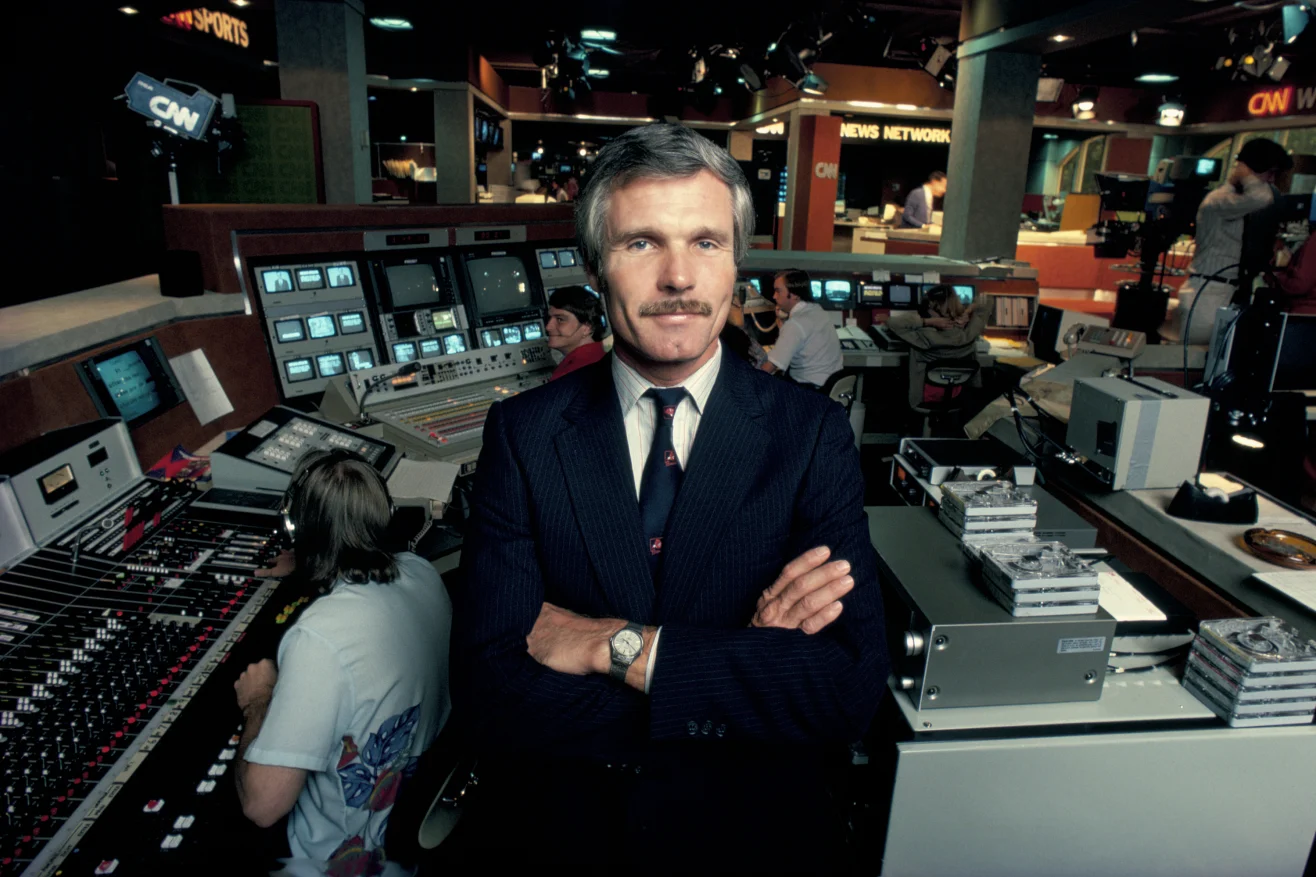
The Ted Turner Biography tells the story of one of the most revolutionary figures in modern media history. Known for founding CNN, Ted Turner permanently changed global journalism by creating the world’s first 24-hour television news network at a time when most media executives believed such an idea could never succeed.
But the Ted Turner Biography extends far beyond CNN. Robert Edward Turner III (November 19, 1938 – May 6, 2026) was an American businessman, television producer, media proprietor, and philanthropist. He founded CNN, the first 24-hour cable news channel, and WTBS, which pioneered the superstation concept in cable television. Turner also founded the television networks TNT, TBS, Cartoon Network, and Turner Classic Movies.
Over several decades, Turner built a broadcasting empire that included TBS, TNT, Cartoon Network, Turner Classic Movies, World Championship Wrestling and nationally televised sports franchises like the Atlanta Braves and Atlanta Hawks. His influence stretched across journalism, entertainment, environmental activism, philanthropy and international politics.
Turner became famous not only for his business success but also for his outspoken personality, fearless risk-taking and unconventional leadership style. Nicknamed “Captain Outrageous” and “The Mouth of the South,” he frequently challenged media norms and corporate expectations.
In May 2026, Turner died peacefully at the age of 87, according to Turner Enterprises, prompting tributes from journalists, politicians, filmmakers, athletes and environmental activists worldwide.
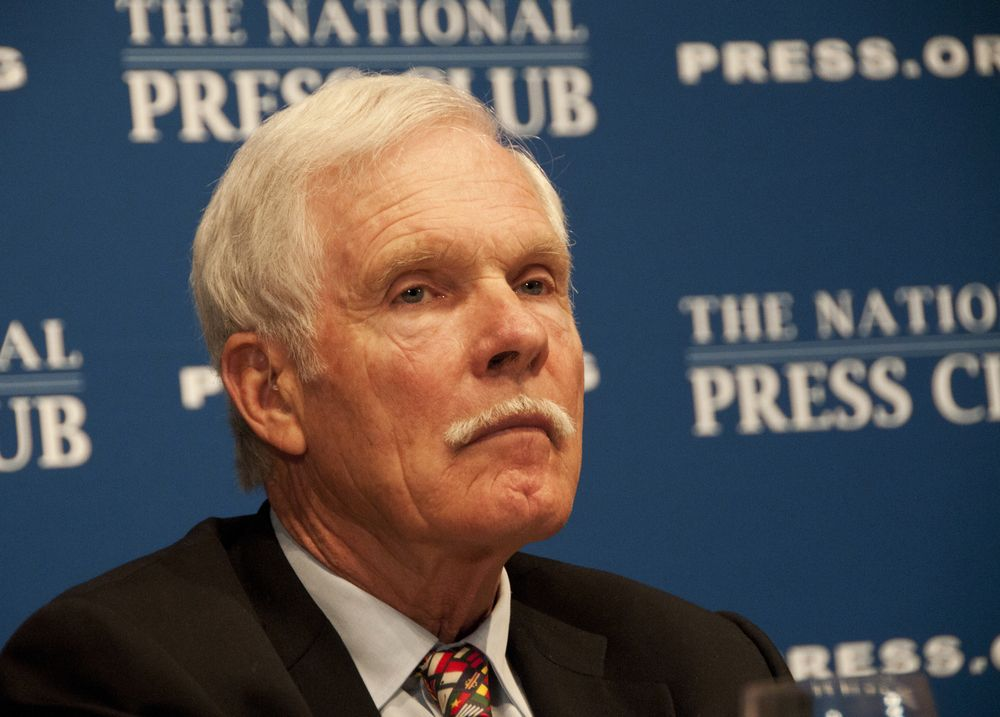
Today, the Ted Turner Biography remains one of the most important stories in the history of global broadcasting.
Early Life and Childhood in the Ted Turner Biography
Robert Edward Turner III was born on November 19, 1938, in Cincinnati, Ohio, United States.
Although he grew up in relative financial comfort because of his father’s successful billboard advertising business, Turner’s childhood was emotionally difficult.
His father, Robert Edward Turner II, was known as highly demanding, strict and emotionally volatile. Turner later spoke publicly about the pressure and harsh discipline he experienced growing up.
The family later relocated to Savannah, Georgia, where Turner attended strict Southern preparatory and military schools.
These experiences shaped many aspects of his personality, including his competitiveness, rebelliousness and refusal to accept limitations imposed by authority figures.
| Born | Robert Edward Turner III November 19, 1938 Cincinnati, Ohio, U.S. |
|---|---|
| Died | May 6, 2026 (aged 87) Lamont, Florida, U.S. |
| Resting place | Bullock Community Cemetery, Brantley, Alabama, U.S. |
| Education | Brown University (expelled) |
| Years active | 1960–2018 |
| Known for | Turner Broadcasting System |
| Spouses | Julia Nye(m. 1960; div. 1964)Jane Smith(m. 1965; div. 1988)Jane Fonda(m. 1991; div. 2001) |
| Children | 5 |
| Website | Official website |
The Ted Turner Biography also includes profound family tragedy.
Turner’s younger sister, Mary Jean, suffered from severe lupus that eventually caused brain damage before her death. The emotional pain deeply affected Turner and contributed to his changing views on religion and life.
The defining trauma came in 1963 when Turner’s father died by suicide.
At only 24 years old, Turner unexpectedly inherited control of the family billboard company.
Many people doubted whether the rebellious young man could successfully run the business.
Instead, he transformed it into the foundation of one of the world’s most influential media empires.
Read Also: James Gichuru legacy: teacher turned independence leader
Brown University and the Rise of “Captain Outrageous”
The Ted Turner Biography includes a turbulent college chapter at Brown University.
Turner initially studied classics before later switching to economics. He also became vice president of the university debating union and captain of the sailing team.
However, his time at Brown was far from conventional.
His father reportedly disapproved strongly of his academic interests and rebellious personality. Turner eventually faced disciplinary action after violating dormitory rules involving a female student visitor.
The university expelled him before he completed his degree.
Although he never formally graduated, Brown later awarded Turner an honorary degree in recognition of his extraordinary contributions to media and business.
The rebelliousness displayed during those years became central to Turner’s public image later in life.
He consistently ignored conventional wisdom and embraced risks that most executives considered impossible.
Building a Media Empire From a Small TV Station
After inheriting Turner Advertising Company, Turner quickly expanded into radio and television acquisitions.
One of the most important moments in the Ted Turner Biography came in 1970 when he purchased a struggling Atlanta television station called WJRJ-TV.
The station later became WTCG and eventually WTBS.
At the time, UHF television stations were considered weak competitors compared to major VHF broadcasters. Turner ignored those assumptions.
He aggressively filled the station with:
- Old Hollywood films
- Cartoons
- Sports broadcasts
- Wrestling
- Sitcom reruns
- Syndicated programming
His greatest innovation came in 1976.
Using satellite technology, Turner transformed WTBS into America’s first “superstation,” distributing the Atlanta station nationwide through cable providers.
The decision revolutionized cable broadcasting economics.
Suddenly, a local television station reached homes across the entire country.
Turner recognized earlier than most media executives that satellite distribution would eliminate traditional local broadcasting limitations.
WTBS soon became nationally famous for broadcasting Atlanta Braves baseball games, Atlanta Hawks basketball and old movie programming.
The success made Turner wealthy and positioned him for his biggest gamble yet.
Read Also: William Omamo legacy: scholar, minister, reformer
CNN Changed Global Journalism Forever
The defining chapter in the Ted Turner Biography arrived in 1980.
When Turner announced plans to create a 24-hour cable news network, many television executives mocked the idea.
Critics argued there was not enough news to sustain around-the-clock coverage.
Turner disagreed completely.
He believed viewers wanted constant access to information rather than waiting for scheduled evening news broadcasts.
On June 1, 1980, CNN officially launched.
The network initially struggled with limited budgets, technical problems and widespread skepticism.
Some critics mockingly called it “Chicken Noodle News.”
Turner remained convinced the concept would eventually succeed.
Major global events later proved him right.
During the 1991 Gulf War, CNN became the dominant international source for live conflict coverage. The war became one of the first major global events broadcast continuously in real time.
The success transformed journalism forever.
The Ted Turner Biography therefore represents a turning point in how humanity consumes news.
CNN fundamentally changed:
- Breaking news coverage
- Political reporting
- War journalism
- International broadcasting
- Cable television economics
- Live crisis reporting
Modern digital news culture traces directly back to Turner’s vision of nonstop information access.
Read Also: Masakhalia legacy: technocrat’s brief Treasury stint
Expanding Beyond CNN
Although CNN became his most famous creation, Turner continued expanding aggressively throughout the 1980s and 1990s.
His empire eventually included:
- TNT
- Turner Classic Movies
- Cartoon Network
- Headline News
- WCW wrestling
- Major film libraries
One of Turner’s most important entertainment acquisitions involved purchasing MGM’s historic pre-1986 film library.
The acquisition helped preserve thousands of classic films and later supported the creation of Turner Classic Movies.
However, Turner also sparked controversy by authorizing colorized versions of black-and-white films, angering filmmakers and movie historians.
The Ted Turner Biography also highlights his interest in educational entertainment.
He helped create “Captain Planet and the Planeteers,” an animated environmental series designed to teach children about conservation and ecological responsibility.
Turner’s ability to identify underserved television audiences became legendary throughout the media industry.
Sports Ownership and National Broadcasting
The Ted Turner Biography also transformed American sports broadcasting.
Turner purchased the Atlanta Braves in 1976 and used WTBS to broadcast games nationally.
Long before national cable sports deals became standard, Braves baseball reached households across America because of Turner’s superstation strategy.
The broadcasts transformed the Braves into one of the country’s most recognizable baseball franchises.
Under Turner’s ownership, the team won the 1995 World Series.
Turner also owned:
- Atlanta Hawks
- Atlanta Thrashers
- World Championship Wrestling
WCW later became WWE’s biggest competitor during the famous “Monday Night Wars” of the 1990s.
Turner’s involvement with sports occasionally became chaotic and theatrical.
In 1977, frustrated by the Braves’ poor performance, Turner briefly appointed himself manager of the team before Major League Baseball intervened.
The incident reflected the impulsive and dramatic personality that made him both controversial and fascinating.
Marriage to Jane Fonda Captivated America
The Ted Turner Biography includes one of the most famous celebrity marriages of the 1990s.
Turner married actress Jane Fonda in 1991 after several years of romance.
Their relationship combined Hollywood fame, activism, politics and media influence.
Former U.S. President Jimmy Carter reportedly described their relationship as one of the most remarkable romances he had witnessed.
Despite strong chemistry, differences eventually emerged.
Fonda later explained that Turner’s restless lifestyle and overwhelming personality became emotionally exhausting over time.
The couple divorced in 2001 but remained close afterward.
Turner had previously been married to:
- Judy Nye
- Jane Shirley Smith
He fathered five children:
- Rhett Turner
- Laura Turner Seydel
- Jennie Turner Garlington
- Teddy Turner
- Beau Turner
Several of his children later became active in philanthropy and environmental work.
Read Also: Paul Kimaru UK life after Machachari fame
Philanthropy and Environmental Activism
As Turner grew older, philanthropy became increasingly central to his public identity.
One of the most extraordinary moments in the Ted Turner Biography came in 1997 when he pledged $1 billion to establish the United Nations Foundation.
The donation became one of the largest charitable commitments ever made by an individual.
Turner also co-founded:
- Nuclear Threat Initiative
- Turner Foundation
- Captain Planet Foundation
- Turner Endangered Species Fund
Environmental conservation became one of his deepest passions.
Turner accumulated nearly two million acres of ranch land across the United States and Argentina, becoming one of North America’s largest private landowners.
Most famously, he helped revive the American bison population.
His ranches maintained approximately 51,000 bison, reportedly the world’s largest private herd.
Turner also launched Ted’s Montana Grill, helping commercialize bison meat as an alternative food product.
Political Views and Public Controversies
The Ted Turner Biography is also filled with controversy.
Turner became known for making provocative statements about:
- Religion
- Climate change
- U.S. foreign policy
- Population growth
- Middle East politics
Critics frequently accused him of recklessness and insensitivity.
Supporters admired his willingness to speak openly regardless of backlash.
Turner strongly advocated for:
- Climate action
- Nuclear disarmament
- Universal healthcare
- Environmental reform
His rivalry with media mogul Rupert Murdoch became legendary inside broadcasting circles.
The conflict symbolized competing political and journalistic visions for the future of cable news.
Health Challenges and Final Years
In 2018, Turner publicly revealed that he had Lewy body dementia, a progressive neurological condition associated with memory decline and cognitive deterioration.
Following the diagnosis, he gradually withdrew from public life.
Public appearances became increasingly rare, though he occasionally discussed his legacy and environmental concerns during interviews.
In early 2025, Turner was hospitalized with pneumonia before later recovering in rehabilitation.
On May 6, 2026, Turner died peacefully at his home near Tallahassee, Florida, surrounded by family members.
Tributes immediately poured in from across journalism, politics, sports and entertainment.
Many CNN anchors described him as the visionary who made their careers possible.
Fascinating Facts About Ted Turner
Several remarkable details help explain why Turner remains such a legendary media figure.
He won the America’s Cup sailing competition in 1977.
Turner once challenged Rupert Murdoch to a televised fistfight.
He briefly served as manager of the Atlanta Braves.
Turner lived inside CNN headquarters during the network’s early years.
He created Captain Planet to promote environmental awareness.
Turner became Time Magazine’s Person of the Year in 1991.
He once ranked among North America’s largest private landowners.
A secret CNN “Doomsday Video” created under his leadership leaked publicly online years later.
Net Worth and Financial Legacy
At the time of his death, Turner’s estimated net worth stood between $2.2 billion and $2.3 billion.
His wealth came from:
- Turner Broadcasting System
- CNN
- Cable television networks
- Sports franchises
- Real estate
- Investments
- Ranching operations
Even after selling major media assets, Turner remained enormously wealthy because of strategic investments and land ownership.
The Ted Turner Biography therefore reflects not only media influence but also extraordinary business success.
Read Also: Tshala Muana Biography
Why the Ted Turner Biography Matters
The Ted Turner Biography matters because modern global media would look completely different without him.
Without Turner:
- 24-hour news networks may not exist in their current form
- Cable specialization could have developed much slower
- Global live crisis coverage would look different
- Cartoon Network and TCM might never have existed
- National sports broadcasting may have evolved differently
Turner fundamentally altered the structure of television itself.
His willingness to challenge establishment thinking became his defining characteristic.
Even critics acknowledged his revolutionary impact on journalism and broadcasting.
Ted Turner’s Enduring Legacy
Ted Turner did far more than launch television channels.
He permanently changed how the world experiences information.
Every breaking-news alert, live global broadcast and specialized cable network still carries elements of Turner’s original vision.
His influence continues through:
- CNN’s international reach
- Environmental foundations
- Wildlife conservation
- Film preservation
- Sports broadcasting innovation
- Modern cable network structures
Few individuals have shaped both media and global culture as profoundly as Ted Turner.
Conclusion
The Ted Turner Biography is the story of a fearless visionary who refused to accept conventional limitations.
From inheriting a billboard company after his father’s death to creating CNN and revolutionizing global journalism, Turner consistently transformed industries through bold risk-taking and relentless ambition.
He reshaped news broadcasting, preserved film history, expanded cable television, revolutionized sports broadcasting and dedicated enormous resources toward environmental conservation.
At the same time, his controversies, outspoken personality and emotional complexity made him one of the most fascinating public figures of his generation.
Even after his death, Ted Turner remains woven into the foundation of modern media itself.
He did not simply participate in broadcasting history.
He changed it forever.
Read Also: Amara Wayans – American Model and Social Media Influencer