The Langley Aerodrome crash of October 7, 1903, was one of the most famous failed flight tests in early aviation history. Samuel Pierpont Langley, secretary of the Smithsonian Institution, had spent years developing a powered flying machine with government support and a team of skilled engineers. His full-size Aerodrome was intended to prove that a man-carrying powered aircraft could fly.
Instead, the machine plunged into the Potomac River shortly after launch.
The aircraft carried Charles M. Manly, Langley’s chief engineer and pilot. Manly survived, but the Aerodrome was badly damaged. The failure was humiliating because it happened in public, near Washington, D.C., only weeks before the Wright brothers achieved controlled powered flight at Kill Devil Hills in North Carolina.
The crash did not mean Langley was foolish. He had made real contributions to aeronautics, especially through earlier unmanned flying models. But the October 1903 failure exposed serious problems in his full-size machine, especially its launch system, structural strength, and lack of practical pilot control.
Basic Accident Details
| Detail | Information |
|---|---|
| Date | Wednesday, October 7, 1903 |
| Aircraft | Langley Aerodrome A |
| Type | Powered experimental aircraft |
| Owner/operator | Private / Samuel P. Langley project |
| Registration | None |
| Pilot | Charles M. Manly |
| Occupants | 1 |
| Fatalities | 0 |
| Other fatalities | 0 |
| Aircraft damage | Substantial |
| Location | Potomac River, near Washington, D.C. |
| Phase | Takeoff / launch |
| Nature of flight | Test |
| Launch method | Catapult from a houseboat |
What Was the Langley Aerodrome?
The Langley Aerodrome was an experimental powered aircraft designed under the direction of Samuel Pierpont Langley. It was called an “Aerodrome,” from Greek roots meaning “air runner.”
Langley had already achieved success with smaller unmanned models. In 1896, his steam-powered Aerodrome models flew over the Potomac, proving that powered heavier-than-air machines could fly without a pilot. Those model successes helped persuade supporters that a full-size man-carrying version might also succeed.
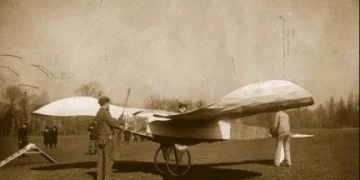
The full-size Aerodrome A was much more ambitious. The Smithsonian’s National Air and Space Museum describes it as a piloted tandem-wing experimental aircraft built and unsuccessfully tested in 1903. It had a 52-horsepower, five-cylinder radial gasoline engine driving two pusher propellers through a geared transmission system.
The machine was large for its time. The Smithsonian lists its wingspan at 48 feet 5 inches, its length at 52 feet 5 inches, and its weight at about 750 pounds including the pilot.
Who Was Samuel Pierpont Langley?
Samuel Pierpont Langley was one of America’s most prominent scientists in the late nineteenth and early twentieth centuries. He served as secretary of the Smithsonian Institution and was deeply interested in the possibility of mechanical flight.
Langley approached aviation from the world of science and engineering. He studied aerodynamics, built models, and believed that powered flight could be achieved through careful design and sufficient engine power.
His early model aircraft were impressive. They showed that a powered machine heavier than air could sustain flight, at least without a human pilot. This made Langley one of the most serious aviation experimenters before the Wright brothers.
However, the move from model aircraft to a full-size piloted machine proved much harder than expected.
Who Was Charles M. Manly?
Charles Matthews Manly was Langley’s chief engineer and the pilot of the Aerodrome during the October 7, 1903 test.
Manly was not just a passenger. He was central to the project. He helped develop the lightweight engine that powered the Aerodrome, and that engine was one of the most advanced parts of the machine.
The engine’s power-to-weight ratio was impressive for the period. In fact, the failure of the Aerodrome was not mainly an engine problem. The aircraft had power. What it lacked was a successful launch, reliable structure, and the kind of control system that would make flight manageable.
Manly survived both of Langley’s 1903 full-size Aerodrome crashes, including the later December 8 attempt that also ended in the Potomac. Smithsonian Libraries notes that Langley’s man-carrying Aerodrome crashed twice into the Potomac River with Manly aboard.
Why Langley Used a Catapult
The Langley Aerodrome had no landing gear. Langley planned to launch it from a houseboat using a catapult system and recover it from the water after flight.
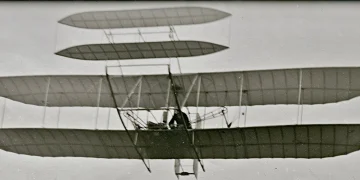
This approach was very different from the Wright brothers’ method. The Wrights launched from rails on land and designed their aircraft around active pilot control. Langley chose calm air over water, believing it would reduce risk during landing.
The catapult was supposed to accelerate the Aerodrome into the air. But this created a serious problem: the aircraft had to survive the stress of launch before it even began flying.
A weak or poorly integrated aircraft could be damaged by the launching process itself. That is exactly what many later accounts argue happened on October 7, 1903.
What Happened on October 7, 1903?
On October 7, 1903, Langley’s Aerodrome A was mounted on its launching apparatus on a houseboat in the Potomac River.
Charles Manly climbed aboard. The goal was to launch the aircraft into free flight.
Instead, the aircraft failed almost immediately. The machine plunged into the Potomac River after launch. The commonly reported explanation is that part of the aircraft’s wing or supporting structure caught or was damaged during release from the catapult, causing the Aerodrome to lose its flying attitude and dive into the water.
A Wright Brothers history source notes that photographs of the October 7 crash show the front wings twisting and forcing the aircraft down, while witnesses said the front guy post had caught on the catapult. It adds that both explanations could be compatible because the guy post was attached ahead of the main spars, allowing launch interference to distort the wing structure.
The result was a public failure. Manly was pulled from the river alive, but the Aerodrome was badly damaged.
Why the Langley Aerodrome Crash Happened
The October 7 crash is usually explained as a launch and structural failure rather than a lack of engine power.
Several factors appear to have contributed.
The Catapult Launch Was Risky
The aircraft had to be thrown into the air from a launching track. If any part of the aircraft caught on the catapult or was misaligned during release, the machine could be damaged before it had a chance to fly.
The Structure Was Too Light
Early aircraft designers faced a difficult balance. A machine had to be light enough to fly but strong enough to survive launch, aerodynamic loads, and control forces. Langley’s Aerodrome may have been too lightly built for the stresses of its launch system.
The Aircraft Lacked Practical Pilot Control
Unlike the Wright brothers’ aircraft, Langley’s Aerodrome did not provide the same level of active three-axis control. Even if it had launched cleanly, it is unclear whether Manly would have had enough control authority to manage the aircraft in flight.
Testing Moved Too Quickly From Models to Full-Size Flight
Langley’s successful models encouraged confidence, but scaling up an aircraft is not simple. A full-size piloted machine faces greater structural loads, human safety concerns, launch complications, and control challenges.
How the Potomac Launch System Worked
Langley’s launch system was built on a houseboat. The Aerodrome was placed on a track, then released by a catapult-like mechanism to accelerate it into the air over the river.
This system had one advantage: it avoided the need for wheels and a runway. In theory, the aircraft would launch over water, fly, and then come down in the river.
But the disadvantages were serious. The aircraft depended completely on the launch apparatus working perfectly. A land-based aircraft could roll, lift off gradually, and give the pilot some chance to respond. Langley’s machine had to go from fixed support to flight almost instantly.
That transition was unforgiving.
Langley Aerodrome Crash Versus Wright Brothers Success
The contrast between Langley and the Wright brothers is one of the most important comparisons in aviation history.
Langley had institutional prestige, government funding, scientific standing, and an excellent engine. The Wright brothers had a bicycle shop, limited money, and years of patient glider testing.
Yet the Wrights solved the control problem more effectively.
| Issue | Langley Aerodrome | Wright Brothers |
| Launch method | Catapult from houseboat | Rail launch over sand |
| Landing plan | Water recovery | Ground landing |
| Control system | Limited practical control | Three-axis control through elevator, wing-warping, rudder |
| Testing path | Models to full-size powered craft | Kites, gliders, wind tunnel, then powered aircraft |
| Pilot training | Limited free-flight practice | Extensive glider experience |
| Result in 1903 | Crashed into Potomac | Successful controlled powered flight |
The Wright brothers’ great achievement was not simply that their engine worked. It was that they understood flight as a control problem.
The December 1903 Second Failure
The October 7 crash was not the end of Langley’s attempt.
After repairs, Langley tried again on December 8, 1903. That attempt also failed. The Aerodrome again fell into the Potomac River with Charles Manly aboard. Smithsonian Magazine describes the second attempt as another plunge into the Potomac, with the wings failing in the rush of air.
This second failure came just nine days before the Wright brothers’ successful powered flights on December 17, 1903.
The timing was devastating for Langley’s reputation. Public opinion quickly turned the Aerodrome into a symbol of expensive failure, while the Wright Flyer became the symbol of practical success.
Was the Langley Aerodrome Capable of Flight?
This question became controversial.
After Langley’s death, the Aerodrome was later modified and tested by Glenn Curtiss in 1914. Those tests became part of a long dispute between the Smithsonian and supporters of the Wright brothers over whether Langley’s machine had been capable of flight before the Wright Flyer.
The controversy is complex, but one point is important: the 1903 Aerodrome as launched by Langley did not achieve successful free flight.
Smithsonian Libraries states that the question of whether Langley’s Aerodrome could fly with a man aboard was addressed in December 1903 when it crashed twice into the Potomac with Manly aboard.
Even if later modified versions could be made to fly, that does not change what happened in October and December 1903. Langley’s actual test machine failed in its real operating configuration.
Why the Crash Was So Publicly Damaging
Langley was a respected scientist and the Smithsonian secretary. His project had received public attention and government support. The failure was therefore not private.
Newspapers mocked the Aerodrome after the Potomac crashes. The famous phrase that it flew “like a handful of mortar” became part of the story of Langley’s humiliation.
The criticism was harsh, but understandable. The public had expected a breakthrough. Instead, they saw an expensive machine fall into the river.
This damaged Langley personally and professionally. He died in 1906, only a few years after the failed tests.
What Langley Got Right
It would be unfair to remember Langley only for failure.
He made several real contributions to aviation.
First, his unmanned Aerodrome models demonstrated powered heavier-than-air flight before 1903.
Second, his work helped prove that engines could be built light enough for aviation.
Third, the Manly-Balzer engine developed for the full-size Aerodrome was a remarkable technical achievement.
Fourth, his experiments kept serious scientific attention focused on flight at a time when many people still doubted whether powered flying machines were possible.
Langley failed to produce a practical airplane, but he helped move aviation toward the point where success became possible.
What Langley Got Wrong
Langley’s biggest mistake was underestimating control.
He focused heavily on power and launching. He believed that if the aircraft had enough lift and enough engine power, it could fly. The Wright brothers understood that a pilot also had to control the aircraft continuously.
Langley also depended on a complex launch system that introduced serious risk. His machine did not have wheels, a runway, or the ability to build speed gradually. It had to survive a sudden mechanical release from a houseboat.
Finally, Langley did not develop the same pilot training experience that the Wrights gained through glider flights. The Wright brothers learned by flying. Langley’s pilot had far less opportunity to practice controlling the machine before powered launch.
Why the October 1903 Crash Matters
The Langley Aerodrome crash matters because it shows that early aviation was not a simple race to build the strongest engine.
The aircraft had power. It had scientific backing. It had money. It had an experienced engineering team. Yet it failed because the whole system did not work together.
A successful aircraft needed:
- Strong but light structure
- Reliable launch method
- Effective control system
- Skilled pilot
- Stable aerodynamics
- Practical testing process
- Safe recovery plan
Langley had solved some of these problems, but not all of them. The Wright brothers solved enough of them to fly.
Common Errors About the Langley Aerodrome Crash
Calling It the First Airplane Flight Attempt
It was one of the most famous early powered flight attempts, but it was not the first attempt by any inventor to fly a powered aircraft.
Saying the Engine Failed
The October 7 crash is more often linked to launch and structural problems than engine failure.
Ignoring Charles Manly
Manly was central to the project. He helped develop the engine and risked his life as the pilot.
Treating Langley as a Fool
Langley was not foolish. He was a serious scientist who solved some aviation problems but failed to solve practical controlled flight.
Claiming the Crash Proved Flight Was Impossible
The crash proved only that Langley’s machine and launch system failed. The Wright brothers proved controlled powered flight possible just weeks later.
Timeline of the Langley Aerodrome Project
| Date / Period | Event |
| 1890s | Samuel Langley studies powered heavier-than-air flight |
| 1896 | Langley’s unmanned Aerodrome models fly over the Potomac |
| Late 1890s–1903 | Langley develops a full-size man-carrying Aerodrome |
| October 7, 1903 | First manned Aerodrome launch fails; aircraft falls into Potomac |
| December 8, 1903 | Second manned attempt also fails in the Potomac |
| December 17, 1903 | Wright brothers achieve controlled powered flight at Kill Devil Hills |
| 1914 | Modified Langley Aerodrome is later tested by Glenn Curtiss, sparking controversy |
| Later years | The Aerodrome becomes part of Smithsonian aviation history |
Key Takeaways
- The Langley Aerodrome crash happened on October 7, 1903.
- The aircraft was launched from a catapult on a houseboat in the Potomac River.
- Charles M. Manly was aboard and survived.
- The aircraft fell into the Potomac shortly after launch.
- The crash was linked to launch and structural problems, including reports that part of the aircraft caught on the catapult.
- Samuel Langley was a respected scientist and Smithsonian secretary.
- The Aerodrome had a powerful lightweight engine for its time.
- The failure showed that power alone was not enough for flight.
- The Wright brothers succeeded weeks later because they solved control more effectively.
- Langley’s project remains important despite its failure.
- The crash became one of the most famous unsuccessful tests before the first controlled powered flight.
- The Aerodrome is now preserved in Smithsonian aviation history.
Frequently Asked Questions
What was the Langley Aerodrome crash?
The Langley Aerodrome crash was the failed October 7, 1903 test of Samuel Langley’s full-size powered aircraft, which fell into the Potomac River shortly after launch.
Who piloted the Langley Aerodrome?
Charles M. Manly piloted the Aerodrome during the October 1903 test.
Did Charles Manly survive the crash?
Yes. Manly survived the October 7, 1903 crash.
Where did the Langley Aerodrome crash?
It crashed into the Potomac River near Washington, D.C.
Why did the Langley Aerodrome crash?
The crash is generally linked to launch and structural problems. Accounts state that part of the aircraft caught or was damaged during the catapult launch, causing it to plunge into the river.
Was the Langley Aerodrome powered?
Yes. The full-size Aerodrome A was powered by a 52-horsepower gasoline engine driving two pusher propellers.
Did Langley try again after the October crash?
Yes. A second attempt on December 8, 1903 also failed, with the Aerodrome again falling into the Potomac River.
Was Samuel Langley close to beating the Wright brothers?
Langley was close in time, but not in practical success. His machine failed in October and December 1903, while the Wright brothers achieved controlled powered flight on December 17, 1903.
What was Langley’s biggest aviation mistake?
His biggest mistake was focusing too much on power and launch while failing to develop the level of control and pilot training that made the Wright brothers successful.
Why is the Langley Aerodrome important?
It is important because it shows both the ambition and the difficulty of early powered flight. Langley’s project failed, but it contributed to aviation engineering and remains a major case study in flight history.
Conclusion
The Langley Aerodrome crash of October 7, 1903, was a dramatic failure, but it was also a valuable lesson in the history of aviation. Samuel Langley had money, scientific authority, a serious engineering team, and a powerful engine. Yet his aircraft plunged into the Potomac River because flight required more than power.
The Aerodrome needed a reliable launch, stronger structure, practical control, and a pilot trained through repeated free-flight experience. Those were the areas where the Wright brothers had the advantage.
Charles Manly survived the crash, and Langley’s dream did not disappear from history. But the October 1903 failure showed that the future of aviation would belong not simply to the machine with the strongest engine, but to the design that could be launched, controlled, flown, and landed as a complete system.
Read Also: Bradsky Airship Disaster: The 1902 Paris Crash That Killed Ottokar de Bradsky and Paul Morin