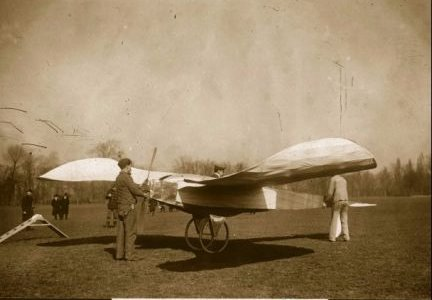
The Blériot-Voisin II crash of 18 July 1905 was one of the dangerous early experiments that shaped French aviation before powered airplanes became practical. The aircraft was a float-equipped glider built through the collaboration of Gabriel Voisin and Louis Blériot. It was tested on the River Seine at Billancourt, near Paris, with Voisin as pilot and a motorboat providing tow power.
The test ended almost immediately. The glider tilted, failed to take off properly, crashed into the water, and was destroyed. Voisin was trapped in the wreckage and narrowly escaped drowning.
No one died, but the crash mattered. It showed that lift alone was not enough. Early aircraft also needed stability, control, safe launch methods, and a design that could recover from small disturbances. The Blériot-Voisin II lacked those qualities.
The incident came during a period when French aviation pioneers were experimenting with gliders, floats, tow launches, box-kite structures, and water-based testing. It was a time of courage and improvisation, but also a time of serious risk.
Basic Accident Details
| Detail | Information |
|---|---|
| Date | Tuesday, 18 July 1905 |
| Aircraft | Blériot-Voisin II |
| Type | Float-equipped glider |
| Owner/operator | Private |
| Pilot | Gabriel Voisin |
| Occupants | 1 |
| Fatalities | 0 |
| Other fatalities | 0 |
| Aircraft damage | Destroyed |
| Location | Billancourt, France |
| Launch area | River Seine |
| Phase | Takeoff / tow launch |
| Nature of flight | Test |
| Main result | Aircraft crashed into the Seine; Voisin narrowly escaped drowning |
What Was the Blériot-Voisin II?
The Blériot-Voisin II was an experimental glider built jointly by Gabriel Voisin and Louis Blériot. It was not a powered aircraft in the usual sense. It had no onboard engine driving it through the air. Instead, it was designed to be towed by a motorboat across the River Seine until it generated enough lift to rise from the water.
The machine was fitted with floats, allowing it to sit on and launch from the river. This made sense for early testing because water offered a wide, open surface and could appear safer than hard ground. But water also introduced serious hazards. A failed takeoff could throw the aircraft into the river, trap the pilot, or damage the structure beyond repair.
The Blériot-Voisin II followed an earlier float-glider experiment associated with Voisin and Ernest Archdeacon. That earlier aircraft had flown on 8 June 1905 after being towed by a motorboat on the Seine between the Billancourt and Sèvres bridges.
Blériot saw promise in the idea and commissioned a similar aircraft. But the Blériot-Voisin II was less stable and harder to control.
Who Was Gabriel Voisin?
Gabriel Voisin was one of the most important French aviation pioneers of the early twentieth century. He was an aircraft designer, builder, pilot, and later an industrialist. Before airplanes became reliable, Voisin was already experimenting with gliders, floats, tow systems, and structural forms inspired by box kites.
Voisin’s importance lies partly in his practical approach. He was not only drawing aircraft. He built them, tested them, and personally took the risks of flying them.
In 1905, he was still a young pioneer working in a field where almost every design was experimental. He had already taken part in successful gliding tests on the Seine. But on 18 July, the Blériot-Voisin II crash nearly cost him his life.
After later disputes and failed designs with Blériot, Voisin eventually formed Les Frères Voisin with his brother Charles. That company became one of Europe’s earliest aircraft manufacturers and played a major role in French aviation before the First World War.
Who Was Louis Blériot?
Louis Blériot was a French inventor, engineer, and aviation pioneer who later became internationally famous for crossing the English Channel by airplane in 1909.
In 1905, however, Blériot was still searching for the right aircraft design. He was experimenting with different forms and collaborating with builders such as Gabriel Voisin.
Blériot commissioned Voisin to build a machine similar to the earlier Voisin float glider, but with design changes. Historical summaries note that the Blériot II differed partly by having a smaller-span lower wing, which affected its structure and stability.
The Blériot-Voisin II crash did not stop Blériot’s aviation career. Instead, it became one of several failed experiments on his long path to becoming one of the most famous aviators in Europe.
Why the Test Took Place on the River Seine
The River Seine was a useful early aviation test site because it provided a long, open stretch of water near Paris. A motorboat could tow a float-equipped glider until it gained enough speed to lift.
This method had several attractions.
First, it avoided the need for an onboard engine. In 1905, aviation engines were still heavy, unreliable, and difficult to integrate into fragile aircraft.
Second, it allowed experimenters to test lift and stability without needing a runway.
Third, a water landing seemed safer than crashing onto hard ground.
But the method had serious disadvantages. A glider on floats could catch a wingtip in the water. A crosswind could destabilize the craft. The towline could create sudden forces. If the aircraft crashed, the pilot could be trapped in the wreckage.
The Blériot-Voisin II accident showed all of those risks clearly.
What Happened on 18 July 1905?
On 18 July 1905, Gabriel Voisin attempted to fly the Blériot-Voisin II from the Seine at Billancourt. The glider was towed by a motorboat.
The weather was not ideal. Historical summaries describe unsuitable conditions, including a strong crosswind, but Voisin attempted the flights because permission to use the river was difficult to obtain.
Voisin first made a short flight in his own glider. He then attempted to fly Blériot’s machine.
The Blériot-Voisin II lifted or began to lift, but it was unstable. The aircraft tilted, caught the water, and crashed into the river. Voisin was trapped inside and nearly drowned before being rescued.
The aircraft was destroyed.
Aviation Safety Network’s summary describes the glider as being on floats and towed by a boat on the river. It tilted immediately, failed to take off, and Voisin was just saved from drowning.
Why the Blériot-Voisin II Failed
The Blériot-Voisin II failed because it lacked the combination of stability and control needed for safe flight.
The aircraft could generate lift, but it did not give the pilot enough authority to manage that lift. It was unstable during the tow launch, and once it began to tilt, there was little Voisin could do.
Several factors likely contributed.
Poor Control
Early gliders often had very limited control systems. The Wright brothers had already shown the importance of three-axis control, but many European experimenters were still using designs that relied more heavily on inherent stability or pilot luck.
The Blériot-Voisin II did not provide enough effective control for the pilot to correct the aircraft as it lifted from the water.
Weak Stability
The aircraft was not equally stable compared with earlier designs. If a wing dropped or the aircraft yawed during takeoff, the floats and wing structure could interact dangerously with the water.
Tow-Launch Risk
Being pulled by a motorboat introduced forces that were hard to manage. The aircraft had to lift cleanly and remain aligned with the tow. A slight imbalance could become a crash.
Crosswind Conditions
A strong crosswind could push one wing down, turn the aircraft, or cause a float or wingtip to catch the water. Historical accounts note that the weather was unsuitable, but the attempt went ahead because river permission was difficult to secure.
Water Hazards
Water testing reduced some risks but created others. A crash into water could trap the pilot, especially inside a fragile frame of wires, struts, and fabric.
Why Gabriel Voisin Nearly Drowned
Voisin nearly drowned because the aircraft crashed into the Seine and trapped him inside the wreckage.
Early aircraft were not designed with modern escape systems. A pilot could become tangled in wires, trapped between structural members, or held down by fabric and floats. If the machine overturned or sank, even a non-fatal crash could become life-threatening within seconds.
That is what made the Blériot-Voisin II accident so serious despite there being no fatalities.
The crash was not merely a failed takeoff. It was a near-fatal water accident.
The Role of Control in Early Aviation
The Blériot-Voisin II crash is best understood as a control failure in the broad sense.
Early aviation pioneers often focused on lift. They wanted wings that could raise a machine into the air. But the deeper problem was control. Once airborne, or even partly airborne during takeoff, an aircraft had to be kept level, balanced, and pointed in the right direction.
The Wright brothers had recognized this earlier than most. Their system of wing-warping, elevator control, and rudder control made their aircraft more controllable than many European machines of the same period.
Voisin and Blériot’s float glider showed the risk of neglecting control. It could not simply be pulled into the sky and expected to remain stable.
The Earlier June 1905 Voisin Success
The July crash is more understandable when compared with Voisin’s earlier success on 8 June 1905.
On that date, Voisin flew a float-equipped glider towed by a motorboat on the Seine. The aircraft flew between the Billancourt and Sèvres bridges and reportedly covered about 600 meters.
That success was important. It encouraged confidence in water-towed gliders and caught Blériot’s attention.
But it also created a danger: the belief that a similar machine could be built and flown with only small changes. The Blériot version differed in ways that affected stability. It did not behave as well as the earlier glider.
That is one of aviation history’s recurring lessons. A small design change can have a large effect on stability and safety.
How the Crash Affected the Blériot-Voisin Partnership
The Blériot-Voisin II crash did not immediately end experimentation, but it showed the difficulty of collaboration between two strong aviation personalities.
Blériot wanted to push designs forward. Voisin was practical but also willing to test dangerous machines. Their partnership continued into later aircraft, including the Blériot III and Blériot IV, but those machines were also unsuccessful.
Eventually, Blériot and Voisin separated. Voisin went on to build aircraft with his brother Charles. Blériot continued developing his own machines and eventually became famous for the 1909 Channel crossing.
The 1905 crash therefore sits early in both men’s aviation careers: a failure before later success.
Why the Aircraft Was Destroyed
The Blériot-Voisin II was destroyed because it crashed into the river during the takeoff attempt.
Float gliders were fragile. They were built from light structural materials, fabric, struts, wires, and floats. A sudden impact with water could tear the structure apart, twist the wings, break supports, and damage control surfaces.
Water can feel soft to humans at low speed, but to a fast-moving aircraft structure it can behave like a hard surface. If a wingtip or float catches, the aircraft can flip or break quickly.
That is likely why the accident record lists the aircraft damage as destroyed.
Why This Crash Matters in French Aviation History
The Blériot-Voisin II crash matters because it captures the experimental nature of French aviation in 1905.
France was one of the most important aviation centers in the world. Inventors, financiers, engineers, journalists, and spectators followed new flying machines closely. The Seine, Issy-les-Moulineaux, Bagatelle, and other locations became testing grounds for machines that were often unstable and dangerous.
The crash also shows how early aviation was not a simple story of steady progress. Voisin had a successful water-towed flight in June. The next similar machine failed in July. Blériot later became a great aviation figure, but his early experiments included repeated failures.
Progress came through trial, crash, repair, redesign, and persistence.
Comparison With the Wright Brothers
The Blériot-Voisin II crash happened in the same era as the Wright brothers’ work in America.
By July 1905, the Wrights were testing the Wright Flyer III at Huffman Prairie. They also suffered crashes and control problems, including Orville Wright’s serious accident on 14 July 1905. But the Wrights were refining a control system that eventually made their aircraft practical.
Voisin and Blériot were still exploring forms that did not fully solve the control problem.
| Issue | Blériot-Voisin II | Wright Flyer III |
| Test year | 1905 | 1905 |
| Location | Seine at Billancourt | Huffman Prairie, Ohio |
| Launch method | Motorboat tow from water | Rail launch with launching system |
| Pilot | Gabriel Voisin | Orville and Wilbur Wright |
| Main problem | Instability and poor control | Pitch/control instability before redesign |
| Outcome | Destroyed in water crash | Redesigned into practical aircraft |
Both stories show the same truth: aviation success depended on control as much as lift.
Common Errors About the Blériot-Voisin II Crash
Calling It a Powered Flight
The aircraft was a glider towed by a motorboat. It was not powered by its own onboard engine.
Saying Gabriel Voisin Died
Voisin did not die in the crash. He nearly drowned but survived.
Treating the Seine as a Safe Test Site
The river reduced some ground-impact risks but introduced drowning, trapping, and float-instability risks.
Ignoring Louis Blériot’s Role
The aircraft was part of the Blériot-Voisin collaboration and was built after Blériot became interested in Voisin’s earlier float-glider work.
Assuming the June Success Guaranteed July Success
The earlier Voisin float glider had flown, but the Blériot-Voisin II was different and less stable.
Timeline of the Blériot-Voisin II Crash
| Date / Period | Event |
| Early 1905 | Gabriel Voisin works on float-equipped glider designs |
| 8 June 1905 | Voisin successfully flies a float glider towed by a motorboat on the Seine |
| After 8 June 1905 | Louis Blériot commissions Voisin to build a similar machine |
| 18 July 1905 | Voisin attempts flights on the Seine at Billancourt |
| 18 July 1905 | Voisin makes a short flight in his own glider |
| 18 July 1905 | Voisin attempts the Blériot-Voisin II |
| 18 July 1905 | The aircraft tilts, crashes into the Seine, and is destroyed |
| After crash | Voisin narrowly escapes drowning |
| Later years | Blériot and Voisin continue separately toward major aviation roles |
Key Takeaways
- The Blériot-Voisin II crash happened on 18 July 1905.
- The accident occurred at Billancourt on the River Seine.
- Gabriel Voisin was the pilot.
- The aircraft was a float-equipped glider, not a powered airplane.
- It was towed by a motorboat during the takeoff attempt.
- The glider tilted, failed to take off properly, and crashed into the river.
- Voisin was trapped and narrowly escaped drowning.
- No fatalities were recorded.
- The aircraft was destroyed.
- The test happened after Voisin’s successful 8 June 1905 Seine glider flight.
- Louis Blériot had commissioned a similar machine after seeing Voisin’s earlier success.
- The crash showed the danger of poor stability and weak control in early aircraft.
- The incident was part of the difficult experimental road toward practical French aviation.
Frequently Asked Questions
What was the Blériot-Voisin II crash?
The Blériot-Voisin II crash was a failed 18 July 1905 float-glider test on the River Seine at Billancourt, France. The aircraft crashed into the water and was destroyed.
Who piloted the Blériot-Voisin II?
Gabriel Voisin piloted the aircraft during the test.
Did Gabriel Voisin die in the crash?
No. Voisin nearly drowned but survived.
Was the Blériot-Voisin II powered?
No. It was a glider on floats, towed by a motorboat on the Seine.
Where did the crash happen?
The crash happened at Billancourt, France, on the River Seine.
What caused the Blériot-Voisin II crash?
The aircraft was unstable during the tow launch. It tilted, failed to take off properly, and crashed into the river. Crosswind conditions and weak control likely contributed.
Was anyone else on board?
No. The accident record lists one occupant, Gabriel Voisin.
Was the aircraft destroyed?
Yes. The Blériot-Voisin II was destroyed in the crash.
Why was the River Seine used for testing?
The Seine provided an open water surface for tow-launched float-glider experiments, allowing a motorboat to pull the aircraft up to flying speed.
Why is this accident historically important?
It shows the risks of early aviation experiments before aircraft designers fully understood stability, control, and safe takeoff methods.
Conclusion
The Blériot-Voisin II crash of 18 July 1905 was a small accident in terms of casualties but a major lesson in early aviation. Gabriel Voisin survived, but only narrowly. The float glider crashed into the Seine, was destroyed, and nearly turned a test flight into a fatal drowning.
The accident showed that copying a promising design was not enough. The Blériot-Voisin II needed stability, control, and safer handling in difficult conditions. Without those qualities, even a machine that looked capable of flight could become dangerous within seconds.
For Gabriel Voisin and Louis Blériot, the crash was one step in a long and difficult learning process. Both men would remain central to aviation history, but the Seine accident showed how uncertain that future still was in 1905. Early flight was not built on success alone. It was built on failures like this one, where each broken machine taught pioneers what the next aircraft had to do better.
Read Also: Wright Flyer III Crash: The 1905 Accident That Forced the Wright Brothers to Rethink Flight