Kenya Airways has explained why one of its New York-bound flights was forced to turn back to Nairobi after developing a technical issue mid-air.
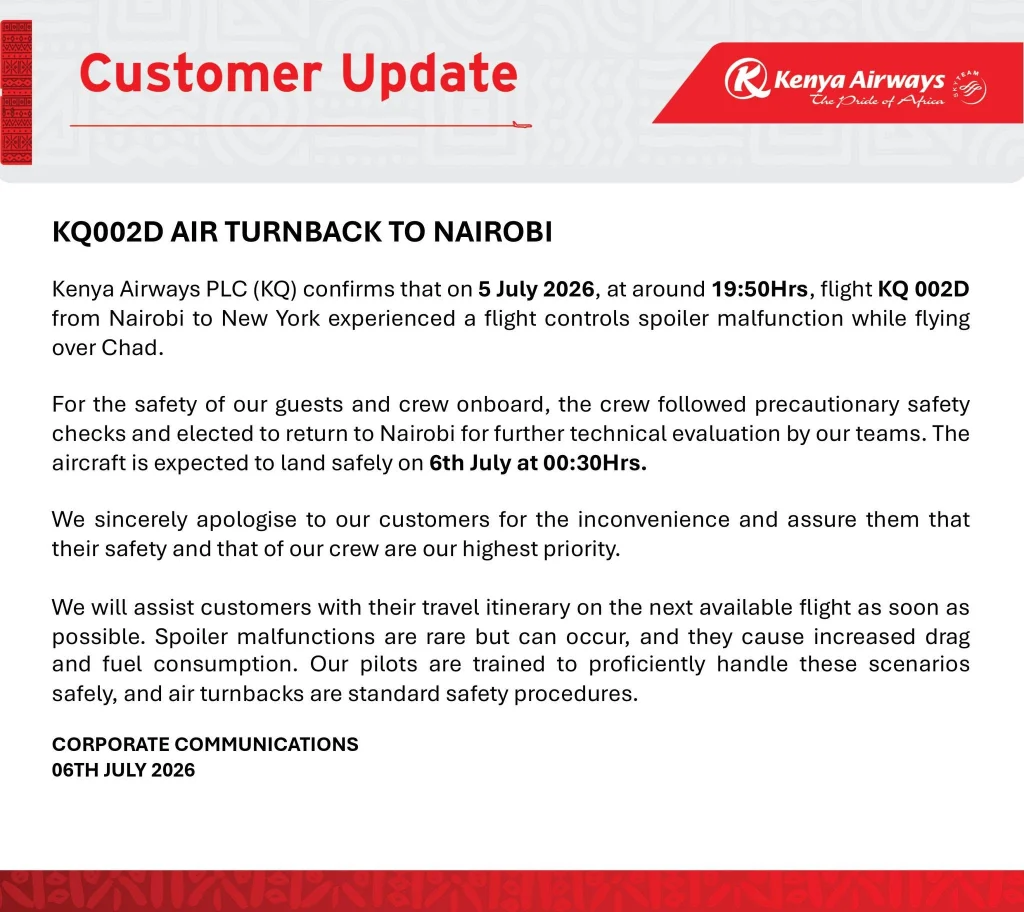
The national carrier said Flight KQ002D, which was operating from Jomo Kenyatta International Airport to John F. Kennedy International Airport in New York, experienced a flight-control spoiler malfunction while flying over Chad on Sunday, July 5, 2026. The issue was detected at around 7:50 p.m., prompting the crew to follow precautionary safety procedures and return the aircraft to Nairobi for technical evaluation.
Kenya Airways said the decision to return was made in the interest of passenger and crew safety, stressing that air turnbacks are standard aviation safety procedures when certain technical faults are detected.
Kenya Airways New York Flight Turns Back Mid-Air
The affected flight was KQ002D, a Kenya Airways service from Nairobi to New York.
According to the airline, the aircraft was flying over Chad when it experienced a malfunction involving the flight-control spoiler system. The crew then carried out precautionary safety checks and elected to return to Nairobi instead of continuing across the Atlantic.
Kenya Airways said the aircraft was expected to land back at Jomo Kenyatta International Airport at about 12:30 a.m. on Monday, July 6, 2026.
The airline apologized to affected passengers and said it would assist them with onward travel arrangements on the next available flight.
What Kenya Airways Said
Kenya Airways said the turnback was a precautionary measure.
In its customer update, the airline confirmed that the aircraft experienced a flight-control spoiler malfunction at around 19:50 hours while flying over Chad. The crew followed safety procedures and returned to Nairobi for further assessment by technical teams.
The airline said:
“Safety of our guests and crew onboard” remained the priority, and the aircraft returned to Nairobi for technical evaluation.
Kenya Airways also said spoiler malfunctions are rare but can happen, and that such faults may increase drag and fuel consumption. The carrier added that its pilots are trained to handle these scenarios safely.
Aircraft Landed Safely in Nairobi
The aircraft landed safely in Nairobi after the precautionary return.
Reports citing Kenya Airways said the Boeing 787-8 Dreamliner landed at JKIA shortly after midnight on Monday, July 6, with no injuries reported among passengers or crew.
The safe landing was important because it showed the incident was handled under standard aviation safety protocols.
In aviation, returning to the departure airport does not automatically mean a flight was in immediate danger. It often means the crew detected a technical issue and chose the safest operational option before continuing a long-haul journey.
What Is a Spoiler Malfunction?
A spoiler malfunction involves the movable panels on an aircraft’s wings.
Aircraft spoilers are panels on top of the wings that help reduce lift, manage descent, assist braking after landing and support speed control. When spoilers do not behave as expected, the aircraft may experience increased drag or reduced aerodynamic efficiency.
Kenya Airways said spoiler malfunctions are rare but can occur.
The airline also explained that such malfunctions can increase drag and fuel consumption, which is why a long-haul flight may return for technical checks instead of continuing to its destination.
For a flight from Nairobi to New York, fuel planning and aircraft performance are critical because the route is long and crosses large stretches of airspace. A technical issue that increases drag can affect fuel margins and operational planning.
Why the Crew Turned Back Instead of Continuing
The decision to turn back was based on safety and operational caution.
A Nairobi–New York flight is a long-haul journey. If an aircraft develops a fault early in the route, the crew and airline operations team must consider several factors: aircraft performance, fuel consumption, weather, diversion airports, technical support, passenger safety and regulatory procedures.
Because the aircraft was still over Africa when the issue was detected, returning to Nairobi allowed Kenya Airways engineers to inspect the aircraft at its home base.
That is often more practical than continuing across the Atlantic with a known technical fault or diverting later to another airport.
Kenya Airways said air turnbacks are standard safety procedures and that pilots are trained to manage such events safely.
Boeing 787-8 Dreamliner Was Operating the Flight
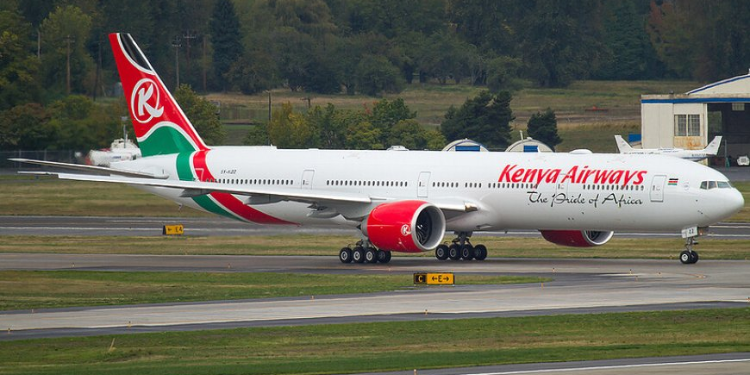
The affected aircraft was a Boeing 787-8 Dreamliner, according to reports citing Kenya Airways.
Kenya Airways uses the Boeing 787-8 Dreamliner on long-haul routes. The airline’s official aircraft page lists its Boeing 787-8 configuration as 30 seats in Premier World and 204 seats in Economy Class.
The Dreamliner is designed for long-haul operations and is used by Kenya Airways on major international routes.
KQ’s Nairobi–New York service is one of the airline’s most important long-haul connections, linking East Africa directly with the United States.
No Injuries Reported
No injuries were reported among those on board.
Kenya Airways said the aircraft landed safely and that passenger and crew safety remained its highest priority.
This distinction matters because technical turnbacks can sound alarming, especially when described as mid-air malfunctions. However, aviation crews are trained to respond to technical warnings calmly and procedurally.
The safe return suggests the aircraft remained controllable and the crew followed established safety protocols.
Passengers to Be Rebooked
Kenya Airways said it would assist affected passengers with onward travel arrangements.
The airline apologized for the inconvenience and said customers would be helped with their itineraries on the next available flight.
For passengers, this kind of disruption can be frustrating, especially on a long-haul route involving hotel bookings, onward connections, work schedules or family travel.
However, airlines generally prioritize aircraft inspection and passenger safety over schedule completion when a technical fault is detected.
Why Technical Turnbacks Happen
Technical turnbacks happen when a flight crew decides it is safer or more practical to return to the departure airport after detecting a fault.
The decision may be based on aircraft systems, weather, fuel, distance to destination, maintenance availability, passenger needs and airline operations.
A turnback is not always an emergency.
Sometimes it is a precaution, especially when the aircraft is still relatively close to its departure region and the airline has maintenance teams available at the origin airport.
In this case, Kenya Airways said the return was precautionary and aimed at allowing further technical evaluation.
Nairobi–New York Route Is a Flagship KQ Service
The Nairobi–New York route is one of Kenya Airways’ most high-profile international services.
The direct flight connects Jomo Kenyatta International Airport with John F. Kennedy International Airport, giving passengers a nonstop link between East Africa and the United States.
Kenya Airways launched the nonstop Nairobi–New York service in October 2018, making it the first airline to offer direct flights between East Africa and the United States.
Before the route was launched, many passengers traveling between Kenya and the United States had to connect through Europe, the Middle East or other African hubs.
The route remains strategically important for business travel, tourism, diaspora connections and cargo movement.
Why the Route Matters to Kenya Airways
The Nairobi–New York route is important because it gives Kenya Airways a direct presence in the U.S. market.
For Kenya, the route supports tourism, trade, diplomacy, education travel and diaspora movement.
For KQ, it strengthens the airline’s position as a regional connector between Africa and the rest of the world.
Long-haul routes are complex and expensive to operate, which makes reliability and safety especially important.
Any disruption on such a route attracts public attention because of the number of passengers affected and the strategic value of the service.
Safety Comes Before Schedule
Kenya Airways’ explanation highlights a central aviation principle: safety comes before schedule.
Turning back a long-haul flight can be costly for an airline. It affects fuel, crew time, passenger connections, aircraft rotation and customer experience.
But when a technical warning involves flight-control components, airlines are expected to act conservatively.
In this case, KQ said the crew followed precautionary safety checks and returned the aircraft for technical evaluation.
That is the standard approach in commercial aviation.
A delay is inconvenient, but continuing with uncertainty can create greater operational risk.
What Happens After a Flight Turns Back?
After a flight returns due to a technical issue, the aircraft is usually inspected by airline engineers.
The technical team checks the relevant systems, reviews cockpit messages, inspects components, verifies maintenance records and determines whether repairs or replacements are needed.
Only after the aircraft is cleared can it return to service.
Passengers are usually rebooked on another flight, placed on a delayed departure, or assisted with accommodation depending on timing, airline policy and available aircraft.
Kenya Airways said customers affected by the KQ002D disruption would be assisted with their travel itineraries on the next available flights.
Public Reaction and Passenger Concerns
Flight disruptions often raise concerns among passengers because many people do not know how aviation technical procedures work.
A phrase such as “flight-control spoiler malfunction” can sound serious, and it is understandable that passengers and the public may want clear answers.
Kenya Airways moved to explain the issue publicly, stating that spoiler malfunctions are rare, pilots are trained to handle them and turnbacks are standard safety procedures.
Clear communication matters in such situations.
Passengers need to know what happened, whether they are safe, when they will continue their journey and what support the airline will provide.
Did the Flight Make an Emergency Landing?
Based on Kenya Airways’ explanation, the airline characterized the return as a precautionary turnback for technical evaluation.
Some reports described the incident as a mid-air technical fault, while the airline emphasized that the crew followed safety checks and returned to Nairobi under standard procedures.
That distinction is important.
A precautionary return does not necessarily mean the aircraft was in immediate danger. It means the crew and airline decided it was safer not to continue the long-haul journey with a detected malfunction.
The aircraft landed safely at JKIA.
What Passengers Should Do During Such Disruptions
Passengers affected by technical delays should stay close to official airline communication channels.
They should check text messages, email updates, the Kenya Airways website, airport screens and customer service desks for rebooking information.
Passengers with onward connections should also contact their connecting airlines, hotels or travel agents as soon as possible.
If travel insurance applies, passengers should keep boarding passes, delay notices and receipts for possible claims.
Most importantly, passengers should avoid relying only on social media rumors. Official airline updates provide the most reliable information about rebooking and flight status.
Final Analysis
The Kenya Airways KQ002D turnback was caused by a flight-control spoiler malfunction while the aircraft was flying over Chad.
The crew followed precautionary safety procedures and returned to Nairobi for technical evaluation. The Boeing 787-8 Dreamliner landed safely at JKIA shortly after midnight on July 6, 2026, with no injuries reported.
While the disruption inconvenienced passengers, the airline’s decision was consistent with aviation safety practice.
A long-haul flight to New York requires careful fuel and performance planning. If a spoiler malfunction increases drag and fuel consumption, returning to base for inspection can be the safest operational choice.
Conclusion: KQ Says Safety Drove the New York Flight Turnback
Kenya Airways says its New York-bound flight turned back to Nairobi after experiencing a flight-control spoiler malfunction while flying over Chad on July 5, 2026.
The affected Flight KQ002D was operating from JKIA to JFK when the crew detected the issue at around 7:50 p.m. The airline said the crew followed precautionary safety checks and returned to Nairobi for further technical evaluation.
The aircraft, a Boeing 787-8 Dreamliner, landed safely in Nairobi at around 12:30 a.m. on July 6, and Kenya Airways apologized to customers while promising to assist them with travel arrangements on the next available flight.
The key takeaway is clear: the flight did not turn back because of a routine delay or scheduling issue. It returned because the crew detected a technical fault and chose the safer option.
For passengers, the delay was inconvenient. For aviation safety, the precautionary return was the right decision.