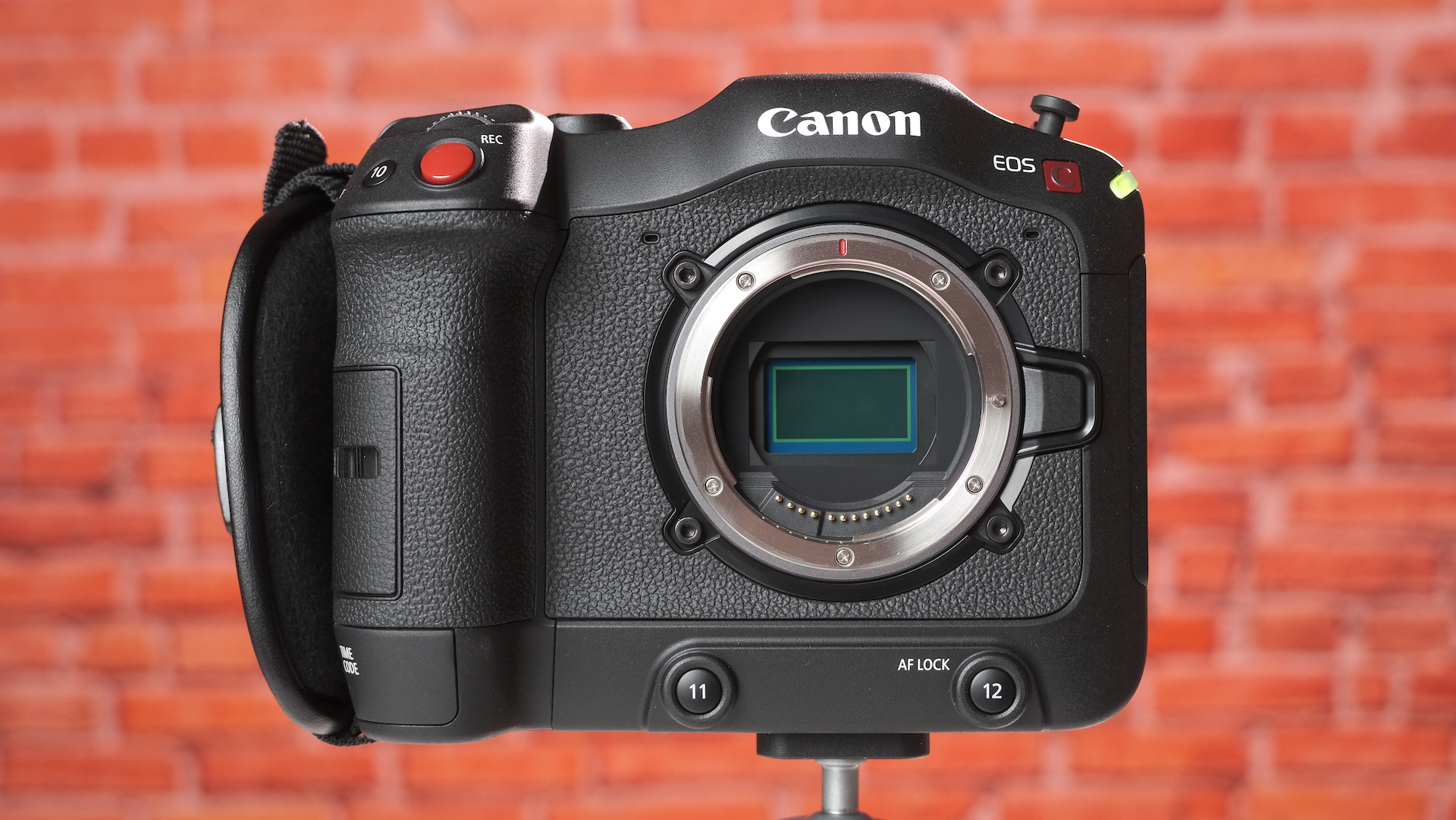
Canon EOS C70 is a compact Cinema EOS camera built for filmmakers, documentary shooters, commercial creators and small production crews that need professional video tools in a portable body.
Released in September 2020, the Canon EOS C70 became an important camera because it brought Cinema EOS image quality into Canon’s RF-mount system. It uses a Super 35mm Dual Gain Output sensor, records 4K DCI, 4K UHD, 2K and HD, and supports Canon Log 2, Canon Log 3, XF-AVC, H.265, H.264 and Cinema RAW Light workflows.
The camera is not a stills-first mirrorless body. It is a dedicated video camera with built-in ND filters, professional audio, timecode, active cooling, dual SD card slots and a compact cinema-style design. It sits between smaller mirrorless cameras and larger Cinema EOS bodies, making it useful for crews that want strong video features without building a large rig.
In the provided lab data, the Canon EOS C70 reaches 12.8 stops of dynamic range at SNR=2 in 4K DCI XF-AVC Intra at ISO 800 and Canon Log 2. Rolling shutter measures 15.6ms in standard 24–60fps modes and improves to 7.7ms in high-frame-rate modes from 75–120fps.
Key Camera Specifications
| Feature | Canon EOS C70 |
|---|---|
| Camera type | Compact Cinema EOS camera |
| Release period | September 2020 |
| Sensor format | Super 35mm |
| Sensor size | 26.2 x 13.8mm |
| Lens mount | Canon RF |
| Base sensitivity | ISO 800 |
| Sensor technology | Dual Gain Output sensor |
| Main recording format | 4K DCI up to 4096 x 2160 |
| RAW workflow | Cinema RAW Light |
| Main compressed codec | XF-AVC |
| Other codecs | H.265/HEVC and H.264 |
| Best listed dynamic range | 12.8 stops at SNR=2 |
| Standard rolling shutter | 15.6ms |
| High-frame-rate rolling shutter | 7.7ms |
| Built-in ND filters | Yes |
| Active cooling | Yes |
| Body weight | About 1.19 kg |
| Dimensions | About 160 mm x 116 mm x 130 mm |
| Listed price | Around $3,499 before taxes |
| Best use | Documentaries, commercials, interviews, events and compact cinema production |
The Canon EOS C70 is designed for video-first creators who need a small body with real cinema tools.
Super 35 DGO Sensor
The Canon EOS C70 uses a Super 35mm Dual Gain Output sensor measuring about 26.2 x 13.8mm.
This sensor is closely connected to Canon’s Cinema EOS image pipeline. The DGO design combines two gain readings to improve highlight and shadow handling, especially in Canon Log 2. This makes the camera attractive for filmmakers who want strong dynamic range without moving to a larger full-frame body.
Why Super 35 Still Matters
Super 35 remains one of the most practical cinema formats.
It works well with cinema lenses, documentary zooms, RF lenses, adapted EF lenses and focal reducer workflows. It gives filmmakers a familiar field of view, manageable depth of field and easier lens coverage than full frame.
For documentary and commercial work, Super 35 is often easier to control than larger formats.
RF Lens Mount
The Canon EOS C70 was Canon’s first Cinema EOS camera with an RF mount.
The RF mount gives users access to Canon’s modern mirrorless lenses, including RF zooms, fast primes, stabilised lenses and hybrid video lenses. EF lenses can also be used through Canon adapters, including the EF-EOS R 0.71x focal reducer.
| Lens Workflow | Best For |
| RF lenses | Native autofocus and modern optics |
| RF L-series zooms | Documentary and commercial work |
| RF primes | Lightweight cinema-style shooting |
| EF lenses with adapter | Existing Canon DSLR users |
| EF cinema lenses | Manual-focus production work |
| EF-EOS R 0.71x adapter | Wider field of view and brighter EF lens workflow |
This lens flexibility is one of the EOS C70’s biggest advantages over older Cinema EOS bodies.
Cinema RAW Light Recording
The Canon EOS C70 supports Cinema RAW Light after its firmware update.
Cinema RAW Light gives filmmakers a 12-bit RAW workflow with more grading flexibility than standard compressed video. In the provided recording data, Cinema RAW Light ST and LT are listed for Super 35 4K DCI.
| Mode | Resolution | Codec | Frame Rate | Data Rate | Bit Depth |
| S35 4K DCI | 4096 x 2160 | Cinema RAW Light ST | 29.97p | 497 Mb/s | 12-bit |
| S35 4K DCI | 4096 x 2160 | Cinema RAW Light ST | 25p | 414 Mb/s | 12-bit |
| S35 4K DCI | 4096 x 2160 | Cinema RAW Light ST | 24p | 398 Mb/s | 12-bit |
| S35 4K DCI | 4096 x 2160 | Cinema RAW Light LT | 59.94p | 645 Mb/s | 12-bit |
| S35 4K DCI | 4096 x 2160 | Cinema RAW Light LT | 25p | 269 Mb/s | 12-bit |
| S35 4K DCI | 4096 x 2160 | Cinema RAW Light LT | 23.98p | 259 Mb/s | 12-bit |
Cinema RAW Light is best for projects that need strong grading control, but it needs more storage and a more careful post-production workflow.
XF-AVC Recording
XF-AVC is one of the most practical recording formats on the Canon EOS C70.
It gives creators a strong 10-bit 4:2:2 workflow while keeping files easier to manage than RAW. For documentaries, interviews, corporate videos, weddings and online productions, XF-AVC will often be the best everyday format.
| Mode | Resolution | Codec | Frame Rate | Data Rate | Sampling | Bit Depth |
| S35 4K DCI | 4096 x 2160 | XF-AVC Intra | 59.94p | 600 Mb/s | 4:2:2 | 10-bit |
| S35 4K DCI | 4096 x 2160 | XF-AVC Intra | 25p | 410 Mb/s | 4:2:2 | 10-bit |
| S35 4K DCI | 4096 x 2160 | XF-AVC Intra | 25p | 250 Mb/s | 4:2:2 | 10-bit |
| S35 4K DCI | 4096 x 2160 | XF-AVC Long GOP | 59.94p | 260 Mb/s | 4:2:2 | 10-bit |
| S35 4K DCI | 4096 x 2160 | XF-AVC Long GOP | 25p | 160 Mb/s | 4:2:2 | 10-bit |
XF-AVC Intra is better for heavier editing and grading. XF-AVC Long GOP is better when storage space and longer recording times matter.
H.265 and H.264 Options
The EOS C70 also supports H.265/HEVC and H.264 recording.
H.265 gives efficient 10-bit recording, while H.264 is lighter but limited to 8-bit in the provided data. These modes help the camera serve different production needs, from high-quality colour grading to fast delivery.
Best Codec Choices
Use Cinema RAW Light when maximum grading flexibility matters.
Use XF-AVC Intra when you need a robust professional file without RAW data sizes. Use XF-AVC Long GOP or H.265 when you need smaller files and longer recording times.
Use H.264 only when workflow simplicity matters more than grading flexibility.
Dynamic Range Performance
The provided lab data lists a maximum dynamic range of 12.8 stops at SNR=2 in S35 4K DCI XF-AVC Intra at 25fps, ISO 800 and Canon Log 2 with DGO active.
Cinema RAW Light LT measures 12.3 stops at SNR=2 in the same 4K DCI sensor mode. XF-AVC Long GOP at 75fps measures 11.9 stops at SNR=2 because DGO is off at higher frame rates.
| Sensor Mode | Resolution | Codec | Frame Rate | ISO | Gamma | Comment | Measured Dynamic Range |
| S35 4K DCI | 4096 x 2160 | Cinema RAW Light LT | 25p | 800 | C-Log 2 | DGO on | 12.3 stops at SNR=2 |
| S35 4K DCI | 4096 x 2160 | XF-AVC Intra | 25p | 800 | C-Log 2 | DGO on | 12.8 stops at SNR=2 |
| S35 4K DCI | 4096 x 2160 | XF-AVC Long GOP | 75p | 800 | C-Log 2 | DGO off | 11.9 stops at SNR=2 |
The key point is that the EOS C70 performs best when DGO is active in standard frame-rate modes.
What Dynamic Range Means for Filmmakers
Dynamic range affects how much highlight and shadow detail the camera can preserve.
This matters when filming skies, windows, dark rooms, stage lights, reflective surfaces, night streets and backlit interviews. The EOS C70 gives strong results in Canon Log 2, especially in XF-AVC Intra at ISO 800.
For best results, protect highlights, avoid heavy underexposure and monitor exposure with waveform or false colour when possible.
Dual Gain Output Explained
Dual Gain Output is one of the EOS C70’s most important technologies.
DGO reads the sensor with two gain levels and combines the results. One readout helps protect highlights, while the other helps capture cleaner shadows. This improves usable dynamic range and gives the image a smoother tonal response.
Why DGO Matters
DGO helps the EOS C70 produce a more filmic image.
It improves shadow quality while keeping highlight detail. This is one reason the camera became popular with documentary shooters, interview crews and filmmakers who need a compact camera with strong latitude.
However, DGO is not active in every high-frame-rate mode, so dynamic range drops when shooting faster frame rates.
Rolling Shutter Performance
The provided lab data lists 15.6ms rolling shutter in full-sensor 4K DCI XF-AVC from 24fps to 60fps.
At higher frame rates from 75fps to 120fps, the rolling shutter improves to 7.7ms because DGO is no longer active.
| Sensor Mode | Resolution | Codec | Frame Rate Range | Rolling Shutter |
| Full Sensor | 4096 x 2160 | XF-AVC | 24–60fps | 15.6ms |
| Full Sensor | 4096 x 2160 | XF-AVC | 75–120fps | 7.7ms |
This gives users a clear trade-off. Standard frame rates give stronger dynamic range with DGO active. High frame rates give faster readout but lower dynamic range.
Why Rolling Shutter Matters
Rolling shutter can distort fast motion.
Quick pans may bend vertical lines, and fast-moving subjects can appear skewed. The EOS C70’s 15.6ms result is manageable for controlled work, interviews and documentary shooting. The 7.7ms high-frame-rate result is better for fast movement.
For action scenes, sports-style shots and quick handheld movement, high-frame-rate modes can help reduce distortion.
4K120 and High Frame Rates
The Canon EOS C70 supports 4K recording up to 120fps.
This makes it useful for slow motion, action inserts, product shots, music videos, sports-style visuals, wedding details and cinematic B-roll.
4K120 Trade-Off
4K120 is powerful, but it has a trade-off.
At higher frame rates, DGO turns off, which reduces measured dynamic range. That means 4K120 is best when motion is more important than maximum latitude.
For interviews and controlled scenes, use standard frame rates. For slow motion and fast action, use high-frame-rate modes.
Recording Formats
The Canon EOS C70 supports Super 35 and Super 16 recording formats.
| Recording Format | Resolution |
| S35 4K DCI | 4096 x 2160 |
| S35 4K UHD | 3840 x 2160 |
| S35 2K | 2048 x 1080 |
| S35 HD | 1920 x 1080 |
| S35 HD | 1280 x 720 |
| S16 2K | 2048 x 1080 |
| S16 HD | 1920 x 1080 |
| S16 HD | 1280 x 720 |
These options make the EOS C70 useful for modern 4K production, Super 35 lens workflows and Super 16 crop work.
Built-In ND Filters
Built-in ND filters are one of the strongest reasons to choose the Canon EOS C70 over a mirrorless camera.
The camera includes internal ND filters with 2-stop, 4-stop and 6-stop settings, plus extended ND options up to 10 stops.
Why ND Filters Matter
ND filters let filmmakers control exposure without changing shutter angle, aperture or ISO.
This is essential for outdoor video. It allows creators to keep natural motion blur and the desired depth of field in bright conditions. For documentaries, events and interviews, built-in ND filters save time and reduce rigging.
Active Cooling
The Canon EOS C70 includes active cooling.
This allows long-duration 4K recording without the same heat pressure that affects many compact mirrorless cameras. For interviews, events, classes, documentaries and corporate shoots, active cooling is a major production advantage.
Why Cooling Matters
Video cameras often need to record for long periods.
A cooled body is more dependable than a passive hybrid camera when shooting long takes. This is one reason the EOS C70 remains practical for working videographers even after newer mirrorless bodies arrived.
Professional Audio
The EOS C70 includes professional audio features.
It has mini XLR inputs, a 3.5mm microphone input and dedicated audio controls. This makes it much more useful for interviews and documentary work than cameras that rely only on small consumer audio inputs.
Why XLR Audio Matters
Good audio is essential for professional video.
XLR inputs allow users to connect professional microphones, wireless receivers and mixers. For documentary shooters, corporate crews, educators and event filmmakers, this reduces the need for external audio adapters.
Dual SD Card Slots
The Canon EOS C70 records to dual SD card slots.
This helps keep media costs lower than CFexpress-based systems while supporting professional recording modes. The camera can support relay recording, simultaneous recording and mixed codec workflows depending on settings.
Media Planning Tips
Use fast, approved UHS-II SD cards for high-bitrate 4K recording.
Cinema RAW Light and high-frame-rate XF-AVC modes can create large files. For paid work, test cards before shooting and back up footage before formatting media.
Dual SD slots are useful, but storage discipline still matters.
Body Design and Handling
The Canon EOS C70 has a compact cinema body that weighs about 1.19 kg.
It is larger than a mirrorless camera but smaller than many traditional cinema cameras. Its design works well for handheld rigs, tripods, gimbals, shoulder setups and compact documentary kits.
Why the Body Works
The C70 blends cinema features with mirrorless portability.
It has built-in ND filters, professional audio and active cooling, but it remains small enough for solo operators. This balance made it popular with documentary shooters, wedding filmmakers, corporate creators and small production teams.
No Built-In EVF
The Canon EOS C70 does not have a traditional built-in electronic viewfinder.
Users rely on the rear screen or external monitors. This is common for compact cinema cameras, but it may be a limitation for bright outdoor work.
Best Monitoring Setup
For serious work, use an external monitor or EVF-style accessory.
An external monitor improves framing, focus checking, exposure monitoring and client review. It also helps when the camera is rigged on a shoulder setup, tripod or gimbal.
Autofocus
The Canon EOS C70 supports Canon’s Dual Pixel CMOS AF system.
This is useful for interviews, documentaries, gimbal shots, event work and solo shooting. Canon’s autofocus is one of the reasons many creators choose the C70 over cinema cameras that rely only on manual focus.
Why Autofocus Matters
Small crews often work without a focus puller.
Reliable autofocus helps keep subjects sharp during interviews, walking shots, handheld filming and unpredictable documentary scenes. Manual focus remains important for narrative production, but autofocus makes the C70 more flexible.
Image Stabilisation
The Canon EOS C70 does not have sensor-shift IBIS like many hybrid mirrorless cameras.
However, it can work with stabilised RF lenses and electronic stabilisation options depending on the mode. For the best handheld results, users should use stabilised lenses, a shoulder rig, tripod, monopod or gimbal.
What This Means in Practice
The C70 is a video-first camera, not a run-and-gun IBIS body.
It can work handheld, but it benefits from support. For interviews, use a tripod. For walking shots, use a gimbal or stabilised lens. For documentary work, a compact shoulder rig can help.
Best Uses for the Canon EOS C70
The Canon EOS C70 is best for creators who need cinema tools in a compact Super 35 body.
It is ideal for:
Documentaries
Commercial videos
Corporate films
Interviews
YouTube production
Wedding films
Event coverage
Music videos
Education videos
Small film crews
Travel productions
Gimbal work
Social media campaigns
B-camera setups
Independent films
The camera is strongest when users need built-in ND filters, strong Canon colour, professional audio and reliable 4K recording.
Canon EOS C70 vs Canon EOS C80
The Canon EOS C80 is newer and full frame, while the EOS C70 remains a strong Super 35 option.
| Feature | Canon EOS C70 | Canon EOS C80 |
| Sensor format | Super 35 DGO | Full frame |
| Maximum resolution | 4K DCI | 6K |
| Lens mount | RF | RF |
| Built-in ND filters | Yes | Yes |
| SDI output | No | Yes |
| Best advantage | DGO Super 35 image and value | Full-frame 6K and stronger I/O |
The C80 is better for full-frame 6K production. The C70 remains strong for Super 35 shooters who want value and built-in cinema tools.
Canon EOS C70 vs Canon EOS C50
The EOS C50 is smaller and full frame, while the C70 has built-in ND filters and a proven Super 35 workflow.
| Feature | Canon EOS C70 | Canon EOS C50 |
| Sensor format | Super 35 | Full frame |
| Maximum recording | 4K DCI | 7K Open Gate |
| Built-in ND filters | Yes | No |
| Body style | Compact cinema body | Smaller cinema body |
| Best advantage | ND filters and DGO sensor | 7K full-frame Open Gate |
The C50 is better for creators who need full-frame Open Gate. The C70 is better for users who need internal ND filters and a mature Super 35 workflow.
Canon EOS C70 vs Canon EOS R5 C
The EOS R5 C is a hybrid 8K camera, while the EOS C70 is a dedicated Super 35 cinema camera.
| Feature | Canon EOS C70 | Canon EOS R5 C |
| Camera type | Cinema EOS video camera | Cinema EOS hybrid |
| Sensor format | Super 35 | Full frame |
| Maximum video | 4K DCI | 8K |
| Built-in ND filters | Yes | No |
| Active cooling | Yes | Yes |
| Still-photo use | Limited | Strong |
| Best advantage | Production ergonomics | 8K and stills |
The R5 C is better for high-resolution hybrid work. The C70 is better for video-first production with built-in ND filters and professional audio.
Canon EOS C70 vs Canon EOS R7
The EOS R7 is a hybrid APS-C camera, while the C70 is a cinema camera.
| Feature | Canon EOS C70 | Canon EOS R7 |
| Sensor format | Super 35 | APS-C / Super 35-class |
| Main use | Video production | Hybrid stills and video |
| Built-in ND filters | Yes | No |
| Professional audio | Yes | Accessory-based |
| Active cooling | Yes | No cinema cooling |
| Best advantage | Cinema workflow | Lower price and stills capability |
The R7 is better for affordable hybrid shooting. The C70 is better for serious video production.
Key Takeaways
- Canon EOS C70 was released in September 2020.
- It uses a Super 35mm DGO sensor measuring about 26.2 x 13.8mm.
- The camera uses the Canon RF mount.
- Base sensitivity is ISO 800.
- It records S35 4K DCI at 4096 x 2160.
- Cinema RAW Light is supported after firmware updates.
- XF-AVC Intra, XF-AVC Long GOP, H.265 and H.264 are available.
- The provided lab data lists 12.8 stops at SNR=2 in XF-AVC Intra at ISO 800 and C-Log 2.
- Cinema RAW Light LT measures 12.3 stops at SNR=2.
- XF-AVC Long GOP at 75fps measures 11.9 stops because DGO is off.
- Rolling shutter is 15.6ms from 24–60fps.
- Rolling shutter improves to 7.7ms from 75–120fps.
- Built-in ND filters are included.
- Active cooling supports long-duration recording.
- Professional audio and dual SD card slots make it production-ready.
- It is best for documentaries, interviews, corporate videos, events and compact cinema work.
Frequently Asked Questions
What is the Canon EOS C70?
Canon EOS C70 is a compact Cinema EOS camera with a Super 35 DGO sensor, RF mount, built-in ND filters, professional audio and 4K recording up to 120fps.
When was the Canon EOS C70 released?
The Canon EOS C70 was released in September 2020.
What sensor does the Canon EOS C70 use?
It uses a Super 35mm Dual Gain Output sensor measuring about 26.2 x 13.8mm.
What lens mount does it use?
The EOS C70 uses the Canon RF mount and can use EF lenses through Canon adapters.
Does the Canon EOS C70 record RAW?
Yes. The camera supports Cinema RAW Light recording after firmware updates.
Does the EOS C70 shoot 4K120?
Yes. It supports 4K recording up to 120fps.
What dynamic range did the provided lab data show?
The provided lab data lists a maximum of 12.8 stops at SNR=2 in S35 4K DCI XF-AVC Intra at ISO 800 and Canon Log 2.
What is the rolling-shutter result?
The provided lab data lists 15.6ms from 24–60fps and 7.7ms from 75–120fps.
Does the Canon EOS C70 have built-in ND filters?
Yes. The EOS C70 includes built-in ND filters with standard and extended ND options.
Does the EOS C70 have active cooling?
Yes. It includes active cooling for long-duration recording.
Is the Canon EOS C70 good for documentaries?
Yes. Its compact body, built-in ND filters, Canon colour, professional audio, autofocus and long recording support make it strong for documentary work.
Who should buy the Canon EOS C70?
The Canon EOS C70 is best for filmmakers, documentary shooters, wedding filmmakers, corporate video teams, YouTubers and small production crews that need a compact Cinema EOS camera with professional video features.
Conclusion
Canon EOS C70 remains one of Canon’s most practical compact cinema cameras.
Its Super 35 DGO sensor, RF mount, built-in ND filters, active cooling, professional audio, Cinema RAW Light, XF-AVC, Canon Log 2, Canon Log 3 and 4K120 recording make it a strong tool for working video creators.
The lab data shows why the camera earned its reputation. XF-AVC Intra at ISO 800 and Canon Log 2 reaches 12.8 stops at SNR=2, while Cinema RAW Light LT reaches 12.3 stops. Rolling shutter is 15.6ms in standard frame rates and improves to 7.7ms in high-frame-rate modes.
The EOS C70 is not a full-frame 6K or 8K camera, and it lacks some higher-end production connections found on newer Cinema EOS bodies. However, it delivers a strong Super 35 image, excellent practical ergonomics and the video tools that mirrorless bodies often lack.
For creators who need a compact, reliable and professional Canon cinema camera for documentaries, interviews, events, corporate films and small-crew production, the Canon EOS C70 remains a smart and capable choice.
Read Also: Canon EOS R3: Specs, Dynamic Range, Rolling Shutter and Video Features