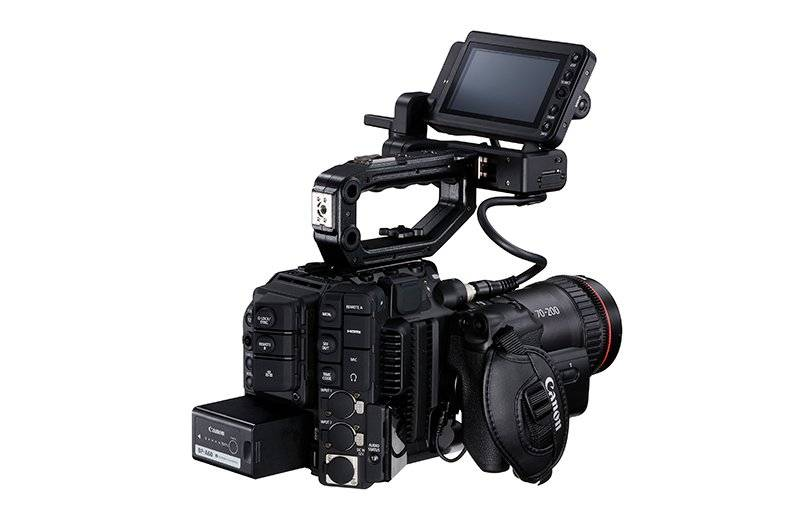
Canon EOS C300 Mark III is a professional Super 35 Cinema EOS camera built for broadcast, documentaries, commercials, corporate production, independent films and high-end video crews.
Released in July 2020, the Canon EOS C300 Mark III introduced Canon’s Super 35mm Dual Gain Output sensor in a modular cinema body. It records 4K DCI, 4K UHD, 2K and HD, and supports Cinema RAW Light, XF-AVC Intra and XF-AVC Long GOP. It is available with EF and PL lens mount workflows, making it useful for both documentary shooters and traditional cinema crews.
The camera uses a Super 35mm sensor measuring about 26.2 x 13.8mm, with ISO 800 listed as the base sensitivity in the provided lab data. It weighs about 1.8 kg and has a modular body designed for handheld rigs, shoulder setups, tripods, studio work and broadcast environments.
In the provided lab data, the Canon EOS C300 Mark III reaches 12.8 stops of dynamic range at SNR=2 in 4K DCI XF-AVC at 25fps, ISO 800 and Canon Log 2. Rolling shutter is listed at 15.6ms for frame rates below 60fps and 7.7ms at higher frame rates from 75fps upward.
Key Camera Specifications
| Feature | Canon EOS C300 Mark III |
|---|---|
| Camera type | Professional Cinema EOS camera |
| Release period | July 2020 |
| Sensor format | Super 35mm |
| Sensor size | 26.2 x 13.8mm |
| Lens mount | EF and PL options |
| Base sensitivity | ISO 800 |
| Sensor technology | Dual Gain Output sensor |
| Main recording resolution | 4K DCI 4096 x 2160 |
| RAW format | Cinema RAW Light |
| Compressed codec | XF-AVC Intra and XF-AVC Long GOP |
| Maximum 4K frame rate | Up to 119.88p |
| Maximum 2K crop frame rate | Up to 180p in Super 16 crop |
| Best listed dynamic range | 12.8 stops at SNR=2 |
| Standard rolling shutter | 15.6ms |
| High-frame-rate rolling shutter | 7.7ms |
| Body weight | About 1.8 kg |
| Dimensions | About 168 mm x 148 mm x 153 mm |
| Listed price | Around $3,999 before taxes in the provided data |
| Best use | Broadcast, documentary, cinema, commercials and professional production |
The Canon EOS C300 Mark III is a production-focused camera, not a hybrid stills body. It is designed for crews that need reliable recording, professional connections, modular rigging and Canon’s Cinema EOS workflow.
Super 35 DGO Sensor
The Canon EOS C300 Mark III uses a Super 35mm Dual Gain Output sensor.
DGO is one of the camera’s most important technologies. It reads each pixel using two gain levels and combines the information to preserve highlights while improving shadow detail. This helps the camera produce strong dynamic range in standard frame-rate modes.
The sensor size of about 26.2 x 13.8mm gives the C300 Mark III a classic Super 35 field of view. This format remains popular in cinema and broadcast because it works well with many professional lenses and gives a practical balance between depth of field, lens coverage and camera size.
Why Super 35 Still Matters
Super 35 remains one of the most trusted formats in professional video.
It is easier to light and focus than full frame in many situations. It also works well with cinema zooms, PL lenses, EF lenses and documentary glass. For broadcast, documentaries and commercial work, Super 35 is still highly practical.
The Canon EOS C300 Mark III uses that format with modern DGO sensor technology, giving creators a strong balance of image quality and production reliability.
Cinema RAW Light Recording
The Canon EOS C300 Mark III records Cinema RAW Light internally.
Cinema RAW Light gives filmmakers more post-production control than compressed codecs. It allows more flexibility for colour grading, white balance adjustment, exposure control and high-end finishing.
In the provided recording data, the camera supports multiple Cinema RAW Light options in 4K DCI.
| Mode | Resolution | Codec | Frame Rate | Data Rate | Bit Depth |
| Super 35 4K DCI | 4096 x 2160 | Cinema RAW Light | 119.88p | 437 Mb/s | 10-bit |
| Super 35 4K DCI | 4096 x 2160 | Cinema RAW Light | 100p | 437 Mb/s | 10-bit |
| Super 35 4K DCI | 4096 x 2160 | Cinema RAW Light | 59.94p | 1 Gb/s | 10-bit |
| Super 35 4K DCI | 4096 x 2160 | Cinema RAW Light | 25p | 1 Gb/s | 12-bit |
| Super 35 4K DCI | 4096 x 2160 | Cinema RAW Light HQ | 59.94p | 2 Gb/s | 12-bit |
| Super 35 4K DCI | 4096 x 2160 | Cinema RAW Light HQ | 25p | 841 Mb/s | 12-bit |
| Super 35 4K DCI | 4096 x 2160 | Cinema RAW Light ST | 25p | 414 Mb/s | 12-bit |
| Super 35 4K DCI | 4096 x 2160 | Cinema RAW Light LT | 25p | 269 Mb/s | 12-bit |
The wide range of RAW quality settings gives crews control over image quality, card space and post-production demands.
XF-AVC Recording
XF-AVC is the most practical everyday codec on the Canon EOS C300 Mark III.
It gives professional 10-bit 4:2:2 files that are easier to manage than RAW while still offering strong image quality. For broadcast, documentary, interviews, corporate work and commercials, XF-AVC often gives the best balance between quality and workflow.
| Mode | Resolution | Codec | Frame Rate | Data Rate | Sampling | Bit Depth |
| Super 35 4K DCI | 4096 x 2160 | XF-AVC Intra | 119.88p | 410 Mb/s | 4:2:2 | 10-bit |
| Super 35 4K DCI | 4096 x 2160 | XF-AVC Intra | 59.94p | 810 Mb/s | 4:2:2 | 10-bit |
| Super 35 4K DCI | 4096 x 2160 | XF-AVC Intra | 25p | 410 Mb/s | 4:2:2 | 10-bit |
| Super 35 4K DCI | 4096 x 2160 | XF-AVC Long GOP | 119.88p | 160 Mb/s | 4:2:2 | 10-bit |
| Super 35 4K DCI | 4096 x 2160 | XF-AVC Long GOP | 59.94p | 260 Mb/s | 4:2:2 | 10-bit |
| Super 35 4K DCI | 4096 x 2160 | XF-AVC Long GOP | 25p | 160 Mb/s | 4:2:2 | 10-bit |
XF-AVC Intra is better for heavy editing and grading. XF-AVC Long GOP is better when file size and longer recording times matter.
Dynamic Range Performance
In the provided lab data, the Canon EOS C300 Mark III reaches a maximum dynamic range of 12.8 stops at SNR=2 in full-sensor 4096 x 2160 XF-AVC at 25fps, ISO 800 and Canon Log 2.
At 75fps, the measured dynamic range drops to 11.6 stops at SNR=2 because the DGO readout is no longer active.
| Sensor Mode | Resolution | Codec | Frame Rate | ISO | Gamma | Measured Dynamic Range |
| Full Sensor | 4096 x 2160 | XF-AVC | 25p | 800 | Canon Log 2 | 12.8 stops at SNR=2 |
| Full Sensor | 4096 x 2160 | XF-AVC | 75p | 800 | Canon Log 2 | 11.6 stops at SNR=2 |
The key point is that the camera performs best at standard frame rates where DGO is active. High frame rates remain useful, but they trade some dynamic range for faster readout and slow-motion capture.
What Dynamic Range Means for Filmmakers
Dynamic range affects how much detail a camera can preserve between bright highlights and dark shadows.
This matters when filming skies, windows, practical lights, night streets, concerts, reflective surfaces and backlit interviews. The C300 Mark III gives strong Canon Log 2 performance at ISO 800, especially in standard frame-rate XF-AVC.
For best results, protect highlights, avoid heavy underexposure and use waveform or false colour for exposure monitoring.
Dual Gain Output Explained
Dual Gain Output is the technology that gives the Canon EOS C300 Mark III its strongest image advantage.
The sensor reads each pixel through two gain paths. One gain path helps protect highlight information. The other helps improve shadow detail and reduce noise. The camera then combines those signals into one image.
Why DGO Matters
DGO improves usable latitude.
It helps the camera hold bright highlights while keeping shadow areas cleaner. This is important for documentaries, interviews, commercials and cinema work where lighting conditions may be difficult.
However, DGO is not active in all high-frame-rate modes. When the camera moves into faster frame rates, rolling shutter improves, but dynamic range drops.
Rolling Shutter Performance
The Canon EOS C300 Mark III has two clear rolling-shutter behaviours.
In standard frame-rate modes below 60fps, the provided lab data lists 15.6ms. At 75fps and higher, rolling shutter improves to 7.7ms.
| Sensor Mode | Resolution | Codec | Frame Rate | Rolling Shutter |
| Super 35 | 4096 x 2160 | XF-AVC | 25p | 15.6ms |
| Super 35 | 4096 x 2160 | XF-AVC | 75p | 7.7ms |
This creates a practical trade-off. Standard frame rates give stronger dynamic range. Higher frame rates give faster readout and less motion distortion.
Why Rolling Shutter Matters
Rolling shutter can make fast movement look distorted.
Quick pans may bend vertical lines, and fast-moving subjects can appear skewed. The EOS C300 Mark III’s 15.6ms result is manageable for controlled video, interviews and documentary shooting. The 7.7ms high-frame-rate result is better for action and fast camera movement.
For the cleanest motion, choose higher frame-rate modes when dynamic range is less critical.
4K120 and High-Speed Recording
The Canon EOS C300 Mark III records 4K DCI up to 119.88p.
This makes it useful for slow motion, sports-style visuals, commercials, product shots, wildlife movement, music videos and cinematic B-roll.
The camera also supports 2K and HD Super 16 crop modes up to 180p.
4K120 Trade-Off
4K120 is a strong creative feature, but it changes the image pipeline.
At higher frame rates, DGO is not active. That means the camera gains faster readout but loses some dynamic-range performance. This is why 75fps measures lower than 25fps in the provided data.
Use standard frame rates when latitude matters most. Use high frame rates when motion and slow motion matter most.
Recording Formats
The Canon EOS C300 Mark III supports 4K, 2K, HD and Super 16 crop formats.
| Recording Format | Resolution |
| 4K DCI 17:9 | 4096 x 2160 |
| 4K UHD | 3840 x 2160 |
| 2K 17:9 | 2048 x 1080 |
| 2K 180p S16 Crop | 2048 x 1080 |
| HD | 1920 x 1080 |
| HD 180p S16 Crop | 1920 x 1080 |
This makes the camera suitable for cinema delivery, broadcast workflows, online video, slow motion and crop-mode production.
EF and PL Lens Mount Options
The Canon EOS C300 Mark III supports EF and PL mount workflows.
This is one of its biggest advantages for professional crews. EF mount is useful for Canon photo lenses, EF cinema lenses and documentary zooms. PL mount is useful for traditional cinema lenses used in narrative, commercial and high-end production.
| Mount Workflow | Best For |
| EF mount | Canon EF lenses, documentary zooms and existing Canon users |
| PL mount | Cinema primes, production lenses and rental-house workflows |
| Locking EF mount | More secure professional EF lens use |
| Super 16 crop | Special lenses and high-frame-rate crop workflows |
The mount flexibility allows the C300 Mark III to work across different production environments.
Modular Body Design
The Canon EOS C300 Mark III uses a modular cinema body.
This design lets crews build the camera for different jobs. It can be used in a stripped-down setup, on a shoulder rig, on a tripod, in a studio, on a gimbal or in a drone-style configuration.
Why Modularity Matters
Professional sets need flexible camera builds.
A documentary shooter may want a lightweight setup. A commercial crew may want a full rig with monitor, wireless video, focus system and matte box. A broadcast team may need reliable power, SDI and audio connections.
The C300 Mark III can be built around the job instead of forcing every production into one setup.
Professional Connectivity
The Canon EOS C300 Mark III includes production-ready connections such as 12G-SDI, timecode, genlock and professional audio options.
These features matter for broadcast, studio work and multi-camera production. They make the camera more useful than hybrid mirrorless cameras that rely on smaller consumer-style ports.
Why SDI and Timecode Matter
Professional productions need reliable signals and sync.
SDI is stronger than HDMI for long cable runs and secure monitoring. Timecode helps sync multiple cameras and audio recorders. Genlock is useful in studio and broadcast environments.
These tools make the C300 Mark III a real production camera, not just a high-quality image box.
Professional Audio
The Canon EOS C300 Mark III supports professional audio workflows through its cinema body and accessory system.
This makes it suitable for interviews, documentaries, broadcast shoots and corporate productions where clean sound is essential.
Why Audio Matters
Good video needs good sound.
Professional audio inputs allow crews to connect microphones, wireless receivers and mixers more reliably than simple consumer inputs. For interviews and documentary work, this can reduce rigging and simplify production.
The C300 Mark III is designed for crews that need image and audio reliability together.
Internal CFexpress Recording
The Canon EOS C300 Mark III records demanding formats to CFexpress media.
This is important because Cinema RAW Light, high-bitrate XF-AVC and high-frame-rate 4K recording need fast write speeds. CFexpress gives the camera the bandwidth required for professional internal recording.
Media Planning Tips
Use approved CFexpress cards for RAW and high-frame-rate recording.
Cinema RAW Light and 4K120 can create large files quickly. For paid work, test cards before the shoot, carry enough media and back up footage before formatting.
Media planning is part of the camera workflow, especially with RAW and high-frame-rate production.
Canon Log 2 Workflow
The Canon EOS C300 Mark III supports Canon Log 2.
Canon Log 2 gives filmmakers a flatter image profile with more grading flexibility than standard picture styles. It is especially useful when trying to preserve highlights and shadows in high-contrast scenes.
Why Canon Log 2 Matters
Canon Log 2 helps the C300 Mark III fit into professional grading workflows.
It allows better matching with other Cinema EOS cameras and gives colourists more control over contrast, highlight roll-off and skin tones. For commercials, documentaries and broadcast features, this is a major benefit.
For quick turnaround, crews can use easier profiles. For serious grading, Canon Log 2 is the stronger choice.
Built-In ND Filters
The Canon EOS C300 Mark III includes built-in ND filters.
Built-in ND filters are essential for professional video because they control exposure without forcing changes to shutter angle, aperture or ISO. This helps filmmakers keep natural motion blur and consistent depth of field in changing light.
Why ND Filters Matter
ND filters save time on set.
Outdoor interviews, documentaries, live events and run-and-gun shoots often face changing light. Built-in ND allows the operator to react quickly without adding external filters.
This is one of the biggest advantages of the C300 Mark III over stills-first mirrorless cameras.
Image Stabilisation and Handheld Work
The Canon EOS C300 Mark III is a cinema camera, so stabilisation depends on lens choice, rigging and electronic support options.
It is not designed like a small IBIS mirrorless camera. Instead, it is meant to be used with shoulder rigs, tripods, gimbals, stabilised lenses and professional support gear.
What This Means in Practice
The camera can work handheld, but it benefits from proper support.
For documentaries, a shoulder rig can improve stability. For interviews, a tripod is best. For moving shots, use a gimbal or stabilised lens. For cinema work, build the camera according to the shot.
Best Uses for the Canon EOS C300 Mark III
The Canon EOS C300 Mark III is best for professional productions that need a reliable Super 35 cinema camera with strong image quality and broadcast-ready tools.
It is ideal for:
Documentaries
Broadcast production
Commercial videos
Corporate films
Interviews
Independent films
Music videos
Sports features
Reality television
Studio production
Multi-camera work
Live production support
Event coverage
Education content
Cinema B-camera setups
The camera is strongest when crews need high-quality 4K, professional connections, modular rigging and dependable Canon colour.
Canon EOS C300 Mark III vs Canon EOS C70
The EOS C70 is smaller and RF-mount based, while the C300 Mark III is more modular and production-focused.
| Feature | Canon EOS C300 Mark III | Canon EOS C70 |
| Sensor format | Super 35 DGO | Super 35 DGO |
| Lens mount | EF / PL | RF |
| Body style | Modular cinema body | Compact cinema body |
| Professional I/O | Stronger | More compact |
| Built-in ND filters | Yes | Yes |
| Best advantage | Broadcast and production flexibility | Smaller body and RF mount |
The C70 is better for solo shooters and compact kits. The C300 Mark III is better for broadcast, modular rigs and larger production environments.
Canon EOS C300 Mark III vs Canon EOS C400
The EOS C400 is newer and full frame, while the C300 Mark III remains a strong Super 35 production camera.
| Feature | Canon EOS C300 Mark III | Canon EOS C400 |
| Sensor format | Super 35 | Full frame |
| Maximum resolution | 4K DCI | 6K |
| Lens mount | EF / PL | RF |
| Base ISO system | ISO 800 | Triple base ISO |
| Built-in ND filters | Yes | Yes |
| Best advantage | Super 35 DGO and EF/PL workflow | Full-frame 6K and newer RF workflow |
The C400 is better for modern full-frame RF production. The C300 Mark III is better for crews that want Super 35, EF/PL compatibility and a proven broadcast-style body.
Canon EOS C300 Mark III vs Canon EOS C500 Mark II
The C500 Mark II is full frame, while the C300 Mark III is Super 35.
| Feature | Canon EOS C300 Mark III | Canon EOS C500 Mark II |
| Sensor format | Super 35 | Full frame |
| Sensor technology | DGO | Full-frame Cinema EOS sensor |
| Maximum resolution | 4K | 5.9K |
| Lens mount | EF / PL | EF / PL |
| Best advantage | DGO dynamic range and high-speed 4K | Full-frame look and higher resolution |
The C500 Mark II is better for full-frame projects. The C300 Mark III is better for Super 35 work and high-speed 4K production.
Canon EOS C300 Mark III vs Canon EOS R5 C
The EOS R5 C is a hybrid 8K camera, while the C300 Mark III is a dedicated production camera.
| Feature | Canon EOS C300 Mark III | Canon EOS R5 C |
| Camera type | Cinema production camera | Cinema EOS hybrid |
| Sensor format | Super 35 | Full frame |
| Maximum video | 4K DCI | 8K |
| Built-in ND filters | Yes | No |
| Professional I/O | Stronger | More limited |
| Still-photo capability | Limited | Strong |
| Best advantage | Production ergonomics | 8K and stills |
The R5 C is better for compact 8K hybrid work. The C300 Mark III is better for serious production environments.
Key Takeaways
- Canon EOS C300 Mark III was released in July 2020.
- It uses a Super 35mm sensor measuring about 26.2 x 13.8mm.
- The camera uses Canon’s Dual Gain Output sensor technology.
- EF and PL mount workflows are supported.
- Base sensitivity is listed as ISO 800.
- The camera records 4K DCI at 4096 x 2160.
- Cinema RAW Light, XF-AVC Intra and XF-AVC Long GOP are supported.
- Cinema RAW Light reaches up to 4K 119.88p in the provided data.
- XF-AVC Intra supports 10-bit 4:2:2 recording.
- The provided lab data lists 12.8 stops at SNR=2 in 4K DCI XF-AVC at ISO 800 and Canon Log 2.
- At 75fps, the provided lab data lists 11.6 stops at SNR=2.
- Rolling shutter is listed at 15.6ms below 60fps.
- Rolling shutter improves to 7.7ms at 75fps and higher.
- The camera includes professional production tools such as SDI, timecode, modular rigging and built-in ND filters.
- It is best for broadcast, documentaries, commercials, interviews and professional Super 35 production.
Frequently Asked Questions
What is the Canon EOS C300 Mark III?
Canon EOS C300 Mark III is a professional Super 35 Cinema EOS camera with a Dual Gain Output sensor, Cinema RAW Light, XF-AVC, 4K120 recording and modular production design.
When was the Canon EOS C300 Mark III released?
The Canon EOS C300 Mark III was released in July 2020.
What sensor does the Canon EOS C300 Mark III use?
It uses a Super 35mm Dual Gain Output sensor measuring about 26.2 x 13.8mm.
What lens mount does it use?
The camera supports EF and PL lens mount workflows, including professional mount options for different production needs.
Does the Canon EOS C300 Mark III record RAW?
Yes. It supports internal Cinema RAW Light recording.
Does the EOS C300 Mark III shoot 4K120?
Yes. The camera records 4K DCI up to 119.88p in supported formats.
What dynamic range did the provided lab data show?
The provided lab data lists 12.8 stops at SNR=2 in full-sensor 4096 x 2160 XF-AVC at 25fps, ISO 800 and Canon Log 2.
What happens to dynamic range at high frame rates?
At 75fps, the provided lab data lists 11.6 stops at SNR=2 because the DGO readout is no longer active.
What is the rolling-shutter result?
The provided lab data lists 15.6ms at frame rates below 60fps and 7.7ms at 75fps and higher.
Does the Canon EOS C300 Mark III have built-in ND filters?
Yes. It includes built-in ND filters for professional exposure control.
Is the Canon EOS C300 Mark III good for documentaries?
Yes. Its Super 35 DGO sensor, built-in ND filters, Canon Log 2, professional audio, modular body and reliable 4K recording make it strong for documentary work.
Who should buy the Canon EOS C300 Mark III?
The Canon EOS C300 Mark III is best for broadcast crews, documentary filmmakers, commercial producers, corporate video teams and cinema users who need a professional Super 35 production camera.
Conclusion
Canon EOS C300 Mark III remains one of Canon’s strongest Super 35 Cinema EOS cameras.
Its Dual Gain Output sensor, Cinema RAW Light, XF-AVC, Canon Log 2, EF and PL mount options, built-in ND filters, professional connectivity, modular body and 4K120 recording make it a serious production tool for broadcast, documentaries, commercials and cinema work.
The lab data shows its strongest image quality at standard frame rates, where DGO is active and 4K DCI XF-AVC reaches 12.8 stops at SNR=2. At higher frame rates, dynamic range drops to 11.6 stops, but rolling shutter improves from 15.6ms to 7.7ms.
That makes the Canon EOS C300 Mark III a camera with a clear trade-off: use standard frame rates for maximum latitude, and use high frame rates for cleaner motion and slow-motion capture.
For professional crews that need a proven Super 35 cinema camera with Canon colour, strong dynamic range, flexible lens mounts and real production tools, the Canon EOS C300 Mark III remains a powerful and reliable choice.
Read Also: Canon EOS C70: Specs, Dynamic Range, Rolling Shutter and Video Features