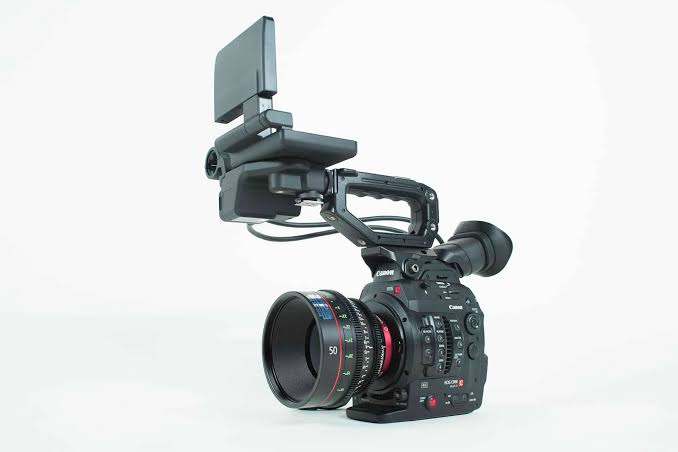
Canon EOS C300 Mark II is a professional Super 35 cinema camera designed for filmmakers, documentary crews, broadcasters, commercial producers and production houses that need a reliable 4K camera with Canon colour science and professional video tools.
Released in the 2015 production cycle, the EOS C300 Mark II replaced the original C300 with major improvements in resolution, dynamic range, colour depth, recording formats and post-production flexibility. It brought 4K internal recording to the C300 line and introduced Canon Log 2, which gave filmmakers more room for grading and high-dynamic-range workflows.
The camera uses a Super 35mm CMOS sensor with a 24.4 x 13.5 mm active image area. It supports 4K DCI at 4096 x 2160, 4K UHD at 3840 x 2160, 2K DCI and HD recording. It also supports XF-AVC internal recording, external RAW output, Dual Pixel CMOS AF and EF or PL lens-mount options.
Although newer Canon cinema cameras now offer stronger specs, the Canon EOS C300 Mark II remains an important model because it helped establish Canon as a serious player in 4K digital cinema production.
Key Canon EOS C300 Mark II Specifications
The Canon EOS C300 Mark II was built as a compact but professional cinema camera for real production environments. It balances image quality, ergonomics, codec strength and lens flexibility.
| Feature | Canon EOS C300 Mark II |
|---|---|
| Release period | September 2015 market cycle |
| Camera type | Professional Super 35 cinema camera |
| Sensor size | 24.4 x 13.5 mm |
| Sensor type | Super 35mm CMOS |
| Effective resolution | About 8.85MP for 4K video |
| Main recording formats | 4K DCI, 4K UHD, 2K DCI, HD |
| Maximum internal 4K recording | 4096 x 2160 |
| Lens mount options | EF and PL |
| Base sensitivity | ISO 800 for Canon Log 2 and Canon Log 3 workflows |
| Image processor | Dual DIGIC DV 5 |
| Main internal codec | XF-AVC |
| 4K internal recording | 10-bit 4:2:2 up to 410Mbps |
| RAW workflow | 4K RAW external output |
| Dynamic range claim | Up to 15 stops with Canon Log 2 |
| Body weight | About 1.8kg |
| Dimensions | About 149 x 183 x 183 mm |
| Current status | Discontinued in Canon regional listings |
The C300 Mark II was not designed as a lightweight creator camera. It was built for crews that needed a dependable cinema body with proper monitoring, audio, ND filters, professional codecs and strong colour grading flexibility.
Super 35mm Sensor and Image Quality
The Canon EOS C300 Mark II uses a Super 35mm CMOS sensor measuring 24.4 x 13.5 mm.
Super 35 remains one of the most important formats in cinema production. It offers a familiar field of view, wide lens compatibility and a classic motion-picture look. Many cinema lenses were designed around Super 35 coverage, making the C300 Mark II easier to pair with professional EF and PL lens packages.
The camera’s 4K DCI recording uses 4096 x 2160 resolution, while 4K UHD uses 3840 x 2160. This gives filmmakers flexibility for cinema, broadcast, streaming and corporate delivery.
Why Super 35 Still Matters
Super 35 is still popular because it balances image quality, depth of field and lens practicality.
Full-frame cameras can create a wider field of view and shallower depth of field, but they also require lenses with larger image circles. Super 35 cameras like the C300 Mark II work well with many classic cinema lenses, broadcast-style zooms and compact production lenses.
For documentaries, narrative films, television and commercials, the Super 35 format remains a reliable production choice.
4K DCI and UHD Recording
The Canon EOS C300 Mark II records 4K DCI at 4096 x 2160 and 4K UHD at 3840 x 2160.
4K DCI is useful for cinema-style production because it uses a 17:9 frame. 4K UHD is better suited for television, online platforms, corporate video and standard 16:9 delivery.
The camera also supports 2K DCI and HD recording, making it useful when a production does not need 4K capture or wants smaller files.
| Recording Format | Resolution |
| 4K DCI | 4096 x 2160 |
| 4K UHD | 3840 x 2160 |
| 2K DCI | 2048 x 1080 |
| HD | 1920 x 1080 |
This range allows crews to choose the right format for each project rather than being locked into one workflow.
XF-AVC 10-Bit Recording
One of the biggest improvements in the Canon EOS C300 Mark II was XF-AVC recording.
The camera records 4K internally using XF-AVC Intra at up to 410Mbps with 10-bit 4:2:2 colour sampling. That was a major upgrade over many earlier cameras that relied on lighter 8-bit codecs.
10-bit 4:2:2 recording gives colourists more information to work with during grading. It helps with skin tones, skies, gradients, green-screen work and heavy colour correction.
XF-AVC Recording Modes
| Resolution | Aspect Ratio | Codec | Frame Rates | Bitrate | Sampling | Bit Depth |
| 4K DCI | 4096 x 2160 | XF-AVC Intra | 23.98p to 29.97p | 410Mbps | 4:2:2 | 10-bit |
| 4K UHD | 3840 x 2160 | XF-AVC | Multiple frame rates | Varies | 4:2:2 | 10-bit |
| 2K DCI | 2048 x 1080 | XF-AVC | Multiple frame rates | Varies | Up to 4:4:4 | 10-bit or 12-bit depending on mode |
| HD | 1920 x 1080 | XF-AVC | Multiple frame rates | Varies | Up to 4:4:4 | 10-bit or 12-bit depending on mode |
XF-AVC remains one of the reasons the C300 Mark II is still respected. It gives productions strong image quality without requiring a RAW workflow on every job.
4K RAW External Output
The Canon EOS C300 Mark II supports 4K RAW output for external recording workflows.
This is important because the camera’s strongest internal format is XF-AVC, while RAW requires an external recorder setup. RAW output gives productions more flexibility in post-production, especially for colour grading, exposure control and visual effects.
The pasted recording data lists Canon Cinema RAW modes at 4K DCI resolution. For practical camera buyers, this should be understood as part of the camera’s external RAW-capable production workflow rather than the same type of internal RAW recording found in later Canon models such as the C200 or C500 Mark II.
Why RAW Output Matters
RAW gives post-production teams more room to adjust the image.
It can help when productions need advanced colour grading, highlight recovery, visual effects pulls or a more flexible finishing pipeline. However, RAW also increases storage needs and requires more careful media management.
For many C300 Mark II users, the best workflow is to use XF-AVC for most jobs and RAW output only when a project truly needs it.
Canon Log 2 and Dynamic Range
Canon EOS C300 Mark II introduced Canon Log 2 to the Cinema EOS line.
Canon Log 2 is designed to capture a wide tonal range and preserve more detail in highlights and shadows. Canon lists the camera with up to 15 stops of dynamic range when using Canon Log 2 at ISO 800 or above.
The camera also supports Canon Log and later Canon Log 3 through firmware. Canon Log 3 is easier to grade and more practical for many productions, while Canon Log 2 offers the widest dynamic range potential.
Dynamic Range Test Status
The pasted lab dataset lists dynamic range as not tested for the Canon EOS C300 Mark II.
That means the camera does not have a ranking in that specific dataset. However, Canon’s official specification and product materials position the camera as a 15-stop dynamic range model when using Canon Log 2.
For real-world production, users should still test exposure, noise and highlight behaviour before a major shoot.
Rolling Shutter Test Status
The pasted dataset also lists rolling shutter as not tested.
Canon promoted the C300 Mark II with reduced rolling shutter distortion compared with the original C300. However, without a lab figure in the pasted dataset, buyers should avoid making direct ranking claims.
In practical use, rolling shutter depends on frame rate, sensor readout mode, camera movement and subject motion. For interviews, documentaries, commercials and narrative scenes, the C300 Mark II remains very usable. For fast whip pans and action-heavy work, production testing is still recommended.
Dual Pixel CMOS AF
The Canon EOS C300 Mark II supports Dual Pixel CMOS AF on EF versions.
This autofocus system is one of Canon’s most useful video features. It gives smoother focus tracking and easier subject acquisition when using compatible EF lenses.
For documentary crews, interview shooters and solo operators, Dual Pixel CMOS AF can save time. It is especially helpful when filming moving subjects or when the operator needs to manage camera, exposure and framing at the same time.
Focus Guide and Manual Focus Support
The C300 Mark II also supports focus-assist tools that help manual focusing.
This is useful for cinema crews using PL lenses or manual EF cinema lenses. Even when autofocus is not used, Canon’s focus guide system can help operators judge focus more accurately.
For professional productions, this makes the camera suitable for both autofocus-assisted documentary work and traditional manual-focus cinema workflows.
EF and PL Mount Options
The Canon EOS C300 Mark II was available with EF and PL mount options.
The EF version is useful for Canon EF lens users, documentary crews and productions that want Dual Pixel CMOS AF. It supports a large range of Canon EF lenses, Canon cinema lenses and third-party EF lenses.
The PL version is aimed at traditional cinema production. PL lenses are common in feature films, commercials and rental-house workflows. A PL mount setup is ideal for crews using cinema primes, anamorphic lenses or professional focus-puller workflows.
Which Mount Is Better?
The better mount depends on your production style.
Choose EF if you want Canon autofocus support, native EF lenses and more affordable lens options.
Choose PL if you work with cinema lens packages, professional crews and traditional film-style production setups.
Built-In ND Filters
The Canon EOS C300 Mark II includes built-in ND filters.
Built-in ND filters are essential for professional video work because they allow cinematographers to control exposure without changing shutter speed, aperture or ISO unnecessarily.
This helps maintain natural motion blur and consistent depth of field in bright outdoor scenes.
Why Built-In ND Is Important
Built-in ND filters make the C300 Mark II faster to use than hybrid mirrorless or DSLR cameras.
Instead of attaching and swapping filters on the front of lenses, operators can adjust ND inside the camera body. This is valuable for documentaries, events, outdoor interviews, commercials and run-and-gun shooting.
Media and Workflow
The C300 Mark II records internally to CFast 2.0 cards.
CFast 2.0 was chosen because 4K XF-AVC at high bitrates requires fast and reliable media. The camera also supports proxy recording to SD cards, which helps editors work faster with smaller files before reconnecting to high-quality master footage.
This workflow was a major improvement for productions moving from HD to 4K. It gave crews professional 4K files while still supporting practical editing pipelines.
Audio and Professional Connections
The Canon EOS C300 Mark II includes professional audio and video connections.
It supports XLR audio through its handle unit, SDI output, HDMI, timecode and Genlock-style production workflows depending on configuration. These tools make it suitable for multi-camera shoots, documentary production, broadcast work and professional monitoring setups.
This is one of the biggest differences between the C300 Mark II and smaller hybrid cameras. It was designed for professional sets where audio, timecode, monitoring and reliability matter.
Body Design and Handling
The Canon EOS C300 Mark II has a modular cinema body weighing about 1.8kg.
Its shape is more compact than large studio cameras but more production-ready than mirrorless hybrids. The detachable monitor, handle, grip and modular accessories allow crews to build the camera for tripod, handheld, shoulder or rigged shooting.
The body is not as small as the later EOS C70, but it remains manageable for documentary and commercial work.
Why the Design Still Works
The C300 Mark II body gives operators direct controls, built-in ND filters, professional ports and strong ergonomics.
For long shooting days, this matters. A small mirrorless camera may be easier to carry, but a cinema body is often faster and more reliable on a professional set.
Canon EOS C300 Mark II vs Original C300
The Canon EOS C300 Mark II improved heavily on the original C300.
The original C300 helped popularize Canon’s Cinema EOS system with strong HD image quality and Canon Log. The Mark II added 4K recording, XF-AVC, Canon Log 2, more dynamic range, better colour depth and RAW output.
For productions moving beyond HD, the C300 Mark II was a major upgrade.
Canon EOS C300 Mark II vs C300 Mark III
The Canon EOS C300 Mark III is the newer and more advanced camera.
The Mark III adds Canon’s DGO sensor, improved dynamic range, Cinema RAW Light internal recording, CFexpress media, stronger slow motion and a more modern modular design.
However, the C300 Mark II can still make sense on the used market if the price is right. It remains a capable Super 35 4K camera with solid internal 10-bit XF-AVC and Canon Log 2.
Price and Availability
The Canon EOS C300 Mark II is now discontinued in some Canon regional listings.
Current pricing depends on used-market supply, condition, included accessories, lens mount version and operating hours. Complete kits may include monitors, grips, handles, batteries, media, chargers and shoulder rigs.
Because it was once a professional cinema camera, buyers should inspect the body carefully before purchasing. Check sensor condition, ports, buttons, fan noise, media slots, firmware version and accessory completeness.
Who Should Buy the Canon EOS C300 Mark II?
The Canon EOS C300 Mark II is best for filmmakers who want a professional Super 35 cinema camera with Canon colour and strong internal 4K recording at a lower used-market price.
It makes sense for:
Documentary filmmakers
Corporate video teams
Commercial producers
Film schools
Independent filmmakers
Broadcast crews
Interview-based productions
Canon EF lens owners
Rental houses with legacy Cinema EOS kits
Crews needing 4K 10-bit XF-AVC
It may not be ideal for creators who need full-frame capture, internal RAW, compact travel rigs, RF mount lenses or the newest Canon autofocus and sensor technology.
Key Takeaways
- Canon EOS C300 Mark II belongs to Canon’s 2015 Cinema EOS lineup.
- It uses a Super 35mm CMOS sensor measuring 24.4 x 13.5 mm.
- Recording formats include 4K DCI, 4K UHD, 2K DCI and HD.
- The camera records 4K internally using XF-AVC.
- 4K XF-AVC Intra supports 10-bit 4:2:2 recording up to 410Mbps.
- Canon Log 2 gives the camera a claimed dynamic range of up to 15 stops.
- The camera supports external 4K RAW output workflows.
- EF and PL mount options are available.
- Dual Pixel CMOS AF is available on EF versions.
- Built-in ND filters make exposure control easier.
- CFast 2.0 cards are used for internal recording.
- Dynamic range and rolling shutter are listed as not tested in the pasted lab dataset.
- Canon Asia now lists the EOS C300 Mark II as discontinued.
- It remains useful for professional 4K Super 35 production on the used market.
Frequently Asked Questions
What is the Canon EOS C300 Mark II?
The Canon EOS C300 Mark II is a professional Super 35 Cinema EOS camera designed for 4K filmmaking, documentaries, broadcast, commercial production and studio workflows.
When was the Canon EOS C300 Mark II released?
The Canon EOS C300 Mark II belongs to Canon’s 2015 Cinema EOS lineup, with market availability around September 2015.
What sensor does the Canon EOS C300 Mark II use?
It uses a Super 35mm CMOS sensor with a 24.4 x 13.5 mm active image area.
What lens mounts are available?
The camera was available in EF and PL mount versions.
Can the Canon EOS C300 Mark II record 4K internally?
Yes. It records 4K DCI and 4K UHD internally using Canon’s XF-AVC codec.
What is the best internal 4K recording mode?
The key internal mode is 4K XF-AVC Intra at up to 410Mbps, with 10-bit 4:2:2 colour sampling.
Does the Canon EOS C300 Mark II record RAW internally?
No. The C300 Mark II supports 4K RAW output for external recording workflows. It does not offer the same internal Cinema RAW Light workflow found in later Canon models.
What is the dynamic range of the Canon EOS C300 Mark II?
Canon lists up to 15 stops of dynamic range with Canon Log 2. The pasted lab dataset lists dynamic range as not tested.
Does the Canon EOS C300 Mark II have autofocus?
Yes. EF versions support Canon Dual Pixel CMOS AF with compatible lenses.
Is the Canon EOS C300 Mark II still worth buying?
Yes, it can still be worth buying for filmmakers who want a used Super 35 cinema camera with Canon colour, 4K 10-bit XF-AVC, built-in ND filters and professional production tools.
Conclusion
The Canon EOS C300 Mark II remains a major camera in Canon’s Cinema EOS history.
It brought 4K internal recording, XF-AVC 10-bit 4:2:2, Canon Log 2, external RAW output, EF and PL mount options, built-in ND filters and professional production features to a Super 35 cinema body.
Newer Canon cameras now offer better sensors, internal RAW, RF mount options and more advanced autofocus. Even so, the C300 Mark II still has value for filmmakers who want a reliable 4K cinema camera with Canon colour science and professional workflow support at a lower used-market price.
Read Also: Canon EOS 5D Mark IV: Specs, Sensor, 4K Video and DSLR Features