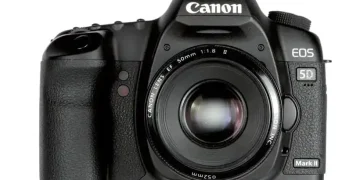
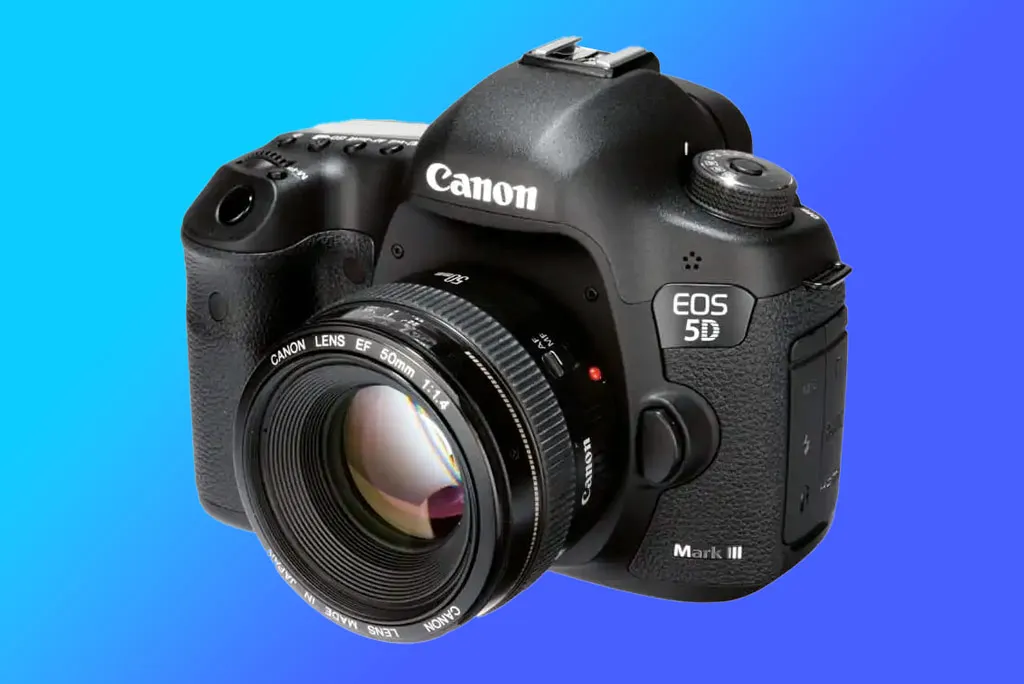
Canon EOS 5D Mark III is one of Canon’s most influential full-frame DSLR cameras, built for photographers, filmmakers and hybrid shooters who needed professional image quality in a durable EF-mount body.
Released in March 2012, the 5D Mark III succeeded the hugely important EOS 5D Mark II, a camera that helped change DSLR filmmaking. Canon improved the Mark III with a stronger autofocus system, faster shooting, better high-ISO performance, improved video compression options and a more refined professional body.
The camera uses a 22.3MP full-frame CMOS sensor measuring 36 x 24 mm, Canon’s EF lens mount and the DIGIC 5+ image processor. It records Full HD video at 1920 x 1080 and offers H.264 compression in ALL-I and IPB modes.
Although it does not record 4K video and has now been overtaken by Canon’s mirrorless EOS R system, the Canon EOS 5D Mark III remains a popular used-market DSLR because of its image quality, rugged build and strong EF lens support.
Key Canon EOS 5D Mark III Specifications
The Canon EOS 5D Mark III was designed as a professional all-rounder for still photography and serious Full HD video work.
| Feature | Canon EOS 5D Mark III |
|---|---|
| Release period | March 2012 |
| Camera type | Full-frame DSLR |
| Sensor size | 36 x 24 mm |
| Effective resolution | About 22.3MP |
| Maximum photo resolution | 5760 x 3840 |
| Lens mount | Canon EF |
| Image processor | DIGIC 5+ |
| Official base ISO | ISO 100 |
| Native ISO range | ISO 100–25,600 |
| Expanded ISO range | ISO 50–102,400 equivalent |
| Video formats | Full HD and HD |
| Maximum video resolution | 1920 x 1080 |
| Main video codec | MPEG-4 AVC/H.264 |
| Highest listed Full HD bitrate | About 91 Mb/s in ALL-I mode |
| Memory card slots | CompactFlash and SD |
| Body weight | About 800g body class |
| Dimensions | About 152 x 116 x 76 mm |
| Dynamic range lab status | Not tested in the pasted dataset |
| Rolling shutter lab status | Not tested in the pasted dataset |
The 5D Mark III is not a modern video powerhouse, but it remains a historically important camera because it gave photographers and filmmakers a dependable full-frame DSLR with better video controls than its predecessor.
Full-Frame Sensor and Image Quality
The Canon EOS 5D Mark III uses a 22.3MP full-frame CMOS sensor.
The 36 x 24 mm sensor gives photographers a classic full-frame look, strong depth-of-field control and good low-light performance for its generation. Its maximum still-photo resolution is 5760 x 3840, which remains useful for portraits, weddings, events, editorial photography and online publishing.
The resolution may seem modest compared with newer 45MP and 60MP cameras, but it remains practical. File sizes are easier to manage, editing is faster and the camera still delivers strong image quality when paired with good EF lenses.
Why 22.3MP Still Works
A 22.3MP full-frame sensor is still enough for many real-world jobs.
It can handle wedding albums, portraits, social media, websites, editorial work and moderate prints. It also gives photographers manageable RAW files, which can be useful when shooting thousands of images at events.
For heavy cropping, wildlife and large commercial prints, newer high-resolution cameras are better. For general professional photography, the 5D Mark III still holds up well.
Canon EF Mount
The Canon EOS 5D Mark III uses the Canon EF mount.
This gives it access to one of the largest professional lens systems ever made. EF lenses include fast primes, L-series zooms, macro lenses, tilt-shift lenses, super-telephoto lenses and many third-party options.
The camera does not use Canon’s newer RF mount, but that is not always a disadvantage. EF lenses remain widely available on the used market, often at lower prices than newer RF equivalents.
Why EF Lenses Still Matter
Many photographers still own Canon EF lenses.
The 5D Mark III lets those users keep shooting natively without adapters. This is one of the biggest reasons the camera remains attractive for buyers who want a full-frame Canon system at a lower cost.
It is especially useful for users with EF L-series lenses who do not yet want to move fully into mirrorless.
Full HD Video Recording
The Canon EOS 5D Mark III records Full HD video at 1920 x 1080.
It supports frame rates such as 23.98p, 25p and 29.97p in Full HD. It also records HD at 1280 x 720, which can be useful for smaller files or older workflows.
The camera does not record 4K. That is its biggest video limitation today. However, in 2012, improved Full HD video with better compression and reduced moiré compared with the 5D Mark II made it a serious tool for independent filmmakers, wedding videographers and commercial shooters.
Recording Modes and Bitrates
The Canon EOS 5D Mark III records video using MPEG-4 AVC/H.264 compression.
| Recording Mode | Resolution | Codec | Frame Rates | Bitrate | Sampling | Bit Depth |
| Full HD ALL-I | 1920 x 1080 | H.264 | 23.98p, 25p, 29.97p | About 91 Mb/s | 4:2:0 | 8-bit |
| Full HD IPB | 1920 x 1080 | H.264 | 23.98p, 25p, 29.97p | About 31 Mb/s | 4:2:0 | 8-bit |
| HD | 1280 x 720 | H.264 | Selected frame rates | Varies | 4:2:0 | 8-bit |
ALL-I records each frame more independently, which can make editing easier and improve motion handling. IPB creates smaller files and is better for longer recording times.
ALL-I vs IPB
The Canon EOS 5D Mark III gave filmmakers more compression choices than earlier DSLR video models.
ALL-I is the better option when image quality and editing performance matter more than file size. It produces larger files but can be easier for editing systems to handle.
IPB is more efficient. It saves storage space and works well for long interviews, event coverage and projects where file size matters.
Which Mode Should You Use?
Use ALL-I for:
Short films
Music videos
Commercial clips
Wedding highlights
Colour grading
Fast movement
Use IPB for:
Long interviews
Events
Documentary coverage
Training videos
Travel clips
Storage-saving workflows
The best mode depends on the project, editing system and storage budget.
No 4K Video
The Canon EOS 5D Mark III does not record 4K video.
This is one of the main reasons newer Canon cameras are better for modern video production. Today, many clients expect 4K delivery or at least 4K capture for reframing and sharper HD output.
Still, the 5D Mark III can produce attractive Full HD footage when exposed well, focused carefully and paired with good lenses. For projects delivered in 1080p, it can still work.
Dynamic Range and Rolling Shutter
The pasted lab dataset lists dynamic range and rolling shutter as not tested for the Canon EOS 5D Mark III.
That means there is no ranking figure from that dataset for direct comparison against tested cinema cameras or modern mirrorless bodies.
In practical use, the camera can produce good still-image RAW files and pleasing video, but it has the limits expected from an older 8-bit DSLR. Users should expose carefully, avoid extreme shadow recovery in video and control highlights when shooting high-contrast scenes.
Rolling shutter can appear during fast pans or quick movement, as with many DSLR video cameras from that era.
ISO and Low-Light Performance
Canon lists the EOS 5D Mark III with a native ISO range of 100–25,600 and expanded sensitivity up to ISO 102,400 equivalent.
For still photography, this gave the camera strong low-light performance when it launched. Wedding photographers, event shooters and photojournalists benefited from cleaner high-ISO images compared with many older DSLRs.
For video, many users preferred ISO values around 160-style increments because of noise behaviour in DSLR video workflows. Officially, however, the camera’s base ISO is ISO 100.
Best Low-Light Uses
The 5D Mark III works well in:
Wedding receptions
Indoor events
Concert photography
Documentary work
Street photography
Available-light portraits
Low-light travel scenes
Modern cameras now perform better at high ISO, but the 5D Mark III still delivers usable results when exposure is managed properly.
Autofocus System
The Canon EOS 5D Mark III uses a 61-point autofocus system.
This was a major upgrade over the 5D Mark II. The AF system was influenced by Canon’s professional EOS-1D X technology and made the 5D Mark III much better for action, weddings, events and photojournalism.
For still photography, this autofocus system remains one of the camera’s strongest features.
Autofocus for Video
Video autofocus is much more limited than modern Canon cameras.
The 5D Mark III does not offer the advanced Dual Pixel CMOS AF experience found in later Canon DSLRs and mirrorless bodies. For serious video work, most users rely on manual focus.
This makes the camera less convenient for solo video creators compared with newer Canon EOS R cameras.
Photography Performance
The Canon EOS 5D Mark III is strongest as a stills camera.
It can shoot up to 6fps, which was useful for weddings, events, portraits, documentaries and some action work. It is not as fast as Canon’s 1D-series bodies, but it offers a strong balance of image quality, autofocus and professional handling.
The camera is well suited for:
Wedding photography
Portrait photography
Event coverage
Travel photography
Landscape photography
Editorial photography
Studio work
Documentary photography
Low-light photography
Its full-frame sensor and EF lens support still make it a capable photography tool.
Body Design and Handling
The Canon EOS 5D Mark III has a durable DSLR body with professional controls.
It includes a deep grip, optical viewfinder, top LCD, rear control dial, joystick, weather-sealed construction and dual card slots. The body weighs about 800g, which makes it solid but still manageable for full-day shooting.
Many photographers still prefer this DSLR handling. The optical viewfinder gives a direct view of the scene, while the large body balances well with EF L-series lenses.
Why DSLR Handling Still Appeals
Mirrorless cameras offer electronic viewfinders, advanced autofocus and better video tools.
However, DSLRs like the 5D Mark III still offer excellent battery life, reliable physical controls and a natural optical viewing experience. For photographers who mainly shoot stills, that still matters.
Dual Card Slots
The Canon EOS 5D Mark III includes one CompactFlash slot and one SD card slot.
Dual card slots are important for professional work because they allow backup, overflow or file separation. Wedding and event photographers especially benefit from this because losing images can be costly.
The mixed CF and SD setup is older than modern dual CFexpress or dual SD systems, but it remains useful.
Audio and Video Controls
The 5D Mark III improved video usability compared with the 5D Mark II.
It added better compression options, timecode support and more practical video controls. It also includes a headphone jack, which helps users monitor audio during recording.
This made the camera much more useful for filmmakers than earlier DSLR bodies.
Audio Limitations
Although the 5D Mark III includes better audio tools than the 5D Mark II, it is still not a cinema camera.
It lacks built-in XLR inputs, internal ND filters and professional video ergonomics. Many filmmakers use external audio recorders or camera rigs when shooting serious video with the 5D Mark III.
Canon EOS 5D Mark III vs 5D Mark II
The Canon EOS 5D Mark III was a major upgrade over the 5D Mark II.
It improved autofocus, continuous shooting, video compression, low-light performance, screen quality, weather sealing and handling.
The 5D Mark II was historically important for DSLR filmmaking, but the Mark III became the more refined and professional tool.
For stills and Full HD video, the 5D Mark III is the stronger choice.
Canon EOS 5D Mark III vs 5D Mark IV
The Canon EOS 5D Mark IV is the newer and more capable camera.
The Mark IV adds a 30.4MP sensor, 4K DCI video, Dual Pixel CMOS AF, touchscreen control, built-in Wi-Fi, GPS and faster overall performance.
However, the 5D Mark III remains cheaper on the used market and still offers strong full-frame stills, EF lens support and classic DSLR handling.
Buyers should choose the Mark III if they want a lower-cost full-frame DSLR. They should choose the Mark IV if they need better resolution, 4K video and more modern live-view autofocus.
Price and Availability
The Canon EOS 5D Mark III is no longer widely available as a new camera.
It is now mainly a used-market DSLR. Current used prices vary depending on condition, shutter count, included batteries, charger, straps, memory cards and body wear.
Used listings from major retailers often place the camera in the several-hundred-dollar range, with lower prices for worn bodies and higher prices for low-shutter-count examples.
Before buying, users should check shutter count, sensor condition, card slots, buttons, LCD, viewfinder, battery door, hot shoe and overall body wear.
Who Should Buy the Canon EOS 5D Mark III?
The Canon EOS 5D Mark III is best for users who want an affordable professional full-frame DSLR for still photography and occasional Full HD video.
It makes sense for:
Canon EF lens owners
Wedding photographers on a budget
Portrait photographers
Event shooters
Travel photographers
Photography students
Studio creators
Documentary photographers
Filmmakers who only need 1080p
Buyers who prefer optical viewfinders
It may not be the best choice for users who need 4K video, modern autofocus tracking, in-body stabilization, silent electronic shooting or RF lens support.
Key Takeaways
- Canon EOS 5D Mark III was released in March 2012.
- It uses a 22.3MP full-frame CMOS sensor measuring 36 x 24 mm.
- The camera uses Canon’s EF lens mount.
- Maximum photo resolution is 5760 x 3840.
- It records Full HD video at 1920 x 1080.
- Video uses H.264 compression in ALL-I and IPB modes.
- ALL-I Full HD recording reaches about 91 Mb/s.
- IPB Full HD recording reaches about 31 Mb/s.
- Internal recording is 8-bit 4:2:0.
- The camera does not record 4K video.
- It uses a 61-point autofocus system for still photography.
- It shoots up to 6fps.
- It has dual CompactFlash and SD card slots.
- Dynamic range and rolling shutter are listed as not tested in the pasted dataset.
- The camera is now mainly a used-market option.
Frequently Asked Questions
What is the Canon EOS 5D Mark III?
The Canon EOS 5D Mark III is a full-frame DSLR camera designed for professional photography and Full HD video recording.
When was the Canon EOS 5D Mark III released?
Canon released the EOS 5D Mark III in March 2012.
What sensor does the Canon EOS 5D Mark III use?
It uses a 22.3MP full-frame CMOS sensor measuring 36 x 24 mm.
What lens mount does the Canon EOS 5D Mark III use?
The camera uses Canon’s EF lens mount.
Can the Canon EOS 5D Mark III record 4K video?
No. The Canon EOS 5D Mark III records up to Full HD at 1920 x 1080.
What video codec does the 5D Mark III use?
It records MPEG-4 AVC/H.264 video with ALL-I and IPB compression options.
What is the maximum photo resolution?
The maximum still-photo resolution is 5760 x 3840.
Does the Canon EOS 5D Mark III have Dual Pixel autofocus?
No. The 5D Mark III does not have the modern Dual Pixel CMOS AF system found in later Canon cameras.
What is the dynamic range of the Canon EOS 5D Mark III?
The pasted dataset lists dynamic range as not tested. For still photography, the camera produces flexible RAW files, but video remains limited by 8-bit internal recording.
Is the Canon EOS 5D Mark III still worth buying?
Yes, it can still be worth buying for photographers who want a low-cost full-frame Canon DSLR with EF lens support, strong still-image quality and basic Full HD video.
Conclusion
The Canon EOS 5D Mark III remains one of Canon’s most important professional DSLRs.
It improved on the legendary 5D Mark II with a stronger autofocus system, better video compression, faster shooting, improved low-light performance and more reliable professional handling. It does not offer modern 4K video, mirrorless autofocus or in-body stabilization, but it still delivers strong full-frame photography and classic DSLR ergonomics.
For Canon EF lens users, photography students and budget-conscious professionals, the Canon EOS 5D Mark III remains a capable used-market camera and an important part of DSLR history.
Read Also: Canon EOS C100: Specs, Sensor, Recording Modes and Cinema Features