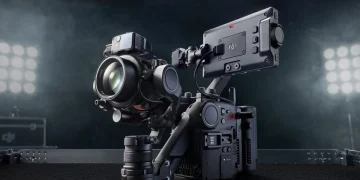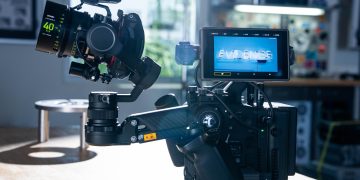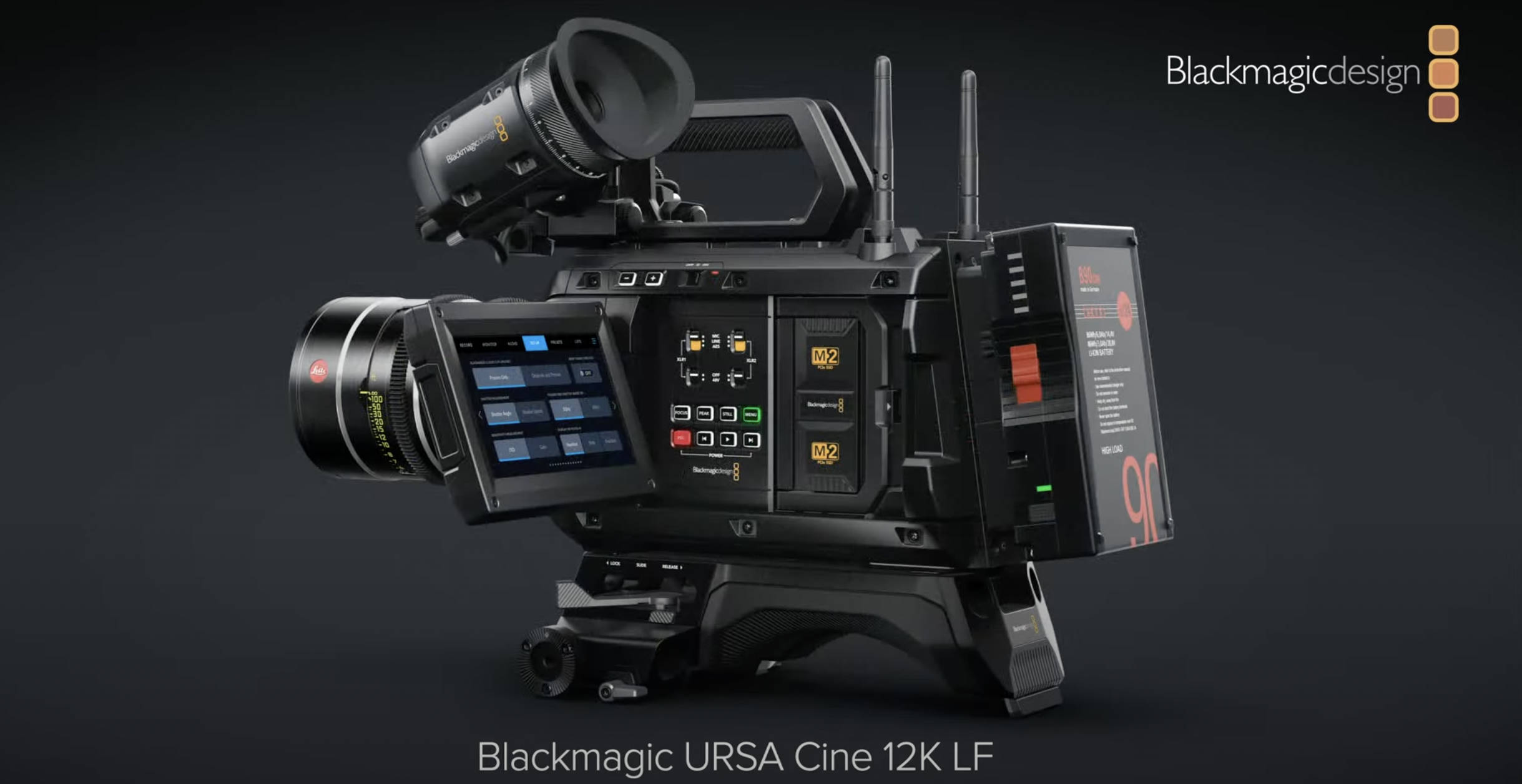
Blackmagic URSA Cine 12K LF is a high-end full-frame digital cinema camera designed for professional film, commercial, studio and post-production workflows.
Released in September 2024, the camera represents one of Blackmagic Design’s most ambitious cinema systems. It combines a 12K large-format RGBW sensor, Blackmagic RAW recording, high frame rates, strong rolling-shutter performance and a production body built for serious sets.
Unlike smaller box cameras such as the Blackmagic PYXIS 12K, the URSA Cine 12K LF is built as a more complete production camera. It is designed for crews that need integrated monitoring, media options, professional power, networked workflows, camera assistants, large lenses and controlled production environments.
The headline feature is the 12K full-frame sensor. It records up to 12288 x 8040 in 3:2 Open Gate, giving filmmakers a huge image canvas for cropping, reframing, visual effects, oversampled 8K or 4K delivery and premium cinema finishing.
Key Camera Specifications
The Blackmagic URSA Cine 12K LF uses a large-format full-frame 35mm RGBW sensor with an effective listed area of 35.64 x 23.32 mm. It records Blackmagic RAW in several compression options and supports multiple aspect ratios from 12K Open Gate down to 4K.
| Feature | Blackmagic URSA Cine 12K LF |
|---|---|
| Camera type | Full-frame digital cinema camera |
| Release period | September 2024 |
| Sensor type | Large-format RGBW sensor |
| Effective sensor size | 35.64 x 23.32 mm |
| Maximum resolution | 12288 x 8040 |
| Base sensitivity | ISO 800 |
| Claimed dynamic range | 16 stops |
| Main codec | Blackmagic RAW |
| Proxy workflow | H.264 proxies |
| Lens mount options | PL, EF and LPL workflows depending on configuration |
| Maximum listed 12K frame rate | Up to 80p in 12K 3:2 |
| Body weight | About 3,960 g |
| Dimensions | About 280 mm x 154 mm x 153 mm |
| Listed price | Around $17,045 before taxes, depending on configuration |
The camera sits above Blackmagic’s smaller cinema bodies by offering a more robust production build and faster sensor readout than the PYXIS 12K in key modes.
12K Full-Frame RGBW Sensor
The URSA Cine 12K LF uses a full-frame RGBW sensor with a maximum 12K 3:2 resolution of 12288 x 8040.
The RGBW sensor design uses red, green, blue and white photosites. Blackmagic uses this approach to improve light sensitivity and dynamic range while still delivering very high-resolution colour capture.
A 12K sensor may sound excessive for many projects, but it gives filmmakers major post-production flexibility. Editors can crop, stabilise, reframe, extract multiple deliverables and downsample to 8K or 4K while keeping strong detail.
Why 12K Matters for Filmmakers
12K is not only about delivering a 12K final master.
Most productions will finish in 4K or 8K. The benefit of 12K is that the original capture contains more information than the final output needs. This can create cleaner downsampled images, better VFX plates and more flexibility for social, cinema and streaming deliverables.
For commercials, music videos, fashion films, product work and high-end narrative projects, that extra resolution can be valuable.
Dynamic Range Performance
Blackmagic claims 16 stops of dynamic range for the URSA Cine 12K LF.
In CineD lab testing, the camera delivered strong measured performance. The best listed result was 13.6 stops at SNR=2 in a 4K 3:2 workflow created from 12K 3:2 downscaling. In native 12K 3:2, CineD measured 13 stops at SNR=2.
| Sensor Mode | Resolution | Codec | ISO | Gamma | Measured Dynamic Range |
| 4K 3:2 from 12K downscale | 4096 x 2680 | BRAW | 800 | BMD Film | 13.6 stops at SNR=2 |
| 12K 3:2 | 12288 x 8040 | BRAW | 800 | BMD Film | 13.0 stops at SNR=2 |
| 9K 17:9 | 9312 x 4896 | BRAW | 800 | BMD Film | 13.1 stops at SNR=2 |
| 8K 17:9 | 8192 x 4320 | BRAW | 800 | BMD Film | 12.6 stops at SNR=2 |
| 4K 17:9 | 4096 x 2160 | BRAW | 800 | BMD Film | 13.2 stops at SNR=2 |
| 4K 17:9 at 180fps | 4096 x 2160 | BRAW | 800 | BMD Film | 13.2 stops at SNR=2 |
These results show that the URSA Cine 12K LF performs strongly, especially when downsampling from 12K to 4K. The measured values are lower than the 16-stop marketing claim, but still very competitive for a high-resolution full-frame cinema camera.
What Dynamic Range Means in Real Production
Dynamic range affects how much detail a camera can hold in highlights and shadows.
For cinematographers, this matters when shooting bright skies, windows, practical lights, dark interiors, reflective surfaces and backlit faces. The URSA Cine 12K LF gives productions good room to grade, but careful exposure still matters.
The camera is strongest when shooters protect highlights and use Blackmagic RAW to refine exposure and colour in post-production.
Rolling Shutter Performance
Rolling shutter is one of the strongest technical areas for the Blackmagic URSA Cine 12K LF.
CineD measured 12ms in full 12K 3:2 Open Gate, which is already good for such a large high-resolution sensor. The camera performs even better in lower-resolution 17:9 modes, where 4K and 8K both measured 5.5ms.
| Sensor Mode | Resolution | Codec | Rolling Shutter |
| 4K 17:9 | 4096 x 2160 | Blackmagic RAW | 5.5ms |
| 8K 17:9 | 8192 x 4320 | Blackmagic RAW | 5.5ms |
| 9K 17:9 | 9312 x 4896 | Blackmagic RAW | 7.4ms |
| 12K 3:2 Open Gate | 12288 x 8040 | Blackmagic RAW | 12ms |
| 12K 3:2 Open Gate at 80fps | 12288 x 8040 | Blackmagic RAW | 12ms |
These numbers are important because rolling shutter affects fast camera movement. The URSA Cine 12K LF performs much better than the smaller PYXIS 12K in full 12K mode and is especially impressive in 4K and 8K 17:9.
Why Rolling Shutter Matters
Rolling shutter can make fast pans, handheld movement and moving subjects look distorted.
A lower rolling-shutter number means the sensor reads out faster. That helps reduce skew, wobble and bending vertical lines.
For action scenes, handheld camera work, music videos, vehicle shots and fast-moving commercials, the URSA Cine 12K LF’s 5.5ms result in 4K and 8K is a major advantage.
Blackmagic RAW Recording
The URSA Cine 12K LF records Blackmagic RAW.
Blackmagic RAW is a major part of the camera’s appeal because it offers high image quality, efficient compression and strong control in DaVinci Resolve. It allows users to adjust ISO, white balance, tint, exposure-related controls and colour settings in post-production.
The camera supports several compression options, including Blackmagic RAW 3:1, 8:1, 12:1, 18:1 and constant-quality settings such as Q0, Q1, Q3 and Q5.
Why BRAW Matters
BRAW gives filmmakers a practical RAW workflow.
Traditional RAW formats can create huge files and complicated post-production demands. Blackmagic RAW is designed to be easier to edit while still giving strong flexibility.
For productions using DaVinci Resolve, this creates a smooth pipeline from capture to grading, editing, finishing and delivery.
Recording Modes and Formats
The URSA Cine 12K LF supports a wide range of recording formats across 12K, 9K, 8K and 4K.
| Recording Format | Resolution |
| 12K 3:2 | 12288 x 8040 |
| 12K 16:9 | 12288 x 6912 |
| 12K 17:9 | 12288 x 6480 |
| 12K 2.4:1 | 12288 x 5112 |
| 12K 6:5 | 9648 x 8040 |
| 9K 3:2 | 9408 x 6264 |
| 9K 16:9 | 8688 x 4896 |
| 9K 17:9 | 9312 x 4896 |
| 9K 2.4:1 | 9312 x 3864 |
| 9K 6:5 | 7680 x 6408 |
| 8K 3:2 | 8192 x 5360 |
| 8K 16:9 | 8192 x 4608 |
| 8K 17:9 | 8192 x 4320 |
| 8K 2.4:1 | 8192 x 3408 |
| 8K 6:5 | 6432 x 5360 |
| 4K 3:2 | 4096 x 2680 |
| 4K 16:9 | 4096 x 2304 |
| 4K 17:9 | 4096 x 2160 |
| 4K 2.4:1 | 4096 x 1704 |
| 4K 6:5 | 3216 x 2680 |
This format range gives cinematographers huge flexibility. They can shoot Open Gate for maximum capture, 17:9 for cinema delivery, 2.4:1 for widescreen, 6:5 for anamorphic workflows and 4K for high-speed or lighter data loads.
Frame Rates and Data Rates
The URSA Cine 12K LF supports full 12K 3:2 recording up to 80p in Blackmagic RAW.
That is a major advantage over smaller 12K cameras because it gives productions high-resolution slow-motion capture while maintaining the full sensor area.
At 12K 3:2 and 23.98p, the provided data lists approximate data rates of 9.6 Gb/s in Blackmagic RAW 3:1, 3.6 Gb/s in 8:1, 2.4 Gb/s in 12:1 and 1.6 Gb/s in 18:1.
| Mode | Codec | Frame Rate | Approximate Data Rate |
| 12K 3:2 | BRAW 3:1 | 23.98p | 9.6 Gb/s |
| 12K 3:2 | BRAW 8:1 | 23.98p | 3.6 Gb/s |
| 12K 3:2 | BRAW 12:1 | 23.98p | 2.4 Gb/s |
| 12K 3:2 | BRAW 18:1 | 23.98p | 1.6 Gb/s |
These figures show why media planning is essential. Shooting 12K RAW creates heavy files, especially at lower compression ratios and higher frame rates.
Why 12K 80p Matters
12K 80p gives filmmakers a rare combination of resolution and slow motion.
It can be useful for commercials, action scenes, fashion, sports-style visuals, product shots, visual effects plates and premium slow-motion work.
The ability to shoot high-resolution slow motion in full 12K makes the URSA Cine 12K LF more production-focused than smaller 12K cameras.
Lens Mount and Lens Coverage
The URSA Cine 12K LF supports professional lens mount workflows, including PL, EF and LPL depending on setup and configuration.
The PL mount is the standard choice for cinema productions. EF support is useful for users with Canon EF lenses. LPL workflows make sense for modern large-format cinema lenses.
Because the sensor is full frame, lens coverage must be checked carefully. Some Super 35 lenses will not cover the full 12K Open Gate area.
Lens Coverage Tips
Full-frame cinema lenses are the safest option for using the full sensor area.
Super 35 lenses may work in cropped modes, such as 9K or selected aspect ratios, depending on the image circle. Anamorphic lenses should also be tested before production, especially in 6:5 and Open Gate modes.
Lens testing is important because high-resolution sensors reveal edge softness, vignetting and optical flaws more clearly.
Production Body and Workflow
The URSA Cine 12K LF uses a larger production-style body than the Blackmagic PYXIS line.
At about 3.96 kg, it is not as small as a compact box camera, but it offers a more complete production platform. It is designed for serious camera builds with cinema lenses, matte boxes, follow focus, monitoring, power systems and crew operation.
The body is better suited to studio, commercial, narrative and controlled production environments than lightweight travel or run-and-gun filming.
Why the Body Design Matters
A production camera needs more than a good sensor.
It needs strong power options, media handling, monitoring, metadata, timecode, assistant-friendly controls and rigging support. The URSA Cine 12K LF is built for that type of environment.
It is especially suitable for crews that want Blackmagic’s image pipeline in a body that feels more production-ready than smaller models.
Media, Proxies and Post-Production
The URSA Cine 12K LF is designed around heavy media and post-production workflows.
High-resolution BRAW needs fast storage, reliable backup systems and a strong editing pipeline. Proxy recording helps make this easier by generating lighter files for editing while keeping high-resolution originals for finishing.
For DaVinci Resolve users, the workflow is especially strong because Blackmagic RAW is deeply integrated into the software.
Why Proxy Workflows Matter
12K footage can be difficult to edit directly on many systems.
Proxy files allow editors to cut smoothly using smaller files, then relink to the original 12K BRAW footage for colour grading and final export.
This is especially useful for long-form projects, documentaries, commercials and multi-camera shoots.
Best Uses for the Blackmagic URSA Cine 12K LF
The Blackmagic URSA Cine 12K LF is best for productions that need high resolution, strong post flexibility and a camera body built for serious workflows.
It is ideal for:
Feature films
Commercials
Music videos
Fashion films
Product videos
Studio interviews
Visual effects plates
Green screen work
High-resolution stock footage
Premium documentaries
Streaming series
DaVinci Resolve-based productions
The camera is strongest when crews can properly manage storage, power, rigging and post-production.
URSA Cine 12K LF vs PYXIS 12K
The URSA Cine 12K LF and PYXIS 12K share a similar 12K full-frame concept, but they are built for different users.
The URSA Cine 12K LF is the stronger production camera. The PYXIS 12K is smaller, cheaper and more compact.
| Feature | URSA Cine 12K LF | PYXIS 12K |
| Sensor | Full-frame 12K RGBW | Full-frame 12K RGBW |
| Maximum resolution | 12288 x 8040 | 12288 x 8040 |
| Full 12K frame rate | Up to 80p | Up to 40p |
| 12K rolling shutter | 12ms | 24.1ms |
| Best 4K rolling shutter | 5.5ms | 10.9ms |
| Body weight | About 3.96 kg | About 1.59 kg |
| Best advantage | Production workflow and speed | Price and compact body |
| Best use | Professional sets | Indie and compact rigs |
The PYXIS 12K is attractive for smaller productions. The URSA Cine 12K LF is better when speed, production tools and sensor readout matter more.
URSA Cine 12K LF vs URSA Cine 17K 65
The URSA Cine 17K 65 is the bigger-sensor sibling in the URSA Cine line.
The 12K LF model uses a full-frame 35mm-class sensor, while the 17K 65 uses a larger 65mm sensor. The 17K version is aimed at even higher-end large-format and IMAX-style workflows.
| Feature | URSA Cine 12K LF | URSA Cine 17K 65 |
| Sensor class | Full-frame 35mm | 65mm |
| Maximum resolution | 12288 x 8040 | 17520 x 8040 |
| Best for | Full-frame cinema production | 65mm large-format production |
| Workflow | High-resolution BRAW | Extreme large-format BRAW |
| Main advantage | Balance of resolution and practicality | Maximum sensor size and resolution |
The URSA Cine 12K LF is more practical for many productions. The 17K 65 is for productions that need a much larger image canvas.
Key Takeaways
- Blackmagic URSA Cine 12K LF was released in September 2024.
- It uses a full-frame RGBW sensor with an effective area of 35.64 x 23.32 mm.
- Maximum resolution is 12288 x 8040.
- Blackmagic claims 16 stops of dynamic range.
- CineD measured up to 13.6 stops at SNR=2 in a downscaled 4K 3:2 workflow.
- Native 12K 3:2 measured 13 stops at SNR=2.
- Rolling shutter measured 12ms in 12K Open Gate.
- Rolling shutter improved to 5.5ms in 4K and 8K 17:9.
- The camera records Blackmagic RAW.
- Full 12K 3:2 recording supports up to 80p.
- Lens mount workflows include PL, EF and LPL depending on configuration.
- The body weighs about 3.96 kg.
- It is best for professional productions that need high resolution, fast readout and strong DaVinci Resolve integration.
Frequently Asked Questions
What is the Blackmagic URSA Cine 12K LF?
The Blackmagic URSA Cine 12K LF is a professional full-frame digital cinema camera with a 12K RGBW sensor, Blackmagic RAW recording and production-focused design.
When was the Blackmagic URSA Cine 12K LF released?
The camera was released in September 2024.
What is the maximum resolution?
The maximum recording resolution is 12288 x 8040 in 12K 3:2 mode.
What sensor does the URSA Cine 12K LF use?
It uses a full-frame RGBW sensor with an effective listed size of 35.64 x 23.32 mm.
What is the base ISO?
The base sensitivity is ISO 800.
What codec does the camera record?
The camera records Blackmagic RAW and can support proxy workflows for easier editing.
What dynamic range does the URSA Cine 12K LF offer?
Blackmagic claims 16 stops, while CineD measured up to 13.6 stops at SNR=2 in a downscaled 4K 3:2 workflow.
What is the rolling shutter performance?
CineD measured 12ms in 12K 3:2 Open Gate and 5.5ms in 4K and 8K 17:9 modes.
Can the URSA Cine 12K LF shoot 12K 80fps?
Yes. The camera supports 12K 3:2 recording up to 80p in Blackmagic RAW.
What lens mounts does it support?
The camera supports PL, EF and LPL workflows depending on mount configuration.
How heavy is the URSA Cine 12K LF?
The body weighs about 3.96 kg.
Who should use the Blackmagic URSA Cine 12K LF?
It is best for professional filmmakers, commercial crews, VFX teams, studios and DaVinci Resolve users who need high-resolution full-frame capture.
Conclusion
Blackmagic URSA Cine 12K LF is a powerful full-frame cinema camera built for productions that need high resolution, fast readout and a serious Blackmagic RAW workflow.
Its 12K RGBW sensor gives filmmakers a huge image canvas, while its 80p 12K recording, 5.5ms rolling-shutter result in 4K and 8K, flexible aspect ratios and DaVinci Resolve integration make it much more than a resolution showcase.
The camera demands proper storage, rigging and post-production planning. However, for crews that can support its workflow, the URSA Cine 12K LF offers a strong mix of resolution, dynamic-range performance, speed and production-ready design.
Read Also: Blackmagic PYXIS 12K: Specs, Sensor, Dynamic Range and Features