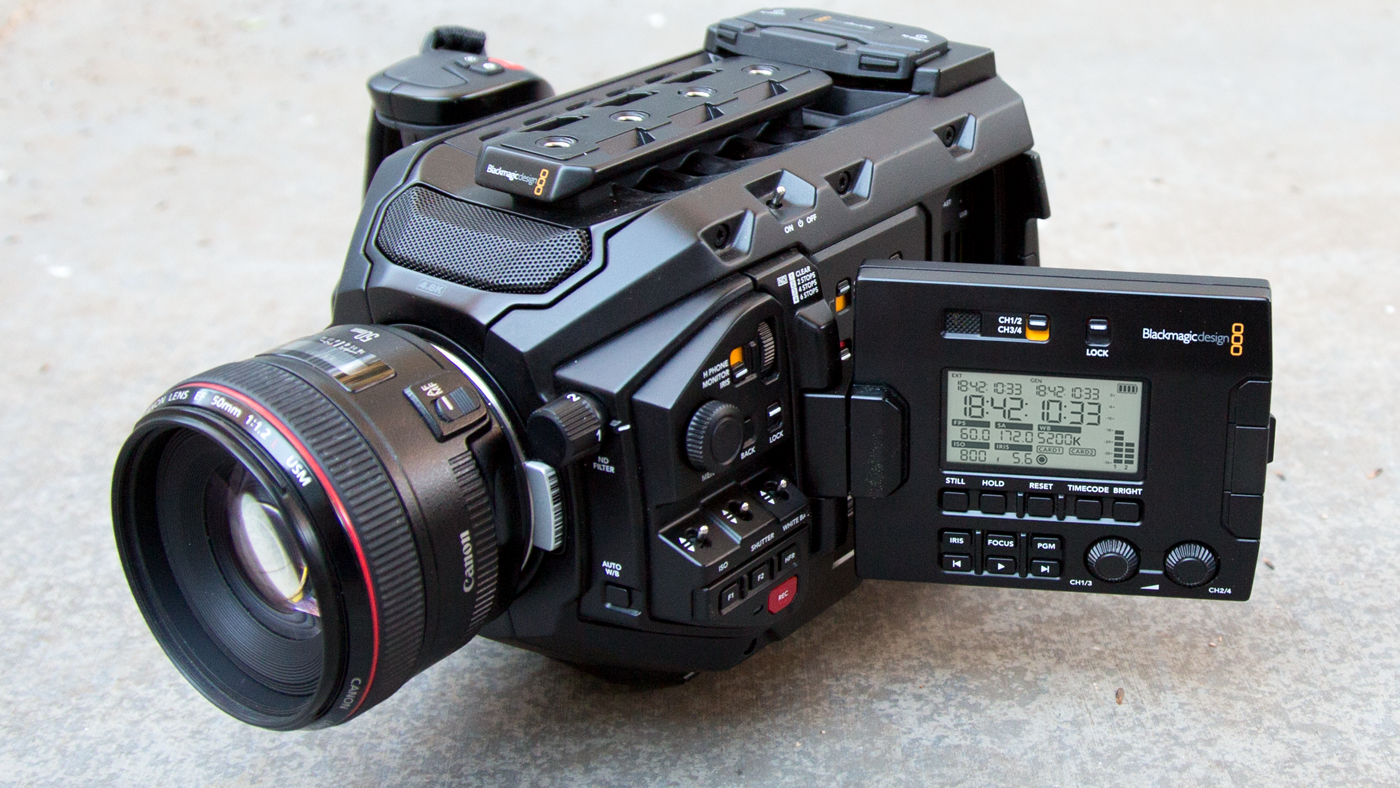
URSA Mini Pro 4.6K G2 is a professional Super 35 digital cinema camera built for filmmakers who need strong image quality, high frame rates and practical production features in one body.
Released in March 2019, the Blackmagic Design URSA Mini Pro 4.6K G2 improved the original URSA Mini Pro 4.6K with faster electronics, higher frame rates and Blackmagic RAW support. It kept the familiar URSA Mini Pro production body, built-in ND filters, interchangeable lens mount system and professional controls.
The camera uses a Super 35mm 4.6K sensor measuring about 25.34 x 14.25 mm. It records up to 4608 x 2592 and supports Blackmagic RAW, Apple ProRes, high-speed 4.6K recording and flexible formats for cinema, broadcast, documentary and commercial production.
Although newer Blackmagic cameras now offer 6K, 12K and full-frame sensors, the URSA Mini Pro 4.6K G2 remains important because it balances image quality, usability and production speed. It is a camera designed for real sets, not only spec sheets.
Key Camera Specifications
The URSA Mini Pro 4.6K G2 uses a Super 35 sensor with a maximum resolution of 4608 x 2592. It supports EF and PL lens workflows and records both Blackmagic RAW and ProRes.
| Feature | Blackmagic URSA Mini Pro 4.6K G2 |
|---|---|
| Camera type | Super 35 digital cinema camera |
| Release period | March 2019 |
| Sensor format | Super 35mm |
| Sensor size | 25.34 x 14.25 mm |
| Maximum resolution | 4608 x 2592 |
| Lens mount options | EF and PL |
| Base sensitivity | ISO 800 |
| Claimed dynamic range | 15 stops |
| Measured dynamic range | Up to 12.6 stops at SNR=2 in provided lab data |
| Main codecs | Blackmagic RAW and Apple ProRes |
| Built-in ND filters | Yes |
| Maximum 4.6K frame rate | Up to 120fps depending on codec |
| Maximum HD frame rate | Up to 300fps depending on mode |
| Body weight | About 2.3 kg |
| Dimensions | About 209 mm x 147 mm x 193 mm |
| Listed price | Around $6,829 before taxes |
The camera’s strongest appeal is its mix of high-speed Super 35 recording, production ergonomics and Blackmagic’s RAW workflow.
Super 35 4.6K Sensor
The URSA Mini Pro 4.6K G2 uses a Super 35 sensor with a 4.6K 16:9 resolution of 4608 x 2592.
Super 35 is one of the most established cinema formats. It gives cinematographers a familiar field of view, manageable depth of field and wide lens compatibility. It is also easier to lens than full-frame and 65mm cameras.
The 4.6K resolution gives enough detail for 4K finishing, reframing and oversampling while keeping file sizes more manageable than 6K or 12K cameras.
Why Super 35 Still Works
Super 35 remains practical for professional production.
It works well with cinema zooms, PL primes, EF lenses and broadcast-style workflows. It also keeps focus control more manageable for documentary, commercials, music videos and narrative films.
For many productions, a strong 4.6K Super 35 image is more useful than higher resolution with a less practical workflow.
Dynamic Range Performance
Blackmagic claims 15 stops of dynamic range for the URSA Mini Pro 4.6K G2.
In the provided CineD lab data, the camera measured 12.6 stops at SNR=2 in Full Sensor mode at 4608 x 2592, ProRes XQ, ISO 800 and BMD Film. In Blackmagic RAW scaled to UHD, the camera measured 12.1 stops at SNR=2.
| Sensor Mode | Resolution | Codec | ISO | Gamma | Measured Dynamic Range |
| Full Sensor | 4608 x 2592 | ProRes XQ | 800 | BMD Film | 12.6 stops at SNR=2 |
| Full Sensor scaled to UHD | 4608 x 2592 to UHD | BRAW | 800 | BMD Film | 12.1 stops at SNR=2 |
These results show that the camera performs strongly, but the measured lab result is more conservative than the 15-stop manufacturer claim.
What Dynamic Range Means for Filmmakers
Dynamic range affects how well a camera holds detail in bright highlights and dark shadows.
This matters when shooting windows, skies, practical lights, reflective surfaces, dark rooms and backlit scenes. The URSA Mini Pro 4.6K G2 gives filmmakers useful latitude, but it still rewards careful exposure.
The best results come from protecting highlights, avoiding heavy underexposure and using BMD Film or RAW controls carefully during grading.
Rolling Shutter
The provided camera data does not include an independent rolling-shutter result for the URSA Mini Pro 4.6K G2.
That means there is no confirmed rolling-shutter measurement here in the same format as the dynamic-range test. Since the camera uses a rolling-shutter CMOS sensor, filmmakers should still be careful with fast pans, whip movements and fast-moving subjects.
Why Rolling Shutter Testing Matters
Rolling shutter can make fast movement look distorted.
Vertical lines may bend during quick pans, and moving subjects can appear skewed. This is less noticeable in interviews, studio scenes, tripod work and controlled camera moves.
For action, sports, vehicle shots or aggressive handheld work, users should test the intended recording mode before production.
Blackmagic RAW Recording
The URSA Mini Pro 4.6K G2 records Blackmagic RAW.
Blackmagic RAW is one of the camera’s biggest strengths. It gives filmmakers RAW flexibility while keeping files easier to edit than many traditional RAW formats. It works especially well in DaVinci Resolve, where users can adjust ISO, white balance, tint and colour science controls in post-production.
The camera supports several Blackmagic RAW options, including lossless, 3:1 and 4:1 in the provided recording data.
Why BRAW Matters
Blackmagic RAW gives creators strong control over the image.
It allows more flexibility than standard compressed video, especially when grading exposure, colour and contrast. It also keeps the workflow practical for independent filmmakers and production companies that do not want extremely heavy RAW files.
For DaVinci Resolve users, BRAW is a major advantage.
ProRes Recording Options
The URSA Mini Pro 4.6K G2 also records Apple ProRes.
ProRes is useful when productions need a simple and widely supported editing format. It does not offer the same RAW flexibility as BRAW, but it is trusted in professional post-production and easy to manage.
The camera supports several ProRes choices, including ProRes XQ, ProRes 4444, ProRes 422 HQ, ProRes 422, ProRes LT and ProRes Proxy.
| ProRes Option | Sampling | Bit Depth |
| ProRes XQ | 4:4:4:4 | 12-bit |
| ProRes 4444 | 4:4:4:4 | 12-bit |
| ProRes 422 HQ | 4:2:2 | 10-bit |
| ProRes 422 | 4:2:2 | 10-bit |
| ProRes LT | 4:2:2 | 10-bit |
| ProRes Proxy | 4:2:2 | 10-bit |
This gives productions flexibility. High-end jobs can use ProRes XQ or BRAW, while faster-turnaround work can use lighter ProRes options.
Recording Modes and Formats
The URSA Mini Pro 4.6K G2 supports a wide range of recording formats from 4.6K down to HD.
| Recording Format | Resolution |
| 4.6K 16:9 | 4608 x 2592 |
| 4.6K 2.40:1 | 4608 x 1920 |
| 4K 16:9 | 4096 x 2304 |
| 4K DCI | 4096 x 2160 |
| 4K Ultra HD | 3840 x 2160 |
| 3K Anamorphic | 3072 x 2560 |
| 2K 16:9 | 2048 x 1152 |
| 2K DCI | 2048 x 1080 |
| HD | 1920 x 1080 |
This format range makes the camera useful for narrative work, commercials, music videos, documentaries, broadcast work and anamorphic-style production.
High-Speed Recording
High-speed recording is one of the biggest upgrades in the URSA Mini Pro 4.6K G2.
The camera can shoot up to 120fps in full 4.6K depending on codec and settings. It can also reach higher frame rates in windowed lower-resolution modes, including up to 300fps in HD.
In the provided recording data, 4.6K Blackmagic RAW supports frame rates up to 119.88p, while ProRes HQ supports up to 80p in 4.6K.
| Mode | Codec | Maximum Listed Frame Rate |
| 4.6K 16:9 | Blackmagic RAW lossless | Up to 119.88p |
| 4.6K 16:9 | Blackmagic RAW 3:1 | Up to 119.88p |
| 4.6K 16:9 | ProRes HQ | Up to 80p |
| 4K DCI windowed | Blackmagic RAW | Up to 150fps class |
| HD windowed | Blackmagic RAW | Up to 300fps class |
This makes the camera very useful for music videos, sports-style visuals, action, commercials and creative slow-motion sequences.
Why High Frame Rates Matter
Slow motion can add drama, elegance and visual impact.
A 120fps 4.6K mode gives filmmakers detailed slow-motion footage while keeping the Super 35 field of view. Higher frame rates in 4K and HD give more flexibility when motion is the creative priority.
For productions that need slow motion without moving to a larger camera system, the G2 is a strong choice.
Built-In ND Filters
The URSA Mini Pro 4.6K G2 includes built-in ND filters.
Built-in ND filters are essential for professional video because they help control exposure without changing aperture, shutter angle or ISO. This allows cinematographers to keep the desired depth of field and natural motion blur in bright conditions.
The camera includes clear, 2-stop, 4-stop and 6-stop ND options.
Why Built-In ND Filters Matter
ND filters make production faster.
Instead of adding external filters whenever light changes, operators can adjust exposure directly in the camera. This is useful for documentaries, commercials, outdoor scenes, interviews and run-and-gun shooting.
Built-in ND is one of the practical advantages of the URSA Mini Pro body over many smaller cinema cameras.
Lens Mount Options
The URSA Mini Pro 4.6K G2 supports EF and PL lens workflows.
The EF version is useful for filmmakers who already own Canon EF lenses. The PL mount is the standard for professional cinema lenses and is better suited for higher-end narrative, commercial and studio production.
| Mount | Best For |
| EF | Canon EF lenses, Sigma EF lenses, owner-operators and indie filmmakers |
| PL | Cinema primes, cinema zooms, rental lenses and professional sets |
This mount flexibility allows the camera to serve both independent creators and traditional film crews.
Lens Coverage Considerations
Because the camera uses a Super 35 sensor, lens coverage is easier than on full-frame cameras.
Most Super 35 PL cinema lenses will cover the sensor. EF full-frame lenses will also cover it easily. APS-C EF lenses may work depending on the lens and recording mode.
Anamorphic lenses should be tested before production, especially in the 3K anamorphic mode.
Production Body and Controls
The URSA Mini Pro 4.6K G2 uses a professional production-style body.
At about 2.3 kg, it is larger than a Pocket Cinema Camera but lighter than many traditional cinema systems. It is designed for shoulder rigs, tripods, handheld production, studio work and documentary shooting.
The body includes physical controls, built-in monitoring tools, professional inputs and a layout that works well for camera crews.
Why the URSA Body Matters
A good production body saves time on set.
The URSA Mini Pro design gives camera assistants and operators access to important controls without relying only on touchscreen menus. This matters in fast-moving production environments.
The body is also easier to build into a professional rig than smaller photo-style cameras.
Media and Storage
The URSA Mini Pro 4.6K G2 supports professional recording media for high-data-rate workflows.
Users can record to CFast 2.0 cards, SD UHS-II cards and external USB-C flash disks depending on codec and recording settings. High-speed 4.6K Blackmagic RAW requires fast and reliable media.
Storage Planning Tips
High frame rates and RAW recording create large files.
A production should use approved media, test every card or drive and plan for daily backups. BRAW can be efficient, but high-speed 4.6K still needs strong storage discipline.
For paid work, footage should be copied safely before cards are reused.
Audio and Professional I/O
The URSA Mini Pro 4.6K G2 includes professional audio and video connectivity.
It supports XLR audio inputs, SDI monitoring and output workflows, timecode, reference input and production-ready camera connections. These features help it fit into multi-camera shoots, studio setups and professional cinema environments.
Why Professional I/O Matters
Professional productions need reliable connections.
SDI is more robust than HDMI for many on-set workflows. XLR audio is important for microphones, mixers and documentary recording. Timecode support helps sync multiple cameras and audio recorders.
These tools make the URSA Mini Pro 4.6K G2 more practical than smaller creator cameras for professional sets.
Best Uses for the URSA Mini Pro 4.6K G2
The URSA Mini Pro 4.6K G2 is best for productions that need a strong Super 35 image, high frame rates and a professional body.
It is ideal for:
Feature films
Short films
Commercials
Music videos
Documentaries
Broadcast-style production
Corporate videos
Studio interviews
Sports-style slow motion
Fashion films
Product videos
Independent cinema
Multi-camera productions
The camera is especially useful when built-in ND filters, high-speed recording and professional controls matter.
URSA Mini Pro 4.6K G2 vs URSA Mini Pro 12K
The URSA Mini Pro 12K is the higher-resolution successor, but the 4.6K G2 remains more manageable for many productions.
| Feature | URSA Mini Pro 4.6K G2 | URSA Mini Pro 12K |
| Sensor format | Super 35 | Super 35 |
| Maximum resolution | 4608 x 2592 | 12288 x 6480 |
| Base ISO | 800 | 800 |
| Claimed dynamic range | 15 stops | 14 stops |
| Main codec | BRAW and ProRes | BRAW |
| ProRes support | Yes | No internal ProRes focus |
| Main advantage | Manageable files and ProRes flexibility | Extreme resolution |
| Best use | General cinema production | VFX and high-resolution work |
The 12K model is stronger for resolution-heavy production. The 4.6K G2 is more practical for teams that want high speed, ProRes and a simpler workflow.
URSA Mini Pro 4.6K G2 vs Pocket Cinema 6K Pro
The Pocket Cinema 6K Pro is smaller and cheaper, while the URSA Mini Pro 4.6K G2 is more production-focused.
| Feature | URSA Mini Pro 4.6K G2 | Pocket Cinema 6K Pro |
| Sensor format | Super 35 | Super 35 |
| Maximum resolution | 4.6K | 6K |
| Body type | Production camera | Compact handheld cinema camera |
| Built-in ND filters | Yes | Yes |
| Lens mount | EF or PL | EF |
| High frame rates | Stronger | Good but less production-focused |
| Best advantage | Pro body and high-speed recording | Lower cost and compact size |
The Pocket 6K Pro is better for small crews and budget work. The URSA Mini Pro 4.6K G2 is better for professional builds and production environments.
URSA Mini Pro 4.6K G2 vs PYXIS 6K
The PYXIS 6K is newer and full frame, while the URSA Mini Pro 4.6K G2 is a traditional Super 35 production camera.
| Feature | URSA Mini Pro 4.6K G2 | PYXIS 6K |
| Sensor format | Super 35 | Full frame |
| Maximum resolution | 4608 x 2592 | 6048 x 4032 |
| Body design | Production body | Modular box body |
| Built-in ND filters | Yes | No |
| Lens mounts | EF and PL | EF, L and PL |
| Best advantage | Built-in production tools | Full-frame modular workflow |
The PYXIS 6K is better for modular full-frame builds. The URSA Mini Pro 4.6K G2 is better for users who want built-in ND filters and traditional camera operation.
Key Takeaways
- Blackmagic URSA Mini Pro 4.6K G2 was released in March 2019.
- It uses a Super 35 sensor measuring about 25.34 x 14.25 mm.
- Maximum resolution is 4608 x 2592.
- The camera supports EF and PL lens workflows.
- Base sensitivity is ISO 800.
- Blackmagic claims 15 stops of dynamic range.
- CineD measured 12.6 stops at SNR=2 in ProRes XQ.
- Blackmagic RAW and Apple ProRes recording are supported.
- 4.6K Blackmagic RAW supports up to 119.88p in the provided data.
- ProRes HQ supports up to 80p in 4.6K.
- Built-in ND filters include clear, 2-stop, 4-stop and 6-stop options.
- The camera body weighs about 2.3 kg.
- Rolling-shutter results were not included in the provided data.
- It is best for commercials, documentaries, music videos, narrative films and production-focused Super 35 workflows.
Frequently Asked Questions
What is the Blackmagic URSA Mini Pro 4.6K G2?
The URSA Mini Pro 4.6K G2 is a Super 35 digital cinema camera with 4.6K recording, Blackmagic RAW, ProRes, built-in ND filters and a professional production body.
When was the URSA Mini Pro 4.6K G2 released?
The camera was released in March 2019.
What sensor does it use?
It uses a Super 35mm sensor with a listed active area of about 25.34 x 14.25 mm.
What is the maximum resolution?
The maximum resolution is 4608 x 2592 in 4.6K 16:9 mode.
What is the base ISO?
The base sensitivity is ISO 800.
What lens mounts does it support?
The camera supports EF and PL lens workflows.
Does the URSA Mini Pro 4.6K G2 record Blackmagic RAW?
Yes. It records Blackmagic RAW in several compression options.
Does it record ProRes?
Yes. It supports Apple ProRes, including high-quality 12-bit 4:4:4:4 and 10-bit 4:2:2 options depending on settings.
What dynamic range did CineD measure?
CineD measured 12.6 stops at SNR=2 in Full Sensor 4.6K ProRes XQ at ISO 800 and BMD Film.
What is the rolling shutter result?
The provided data does not include a rolling-shutter test result for the URSA Mini Pro 4.6K G2.
Does it have built-in ND filters?
Yes. It includes built-in ND filters with clear, 2-stop, 4-stop and 6-stop settings.
Who should use the URSA Mini Pro 4.6K G2?
It is best for filmmakers, documentary crews, music video teams, commercial productions and small studios that need a Super 35 production camera with high-speed recording and professional controls.
Conclusion
Blackmagic URSA Mini Pro 4.6K G2 remains a strong Super 35 cinema camera for productions that value image quality, speed and practical camera design.
Its 4.6K sensor, ISO 800 base sensitivity, Blackmagic RAW, ProRes support, built-in ND filters, EF and PL lens options and high-speed frame rates make it more than a simple update to the original URSA Mini Pro. It is a production-focused camera that can handle documentaries, commercials, music videos and narrative work.
Newer Blackmagic cameras offer more resolution and larger sensors, but the URSA Mini Pro 4.6K G2 still has a clear advantage for users who want a manageable Super 35 workflow with strong built-in production tools.
For filmmakers who need a reliable cinema camera with RAW, ProRes, high frame rates and practical ergonomics, the URSA Mini Pro 4.6K G2 remains a capable choice.
Read Also: Pocket Cinema 6K: Specs, Dynamic Range, Recording Modes and Features