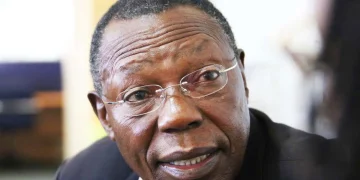
Mahmoud Ahmadinejad, born October 28, 1956, in Garmsār, Iran, was the son of a blacksmith who grew up in Tehran. In 1976, he entered the Iran University of Science and Technology (IUST) to study civil engineering. His student years coincided with growing unrest against the Shah, and he became active in the demonstrations that shaped the Iranian Revolution (1978–79).
Following the revolution, Ahmadinejad joined the Islamic Revolutionary Guards Corps (IRGC) and later participated in the Iran-Iraq War (1980–88), where he served in engineering and logistical roles. He earned a doctorate in transportation engineering and planning at IUST, cementing his background as a technocrat.
Early Political Career
In 1993, Ahmadinejad was appointed governor of the newly formed Ardabīl province, a post he held until 1997. He then returned to academia as a lecturer at IUST.
By the early 2000s, he re-emerged in politics as part of Ābādgarān-e Īrān-e Eslāmī (Developers of an Islamic Iran), a conservative populist movement. After the faction’s victory in Tehran’s 2003 city council elections, Ahmadinejad was appointed mayor of Tehran. His tenure focused on urban management, including traffic solutions, pricing controls, and populist reforms, which bolstered his grassroots appeal.
Presidency (2005–2013)
Election and First Term
Ahmadinejad entered the 2005 presidential race as a relative outsider. Surprising observers, he advanced to the runoff and defeated former president Akbar Hashemi Rafsanjani. Backed by Ayatollah Ali Khamenei, Iran’s supreme leader, he was inaugurated on August 3, 2005.
During his first term, Ahmadinejad:
- Promoted populist economic policies, including subsidies on food and fuel.
- Adopted strict conservative social measures, such as limiting broadcast music and enforcing Islamic dress codes.
- Asserted a hardline foreign policy, defending Iran’s right to pursue nuclear enrichment.
- Drew global condemnation for remarks dismissing the Holocaust and calling for Israel’s elimination from “the pages of history.”
By 2007, he declared Iran had developed industrial-scale nuclear fuel production, triggering international sanctions. His confrontational style generated both domestic criticism and international isolation, though he maintained strong support among conservatives.
2009 Election and Crisis
The 2009 presidential election became the defining event of his political career. Ahmadinejad claimed victory with over 60 percent of the vote, but his main challenger, Mir Hossein Mousavi, alleged fraud.
Massive protests, known as the Green Movement, erupted across Iran. The unrest, met with brutal crackdowns, exposed deep divisions within the Islamic Republic. Despite a partial recount by the Council of Guardians, the results were upheld, and Ahmadinejad began his second term under intense controversy.
Second Term and Power Struggles
From 2009 to 2013, Ahmadinejad’s presidency was marked by increasing tension with Ayatollah Khamenei. Key clashes included:
- A dispute in 2011 over the dismissal of the intelligence minister, during which Ahmadinejad boycotted cabinet meetings for 11 days.
- Challenges in parliament, where he faced questioning in 2012 over economic mismanagement and alleged power grabs.
- Rising inflation, partly due to sanctions and heavy state spending, which eroded his populist credibility.
Despite diplomatic overtures, including congratulating Barack Obama in 2008 and expressing openness to dialogue, relations with the West remained hostile. By the time his presidency ended in August 2013, Ahmadinejad’s influence had diminished, and he was succeeded by Hassan Rouhani, a more moderate leader.
Post-Presidential Life
After leaving office, Ahmadinejad was appointed to the Expediency Discernment Council, a body mediating legislative disputes. Though he announced intentions to retire, he attempted comebacks:
- 2017 presidential bid: Disqualified by the Council of Guardians despite submitting paperwork.
- 2021 and 2024 elections: Again barred from running.
Even in disqualification, Ahmadinejad remained a symbol of populist conservatism and an outspoken critic of the Iranian establishment.
Legacy
Mahmoud Ahmadinejad’s biography reflects a paradoxical figure in modern Iranian history:
- To supporters, he was a champion of the poor, a defender of Iranian sovereignty, and a symbol of resistance against Western pressure.
- To critics, he was a polarizing leader, whose populist spending fueled inflation, whose foreign policy deepened isolation, and whose 2009 re-election crisis undermined Iran’s legitimacy.
Although sidelined in recent years, Ahmadinejad’s presidency continues to shape debates over Iran’s nuclear ambitions, domestic freedoms, and role in the global order.