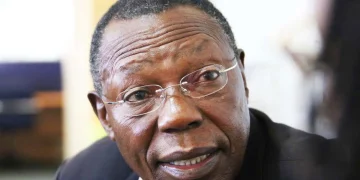
Ibrahim Babangida was born on August 17, 1941, in Minna, Nigeria. He received his military education in Nigeria, India, Great Britain, and the United States, equipping him with international training and modern combat strategies. Rising steadily through the ranks, Babangida gained a reputation for courage. In 1976, during an attempted coup, he famously entered a rebel-held radio station unarmed to quell the uprising, an act that cemented his place in military history.
His career advanced quickly. After Gen. Murtala Mohammed became military head of state in 1975, Babangida was appointed to the Supreme Military Council. He later played a role in the 1983 coup that toppled the civilian administration of Shehu Shagari, bringing Gen. Muhammadu Buhari to power.
Rise to Power and Governance
Discontent grew under Buhari’s restrictive regime, and in August 1985, Babangida staged a palace coup, assuming leadership as Nigeria’s head of state. His early years in power were marked by a promise of reform: he eased restrictions on the press, released political detainees, and projected an image of moderation.
Yet, Babangida inherited Nigeria’s deepening economic crisis. To stabilize the economy, he implemented an International Monetary Fund-backed structural adjustment program, which included the devaluation of the naira. While these policies won international support, they sparked domestic unrest, protests, and labor strikes. In response, Babangida dissolved parts of the Nigeria Labour Congress and temporarily shut down universities.
Political Transition and Challenges
Babangida pledged a return to civilian rule, initially setting the date for 1990 but later pushing it to 1992. To control the process, he banned established politicians and created two state-approved parties: the National Republican Convention and the Social Democratic Party (SDP).
In 1990 he survived a coup attempt led by Major Gideon Orkar, which called for secession of several northern states. The coup was swiftly crushed, reinforcing Babangida’s grip on power. That same year, Nigeria controversially suspended membership in the Islamic Conference Organization, amid debates over religious balance in politics.
Babangida also oversaw the historic relocation of Nigeria’s capital from Lagos to Abuja in 1991, a symbolic move to place the government in a more central and neutral location.
The 1993 Election and Annulment
On June 12, 1993, Nigerians voted in a presidential election widely regarded as the fairest in the country’s history. Early results showed Moshood Abiola of the SDP as the likely winner. However, Babangida abruptly annulled the election, citing irregularities. The decision provoked widespread outrage, protests, and international condemnation.
Under mounting pressure, Babangida stepped down in August 1993, handing power to an interim civilian government led by Ernest Shonekan. This transition was short-lived, as Gen. Sani Abacha soon seized power.
Regional Leadership and Legacy
Beyond Nigeria, Babangida reshaped the Economic Community of West African States (ECOWAS). Under his leadership, the bloc expanded beyond economics into peacekeeping, deploying the ECOMOG force to Liberia during its civil war in the early 1990s.
Though his presidency ended in controversy, Babangida remained an influential figure in Nigerian politics. In 2025, he released his autobiography, A Journey in Service, in which he expressed regret over annulling the 1993 election, acknowledging its long-lasting damage to Nigeria’s democratic journey.
Quick Facts
| Attribute | Details |
|---|---|
| Full Name | Ibrahim Babangida |
| Born | August 17, 1941, Minna, Nigeria |
| Age | 84 (as of 2025) |
| Title / Office | Head of State of Nigeria (1985–1993) |
| Political Affiliation | Military leadership (non-partisan) |
| Notable Works | A Journey in Service: An Autobiography (2025) |
| Key Events | 1985 coup, IMF reforms, 1990 Orkar coup attempt, annulment of 1993 election, Abuja capital relocation |
| Regional Role | Expanded ECOWAS into peacekeeping with ECOMOG in Liberia |