The government had been looking for an excuse to collect up all “the political undesirables” and begin implementing a system of disinheriting the leaders of their country, and the proclamation of a state of emergency provided it with just that.
On October 16, 1952, Oliver Lyttelton, the Secretary of State for Colonies at the time, informed Parliament that some measures were necessary to scare the Mau Mau when the topic of political repression surfaced in Britain a few days before the State of Emergency was declared in Kenya.
Lyttelton, cited in the Hansard, said that Mau Mau was a Kikuyu-only secret group that was a spinoff of the Kikuyu Central Association, which had been outlawed in the 1940s.
The Government enacted the Forfeiture of Lands Ordinance in 1953 in a cunning attempt to deter other Kenyans from advocating for independence, giving the Governor the authority to deliver a mortal blow to Kenyatta and his associates.
The Governor was given the authority to take land held by someone who had been found guilty of certain offenses under paragraph (ii) of sub-section 3 of the ordinance.
Baring seized 31.24 acres in Kiambu that belonged to Kenyatta by issuing government notice number 1444 in the exercise of these powers.
“Whereas Jomo Kenyatta, also known as Kamau s/o Muigai, was found guilty on April 8, 1953, by an acting resident magistrate in Kapenguria in Criminal case no. 1 of 1953, of the following offenses,” the setting apart order stated.
Managing the unlawful society known as Mau Mau, contrary to section 70 of the criminal code; Being a member of the said unlawful society pursuant to section 71(a) of the penal code, and was sentenced to seven years and with hard labor.
Furthermore, whereas the aforementioned offenses for which the aforementioned Jomo Kenyatta was found guilty are offenses covered under the 1953 Forfeiture of Lands Ordinance;
Thus, using the authority granted by paragraph ii of sub-section 3 of the Forfeiture of Lands Ordinance of 1953, I hereby issue the following directive:
That the area included in this order’s schedule, which is land that is a part of the Native Lands and in which the aforementioned Jomo Kenyatta has an interest, will be considered to be set aside in accordance with the provisions of the ordinance mentioned.
On October 2, 1954, Baring signed an order that affected four land lots with dimensions of 2.9 acres, 1.52 acres, 11.06 acres, and 15.76 acres. Every piece of land has its survey coordinates provided by a timetable created by the Kiambu DC.
Following the land’s alienation, the government invaded the Ichaweri lot where Kenyatta had built his house and began to tear it down, block by block.
After that, the blocks were transported to Gatundu town, where they were used to build a government residence for public workers in the compound that served as the divisional administration headquarters at the time.
As pressure mounted to free the imprisoned lawmakers, the destruction would later come back to harm the government, remembers former Commissioner of Police Bernard Njinu.
When the government failed to convince Kenyatta, who had already been elected KAU head in absentia and was set to be released, to relocate, Njinu was employed as an intelligence officer in Isiolo in 1961.
The government was prepared to build Kenyatta a new home because he was officially homeless and landless, but he insisted on staying in his previous residence and purchasing land in Ichaweri.
At the time, his wish to go back to Ichaweri in the Kimunyu sub-location was impractical since his land had been given to unidentified individuals.
Njinu describes how he was sent temporarily from Isiolo to help with the search effort.
“After I located him in Ngong, the government gave Jomo his land back.
Politicians Wafula Wabuge, John Keen, and Masinde Muliro were in Gatundu when I arrived from Isiolo, and they were frantically attempting to find Kenyatta’s farm. The trio’s mission was to see to it that a new home was built before to Kenyatta’s release.
Born in 1932, Njinu tells how he tracked out the mysterious benefactor, whose name he cannot recall.
Now that Kenyatta’s land dispute had been resolved, Njinu was faced with the more difficult duty of providing protection for the politicians while they oversaw the Ichaweri house’s rebuilding.
Njinu remembers clearly the day Kenyatta was freed on August 14, 1961, driven home with his pregnant wife Mama Ngina and taken in a police plane from Malaral to Kahawa after all the preparations were finished. After the controversial 2007 General Elections, Kenya’s Deputy Prime Minister and Gatundu South MP since 2002 was born, and the infant was subsequently christened Uhuru.
“There was a great deal of concern in Gatundu when Kenyatta came. He did not sit well with certain White people. They were afraid he would rally his followers to remove them. According to Njinu, the homeguards were also afraid that Kenyatta would punish them for working with his jail guards.
One such accomplice, Ndung’u Kagoi from Gatanga, is said to have screamed to the inanimate radio as he struck it with his walking stick upon learning of Kenyatta’s release.
“Wanjirire ndakarekio gaka gatutu gaka githi towe wandira magego wanjiira niarekio? Ndigithiria em teoria!Are you not the one who informed me that Kenyatta had been imprisoned for life and that he was now free? This thing (radio)? Give stop spreading rumors!).
Barbed wire was installed to protect busloads of joyous Kenyans from harming Kenyatta as they relentlessly flowed into Gatundu to pay their respects.
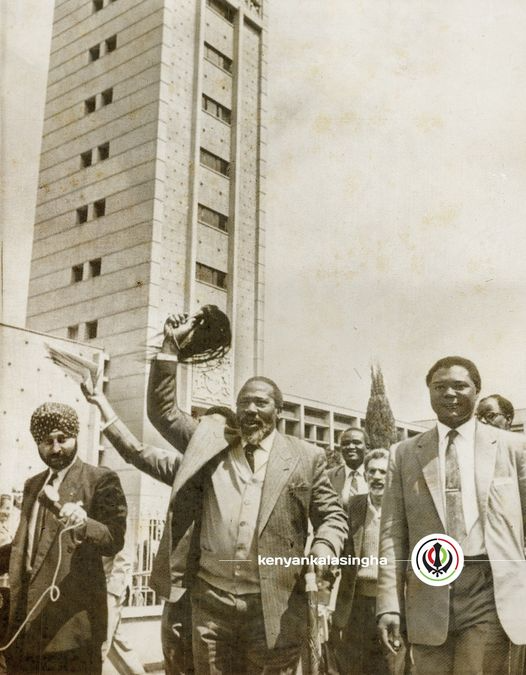
I had no idea who could hurt him at the moment. Njinu explains, “I wasn’t supposed to let visitors in.” “Kenyatta would address the enormous crowd from his side of the fence, waving his flywhisk, while donning his signature leather jacket.”
Njinu had no idea that his task of keeping an eye on Kenya’s most endearing politician was only getting started. Furthermore, he had no way of knowing that he would eventually reside in the very home that the colonialist had built using Kenyatta’s stones.
He learned that he was expected to report at Kenyatta’s house every morning when he was subsequently assigned to be a member of the Presidential Escort in 1964.
His house in Karatu, which is around 10 kilometers from Gatundu town, was out of business as a result. In the administrative center of Gatundu, a home was assigned to him.
However, once Kenyatta gave him the order to leave the larger house for a doctor, Njinu was compelled to move into the home built with his stones.
“Kenyatta gave me the order to relocate inside the home he built with his stones. Naturally, he was aware of its past, but he never raised the subject because, as Njinu remembers, “he had the characteristic attitude of forgiving but never forgetting.”
For the most of his 14-year career, Njinu commuted from that home, first serving as a member of the Presidential Escort and then leading it until Kenyatta’s death on August 22, 1978.
Following the attempted coup in 1982, the Presidential Escort Commander was appointed Commissioner of Police four years after Kenyatta’s passing.