Oginga Odinga was, certainly, the doyen of opposition politics in the colonial and the post-independence eras. Since the colonial days, he was noted for his political and ideological steadfastness.
Odinga led with courage. In contrast to many politicians, Jaramogi, as his supporters called him, was unwilling to sacrifice his principles, no matter the cost. As Minister of Home Affairs, he served in the first Cabinet after independence in 1963. Following Kenya’s independence in 1964 and Kenyatta’s election as president, Odinga was named vice president and minister of home affairs. However, he resigned in 1966 after having a disagreement with the President.
It’s true that Odinga entered opposition politics at a young age. Being the first vice-president of Kanu to be suspended in 1961 for “making statements with communistic tendencies and supporting non-Kanu candidates and the Kenya Action Group,” he created history.
The suspension was declared by Kanu chairman James Gichuru following a one-hour meeting with Secretary-General Tom Mboya.
Odinga thought the greatest way to help the impoverished was through socialism. He referred to it as “equalization of opportunities” and urged the wealthy to give the impoverished a helping hand.
He was born in 1911 and attended Maseno and Alliance schools. His strongest courses were math and history. He played hockey for his school when the sport was established at Maseno. After that, he enrolled at Makerere College to earn an education diploma. Walter Odede, Kenya’s first veterinary scientist, and Godfrey Binaisa, who rose to become Uganda’s Attorney-General and then acting President, were among his colleagues at Makerere.
Following his time at Makerere, Odinga was hired as a teacher at Maseno, his former school, where the well-known Carey Francis served as principal. Odinga, who had graduated, had intended to go to Britain to further his study, but Carey Francis advised him, saying, “The education you have is enough and you should now use it to help those who have none.”
The Odinga rebel emerged early. He objected to the usage of Christian names while he was a teacher at Maseno and chose Ajuma instead of his biblical name, Adonijah. Oginga son of Odinga was his preference. Carey Francis described his former student as “discontented with life and grumbling at everything” when he departed Maseno, indicating that his affection for Odinga had diminished.
This was in contrast to a previous letter from Francis’ mother, which expressed optimism about Adonijah’s future and predicted that he would become a great man. Odinga would write: “I loved teaching mathematics and the students knew that I placed no limit on the time I would spend helping them to solve problems” in his autobiography, Not Yet Uhuru. I assumed the title of Master of Mathematics. I informed the pupils that the Bible is comparable to an arithmetic problem after hearing that even my sermons were mathematical. The pursuit of a solution is paramount.
Odinga left Maseno after three years to take a position as principal of the Veterinary School, a position he held for four years. After quitting, he established the Luo Thrift and Trading Corporation to try his hand at entrepreneurship. The Luo Union movement was also founded by Odinga and his associates in an effort to bring their people together across East Africa.
Later on, he entered politics and won election to serve on the Sakwa Location Advisory Council and the Nyanza African District Advisory Council, positions he held from 1947 to 1949. Odinga was originally introduced to Kenyatta by Achieng’ Oneko in 1948. In June of 1952, he had another meeting with Kenyatta before heading to a public protest held by KAU.
On October 20, 1952, three months later, a State of Emergency was proclaimed, and 183 KAU leaders were taken into custody.
There were indications during the Emergency that Odinga would also be taken into custody. However, he managed to live, mostly due to his position as chairman of Luo Union East Africa and Luo Thrift and Trading Corporation. But one night, he was taken up by security guards from his Kisumu residence, and they took him to the woods to question him.He had recently returned from Prime Minister Jawaharlal Nehru’s formal visit to India. There were rumors that he had purchased weapons to oppose the colonial authority.
Among those advocating for the release of the imprisoned Kapenguria was Odinga. Six liberation warriors, among them Kenyatta. According to Odinga, Kenyans and their leaders could only unify behind a single leader if meaningful independence was attained. As the liberation fighters were detained, their allies put pressure on the colonial rulers to liberate them and grant Kenyans independence.
Odinga was one of eight Africans elected to the Legislative Council in 1957; the body had been a political stronghold for white settler interests. Afterwards, they established the African Elected Members Organization, with Mboya serving as secretary and Odinga as chairman. Joseph Muimi, Muliro, Ngala, Lawrence Oguda, Bernard Mate, and Moi were the others.
When Kanu was established in 1960, Odinga was chosen to serve as vice president, Gichuru president, and secretary general for Mboya.
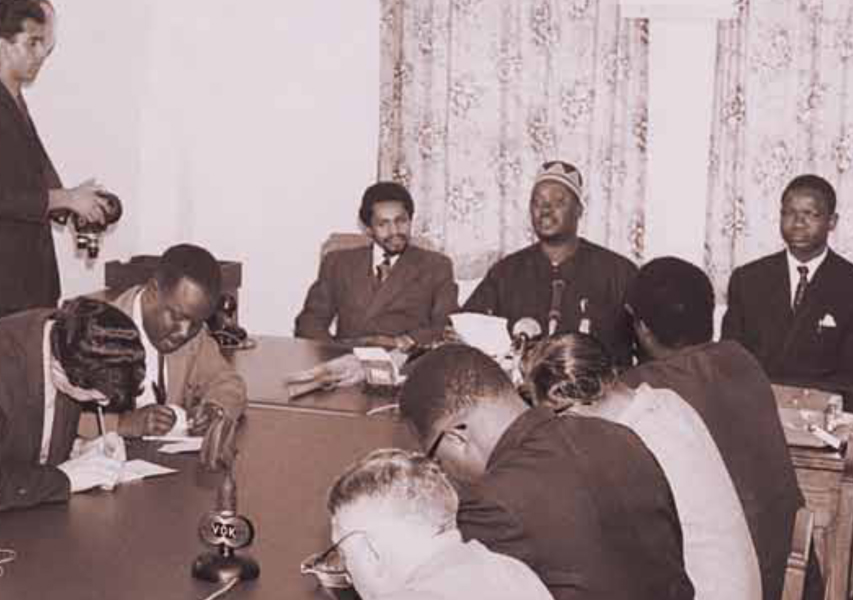
However, disagreements within Kanu reached a breaking point in 1966 when the party’s constitution was altered to allow for eight vice presidents, one for each of the eight provinces, as opposed to only one. Odinga’s wings were clipped into this shape. Moi from the Rift Valley, Gichuru from Central, Kibaki from Nairobi, Lawrence Sagini from Nyanza, Eric Khasakhala from Western, Jeremiah Nyagah from Eastern, and Mohamud Jubat from North-Eastern were the vice presidents. Odinga, though, could not stand it. He left Kanu, created the KPU, and resigned as vice president of the nation and the party. Oneko, the Minister of Information, Broadcasting, and Tourism, and Bildad Kaggia, the MP for Kandara and former prisoner who was chosen as the vice-president of the KPU, were among others who defected alongside him.
After that, Odinga and Kenyatta’s relationship deteriorated until it reached a breaking point in 1969 when they fought at a public event in Kisumu during the inauguration of the Nyanza Provincial General Hospital, which was supported by the Union of Soviet Socialist Republics, also known to the locals as “Russia.”
Odinga and his KPU comrades were detained after KPU supporters stoned the presidential motorcade, resulting in the presidential guard killing many people. In 1971, he was freed from prison and reunited with Kanu. But his problems persisted. He was prohibited from running for the Kanu vice-chairmanship in 1977 during scheduled elections, which were abruptly postponed.
Odinga was named head of the Cotton Lint and Seed Marketing Board in 1980 after Moi assumed leadership following Kenyatta’s death in 1978. This was interpreted as Moi’s attempt to warm Odinga back into the political fold. However, the honeymoon was short-lived. At a public demonstration in Mombasa, the opposition leader expressed his opinions and caused controversy by calling Kenyatta “a land grabber.”
His detractors and leaders from all fields raised a clamor. He was kicked off the board by Moi. When Odinga was expelled from Kanu in May 1980, the President claimed that his foreign travels had damaged the reputation of the Government.In the 1980 by-election, Odinga would have returned to Parliament if his friend and Bondo MP Hezekiah Ougo had resigned in favor of him. However, Moi required Kenyatta’s followers’ complete backing as he was cementing his position at the time of the contentious comment.
In an attempt to challenge Kanu, Odinga and the vocal Kitutu Masaba MP George Anyona were creating a party in 1982.
After being kicked out of Kanu, the two publicly expressed their frustration at being left out of the political spotlight. However, Kanu put a stop to their intentions when Kenya became a one-party state when the Constitution was changed. Odinga’s son Raila and Anyona were held without being given the opportunity to face charges, and Odinga was put under house arrest. Odinga was barred from political participation and kept out of politics for ten more years after being expelled from the sole registered party.
The dean of oppositionists declared his plan to create an opposition party in 1990 during an international news conference. Odinga made an unsuccessful effort to register the National Democratic Party (NDP) in February 1991. The result was the creation of the well-liked pressure organization Forum for the Restoration of Democracy (Ford) among Kenyans. The 1982 legislation that had made Kenya a one-party state was revoked in December 1991, and Ford and other parties were registered under the temporary chairmanship of Odinga.
However, Ford divided into two groups in 1992: Ford-Asili, led by former Cabinet Minister and Kiharu MP Kenneth Matiba, and Ford-Kenya, led by Odinga. The opposition parties, including Mwai Kibaki’s Democratic Party, were defeated by Moi’s Kanu in that year’s general election. Odinga placed fourth, Kibaki third, and Matiba second. However, he returned to the august House after a 23-year absence when he was elected as the MP for Bondo.
When asked in 1959 what he thought of trade unionist-turned-politician Tom Mboya, who was then serving as the Legco member for Nairobi, Odinga said, “He is a very brilliant young man who might break his neck quickly because of his flamboyance!” to a visiting British journalist.
The seasoned politician claimed to be a democracy and to be able to disagree with both allies and adversaries, but he did not harbor resentment. His aides recall him scolding his son Raila in 1993 for defying Kanu’s choice to run against Ford-Kenya in Mombasa’s Kisauni by-election. “There is no reason Kanu should not field a candidate against Ford-Kenya because politics is like football — the best team wins!” said the elder Odinga. As of the now, Raila is prime minister. Oburu Oginga, the older son of Odinga, served as the Assistant Minister of Finance.
The Leader of the Official Opposition in Parliament, Odinga, seemed to sense that his time had come when he gave a farewell speech to Parliament on December 9, 1993, just before lawmakers left for the Christmas break. He said, “I want to leave you (MPs) with one thing: Please make this House responsible.” I want Kanu, our people on the other side, to take responsibility for this House as well. Kenya is our home, and we should not mistreat it.
Odinga was buried at his remote Bondo home after passing away in January 1994. He had seventeen offspring and four spouses.