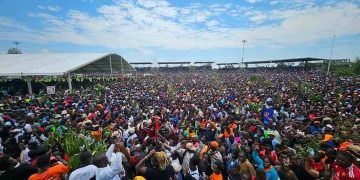
It has been 48 years since Kenya entered one of the most emotional moments in its national history following the death of founding president Mzee Jomo Kenyatta on August 22, 1978. Kenya Remembers Jomo Kenyatta 48 Years After His Death
Historic images from that period continue to capture the atmosphere of grief, uncertainty, and national reflection that swept across the country as Kenyans mourned the man widely regarded as the “Father of the Nation.”
Photographs showing Kenyatta lying in state remain among the most iconic images in Kenya’s political history.
Read Also: Rare 1939 Photo Shows Jomo Kenyatta in England Garden
Kenya’s First President
Jomo Kenyatta[a] (c. 1897 – 22 August 1978) was a Kenyan anti-colonial activist and politician who governed Kenya as its Prime Minister from 1963 to 1964 and then as its first President from 1964 to his death in 1978. He played a significant role in the transformation of Kenya from a colony of the British Empire into an independent republic. Ideologically an African nationalist and a conservative, he led the Kenya African National Union (KANU) party from 1961 until his death.
Jomo Kenyatta led Kenya through its transition from British colonial rule to independence in 1963.
After first serving as prime minister, he later became the country’s first president and remained in office until his death in 1978.
During his presidency, Kenya focused on:
- nation-building,
- economic development,
- expansion of public institutions,
- and maintaining political stability during the early post-independence years.
For many Kenyans, Kenyatta symbolized independence, unity, and the beginning of self-rule after decades of colonial administration.
National Mourning in 1978

News of Kenyatta’s death shocked the country and triggered a period of official national mourning.
Thousands of Kenyans gathered in Nairobi and across the country to pay tribute to the late president, while international leaders sent condolences to Kenya.
The body of the president was placed in state as government officials, diplomats, military officers, religious leaders, and ordinary citizens lined up to honor him.
The funeral ceremonies became one of the largest state events ever witnessed in Kenya at the time.
Read Also:How “Facing Mount Kenya” Became Jomo Kenyatta’s Landmark Book
A Historic Political Transition
Kenyatta’s death also marked a major political turning point in Kenya’s history.
Following constitutional procedures, then Vice President Daniel arap Moi assumed the presidency, beginning a new political era that would shape Kenya for the next 24 years.
The peaceful transfer of power following Kenyatta’s death became one of the defining moments in Kenya’s early post-independence political development.
Images That Became Part of National Memory
Photographs from the 1978 mourning period continue to hold strong emotional and historical significance.
They document:
- the public grief surrounding Kenyatta’s death,
- the transition between political eras,
- and the symbolic end of Kenya’s founding presidency.
For younger generations, such images offer a visual connection to one of the most important chapters in the country’s modern history.
Kenyatta’s Lasting Legacy
Nearly five decades later, Jomo Kenyatta remains one of the most influential figures in Kenyan history.
His name continues to be associated with:
- Kenya’s independence struggle,
- the formation of the republic,
- African nationalism,
- and the rise of one of East Africa’s most influential political families.
The images of August 1978 therefore remain not only historical records, but also enduring symbols of Kenya’s national journey.