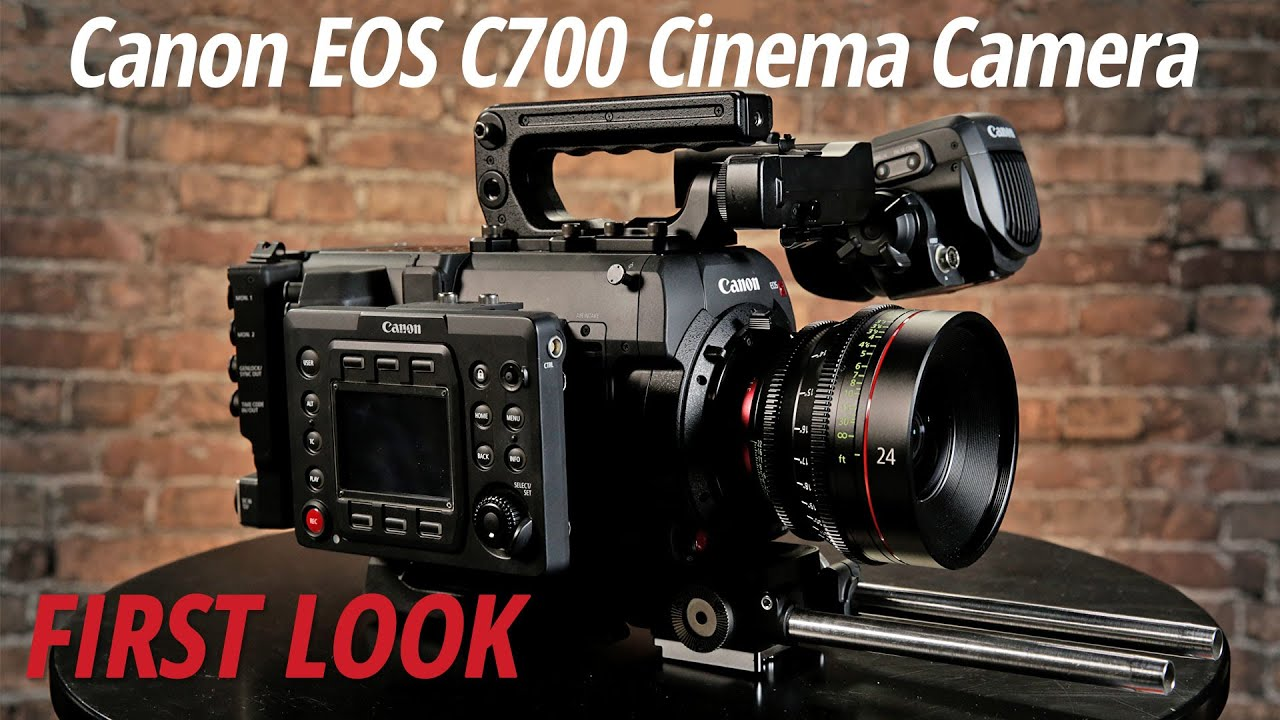
Canon EOS C700 is a professional Super 35 cinema camera designed for high-end film, television, commercial, broadcast and studio production.
Released in the 2016 production cycle, the EOS C700 became Canon’s flagship Cinema EOS camera before the later full-frame C700 FF arrived. It was built for productions that needed a serious A-camera body, professional connections, high-quality codecs, RAW support and flexible lens-mount options.
The camera uses a Super 35mm CMOS sensor with a 28.9 x 15.2 mm active image area. It supports 4K DCI, 4K UHD, 2K DCI and HD recording formats. Depending on configuration and workflow, the C700 can record internally in XF-AVC or ProRes, while Canon RAW recording requires the CODEX capture drive system.
The EOS C700 is now an older and discontinued Cinema EOS model, but it remains important in Canon’s cinema camera history because it showed Canon’s ambition to compete directly in the professional production camera market.
Key Canon EOS C700 Specifications
The Canon EOS C700 was built as a production camera rather than a compact handheld cinema body. Its design focuses on professional workflows, studio integration and reliable set operation.
| Feature | Canon EOS C700 |
|---|---|
| Release period | December 2016 market cycle |
| Camera type | Professional Super 35 cinema camera |
| Sensor type | Super 35mm CMOS |
| Sensor size | 28.9 x 15.2 mm |
| Effective 4K resolution | 4096 x 2160 |
| Lens mount options | EF or PL |
| Base sensitivity | ISO 800 |
| Image processor | Triple DIGIC DV 5 |
| Main recording formats | Canon RAW, XF-AVC, ProRes |
| Internal media | CFast 2.0 cards |
| Proxy media | SD card |
| RAW recording | CODEX capture drive workflow |
| Body weight | About 3.4kg |
| Dimensions | About 327 x 154 x 167 mm |
| Built-in ND filters | Up to 10 stops |
| Dynamic range claim | Up to 15 stops with Canon Log 2 |
The EOS C700 was not designed for casual creators. It was made for professional crews that needed a rugged cinema body with proper inputs, outputs, monitoring tools and post-production flexibility.
Super 35mm Sensor and Image Quality
The Canon EOS C700 uses a Super 35mm sensor measuring 28.9 x 15.2 mm.
Super 35 has long been one of the most popular formats in digital cinema. It gives filmmakers a familiar field of view, strong lens compatibility and a cinematic image without requiring full-frame or large-format lens coverage.
The camera records 4K DCI at 4096 x 2160, which is the main cinema 17:9 format. It also supports 4K UHD at 3840 x 2160 for standard 16:9 broadcast and streaming delivery.
Why Super 35 Still Matters
Super 35 remains useful because many cinema lenses were built for this format.
Compared with full-frame cameras, Super 35 can make lens choices easier and more affordable. It can also help productions use classic cinema glass, broadcast zooms, PL primes and EF lenses without worrying about full-frame coverage.
For film crews, the format is familiar, practical and still widely respected.
Recording Formats
The Canon EOS C700 supports several core recording formats.
| Recording Format | Resolution |
| 4K DCI | 4096 x 2160 |
| 4K UHD | 3840 x 2160 |
| 2K DCI | 2048 x 1080 |
| HD | 1920 x 1080 |
These options make the camera flexible for cinema, broadcast, documentary, studio and post-production workflows.
A feature film may choose 4K DCI or RAW for maximum quality. A television production may choose 4K UHD or HD. A broadcast crew may use XF-AVC or ProRes because those formats integrate more easily into existing editing systems.
Canon RAW and CODEX Workflow
Canon EOS C700 supports Canon RAW recording through a CODEX capture drive system.
This RAW workflow allows the camera to record high-quality image data for professional grading, VFX and finishing. RAW gives colourists more control over exposure, white balance, colour response and highlight recovery compared with standard compressed codecs.
Canon’s specification lists RAW recording options through the CDX-36150 capture drive, including 4K RAW and high-frame-rate options.
Why RAW Matters
RAW recording is valuable when image quality and post-production control matter most.
It is useful for:
Feature films
High-end commercials
Music videos
VFX-heavy productions
HDR projects
Colour-critical studio work
However, RAW also requires more media, more storage and stronger post-production planning. That is why the EOS C700 also supports XF-AVC and ProRes for productions that need easier workflows.
XF-AVC Internal Recording
The Canon EOS C700 records XF-AVC internally to CFast 2.0 cards.
XF-AVC is Canon’s professional codec designed for strong image quality and manageable file sizes. The camera supports up to 4K internal recording at high bitrates, making it suitable for broadcast, documentary and commercial workflows.
XF-AVC is especially useful when productions need a reliable format that balances image quality, editability and storage efficiency.
XF-AVC Use Cases
XF-AVC is a practical choice for:
Broadcast television
Corporate films
Documentaries
Interviews
Commercial shoots
Long-form production
Studio recording
It is more efficient than RAW and easier to manage on many editing systems.
ProRes Workflow
Canon EOS C700 also supports ProRes recording.
ProRes remains a popular production codec because it is widely supported by editing software, post-production houses and broadcast workflows. It gives crews a familiar format that can move quickly from camera to edit.
The EOS C700 supports ProRes workflows through internal and CODEX-based options depending on mode and setup.
For productions that want fast turnaround without sacrificing too much quality, ProRes can be a strong choice.
Dynamic Range and Canon Log 2
Canon lists the EOS C700 with up to 15 stops of dynamic range when using Canon Log 2.
Canon Log 2 is designed to preserve as much image information as possible for grading. It creates a flat image that needs post-production but gives colourists more room to shape contrast, shadows, highlights and colour.
Canon also lists Wide DR and Canon Log options for productions that need faster workflows or less intensive grading.
Dynamic Range Test Status
The pasted lab dataset lists dynamic range as not tested for the Canon EOS C700.
That means the camera should not be ranked against lab-tested models using that specific dataset. Canon’s own specification still positions the camera as a high-dynamic-range production tool, especially when using Canon Log 2.
For serious projects, cinematographers should test the camera under their own lighting conditions before production.
Rolling Shutter Test Status
The pasted dataset also lists rolling shutter as not tested.
That means there is no lab measurement in that dataset for comparing the EOS C700 directly with newer Canon, Sony, RED or ARRI models.
In real production, rolling shutter performance depends on frame rate, sensor readout mode, camera movement and subject motion. Crews planning fast pans, handheld action or sports-style work should test the camera before committing to a major shoot.
EF and PL Mount Options
The Canon EOS C700 was offered in both EF and PL mount versions.
The EF version supports Canon EF lenses and Dual Pixel CMOS AF. This makes it useful for documentary, event, commercial and smaller production teams using Canon glass.
The PL version is aimed at traditional cinema production. PL lenses are common in feature films, commercials and rental-house workflows. The PL version also supports Cooke /i metadata technology, which helps productions record lens information for post-production and VFX.
Which Mount Is Better?
The better mount depends on the production.
EF mount is better for users who own Canon EF lenses, want autofocus support or need a more flexible documentary-style setup.
PL mount is better for crews using cinema primes, anamorphic lenses, professional zooms and traditional focus-puller workflows.
Built-In ND Filters
The Canon EOS C700 includes built-in ND filters with up to 10 stops of control.
Built-in ND filters are a major advantage over many mirrorless and DSLR cameras. They allow cinematographers to control exposure without changing shutter angle, aperture or ISO unnecessarily.
This helps maintain consistent motion blur and depth of field, especially when shooting outdoors or under strong studio lights.
Why Built-In ND Matters
Built-in ND filters save time on set.
Instead of adding external filters to each lens, operators can adjust exposure from the camera body. This is useful for documentaries, interviews, commercials, live production and location shoots where lighting can change quickly.
Professional Body and Connectivity
The Canon EOS C700 is a large production camera.
Its body weighs about 3.4kg and measures about 327 x 154 x 167 mm. This makes it much larger than compact Cinema EOS cameras such as the C200, C300 Mark III or C500 Mark II.
The size supports a professional production layout. The camera includes SDI outputs, HDMI, timecode, Genlock, audio inputs, remote connections, Ethernet and support for an optional OLED viewfinder.
Why the Large Body Makes Sense
The EOS C700 was not designed as a small solo-shooter camera.
It was built for crews using follow-focus systems, matte boxes, shoulder rigs, studio power, external monitors, wireless video, V-mount batteries and professional audio.
For large productions, the body layout can be an advantage because it fits established cinema and broadcast workflows.
Slow and Fast Motion
Canon’s specifications list slow and fast motion options from 1fps to 240fps depending on recording mode and setup.
The camera can record high-frame-rate RAW through CODEX workflows and cropped 2K modes. This makes it useful for action, commercial product shots, sports-style motion and dramatic slow-motion sequences.
High-frame-rate recording requires careful planning because media and storage demands increase quickly.
Monitoring and Exposure Tools
The Canon EOS C700 includes professional monitoring tools such as waveform monitor, false colour, peaking, zebras and markers.
These tools help camera operators and cinematographers judge exposure, focus and framing accurately on set.
False colour is useful for exposure control. Peaking helps with manual focus. Markers help crews frame for different aspect ratios. Waveform monitoring helps ensure highlights and shadows stay within the intended range.
These tools separate the C700 from basic hybrid cameras and make it more suitable for professional crews.
Audio and Production Workflow
The EOS C700 includes professional audio support, including XLR inputs and 24-bit audio recording in internal and capture-drive workflows.
This matters for documentaries, interviews, broadcast and studio productions where clean audio is essential.
The camera also supports timecode and Genlock, making it suitable for multi-camera setups, studio environments and synchronized production.
Canon EOS C700 vs C700 FF
The Canon EOS C700 and C700 FF are closely related but use different sensors.
The EOS C700 uses a Super 35 sensor and records up to 4K DCI. The later EOS C700 FF uses a full-frame sensor and supports 5.9K RAW.
The C700 FF offers a larger sensor and higher resolution, while the original C700 may be more practical for productions using Super 35 lens packages.
For crews with existing Super 35 PL or EF lenses, the original EOS C700 can still make sense.
Canon EOS C700 vs C200
The EOS C700 and EOS C200 serve different production levels.
The EOS C200 is smaller, lighter and more suitable for solo shooters or small crews. It records Cinema RAW Light internally and is easier to carry for documentaries, weddings and independent filmmaking.
The EOS C700 is larger, more connected and built for professional sets. It offers more production tools, better studio integration and stronger support for CODEX, ProRes, XF-AVC and broadcast-style workflows.
The C200 is easier to own. The C700 is more of a production-house or rental-camera system.
Price and Availability
The Canon EOS C700 is now discontinued in Canon’s older Cinema EOS product listings.
Availability depends on used-market supply, rental-house inventory and remaining dealer stock. Because it was originally a flagship cinema camera, buyers should also consider the cost of accessories, CODEX recording, media, batteries, viewfinders, shoulder rigs and storage.
For many filmmakers today, renting the EOS C700 may be more practical than buying it.
Who Should Use the Canon EOS C700?
The Canon EOS C700 is best suited for professional crews that need a full production camera rather than a compact creator body.
It makes sense for:
Feature films
Television drama
Studio production
Broadcast workflows
Commercial shoots
High-end documentaries
Rental houses
Multi-camera setups
PL or EF cinema lens users
Crews needing SDI, timecode and Genlock
It is not the best camera for casual users, travel creators, small YouTube teams or anyone who needs a lightweight run-and-gun setup.
Key Takeaways
- Canon EOS C700 was released in the 2016 production cycle.
- It uses a Super 35mm CMOS sensor measuring 28.9 x 15.2 mm.
- The camera records 4K DCI, 4K UHD, 2K DCI and HD.
- Lens mount options include EF and PL.
- Canon RAW recording uses a CODEX capture drive workflow.
- Internal recording supports XF-AVC and ProRes.
- Canon lists up to 15 stops of dynamic range with Canon Log 2.
- The pasted lab dataset lists dynamic range as not tested.
- Rolling shutter is also listed as not tested in the pasted dataset.
- The camera includes built-in ND filters with up to 10 stops.
- It uses CFast 2.0 cards for internal recording.
- The body weighs about 3.4kg.
- The camera supports professional SDI, timecode, Genlock and audio workflows.
- Canon now lists the EOS C700 among discontinued Cinema EOS products.
Frequently Asked Questions
What is the Canon EOS C700?
The Canon EOS C700 is a professional Super 35 Cinema EOS camera designed for film, television, broadcast, studio and commercial production.
When was the Canon EOS C700 released?
The Canon EOS C700 belongs to Canon’s 2016 Cinema EOS lineup, with market availability listed around December 2016.
What sensor does the Canon EOS C700 use?
It uses a Super 35mm CMOS sensor with a 28.9 x 15.2 mm active image area.
What is the maximum recording format?
The main listed recording formats include 4K DCI at 4096 x 2160, 4K UHD at 3840 x 2160, 2K DCI and HD.
Does the Canon EOS C700 record RAW?
Yes. The camera supports Canon RAW recording through a CODEX capture drive workflow.
Does the Canon EOS C700 record internally?
Yes. It records XF-AVC and ProRes internally to CFast 2.0 cards, depending on the mode.
What lens mounts are available?
The EOS C700 was offered in EF and PL mount versions.
Does the Canon EOS C700 have autofocus?
The EF version supports Canon Dual Pixel CMOS AF. PL mount production workflows normally rely on manual focus and cinema lens control.
What is the dynamic range of the Canon EOS C700?
Canon lists up to 15 stops of dynamic range with Canon Log 2. The pasted lab dataset lists dynamic range as not tested.
Is the Canon EOS C700 still worth using?
Yes, it can still be useful for professional crews that need a Super 35 production camera with Canon colour, RAW support, XF-AVC, ProRes, SDI, timecode, Genlock and EF or PL mount options.
Conclusion
The Canon EOS C700 remains one of Canon’s most ambitious Super 35 cinema cameras.
It was built as a true production camera with 4K DCI recording, Canon RAW support, XF-AVC, ProRes, Canon Log 2, EF and PL mount options, built-in ND filters and professional connectivity.
Although newer Canon cinema cameras are smaller, lighter and more modern, the EOS C700 still has value in professional environments where Super 35 lenses, robust body design and established cinema workflows matter. It stands as a major step in Canon’s effort to compete in high-end digital cinematography.
Read Also: Canon EOS C200: Specs, Sensor, Dynamic Range and Cinema RAW Light Features