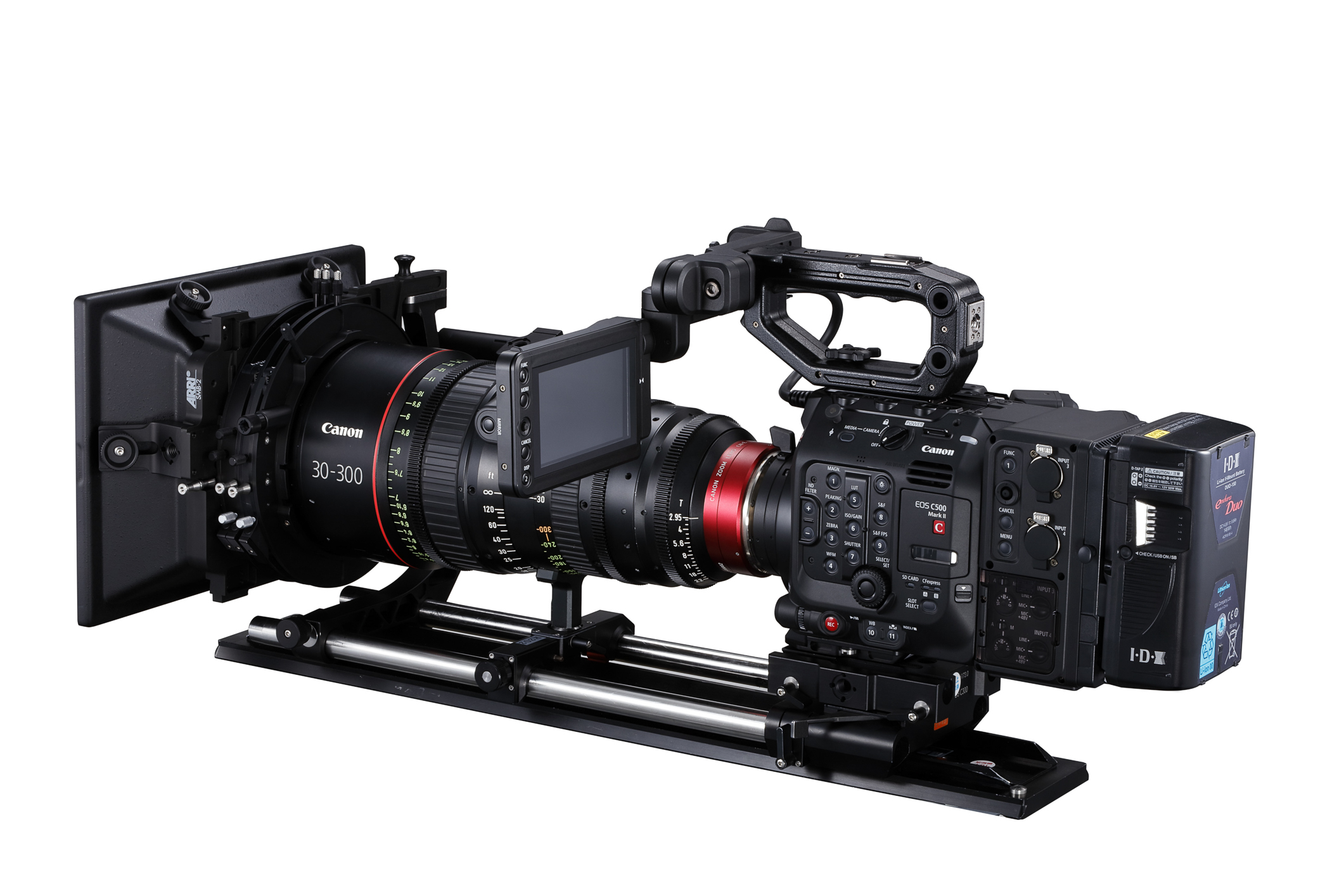
Canon EOS C500 Mark II is a professional full-frame Cinema EOS camera built for filmmakers, production companies, documentary crews and commercial cinematographers who need high-end image quality in a compact modular body.
Released in December 2019, the camera brought Canon’s 5.9K full-frame cinema sensor into a smaller and more flexible body than earlier high-end Cinema EOS systems. It supports internal Cinema RAW Light recording, Canon Log 2, Canon Log 3, XF-AVC, dual CFexpress cards, interchangeable lens mounts and a modular design for different shooting styles.
The camera sits above hybrid mirrorless bodies and below larger dedicated studio systems. It is designed for serious productions that need RAW recording, strong colour science, reliable ergonomics and cinema-focused connectivity.
For filmmakers who want Canon’s full-frame look, 5.9K capture and professional recording formats, the EOS C500 Mark II remains an important camera even years after launch.
Key Canon EOS C500 Mark II Specifications
The Canon EOS C500 Mark II combines a full-frame cinema sensor with internal RAW recording and a compact production-ready body.
| Feature | Canon EOS C500 Mark II |
|---|---|
| Release period | December 2019 |
| Camera type | Professional full-frame cinema camera |
| Sensor size | 38.1 x 20.1 mm |
| Maximum recording resolution | 5.9K, 5952 x 3140 |
| Lens mount | EF standard, PL optional |
| Base sensitivity | ISO 800 |
| Main codecs | Cinema RAW Light and XF-AVC |
| Log profiles | Canon Log 2 and Canon Log 3 |
| Main media | Dual CFexpress cards |
| Proxy media | SD card slot |
| Weight | About 1.8kg body class |
| Dimensions | About 168 x 148 x 153 mm |
| Listed European price context | Around €6,199 excluding VAT, depending on retailer and stock |
The EOS C500 Mark II is best understood as a compact cinema camera rather than a mirrorless hybrid. Its value is in RAW recording, dynamic range, modularity and professional workflow support.
Full-Frame 5.9K Sensor
The Canon EOS C500 Mark II uses a full-frame 35mm sensor with a 38.1 x 20.1 mm active image area.
Its main recording format is 5.9K at 5952 x 3140 in a 17:9 aspect ratio. This gives filmmakers more resolution than standard 4K, allowing for oversampled 4K output, reframing, stabilization and VFX-friendly capture.
The sensor also supports different crop modes, including Super 35 and Super 16. That helps productions use different lens types and match older cinema workflows when needed.
Why the 5.9K Sensor Matters
A 5.9K sensor gives filmmakers flexibility.
Productions can shoot at full resolution and deliver in 4K with cleaner detail. The extra resolution also helps when stabilizing handheld footage, cropping for different aspect ratios or creating visual effects plates.
For cinema work, the large sensor also creates a more immersive look with wider field of view and shallower depth of field when paired with suitable lenses.
Cinema RAW Light Recording
One of the most important features of the Canon EOS C500 Mark II is internal Cinema RAW Light recording.
The camera records 5.9K Cinema RAW Light internally to CFexpress cards. This gives filmmakers much more control in post-production than standard compressed video formats.
RAW recording helps colourists adjust exposure, white balance, highlight recovery and colour response with greater flexibility. It is especially useful for commercials, music videos, feature films, high-end documentaries and productions that need detailed colour grading.
Cinema RAW Light Modes
The camera supports several Cinema RAW Light options.
| Format | Resolution | Frame Rates | Bit Depth |
| 5.9K Cinema RAW Light | 5952 x 3140 | Up to 59.94p | 10-bit or 12-bit depending on frame rate |
| 5.9K Cinema RAW Light HQ | 5952 x 3140 | Up to 29.97p | 12-bit |
| 5.9K Cinema RAW Light ST | 5952 x 3140 | Up to 59.94p | 12-bit |
| 5.9K Cinema RAW Light LT | 5952 x 3140 | Up to 59.94p | 12-bit |
These options give productions a choice between maximum image quality and more efficient file sizes.
XF-AVC and 4K Workflows
The Canon EOS C500 Mark II also supports XF-AVC recording.
XF-AVC is more practical than RAW for many productions because it creates smaller files and easier editing workflows. The camera records 4K 4:2:2 10-bit XF-AVC, which is strong enough for broadcast, documentary, corporate, commercial and streaming work.
For projects that need fast turnaround, XF-AVC may be a better option than RAW. It still preserves good colour information while reducing storage pressure.
5.9K Oversampling for 4K
The EOS C500 Mark II can oversample from the 5.9K sensor to produce detailed 4K images.
Oversampling helps reduce noise, improve sharpness and create a cleaner 4K image than a simple native 4K readout. This is one reason the camera remains attractive for professional 4K delivery.
Dynamic Range Performance
Canon claims the EOS C500 Mark II can deliver more than 15 stops of dynamic range.
Independent CineD testing measured 13.1 stops at SNR=2 in full-frame 4K XF-AVC at ISO 800 using Canon Log 2. At SNR=1, the result was measured at 14 stops, with a wider patch range.
This is strong performance for a production camera. It gives filmmakers room to protect highlights and retain shadow information in demanding lighting conditions.
Why Canon Log 2 Matters
Canon Log 2 is designed to preserve maximum dynamic range.
It produces a flat image that needs colour grading, but it gives editors and colourists more control over contrast, highlights, shadows and colour. For high-end productions, Canon Log 2 is usually the preferred option when dynamic range matters most.
Canon Log 3 is easier to grade and can be useful for faster workflows, but Canon Log 2 offers more flexibility when the production team has time for proper post-production.
Rolling Shutter Performance
Rolling shutter is important for filmmakers because it affects fast movement and camera pans.
CineD measured the Canon EOS C500 Mark II at 15.8ms rolling shutter in full-frame 5.9K Cinema RAW Light at 25fps. That is a strong result for a full-frame cinema camera of its generation.
In practical use, this means the camera handles motion better than many hybrid cameras and some larger-sensor systems. Fast whip pans and extreme movement can still show rolling shutter effects, but the C500 Mark II performs well for narrative, documentary, commercial and controlled handheld work.
Recording Formats
The Canon EOS C500 Mark II supports multiple recording formats for different production needs.
| Recording Format | Resolution |
| Full Frame 5.9K | 5952 x 3140 |
| Full Frame 4K DCI | 4096 x 2160 |
| Full Frame 4K UHD | 3840 x 2160 |
| Full Frame 4:3 | 4192 x 3140 |
| Full Frame 6:5 | 3768 x 3140 |
| Full Frame 2K | 2048 x 1080 |
| Full Frame HD | 1920 x 1080 |
| Super 35 4K DCI | 4096 x 2160 |
| Super 35 4K UHD | 3840 x 2160 |
| Super 35 2K | 2048 x 1080 |
| Super 35 HD | 1920 x 1080 |
| Super 16 2K | 2048 x 1080 |
| Super 16 HD | 1920 x 1080 |
This flexibility helps cinematographers work with full-frame lenses, Super 35 lenses, anamorphic lenses and different delivery formats.
EF and PL Mount Options
The Canon EOS C500 Mark II ships commonly with an EF mount, but it also supports optional PL mount configurations.
This is a major advantage for production crews. EF mount support gives access to Canon EF still lenses and Canon cinema lenses. PL mount support opens the door to professional cinema glass from many manufacturers.
The camera’s interchangeable mount system makes it more flexible than cameras locked to one lens ecosystem.
Why Mount Flexibility Matters
Different productions use different lenses.
A documentary crew may prefer lightweight EF zooms with autofocus. A feature film crew may prefer PL cinema primes. A commercial shoot may need anamorphic lenses or specialized macro optics.
The C500 Mark II can support these different workflows more easily than many fixed-mount cameras.
Autofocus and Electronic Stabilization
The Canon EOS C500 Mark II supports Canon’s Dual Pixel CMOS AF.
This gives filmmakers reliable autofocus for interviews, documentaries, gimbal work and solo shooting. It is especially useful when using compatible EF lenses.
The camera also introduced electronic image stabilization within the Cinema EOS line. This 5-axis electronic stabilization can help reduce handheld shake, although it is not the same as sensor-shift IBIS found in some mirrorless cameras.
For handheld production, documentary work and lightweight rigs, these features can be very useful.
Modular Design and Professional Connections
The EOS C500 Mark II has a modular design that can be expanded depending on the production.
Optional extension units add features for broadcast, studio and multi-camera workflows. These can include additional audio inputs, Genlock, timecode, Ethernet and V-mount battery support depending on the unit.
The camera also includes professional video outputs such as 12G-SDI, making it suitable for monitoring, recording and live-production workflows.
Why Modularity Helps Crews
Not every production needs the same camera setup.
A documentary shooter may want a small handheld rig. A studio production may need timecode, V-mount batteries and extra XLR audio. A commercial crew may need external monitors, wireless video and focus systems.
The C500 Mark II can be built up or stripped down depending on the job.
Dual CFexpress Recording
The camera records to dual CFexpress cards and also includes an SD card slot for proxy recording.
CFexpress cards are necessary because 5.9K RAW creates very high data rates. Dual slots allow relay recording, simultaneous recording and safer professional workflows.
Proxy recording is also useful. Editors can work quickly with smaller proxy files before reconnecting to high-resolution RAW or XF-AVC media for final grading.
Who Should Use the Canon EOS C500 Mark II?
The Canon EOS C500 Mark II is designed for professional film and video work.
It is best suited for:
Feature films
Documentaries
Commercial productions
Corporate films
Music videos
Broadcast work
Streaming productions
High-end YouTube or studio channels
Production companies using Canon cinema workflows
Cinematographers needing RAW and full-frame capture
It is not the best choice for casual creators who need a small camera for simple content. It requires professional media, batteries, lenses, storage and post-production planning.
Canon EOS C500 Mark II Price and Availability
The Canon EOS C500 Mark II is now positioned as an older but still capable Cinema EOS camera.
European listings can place it around the €6,199 range before VAT, depending on retailer, condition and stock. In some regions, new-stock availability has become limited as Canon’s newer cinema cameras have entered the market.
This makes the C500 Mark II interesting for used buyers and rental houses. It still offers high-end 5.9K RAW and full-frame Canon colour, but it may cost less than newer cinema camera bodies.
Canon EOS C500 Mark II vs Newer Cinema Cameras
Newer Canon cinema cameras may offer improved autofocus, smaller body designs, RF mount support, better power efficiency or newer recording options.
However, the EOS C500 Mark II still has strong advantages. It offers a proven full-frame 5.9K sensor, internal Cinema RAW Light, modular design, EF/PL mount flexibility and professional production tools.
For users already invested in EF cinema lenses or traditional Canon Cinema EOS workflows, it remains a powerful option.
Key Takeaways
- Canon EOS C500 Mark II launched in December 2019.
- It uses a full-frame 5.9K sensor measuring 38.1 x 20.1 mm.
- Maximum recording resolution is 5952 x 3140.
- The camera supports internal Cinema RAW Light.
- It also records 4K 4:2:2 10-bit XF-AVC.
- Canon lists 15+ stops of dynamic range.
- CineD measured 13.1 stops at SNR=2 in XF-AVC Canon Log 2.
- CineD measured rolling shutter at 15.8ms in 5.9K RAW.
- The camera supports EF and optional PL mount workflows.
- Dual CFexpress slots support professional RAW recording.
- The modular body supports documentary, commercial, broadcast and cinema production.
- Current availability depends on region, with some retailers listing it as discontinued or limited stock.
Frequently Asked Questions
What is the Canon EOS C500 Mark II?
The Canon EOS C500 Mark II is a professional full-frame Cinema EOS camera designed for 5.9K RAW recording, 4K production, Canon Log workflows and modular filmmaking.
When was the Canon EOS C500 Mark II released?
Canon released the EOS C500 Mark II in December 2019.
What sensor does the Canon EOS C500 Mark II use?
It uses a full-frame 5.9K CMOS sensor with a 38.1 x 20.1 mm active image area.
What is the maximum recording resolution?
The maximum recording resolution is 5.9K at 5952 x 3140.
Does the Canon EOS C500 Mark II record RAW internally?
Yes. It records Cinema RAW Light internally to CFexpress cards.
Does the Canon EOS C500 Mark II support 4K 10-bit?
Yes. It supports 4K 4:2:2 10-bit XF-AVC recording.
What is the dynamic range of the Canon EOS C500 Mark II?
Canon claims more than 15 stops, while CineD measured 13.1 stops at SNR=2 in XF-AVC Canon Log 2.
What is the rolling shutter performance?
CineD measured 15.8ms rolling shutter in full-frame 5.9K Cinema RAW Light at 25fps.
What lens mount does the camera use?
The camera commonly uses an EF mount and supports optional PL mount configurations.
Is the Canon EOS C500 Mark II still worth buying?
Yes, it can still be worth buying for filmmakers who need 5.9K RAW, full-frame Canon colour, EF/PL flexibility and professional cinema workflows at a lower price than newer cinema cameras.
Conclusion
The Canon EOS C500 Mark II remains a serious full-frame cinema camera for professional filmmakers.
Its 5.9K sensor, internal Cinema RAW Light, Canon Log 2, XF-AVC, strong dynamic range, dual CFexpress recording and modular body make it useful for film, documentary, commercial and broadcast work.
While newer Canon cinema cameras now compete with it, the C500 Mark II still offers a powerful mix of image quality, workflow flexibility and production reliability. For filmmakers who want full-frame Cinema EOS performance without moving to the newest flagship bodies, it remains a strong and practical choice.
Read Also: Canon EOS-1D X Mark III: Specs and Video Features