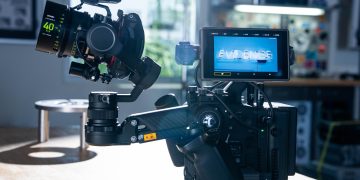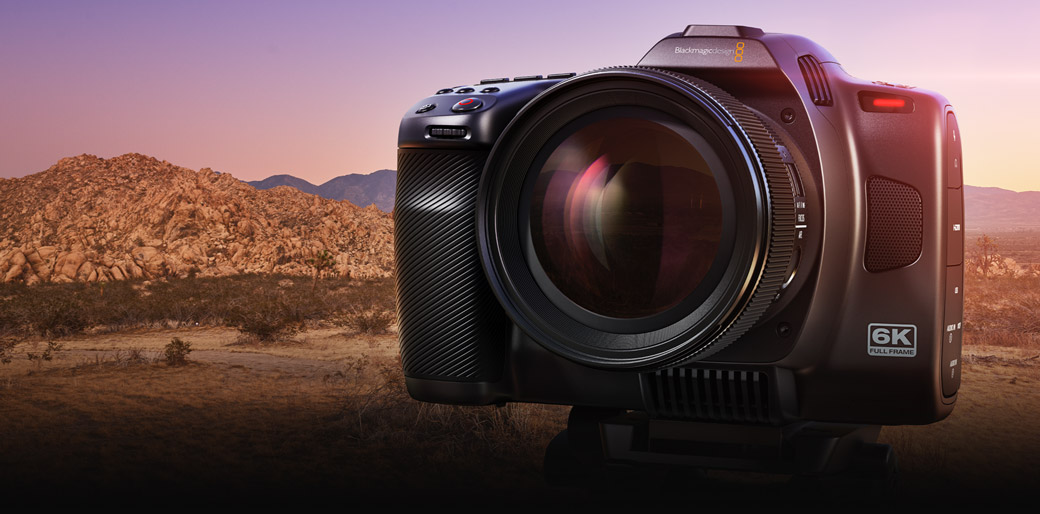
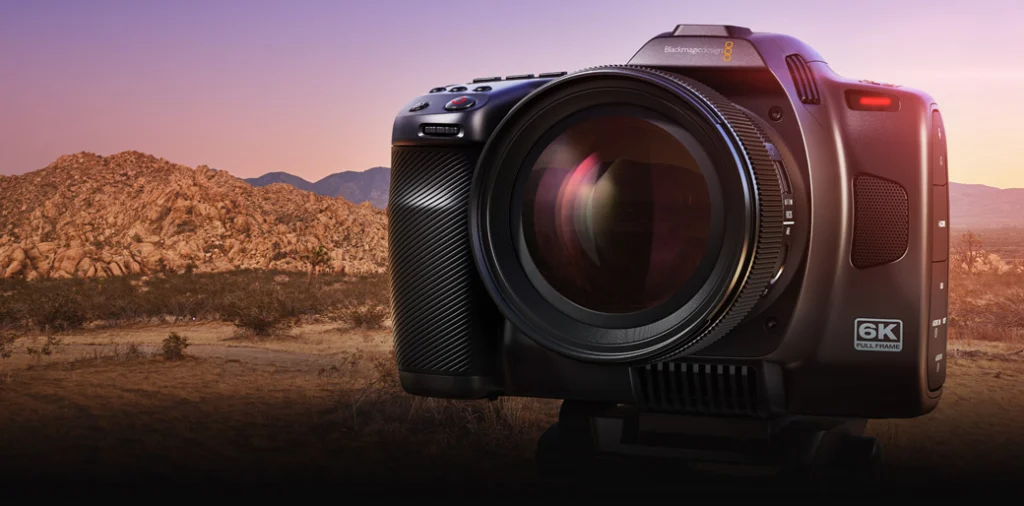
Blackmagic Cinema Camera 6K is a full-frame digital film camera designed for filmmakers who want cinematic image quality, Blackmagic RAW recording and a flexible L-Mount system at a competitive price.
Released in September 2023, the camera marked an important step for Blackmagic Design because it brought a full-frame 36 x 24mm sensor into a familiar handheld-style body. It replaced the Super 35 approach of earlier Pocket Cinema Camera models with a wider imaging area, 6K Open Gate capture and stronger lens flexibility through the Leica L-Mount.
The Blackmagic Cinema Camera 6K is aimed at independent filmmakers, documentary shooters, music video creators, YouTubers, commercial teams, students and small production companies. It is not a traditional broadcast camcorder and it is not a fully rigged cinema production body like the URSA Cine line. Instead, it sits in the middle as a compact creative camera that can produce high-quality images when used carefully.
Its main strengths are full-frame capture, Blackmagic RAW, dual native ISO, DaVinci Resolve integration and a price that makes serious cinema workflows more accessible.
Key Camera Specifications
The Blackmagic Cinema Camera 6K uses a full-frame 35mm sensor measuring 36 x 24mm. Its maximum resolution is 6048 x 4032 in 6K Open Gate 3:2 mode.
| Feature | Blackmagic Cinema Camera 6K |
|---|---|
| Camera type | Full-frame digital cinema camera |
| Release period | September 2023 |
| Sensor format | Full Frame 35mm |
| Sensor size | 36 x 24mm |
| Maximum resolution | 6048 x 4032 |
| Open Gate aspect ratio | 3:2 |
| Lens mount | L-Mount |
| Base sensitivity | Dual native ISO 400 and 3200 |
| Main codec | Blackmagic RAW |
| Proxy recording | H.264 proxies |
| Claimed dynamic range | 13 stops |
| Measured dynamic range | Up to 11.6 stops at SNR=2 in provided lab data |
| Best measured rolling shutter | 15ms in 4K DCI |
| Recording media | CFexpress and USB-C external disks |
| Weight | About 1.2 kg |
| Dimensions | About 122 mm x 94 mm x 180 mm |
| Listed price | Around $2,989 before taxes |
This camera is strongest for users who want full-frame Open Gate capture and a professional RAW workflow without paying for a larger cinema system.
Full-Frame 6K Sensor
The Blackmagic Cinema Camera 6K uses a full-frame 36 x 24mm sensor.
This is larger than Super 35 and gives filmmakers a wider field of view with compatible lenses. It also makes shallow depth of field easier to achieve, especially when using fast full-frame lenses.
The sensor records 6K Open Gate at 6048 x 4032. Open Gate uses the full sensor height and width, which gives editors and colourists more flexibility in post-production.
Why Full Frame Matters
Full frame changes the way lenses feel.
Compared with Super 35, a full-frame sensor can create wider compositions, stronger subject separation and a more spacious image. This is useful for interviews, music videos, fashion films, documentaries, travel content, commercials and narrative filmmaking.
The 36 x 24mm sensor also helps the camera work well with modern full-frame mirrorless lenses, especially through the L-Mount system.
6K Open Gate Recording
The headline recording mode is 6K Open Gate 3:2 at 6048 x 4032.
Open Gate is important because it captures the full sensor area. This gives creators more room for cropping, reframing, stabilisation, vertical video versions and anamorphic workflows.
| Recording Format | Resolution |
| 6K Open Gate 3:2 | 6048 x 4032 |
| 6:5 Anamorphic | 4832 x 4032 |
| 6K DCI 17:9 | 6048 x 3200 |
| 6K 2.4:1 | 6048 x 2520 |
| Super 35 4:3 4K | 4096 x 3072 |
| 4K DCI | 4096 x 2160 |
| Super 16 16:9 | 2112 x 1184 |
| HD 16:9 | 1920 x 1080 |
This range makes the camera flexible for different productions. A filmmaker can shoot Open Gate for maximum flexibility, 6:5 for anamorphic work, 4K DCI for faster readout or Super 16 for specialty lens workflows.
Dynamic Range Performance
Blackmagic claims 13 stops of dynamic range for the Cinema Camera 6K.
In the provided lab data, CineD measured 11.6 stops at SNR=2 in 6K Open Gate 3:2 at ISO 400 and BMD Film. At ISO 3200, the same mode measured 10.2 stops at SNR=2. In 4K DCI, the camera measured 11.7 stops at SNR=2.
| Sensor Mode | Resolution | Codec | ISO | Gamma | Measured Dynamic Range |
| 6K Open Gate 3:2 | 6048 x 4032 | BRAW | 400 | BMD Film | 11.6 stops at SNR=2 |
| 6K Open Gate 3:2 | 6048 x 4032 | BRAW | 3200 | BMD Film | 10.2 stops at SNR=2 |
| 4K DCI | 4096 x 2160 | BRAW | 400 | BMD Film | 11.7 stops at SNR=2 |
These results show that ISO 400 is the stronger choice when maximum image latitude matters. ISO 3200 remains useful for low-light work, but it reduces measured dynamic range.
What Dynamic Range Means for Filmmakers
Dynamic range affects how much detail a camera can hold between bright highlights and dark shadows.
This matters when shooting windows, skies, practical lights, reflective surfaces, night scenes and dark interiors. The Blackmagic Cinema Camera 6K can produce strong images, but it rewards careful exposure.
For best results, filmmakers should protect highlights, avoid deep underexposure and use Blackmagic RAW controls carefully in DaVinci Resolve.
Rolling Shutter Performance
Rolling shutter is one of the key technical limits of the Blackmagic Cinema Camera 6K.
The provided lab data shows 25ms rolling shutter in 3:2 Open Gate, 18.7ms in 6K 17:9 DCI and 15ms in 4K DCI.
| Sensor Mode | Resolution | Codec | Rolling Shutter |
| 3:2 Open Gate | 6048 x 4032 | BRAW | 25ms |
| 6K 17:9 DCI | 6048 x 3200 | BRAW | 18.7ms |
| 4K DCI | 4096 x 2160 | BRAW | 15ms |
These results mean Open Gate is best for controlled movement, interviews, studio scenes, narrative work and careful camera operation. For faster movement, 4K DCI is the better option because the readout is quicker.
Why Rolling Shutter Matters
Rolling shutter can make fast camera movement look distorted.
When a sensor reads slowly, quick pans can bend vertical lines, and fast-moving subjects may appear warped. This is more visible in handheld action, sports, whip pans and vehicle shots.
The Cinema Camera 6K is not the best option for heavy action in full sensor mode, but it can work very well when movement is controlled.
Blackmagic RAW Recording
The Blackmagic Cinema Camera 6K records 12-bit Blackmagic RAW.
Blackmagic RAW is one of the camera’s strongest features because it gives filmmakers more control than standard compressed video. It allows adjustments to ISO, white balance, tint and other image settings in post-production.
The camera also records H.264 proxy files, making editing and collaboration easier.
Why BRAW Matters
Blackmagic RAW gives independent filmmakers a serious post-production workflow.
It keeps image quality high while remaining efficient enough for DaVinci Resolve. This is important for small crews because they can capture flexible RAW files without needing the budget or infrastructure of a high-end cinema camera system.
For colourists, BRAW provides more room to shape contrast, saturation, exposure and colour than standard video codecs.
Recording Modes and Frame Rates
The Cinema Camera 6K supports 6K Open Gate up to 36fps.
This is useful for cinematic frame rates and slight slow motion. For higher frame rates, users can switch to cropped modes such as 4K DCI, Super 16 or HD.
| Mode | Maximum Frame Rate |
| 6K Open Gate | Up to 36fps |
| 6K DCI | Up to 48fps |
| 4K DCI | Up to 60fps |
| Super 16 | Up to 100fps |
| HD | Up to 120fps |
This makes the camera flexible, but not a dedicated high-speed system. It is strongest as a full-frame 6K cinema camera, not as an action or sports camera.
Blackmagic RAW Compression Options
The camera supports several Blackmagic RAW compression settings, including 3:1, 5:1, 8:1, 12:1 and constant-quality options such as Q0, Q1, Q3 and Q5.
Lower compression settings create larger files but preserve more image information. Higher compression settings reduce file size and make long shooting days easier to manage.
Choosing the Right BRAW Setting
BRAW 3:1 is best for high-end work where image quality matters most.
BRAW 5:1 and 8:1 are good middle-ground choices for many productions. BRAW 12:1 is more storage-friendly and can work for interviews, online video, corporate work and long-form documentary shooting.
The best choice depends on the project’s budget, storage, delivery format and grading needs.
L-Mount Lens System
The Blackmagic Cinema Camera 6K uses the L-Mount.
L-Mount is flexible because it works with modern lenses from Leica, Panasonic and Sigma. It also supports adapters for many other lens systems, including PL and EF in some workflows.
This makes the camera attractive to users who want access to full-frame lenses without being locked into one traditional cinema mount.
Lens Coverage Considerations
Because the sensor is full frame, lens coverage matters.
Full-frame lenses are the safest choice for 6K Open Gate. Super 35 lenses may need cropped modes. Some vintage lenses may cover only part of the sensor or show heavy vignetting at the edges.
Filmmakers should test lenses before important shoots, especially when using Open Gate or anamorphic modes.
6:5 Anamorphic Mode
The Cinema Camera 6K supports a 6:5 anamorphic mode at 4832 x 4032.
This is useful for filmmakers who want a widescreen anamorphic look. Anamorphic lenses can create oval bokeh, horizontal flares and a wider cinematic feel.
The full-frame sensor also gives anamorphic shooters more creative options, depending on lens coverage.
Why Anamorphic Support Matters
Anamorphic shooting remains popular in narrative films, music videos and commercials.
The 6:5 mode gives filmmakers a practical way to use anamorphic lenses while maintaining strong resolution. It also helps create a look that feels different from standard spherical lenses.
CFexpress and USB-C Recording
The camera records to CFexpress cards and can also record directly to USB-C disks.
This is important because Blackmagic RAW files can be large, especially in 6K Open Gate. CFexpress media gives reliable internal recording, while USB-C disks offer a more affordable and flexible storage option for some productions.
Why External Recording Helps
External USB-C recording can reduce media costs.
Many filmmakers already use external SSD workflows with Blackmagic cameras. This makes it easier to record longer takes, move footage quickly and manage storage on lower-budget productions.
However, users must choose fast and reliable drives that meet the camera’s recording requirements.
Monitoring and Controls
The Blackmagic Cinema Camera 6K uses a large rear touchscreen and Blackmagic OS.
Blackmagic OS is one of the easiest camera menu systems in the cinema-camera market. It gives users quick access to resolution, codec, frame rate, ISO, white balance, shutter, audio and monitoring settings.
The camera also supports useful exposure tools such as false colour, zebras, focus assist and LUT monitoring.
Why Blackmagic OS Is Popular
Blackmagic OS is simple and visual.
This helps solo shooters, students and small crews work faster. Instead of digging through complicated menus, users can adjust major settings quickly.
For independent filmmakers, that ease of use is a major advantage.
No Built-In ND Filters
One important limitation is the lack of built-in ND filters.
Neutral density filters help control exposure in bright conditions without changing aperture, shutter angle or ISO. Many cinema cameras include internal ND filters, but the Blackmagic Cinema Camera 6K does not.
This means users need external ND filters or matte-box filters when shooting outdoors.
Why ND Filters Matter
ND filters are essential for cinematic exposure control.
Without ND filters, filmmakers may be forced to stop down the lens or increase shutter speed in bright conditions. That can change the look of the image.
For serious video work, buyers should budget for good ND filters.
Stabilisation and Handheld Shooting
The Blackmagic Cinema Camera 6K does not have in-body image stabilisation.
This means handheld footage depends on the operator, lens stabilisation, shoulder rigs, gimbals or post-production stabilisation. Some L-Mount lenses include optical stabilisation, but the camera body itself does not provide sensor-shift stabilisation.
Best Handheld Approach
For handheld work, the camera benefits from a cage, top handle, side handle, shoulder rig or stabilized lens.
The body shape can work well for handheld filming, but it becomes much better when properly rigged. A small monitor, external power and good handles can make the camera more practical on set.
Best Uses for the Blackmagic Cinema Camera 6K
The Blackmagic Cinema Camera 6K is best for creators who want full-frame image quality and a RAW workflow at a relatively accessible price.
It is ideal for:
Independent films
Music videos
Documentaries
Commercials
Short films
YouTube productions
Interviews
Corporate videos
Fashion films
Product videos
Travel filmmaking
Student films
Social media campaigns
It works best when the user can control exposure, lighting and camera movement.
Blackmagic Cinema Camera 6K vs PYXIS 6K
The Cinema Camera 6K and PYXIS 6K share a similar full-frame 6K imaging concept, but they use different body designs.
The Cinema Camera 6K is more handheld and affordable. The PYXIS 6K is more modular and better suited to rigged production builds.
| Feature | Cinema Camera 6K | PYXIS 6K |
| Sensor | Full-frame 6K | Full-frame 6K |
| Maximum resolution | 6048 x 4032 | 6048 x 4032 |
| Lens mount | L-Mount | EF, L-Mount and PL versions |
| Body style | Handheld-style body | Modular box camera |
| Recording | BRAW | BRAW and proxy workflows |
| Best for | Solo and small-crew shooting | Rigged production setups |
| Main advantage | Lower price and simple operation | Mount choice and modularity |
The Cinema Camera 6K is better for users who want a simpler handheld camera. The PYXIS 6K is better for users who want a production box camera with more mounting flexibility.
Blackmagic Cinema Camera 6K vs Pocket 6K Pro
The Cinema Camera 6K and Pocket Cinema Camera 6K Pro are both popular Blackmagic options, but they differ in sensor size and features.
| Feature | Cinema Camera 6K | Pocket Cinema Camera 6K Pro |
| Sensor format | Full frame | Super 35 |
| Lens mount | L-Mount | EF |
| Built-in ND filters | No | Yes |
| Open Gate | Yes, 6K 3:2 | No full-frame Open Gate |
| Best advantage | Full-frame look and L-Mount | Built-in ND and Super 35 EF workflow |
| Best use | Full-frame filmmaking | Practical EF-based production |
The Cinema Camera 6K is better for full-frame shooters. The Pocket 6K Pro remains attractive because of its built-in ND filters and EF lens compatibility.
Key Takeaways
- Blackmagic Cinema Camera 6K was released in September 2023.
- It uses a full-frame 36 x 24mm sensor.
- The maximum resolution is 6048 x 4032 in 6K Open Gate.
- The camera uses the L-Mount.
- It has dual native ISO at 400 and 3200.
- It records 12-bit Blackmagic RAW.
- H.264 proxy recording is supported.
- Blackmagic claims 13 stops of dynamic range.
- The provided lab data shows 11.6 stops at SNR=2 in 6K Open Gate at ISO 400.
- 4K DCI measured 11.7 stops at SNR=2.
- Rolling shutter measured 25ms in Open Gate, 18.7ms in 6K DCI and 15ms in 4K DCI.
- 6K Open Gate records up to 36fps.
- 4K DCI records up to 60fps.
- The camera records to CFexpress and USB-C external disks.
- It is best for indie films, documentaries, commercials, music videos and small-crew production.
Frequently Asked Questions
What is the Blackmagic Cinema Camera 6K?
The Blackmagic Cinema Camera 6K is a full-frame digital film camera with 6K Open Gate recording, Blackmagic RAW, L-Mount and dual native ISO.
When was the Blackmagic Cinema Camera 6K released?
The camera was released in September 2023.
What sensor does it use?
It uses a full-frame 36 x 24mm sensor.
What is the maximum resolution?
The maximum recording resolution is 6048 x 4032 in 6K Open Gate 3:2 mode.
What lens mount does the camera use?
The Blackmagic Cinema Camera 6K uses the L-Mount.
What is the base ISO?
The camera has dual native ISO at 400 and 3200.
Does it record Blackmagic RAW?
Yes. The camera records 12-bit Blackmagic RAW.
Does it record ProRes?
No. This model is focused on Blackmagic RAW and H.264 proxy workflows, not internal ProRes recording.
What dynamic range does it offer?
Blackmagic claims 13 stops. The provided lab data shows 11.6 stops at SNR=2 in 6K Open Gate at ISO 400.
What is the rolling shutter performance?
The provided lab data shows 25ms in Open Gate, 18.7ms in 6K 17:9 DCI and 15ms in 4K DCI.
Does it have built-in ND filters?
No. The Blackmagic Cinema Camera 6K does not have built-in ND filters.
Who should use the Blackmagic Cinema Camera 6K?
It is best for independent filmmakers, documentary shooters, music video creators, commercial teams, YouTubers and small production crews that want full-frame BRAW capture.
Conclusion
Blackmagic Cinema Camera 6K is a strong full-frame filmmaking tool for creators who want 6K Open Gate recording, Blackmagic RAW and L-Mount flexibility without moving into a much more expensive cinema system.
Its biggest strengths are image flexibility, full-frame field of view, DaVinci Resolve integration, dual native ISO and accessible pricing. It gives independent filmmakers a powerful RAW workflow in a compact body.
The camera also has clear limitations. Rolling shutter is noticeable in full sensor modes, measured dynamic range is lower than the 13-stop claim, and the lack of built-in ND filters means users need extra accessories for outdoor shooting.
Even with those trade-offs, the Blackmagic Cinema Camera 6K remains one of the most attractive full-frame cinema cameras for creators who want serious image quality, flexible grading and a manageable production workflow.
Read Also: Blackmagic PYXIS 6K: Specs, Sensor, Dynamic Range and Features