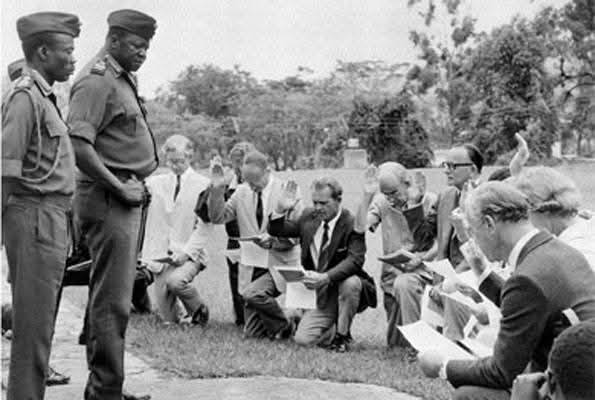
Kampala, Uganda – September 1975. On the manicured lawns of State House in Entebbe, a moment unfolded that captured the essence of post-colonial Africa and the personality of one of its most controversial leaders. Surrounded by soldiers and government officials, President Idi Amin Dada stood tall as a group of British expatriates knelt before him, raising their right hands to swear allegiance to the Republic of Uganda. Cameras flashed, and within days, the image of Europeans kneeling before an African leader travelled around the world.
The ceremony, which Amin described as a citizenship oath, was part of his campaign to rid Uganda of lingering colonial influence and promote national pride. To many observers, it was a symbolic act of reversal—an image of Africans reclaiming power after decades of subjugation. To others, it was an unsettling display of intimidation and political theatre.
After coming to power in 1971, Idi Amin had moved swiftly to cut Uganda’s dependence on Britain and assert his independence from Western control. He expelled thousands of Asians who held British passports in 1972, nationalized major businesses, and styled himself as a defender of African sovereignty. By 1975, relations between Uganda and Britain were tense, yet several British nationals still lived and worked in the country as technicians, engineers, and educators.
It was against this backdrop that Amin invited these expatriates to a special event, announcing that anyone wishing to stay in Uganda permanently would need to take Ugandan citizenship. On the morning of the ceremony, the participants arrived expecting a simple administrative procedure. Instead, they found themselves kneeling on the grass before the president, reading aloud a pledge of loyalty.
Eyewitnesses later said they believed Amin had tricked them into kneeling, thinking it was part of the oath-taking protocol. But for the president, the gesture carried deeper meaning. In his view, it symbolized respect for the Ugandan state, a literal bow before African authority that once bowed to colonial power. Amin reportedly told them, “You have served here for years. If you love Uganda, become Ugandans.”
The photographs from that day show a striking contrast: the uniformed president towering above a row of kneeling Europeans, soldiers standing at attention, and the solemn faces of those taking their oaths. Internationally, the images ignited debate. Western media portrayed it as a calculated humiliation, a display meant to embarrass Britain. Across Africa, however, many saw it as poetic justice—a vivid symbol of the continent’s new self-confidence.
Amin’s regime was known for its blend of fear, charisma, and spectacle. He understood the power of imagery, and this event was no exception. It reinforced his public persona as a fearless, unpredictable leader who could command the world’s attention with dramatic acts that mixed politics, pride, and provocation.
Today, the photographs of British expatriates kneeling before Idi Amin remain among the most unforgettable images of the 1970s. They continue to evoke strong reactions—admiration from some, discomfort from others—but above all, they serve as a reminder of a complex era when newly independent African nations were redefining power on their own terms. The moment also illustrates Amin’s mastery of symbolism: behind his eccentric humor and ruthless leadership lay a deep understanding that sometimes a single photograph could tell the story of an entire generation’s struggle for dignity.