Roy Bruce McKenzie held the role of minister in the colonial administration after independence and remained in that capacity until 1969, when he resigned due to health issues. He served as the Agriculture Minister.
The politician, who was born in South Africa, is recognized for having guided Kenya’s agricultural industry through its darkest phase, during which African owners acquired lands previously owned by white people and small-scale farming supplanted large-scale farming.
He was born in 1919 to Roy Douglas McKenzie, and attended Hilton College, a boys’ exclusive boarding school in the KwaZulu-Natal Midlands, for his early schooling. When World War II broke out in 1939, McKenzie enlisted in the South African Air Force (SAAF) and went on to battle in the SAAF units that were sent to combat Mussolini’s war in Africa. He was awarded the Distinguished Service Order (DSO) and the Distinguished Flying Cross (DFC) as a result.
In 1946, McKenzie was among the troops that were demobilized following the war. After moving to Kenya, he established Gingalili Farm, a 1,200-acre dairy farm near Solai, Nakuru. For many years, white farmers chose him to be the chairman of the Royal Agricultural Society of Kenya, which is now known as the Agricultural Society of Kenya, since he raised some of the greatest pedigree cattle in the nation.
One of the most prosperous colonial farmers, McKenzie joined the group of farmer-politists who led settler politics in Kenya, together with notable figures like Michael Blundell, Charles Makham, and Ferdinard Cavendish-Bentinck (CB). McKenzie received a nomination to the Legislative Council (Legco) in 1957. He was present when British Secretary of State for the Colonies Allan Lennox-Boyd threatened to impose a ten-year constitution on Kenya at Government House in Nairobi.
However, McKenzie was not a strong proponent of the protracted constitutional transfer that white settlers—who were eager to reap the rewards of their investments—favored. During the 1958 Legco opening, the Lennox-Boyd Constitution, which called for 14 Africans, 14 Europeans, 6 Asians, and 2 Arabs in the Legco, met challenges.
Governor Evelyn Baring was confronted by the 14 elected Africans who left after he said that there would be no more constitutional amendments. This resulted in an impasse. The only other African to take a cabinet position was Musa Amalemba.
Blundell quit his position as Minister of Agriculture, Animal Husbandry, and Water Resources in a fit of rage in order to promote his centrist political views by founding the New Kenya Party. In 1959, his liberal colleague McKenzie succeeded him, a move intended to reassure the white settlers that they needed not worry. African leaders rejected Blundell’s previous attempts, made in April 1959, to get them to join his New Kenya Party because they preferred to conduct constitutional negotiations with the colonial administration rather than the Lennox-Boyd one.
After Harold Mcmillan became British prime minister and said that “a wind of change” was blowing across the colonies, McKenzie entered the administration. In addition, Ian MacLeod had declared the repeal of the Lennox-Boyd Constitution and had taken over as Secretary of State for the Colonies, making it an intriguing time in Kenyan politics. African lawmakers stopped boycotting the Legco as a consequence.
When European colonists were alarmed at the idea of an African-led administration, McKenzie assumed leadership of the Ministry of Agriculture. Through McKenzie, the difficult land issue was to be resolved. He was tasked with devising a strategy for the Lancaster Conference in London that would appease both Europeans and Africans. He succeeded in floating the willing-buyer willing-seller policy through his efforts and talks with MacLeod.
As the Minister of Agriculture, McKenzie was seen negatively by white farmers and frequently overshadowed by extreme right-wingers. Among them was Ferdinard Cavedish-Bentinck, a former Legco Speaker who vigorously pushed for Britain to reimburse the farmers for any losses.
McKenzie was the one who initially told the settlers’ conference at County Hall in Nairobi in April 1960 that the government would purchase the huge farms and split them among the newly arrived African farmers, with White people serving as supervisors. The laughing erupted in the hall!
His work was significant in formulating and generating ideas for the relocation of Africans in the highlands. Blundell, the man McKenzie succeeded in the ministry, was a willing ally. McKenzie had warned in the Legco that the country’s economy would collapse if European farmers engaged in a “rat race” to leave Kenya when the promised 30 million pounds became available for land purchases. MacLeod met with Gichuru and Mboya in September 1960 as a result of these concerns.
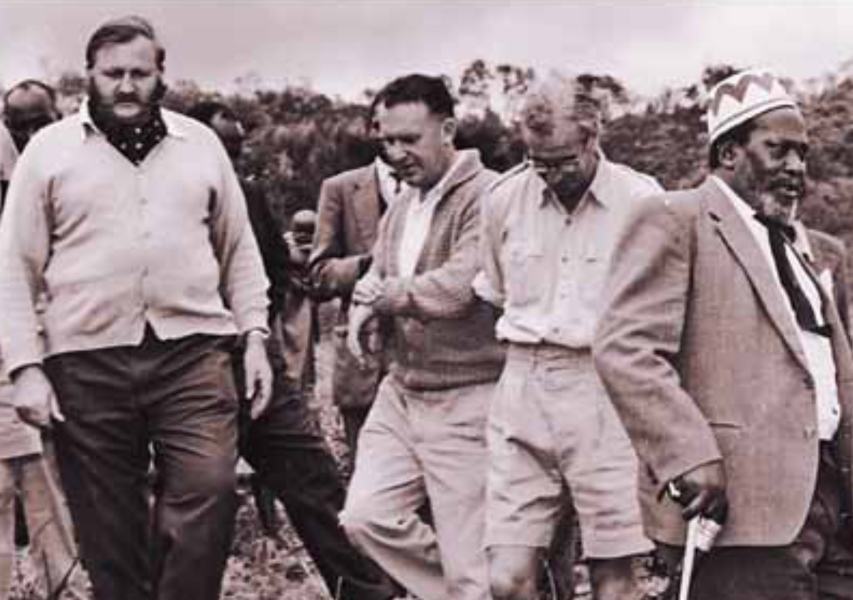
Later, McKenzie met with Local Government Minister Wilfrid Havelock. He gave the two assurances that white farmers would not have a difficult time leaving, and he promised to push the British government to provide funding to the newly formed Kenyan government so that landless Africans could be resettled, particularly in the area known as the White Highlands.
McKenzie — and, to some extent, Havelock — had emerged as the most moderate white ministers representing Blundell’s New Kenya Group. The group was closer to Kanu than previously thought. From the onset, therefore, McKenzie was part of a group aiming at a multi-racial Kenya. He hoped that this could help eliminate the colour problem before Kenya became independent. But it was the recession caused by a drop in agricultural production and settlers’ panic that worried him in the run-up to the release of Jomo Kenyatta.
At most forums, he preached responsible leadership and dismissed talk of an economic collapse if the Africans took over. He hoped the new leadership would not act irresponsibly, especially on the land issue. But McKenzie faced political problems for his efforts.
In an attempt to overshadow McKenzie’s New Kenya Group, the European Convention of Associations voted 38–4 on October 7, 1960, to endorse Cavendish–Bentick and his Kenya Coalition in the elections. McKenzie and other moderates would not be relevant in European politics under the scenario. Consequently, he gradually began to sympathize with Kanu, which was becoming the most well-liked African party.
The white farmers feared that if McKenzie and his followers, including Blundell, had their way, Europeans would be represented at the second Lancaster Conference on Kenya’s independence by a group that was backed by the British government and largely represented the viewpoints of Tory backbenchers at Westminister.
In 1978, McKenzie lost his life while looking for a commercial deal in Uganda. In order to seal the deal with Ugandan President Idi Amin, McKenzie had gone to Uganda. However, McKenzie’s managers were wary of him because they thought he would become close to the President. A lion’s head sculpture that was supposedly a gift from the President was placed on board by an Amin ally during their return trip. It was discovered to be a bomb that destroyed McKenzie’s Piper Aztec 23 aircraft as it was getting ready to land at Wilson Airport in Nairobi, flying above Ngong Hills. He was fifty-nine.