Over the course of his colorful life, Frederick Lawrence Munyua Waiyaki cultivated an enduring international reputation as a man who could hold his own in the highest echelons of power; one who demonstrated uncommon courage in a sycophantic era and could be trusted to think on his feet. Frederick Lawrence Waiyaki was suave, witty, and distinguished even into his sunset years. Thus, it should come as no surprise that his devotion to the country extended through the terms of both founding President Jomo Kenyatta and Daniel arap Moi, who followed him as Head of State.
Waiyaki, a highly regarded medical professional, served in the Cabinet under Kenyatta, first in the crucial position of Foreign Affairs, and later under Moi in the position of Agriculture.
An old friend and confidant of President Kenyatta, Waiyaki became famous as the first person State House Mombasa called for after the President passed away in the wee hours of August 22, 1978. Honored as the leading diplomat in Kenya, Waiyaki was startled out of sleep at the Nyali Beach Hotel while presiding over an annual retreat for Kenyan diplomats, a group that had visited the President only hours before he passed away.
Peter Muigai, Kenyatta’s son, called the Minister, who was among the first to witness the President’s lifeless corpse when he arrived at three in the morning. The dependable doctor officially confirmed that Kenyatta was dead, working with his personal physician Dr. Eric Jumwa Mngola, who also served as the Permanent Secretary for Health and Director of Medical Services.
Along with Muigai at that time were Coast Provincial Commissioner Eliud Mahihu and the President’s wife, Mama Ngina Kenyatta. Along with Mngola and the medically trained Minister of Defense, Njoroge Mungai, Waiyaki had been among the select few informed of Kenyatta’s deteriorating health.
It was shocking to discover the nature of the call’s motive, though, as I had not been completely informed. In a press interview, Waiyaki said, “I sensed that something was seriously wrong when I entered State House.” “His face in death appeared so serene. It’s possible that he was sleeping.
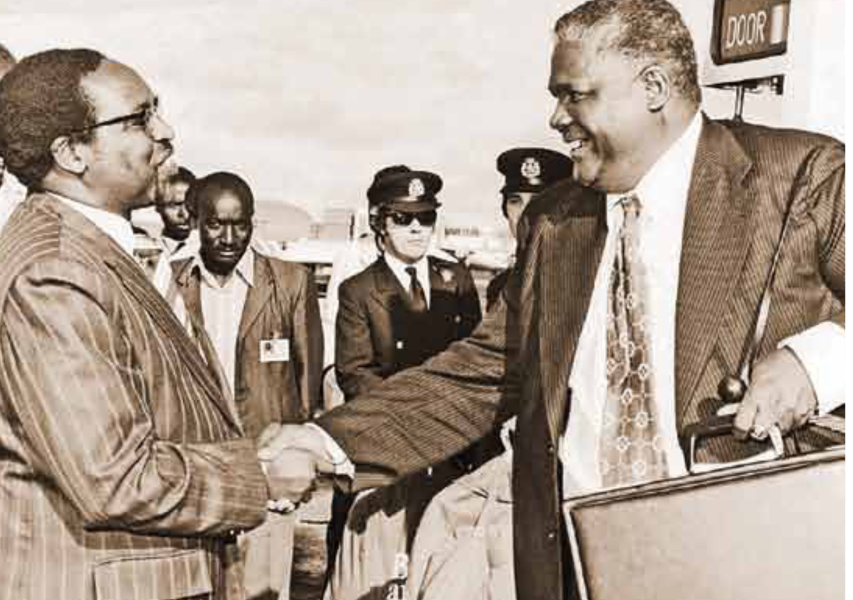
It was no coincidence that the Minister was among the first to learn of Waiyaki’s passing; the two were such good friends that the Minister frequently paid Kenyatta a visit at his home in Gatundu. He claimed, “I got along very well with Mzee and had unrestricted access to his house.”
As a recent university graduate, Waiyaki first met Kenyatta in 1951 at the Green Hotel Restaurant on Latema Road in Nairobi. After taking him to the restaurant for lunch, his father saw Mbiyu Koinange and Kenyatta in one of the cubicles. Waiyaki believes his father purposefully sent him there to see Kenyatta because he knew he would be there.
“I was acquainted with Mbiyu since we were the same age. As the fight for independence grew more intense, I got to know Kenyatta, a man who was drawn to young, educated men,” Waiyaki said.
Later, after the colonial government had detained Kenyatta in Maralal and had started spreading propaganda that he was unfit to govern the country due to his health, Waiyaki offered, along with medical colleagues Njoroge Mungai, John Nesbitt, and Jason Likimani, to visit him in detention in order to verify the claims made by the Mzungu that he was not well. Waiyaki recollected, “We found a jolly, intelligent, fantastic man who not only was fit medically but also had a very sharp brain.”
In his capacity as Kenya’s Minister of Foreign Affairs, Waiyaki had immense esteem both domestically and abroad. In the 1970s, he established himself as Kenya’s undisputed voice both domestically and internationally. He spelled out the nation’s stance in detail, particularly with regard to two divisive global issues: colonialism and apartheid. Waiyaki, credited with restoring honor and dignity to the ministry, bravely opposed South Africa’s apartheid government, which he personally saw.
Ochieng’ Adala, a career diplomat and the chief of the ministry’s African Division, frequently accompanied Waiyaki on trips to international and continental conferences. Adala claimed that Waiyaki was a man of ideas and initiative. “He demonstrated the ability to manage circumstances that emerged beyond the prearranged content and make spontaneous choices,” he disclosed.
The Truth, Justice, and Reconciliation Commission Chairman and former diplomat Bethuel Kiplagat called Waiyaki “a committed Pan-African, a great and outstanding Foreign Affairs Minister and a pleasant individual” in 2007. He led with no nonsense, was fearless, and didn’t hold back. He was intelligent, prudent, and did not overstep his bounds.
Following Kenyatta’s death, Moi assumed leadership and kept Waiyaki in the Ministry of Foreign Affairs until the 1979 General Election, at which point the physician was transferred to the powerful Ministry of Agriculture. Naturally, Waiyaki threw himself into his new position with integrity and fervor, learning everything he could about the problems facing the farmers in the area. He was diligent in identifying ways to get around obstacles that were made worse by the era of change from the oppressive colonial system of land ownership and agricultural practices to the recently implemented government programs meant to support native farmers.
After leaving politics, Waiyaki was interested in business, farming, and real estate development. Early in 2008, he lost his wife Naomi to cancer, which was traumatic. “My wife received a cancer diagnosis in 2003. After her operation, we were certain that the illness had been brought under control. However, eight weeks later, cancer moved to her kidney,” Waiyaki remembered. Later, he would work as a diplomacy professor at a US institution and do a little medical practice.
At the age of 91, he passed away on April 25, 2017.