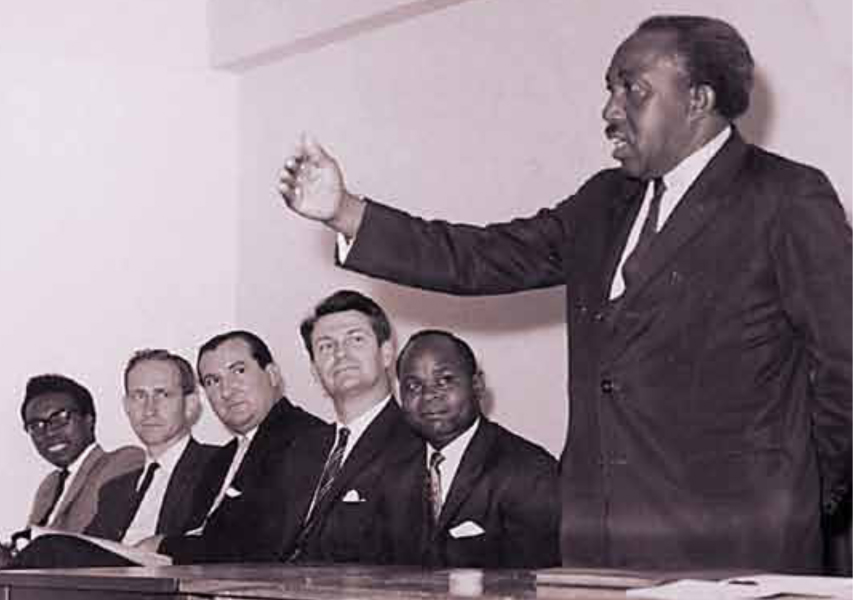
![Jackson Harvester Angaine in his heyday. [PHOTO: FILE/STANDARD]](https://www.nyongesasande.com/wp-content/uploads/2024/03/Angaine141113.webp)
Jackson Harvester Angaine referred to himself as the “King of Meru” in his later years. He will be known as the minister with the most difficult task during Kenya’s independence: resettling millions of landless Kenyans in the area that was once the White Highlands.
Additionally, he was a key figure in the establishment of the African propertied elite, which resulted in egregious disparities in property, particularly land ownership. Between 1964 and 1979, when he lost his parliamentary seat for the first time, Angaine rode the Ministry of Lands and Settlement like a giant.
Born in 1900 in Gautuku village, Ntima location, Meru, Angaine entered the United Methodist Missionary Society School at Kaaga for elementary school in 1913. Later, he transferred to Alliance, where he was placed one class above Odinga. The son of Paramount Chief Angaine M’Itiria, Angaine distinguished himself at Alliance as a boxer. He completed the London Matriculation course but chose not to enroll in college. Rather, he chose to become an accountant.
When he joined KAU and was elected chairman of the Meru District, his political career officially began. KAU lacked a national icon to inspire the people. Kenyatta’s homecoming, along with his background in Britain, provided KAU with the necessary political mobilization. It provided political and social rights education to those who supported it.
KAU sparked enthusiasm among the Gikuyu, Embu, and Meru people under the leadership of Kenyatta and with the assistance of a group of youthful politicians. After this, it expanded to other regions and soon had leaders at both the district and national levels. As the Ameru’s leader, Angaine’s status propelled him to the forefront of national politics.
The Mau Mau, whose chief leader, Dedan Kimathi, was the Ol Kalou KAU chairman, emerged as a result of the KAU being divided between radicals and moderates, with the former rejecting the latter’s offer for talks. The organization was headquartered in Angaine’s garden in Meru, which is close to Mt. Kenya Forest.
However, on October 9, 1952, the Mau Mau attacked when Kung’u Waruhiu, a Paramount Chief assigned to manage colonial administration in central Kenya, was traveling to a Seventh Day Adventist mission. They pelted his American-built Hudson automobile with gunfire. The first indication that the Mau Mau were prepared to use force, if necessary, to alter Kenya’s political system came from this killing.
The settlers claimed that the KAU leadership was responsible for the attacks on European farms, and the murder sparked a need for swift action against them. October 20, 1952, was less than two weeks after Waruhiu’s burial when Operation Jock Stock, which targeted KAU leaders and the Gikuyu, Embu, and Meru populations, was started. In the so-called White Highlands, fear increased dramatically as thousands of Kikuyus, Embus, and Merus were taken into custody. There was a blockage on Kenya’s key economy.
The colonial dragnet was impossible for Angaine to evade. He was held in custody on Manda Island, Mackinnon Road, Hola, and Kajiado. The final one served as a detention center for nationalist inmates believed to be Mau Mau’s commanders. Angaine lost the most of his teeth at Manda. He was almost starved to death and was regarded as a hardened criminal.