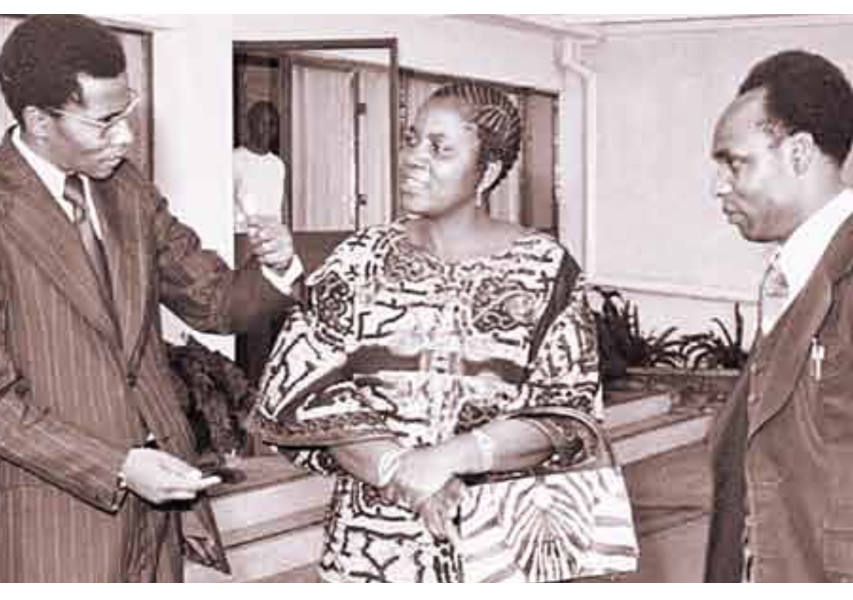
Following a successful teaching career, Eliud Ngala Mwendwa was named to Kenyatta’s first Cabinet, where he held various ministry positions and oversaw numerous historic initiatives. He played a key role in the creation of the National Youth Service (NYS) and the National Social Security Fund (NSSF) while serving as Minister of Labor.
Mwendwa, the son of a paramount chief, dominated Kitui District politics with a colossal presence. He had the proverbial silver spoon in his mouth from birth. Naturally, he made the Mwendwa family into one of Kenya’s richest dynasties. Thus, Kitili, the first African Chief Justice of independent Kenya, and Ngala, his brother Kyale, and Kitili’s wife Nyiva were all Cabinet Ministers in the Kenyatta and Moi administrations. Kitavi’s family was also the source of colonial Senior Chief Mwendwa Kitavi.
Mwendwa was born in 1923 in Kalia, Matinyani, Kitui, into a polygamous household. Rather than out of obligation, he took care of his father’s animals for enjoyment. In addition to having enough herders to take care of his cattle, his father also employed agricultural laborers and armed askaris to protect him and do tasks.
In 1935, Ngala enrolled in the Africa Inland Church’s Matinyani Primary School. After three years, he took the Common Entrance Exam in order to enroll at Kitui School. The octogenarian claims, “I saw white men for the first time at Kitui school.” “In 1943, after finishing my studies, I joined Alliance Boys.”
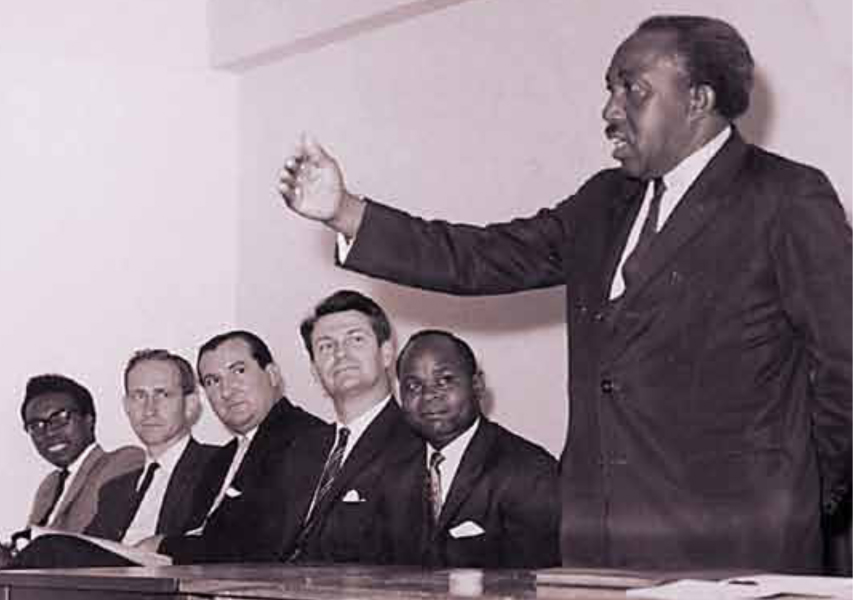
He went on to the Kagumo Teachers Training College after that. The passengers’ usage of a county administration car made Mwendwa’s first journey to Nairobi memorable. “We went to Nairobi via Thika, where we spent the night and then took a train to Nairobi and to Kagumo because the road from Kitui through Machakos was nonexistent,” the man said.
After completing his studies at Kagumo in 1946, he secured a teaching position at Kitui, his previous school, in 1947. He was sent to the Matinyani DEB School in 1951, where he worked as a teacher until 1957. He was an excellent sportsman and motivator for students to participate in a variety of subjects.
Being a teacher was a noble job. For the kids in the village, a teacher served as both a father figure and a leader in the community. It is understandable why the majority of Kenyans who pursued higher education at Makerere College or elsewhere and went on to become well-known administrators or politicians were instructors in elementary or secondary schools in their own country.
Mwendwa started a business in 1957. However, he handed over the company to his older brother Mang’uye in 1958 and started working as a tutor at what is now St. Angela’s Girls Secondary School, formerly known as Mutune Teachers Training College.
“I have never submitted a formal application for employment,” Mwendwa declares, noting that in those days, unemployment among educated people was unheard of. However, as the Mau Mau conflict grew more intense, the colonial authorities implemented emergency regulations, which increased the political temperature in the nation. Mwendwa was not leading the independence movement. Although he claims to have only vague memories of the independence movement, he claims that many chiefs were oppressive and unjustly detained individuals for no apparent reason.