In January 1994, Kenya mourned the loss of one of its greatest freedom fighters — Jaramogi Ajuma Oginga Odinga, the nation’s first Vice President and a towering figure in the struggle for independence. At 82 years old, Jaramogi passed away peacefully at his home in Kisumu, surrounded by family. His death was confirmed by Aga Khan University Hospital, marking the end of a life deeply intertwined with Kenya’s political transformation.
For years, Jaramogi’s health had been steadily declining. He suffered from heart-related complications, which eventually culminated in heart failure on January 20, 1994. Age, combined with decades of political battles, detentions, and house arrests under the Moi regime, had taken a toll on his once-vigorous frame. Despite his frailty, he remained committed to multi-party democracy and social justice, refusing to retire from political life until his final days.
A Nation in Mourning
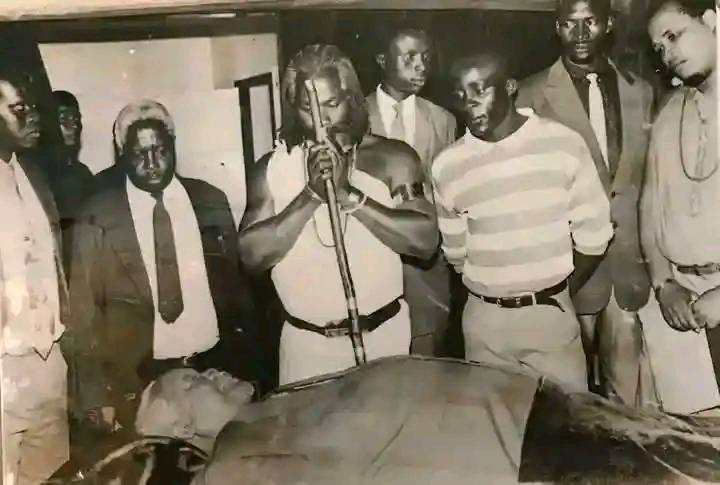
After his passing, Jaramogi’s body was taken to Lee Funeral Home in Nairobi for public viewing — an emotional moment that drew mourners from all walks of life. The atmosphere was solemn as Ngonya Wa Gakonya led prayers beside the casket. Crowds gathered quietly, paying homage to a man who had spent his life fighting for Kenya’s freedom and equality.
The sight of Jaramogi’s body lying in state was a moment of collective reflection for the nation. It marked not only the end of an era but also the closing of a chapter in Kenya’s journey from colonial subjugation to independence.
Despite decades of political rivalry and controversy, tributes poured in from across the political divide. For both supporters and critics, Jaramogi remained a symbol of courage — a man whose convictions shaped Kenya’s political conscience.
His Life and Enduring Legacy
Born in October 1911, Jaramogi Oginga Odinga emerged as one of Kenya’s most fearless voices during the independence struggle. He served as Kenya’s first Vice President under Jomo Kenyatta, later breaking ranks with him over ideological differences about wealth distribution, governance, and freedom.
Jaramogi’s political philosophy emphasized economic equality, African socialism, and true sovereignty — beliefs that often put him at odds with the ruling elite. His book, “Not Yet Uhuru,” remains one of the most profound political autobiographies in African literature, chronicling not just his own journey but also the long-standing political feud between the Odinga and Kenyatta families — a rivalry that continues to shape Kenya’s political landscape through their sons, Raila Odinga and Uhuru Kenyatta.
Honouring a Political Giant
Today, Jaramogi’s memory lives on through the Jaramogi Oginga Odinga Mausoleum and Museum in Kang’o, Bondo, Siaya County. The site houses personal artifacts, photographs, and cultural exhibits celebrating Luo heritage and Kenya’s independence journey. It serves as both a historical archive and a spiritual resting place for a man who gave his life to the cause of liberation.
Nearly three decades after his death, Jaramogi remains one of Kenya’s most respected and studied political figures — a visionary whose ideals still influence debates about democracy, justice, and national unity.