
Qualcomm has confirmed that Snapdragon Summit 2026 will take place from September 22 to September 24 in Maui, Hawaii, setting the stage for what is expected to be one of the most important mobile-chip announcements of the year.
The company has not officially revealed what products it will introduce at the event. However, Snapdragon Summit has traditionally been Qualcomm’s platform for unveiling its next-generation flagship mobile processors, and attention is already turning to the expected successor to last year’s Snapdragon 8 Elite Gen 5.
The next flagship chipset is widely rumoured to be called Snapdragon 8 Elite Gen 6, with reports also pointing to a possible Snapdragon 8 Elite Gen 6 Pro. If accurate, this would mark a more segmented flagship strategy from Qualcomm, with different high-end chips potentially aimed at different tiers of premium Android smartphones.
For Android phone makers, the timing matters. The chips announced at Snapdragon Summit usually shape the next wave of flagship devices from brands such as Samsung, Xiaomi, OnePlus, Vivo, iQOO, Honor, Oppo, Realme, RedMagic and Asus ROG. A September announcement gives manufacturers time to prepare devices for late-year China launches and global flagship releases in early 2027.

For consumers, Snapdragon Summit 2026 could provide the first official look at the hardware that powers the next generation of premium Android phones.
What Is Snapdragon Summit?
Snapdragon Summit is Qualcomm’s annual technology event for announcing major Snapdragon platforms and showcasing the company’s roadmap across mobile, computing, AI, gaming, connectivity and device ecosystems.
Although the event often attracts attention because of smartphone chip announcements, Snapdragon has become much broader than mobile phones. Qualcomm now uses the platform to discuss on-device AI, premium Android performance, laptop processors, XR devices, gaming, audio, wireless connectivity and automotive technology.
Still, the main spotlight usually falls on the flagship Snapdragon 8-series mobile platform. These chips power many of the most important Android phones of each generation. Every year, phone makers, tech reviewers, gamers and performance enthusiasts watch closely for CPU, GPU, NPU, camera, modem and efficiency improvements.
Snapdragon Summit is also where Qualcomm communicates its broader direction. In recent years, the company has focused heavily on AI running directly on devices rather than relying only on cloud processing. That theme is likely to remain important in 2026 as smartphone makers continue adding generative AI tools, advanced photo editing, real-time translation, AI assistants and smarter camera features.
Why the 2026 Event Matters
Snapdragon Summit 2026 matters because the premium Android market is entering a new phase. Flagship phones are no longer judged only by camera hardware, display brightness and charging speed. They are increasingly judged by AI performance, gaming stability, battery efficiency, image processing, thermal control and long-term software capability.
Qualcomm’s next flagship chip will likely influence all of those areas.
If the rumoured Snapdragon 8 Elite Gen 6 arrives at the event, it could become the processor that powers many 2027 flagship Android phones. That includes devices expected from China-based brands in late 2026 and global models launching early the following year.
The possibility of a Snapdragon 8 Elite Gen 6 Pro also adds intrigue. A Pro version could allow Qualcomm and smartphone brands to create clearer separation between standard flagships and ultra-premium models. For example, a standard flagship phone might use the regular Snapdragon 8 Elite Gen 6, while the most expensive Ultra, Pro Max or gaming-focused phones could use the Pro version.
That would give manufacturers more flexibility, but it could also make the Android flagship market more complicated for buyers.
Snapdragon 8 Elite Gen 6: What Is Rumoured?
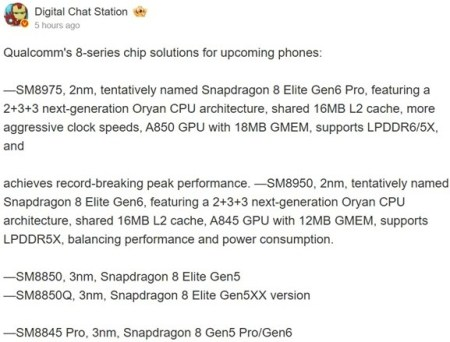
The expected headline announcement is the Snapdragon 8 Elite Gen 6, reportedly carrying the model number SM8950. This would likely succeed the Snapdragon 8 Elite Gen 5, which was introduced as Qualcomm’s previous flagship mobile platform.
The exact specifications are not official. Current rumours suggest the chip may use a next-generation manufacturing process and a redesigned high-performance architecture. Reports have also suggested improved CPU performance, stronger graphics capability and better AI processing.
If Qualcomm follows its recent strategy, the new chip will likely focus on several core areas:
Faster CPU performance for demanding apps and multitasking.
Improved GPU performance for gaming and graphics-heavy workloads.
More powerful on-device AI processing.
Better image signal processing for cameras.
Improved power efficiency.
Enhanced connectivity through updated modem and wireless features.
Stronger support for premium displays, video, audio and gaming features.
Until Qualcomm confirms the chip, all of these details should be treated as expectations rather than facts. But the direction is clear: the next Snapdragon flagship will need to deliver more AI performance, better sustained gaming and improved battery efficiency.
Snapdragon 8 Elite Gen 6 Pro: Why a Pro Chip Would Matter
The most interesting rumour is the possible Snapdragon 8 Elite Gen 6 Pro, reportedly linked to the model number SM8975. If Qualcomm announces both a standard and Pro flagship chip, it could mark a notable shift in the company’s high-end mobile strategy.
A Pro version could offer higher CPU frequencies, stronger GPU performance, more graphics memory, better AI capabilities or support for newer memory standards. It may also be aimed at ultra-premium devices where manufacturers want maximum benchmark scores, camera performance, gaming stability and AI capability.
This would mirror a broader trend in smartphones. Many brands already divide their flagship lines into standard, Pro and Ultra models. Qualcomm offering multiple high-end chip options would allow phone makers to align processors more closely with product tiers.
However, this could also create confusion. Consumers may need to pay closer attention to which exact Snapdragon version a phone uses. Two phones with similar names could deliver different levels of performance if one uses the standard chip and the other uses the Pro version.
For gaming phones and camera-focused Ultra models, the Pro chip could be especially attractive. But it may also increase device costs, especially if the chip uses a more advanced manufacturing node.
What About Snapdragon 8 Gen 5XX and Snapdragon 8 Gen 5 Pro?
Recent leaks have also mentioned two additional Qualcomm chips: a Snapdragon 8 Elite Gen 5XX version, reportedly using the model number SM8850Q, and a Snapdragon 8 Gen 5 Pro, reportedly using SM8845 Pro.
These names are not official, and the branding may change before launch. Qualcomm’s naming strategy has become more layered, so it is possible that some leaked model names refer to internal variants, refreshed chips, regional versions or products that will launch under different commercial names.
The Snapdragon 8 Gen 5 Pro rumour is especially interesting because some reports suggest it could eventually launch as Snapdragon 8 Gen 6. That would create a more affordable or slightly lower-tier option beneath the Elite-branded flagship.
This kind of strategy would make sense if Qualcomm wants to serve several premium segments:
Ultra-premium phones with the highest-end Elite Pro chip.
Mainstream flagship phones with the regular Elite chip.
Upper-premium or affordable flagship devices with a non-Elite Snapdragon 8 chip.
Gaming and performance variants with tuned versions of existing chips.
For buyers, the naming may become confusing, but the goal would be to give phone brands more flexibility in pricing and positioning.
Why Qualcomm May Need Multiple Flagship Chips
The Android market is no longer one simple flagship category. There are now standard flagships, Pro flagships, Ultra flagships, foldables, compact gaming tablets, gaming phones, camera-first phones and performance-focused affordable flagships.
A single chip cannot perfectly serve every product type.
A foldable phone may need strong efficiency and thermal control because its body is thin and complex. A gaming phone may need maximum GPU performance and sustained cooling. A camera-focused Ultra phone may need advanced imaging support. A more affordable flagship may need strong performance at a lower cost. A compact device may need efficiency more than raw peak frequency.
By creating multiple Snapdragon 8-series options, Qualcomm can give manufacturers more choices. That could help Android brands build more varied devices while still using Snapdragon branding.
The risk is fragmentation. If there are too many versions, consumers may struggle to understand which chip is best. Qualcomm will need clear naming and positioning to avoid confusion.
AI Will Be a Major Theme
AI is almost certain to be one of the biggest themes at Snapdragon Summit 2026.
Smartphone companies are racing to add AI features that run directly on the device. These may include image generation, object removal, call translation, voice assistants, text summarisation, photo enhancement, smart search, real-time transcription and personalised recommendations.
Running AI on-device has several advantages. It can reduce latency, improve privacy, work without constant cloud access and make features feel faster. But it requires a powerful neural processing unit and efficient memory management.
Qualcomm has been pushing on-device AI heavily across its Snapdragon platforms. The next flagship chip is expected to improve AI performance further, allowing smartphone brands to offer more advanced features without relying entirely on cloud servers.
This is especially important because AI is becoming a major selling point for premium phones. Samsung, Google, Honor, Oppo, Vivo, Xiaomi and others are all competing to make smartphones feel smarter. Qualcomm wants Snapdragon hardware to be the foundation for that next wave of AI experiences.
Gaming Performance Will Also Be Closely Watched
Gaming is another major area where Snapdragon Summit 2026 could matter.
Android gaming continues to grow more demanding. High-end games require strong graphics performance, stable frame rates, fast touch response and efficient thermal control. Gaming phones and performance tablets also push chips harder than ordinary daily use.
Qualcomm’s Adreno GPUs have long been a major selling point of Snapdragon flagship chips. If the Snapdragon 8 Elite Gen 6 or Gen 6 Pro includes a major GPU upgrade, it could improve performance in demanding games, emulators where legally used, cloud gaming interfaces and high-refresh-rate displays.
The key will be sustained performance. Peak benchmark scores are useful for marketing, but real gaming depends on whether a chip can maintain performance over time without overheating or throttling.
Phone makers will also play a role. A powerful chip needs good cooling, battery capacity and software tuning. Gaming-focused brands such as RedMagic, Asus ROG, iQOO and Lenovo may use the next Snapdragon platform to build more aggressive gaming devices.
Camera and Imaging Improvements Could Be Important
Qualcomm’s flagship chips do more than power apps and games. They also shape smartphone camera performance through the image signal processor.
A new Snapdragon flagship could improve photo processing, video recording, low-light capture, HDR, autofocus, object tracking and AI-assisted imaging. For premium Android brands, this is critical because camera quality remains one of the biggest reasons people buy expensive phones.
The rise of computational photography means the chipset matters as much as the sensor. A good image pipeline can improve dynamic range, skin tones, motion capture, night mode, zoom processing and video stabilisation.
If Qualcomm introduces stronger AI imaging tools at Snapdragon Summit 2026, phone makers may use them to compete against Google’s Pixel image processing, Samsung’s Galaxy AI camera features and Apple’s iPhone photography pipeline.
A Pro version of the flagship chip could also be positioned for camera-heavy Ultra phones, especially if it offers better imaging bandwidth or AI camera support.
Connectivity: Still a Snapdragon Strength
Snapdragon chips are not only processors. Qualcomm is also known for modem and wireless technology. That means Snapdragon Summit 2026 may include updates around 5G, Wi-Fi, Bluetooth and satellite or advanced connectivity features.
Flagship smartphones increasingly rely on strong connectivity for gaming, streaming, video calls, cloud AI, smart home control and enterprise use. Better modems can improve download speeds, upload performance, signal stability and power efficiency.
Wi-Fi performance also matters, especially with Wi-Fi 7 and future wireless standards becoming more common in premium devices. Low-latency connectivity is important for gaming, XR, cloud services and high-quality video calls.
Qualcomm may use the Summit to show how its next platforms support a broader ecosystem of connected devices, not just phones. That could include PCs, XR headsets, tablets, wearables, earbuds and smart home devices.
Which Phones Could Use the New Snapdragon Chips?
If Qualcomm announces the Snapdragon 8 Elite Gen 6 series in September 2026, the first phones using it could appear shortly afterward, especially in China.
Brands such as Xiaomi, iQOO, Vivo, OnePlus, Realme, Oppo, Honor and RedMagic often move quickly after Snapdragon flagship launches. Some may announce devices in late 2026, while global releases may follow in early 2027.
Samsung’s Galaxy S27 series may also be linked to the new Snapdragon generation, depending on region and Samsung’s own Exynos strategy. In recent years, Samsung has varied its use of Snapdragon and Exynos chips by model and market, so final details will depend on Samsung’s plans.
Gaming phones are likely to be among the most aggressive adopters of the highest-end chip. Camera-focused Ultra phones may also choose the Pro variant if it exists.
For buyers, the first Snapdragon 8 Elite Gen 6 phones may arrive months before some mainstream global flagships. That is common in the Android market, where China launches often come first.
Why Maui Remains the Summit Location
Qualcomm has continued to associate Snapdragon Summit with Maui, Hawaii. The location has become part of the event’s identity, combining product announcements with partner showcases, media briefings and technology demonstrations.
Holding the Summit in Maui also reinforces continuity. Snapdragon Summit has become a predictable annual marker for the mobile industry. When Qualcomm announces the date, phone brands, analysts, journalists and enthusiasts immediately begin looking toward the next flagship chip cycle.
The September 22–24 window is also strategically useful. It comes early enough for Android phone makers to prepare late-year devices and close enough to the holiday and early-year flagship cycle to shape consumer expectations.
What Qualcomm Has Not Confirmed Yet
It is important to separate confirmed information from rumours.
Confirmed: Snapdragon Summit 2026 is scheduled for September 22 to September 24 in Maui, Hawaii.
Not confirmed: the Snapdragon 8 Elite Gen 6 name.
Not confirmed: the Snapdragon 8 Elite Gen 6 Pro name.
Not confirmed: SM8950, SM8975, SM8850Q or SM8845 Pro commercial branding.
Not confirmed: the CPU layout, GPU names, manufacturing process, benchmark performance, AI performance, memory support or launch phones.
Not confirmed: whether Qualcomm will announce one flagship chip, two flagship chips or additional 8-series variants at the Summit.
This distinction matters because chip leaks can be accurate in broad direction but wrong in final details. Qualcomm may change branding, specifications or launch timing before the event.
Why This Announcement Matters for Android Buyers
For most consumers, a chip event may seem technical. But Snapdragon Summit affects the phones people will buy over the next year.
The flagship chip determines how fast a phone feels, how long the battery lasts, how well games run, how powerful AI features can be, how advanced the camera pipeline is and how efficiently the phone handles heat.
A strong Snapdragon generation can make premium Android phones more competitive against iPhones. A weaker generation can make upgrades feel less exciting.
Buyers planning to purchase a premium Android phone in late 2026 or early 2027 should watch the Summit closely. It may reveal whether waiting for the next generation is worthwhile or whether current flagship phones remain strong value.
However, buyers should remember that chip performance is only one part of a phone. Display quality, camera hardware, battery size, software support, charging, durability and pricing also matter.
Final Thoughts
Qualcomm’s confirmation of Snapdragon Summit 2026 dates officially starts the countdown to the next major Android flagship chip cycle. The event will take place from September 22 to September 24 in Maui, Hawaii, and is expected to become the launch stage for Qualcomm’s next premium mobile platforms.
The biggest expectation is the Snapdragon 8 Elite Gen 6, with rumours also pointing to a possible Snapdragon 8 Elite Gen 6 Pro. Leaks have also mentioned additional 8-series variants, but Qualcomm has not confirmed any of those names or specifications.
What is clear is that the next Snapdragon generation will arrive at a critical time. Android phone makers are competing harder on AI, gaming, camera performance, foldables, battery life and premium design. Qualcomm’s next chip will help define what flagship Android phones can do in 2027.
For now, the dates are official. The chips are still rumours. But by late September, the next generation of Snapdragon-powered smartphones should begin to come into focus.
FAQs About Snapdragon Summit 2026
When is Snapdragon Summit 2026?
Snapdragon Summit 2026 is scheduled for September 22 to September 24, 2026. The event will take place in Maui, Hawaii, continuing Qualcomm’s tradition of using the Summit as a major stage for Snapdragon platform announcements.
What will Qualcomm announce at Snapdragon Summit 2026?
Qualcomm has not officially confirmed the product lineup for the event. However, Snapdragon Summit is typically where the company introduces its next flagship Snapdragon mobile chip. Rumours point to a possible Snapdragon 8 Elite Gen 6 and Snapdragon 8 Elite Gen 6 Pro.
Is Snapdragon 8 Elite Gen 6 confirmed?
No. Snapdragon 8 Elite Gen 6 is widely rumoured, but Qualcomm has not officially confirmed the name or specifications. The chip is expected to succeed the Snapdragon 8 Elite Gen 5, but final branding will only be confirmed by Qualcomm.
What is Snapdragon 8 Elite Gen 6 Pro?
Snapdragon 8 Elite Gen 6 Pro is a rumoured higher-end version of Qualcomm’s next flagship mobile chip. Reports link it to the model number SM8975, but Qualcomm has not confirmed the chip, its name or its specifications.
What is the expected model number for Snapdragon 8 Elite Gen 6?
Leaks have linked the standard Snapdragon 8 Elite Gen 6 to the model number SM8950. However, model numbers and commercial names can change before launch, so this should be treated as unconfirmed until Qualcomm announces the product.
Could Qualcomm announce more than one mobile chip?
Yes, that is possible. Rumours mention multiple 8-series chips, including Elite and non-Elite variants. However, Qualcomm has not confirmed how many mobile platforms it will announce at Snapdragon Summit 2026.
Why does Snapdragon Summit matter?
Snapdragon Summit matters because it usually reveals the chips that power the next wave of flagship Android phones. These processors influence performance, battery life, gaming, AI features, camera processing and connectivity across many premium devices.
Which phones could use the next Snapdragon chip?
Future flagship phones from brands such as Samsung, Xiaomi, OnePlus, Vivo, iQOO, Oppo, Honor, Realme, RedMagic and Asus ROG could use Qualcomm’s next flagship platform. Actual device adoption will depend on each brand’s launch plans and regional strategy.
Will the next Snapdragon chip improve AI performance?
AI performance is expected to be a major focus. Qualcomm has been pushing on-device AI across its platforms, and the next flagship chip is likely to improve neural processing for features such as image editing, translation, assistants, transcription and generative AI tools.
Should I wait for Snapdragon Summit before buying a new phone?
If you plan to buy a premium Android phone and can wait, Snapdragon Summit may be worth watching because it will likely reveal the next flagship chip cycle. However, current flagship phones remain powerful, and real-world buying decisions should also consider price, camera quality, battery life and software support.